What Is Bitcoin? A Beginner’s Guide
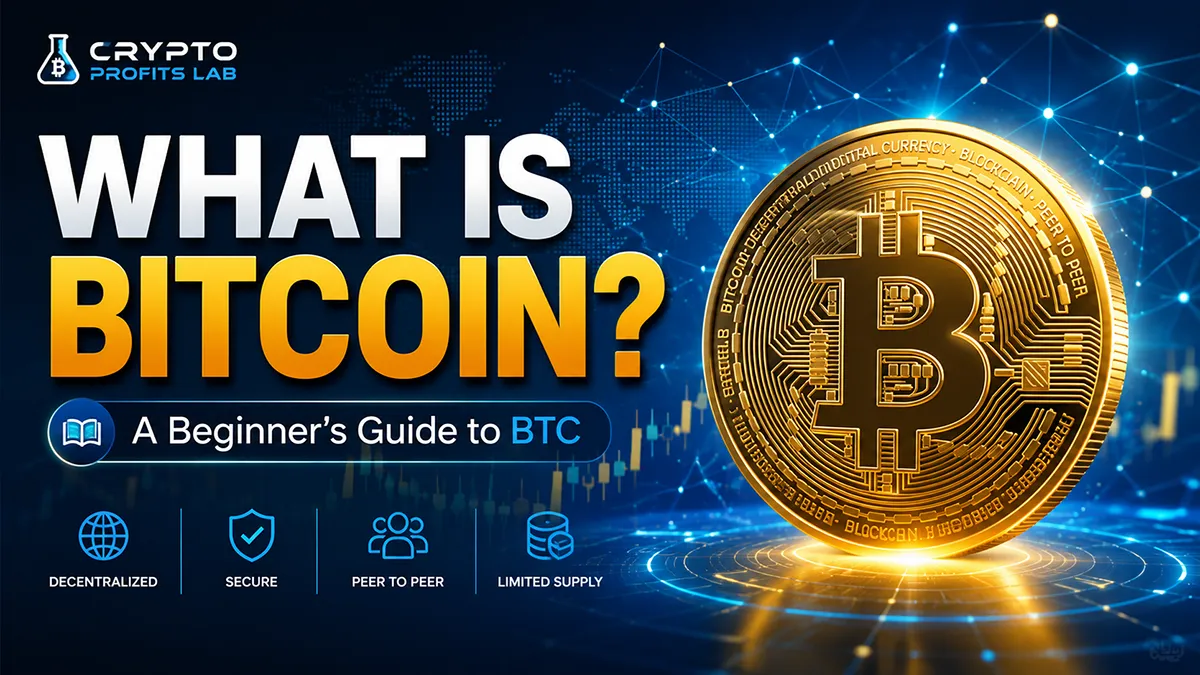
What is Bitcoin? Bitcoin is the first widely adopted cryptocurrency, a digital asset that allows people to send and receive value without relying on a traditional bank, payment company, or central authority. It runs on a public blockchain, uses a limited supply model, and is powered by a global network of computers.
For beginners, Bitcoin can feel confusing because it combines money, technology, economics, security, and investing into one topic. You may hear terms like blockchain, mining, private keys, wallets, halving, market cap, cold storage, and decentralization. The good news is that you do not need to understand everything at once.
This beginner guide explains what is Bitcoin in simple terms. You will learn how Bitcoin works, why it was created, what makes it different from traditional money, how people buy and store it, and what risks beginners should understand before investing.
If you are completely new to digital assets, start with our guide to what is cryptocurrency and our beginner explanation of blockchain technology. Those two topics will make this Bitcoin guide much easier to follow.
What Is Bitcoin?
What is Bitcoin? Bitcoin is a decentralized digital currency that can be transferred between users over the internet. It is often called BTC, which is its ticker symbol.
Unlike dollars in a bank account, Bitcoin is not issued by a government or controlled by a central bank. Instead, Bitcoin operates through a peer-to-peer network. Transactions are recorded on a public ledger called the Bitcoin blockchain.
A simple way to understand Bitcoin is this: it is digital money that uses software rules, cryptography, and a distributed network to allow value transfer without needing a bank as the middleman.
Bitcoin can be used for different purposes, including:
- Sending value globally
- Holding a digital asset with limited supply
- Diversifying an investment portfolio
- Learning how blockchain networks work
- Using crypto as an alternative financial system
- Participating in a decentralized monetary network
What is Bitcoin from a beginner’s perspective? It is the starting point for understanding the broader crypto market because many other cryptocurrencies were created after Bitcoin introduced the idea of decentralized digital money.
Who Created Bitcoin?
Bitcoin was introduced in 2008 by a person or group using the name Satoshi Nakamoto. The original Bitcoin whitepaper explained a peer-to-peer electronic cash system that could operate without relying on a trusted third party.
The Bitcoin network launched in January 2009. Since then, Bitcoin has grown from a small experiment among developers and cryptography enthusiasts into the most recognized cryptocurrency in the world.
Satoshi Nakamoto eventually disappeared from public communication, and their true identity remains unknown. Bitcoin continued to operate because the network does not depend on one person, company, or government.
For the original technical explanation, you can read the Bitcoin whitepaper on Bitcoin.org.
Why Was Bitcoin Created?
To understand what is Bitcoin, it helps to understand why it was created. Bitcoin was designed as a response to problems in traditional finance, especially reliance on centralized institutions.
Traditional money systems depend on banks, payment processors, central banks, governments, and financial intermediaries. These institutions can approve transactions, block transactions, charge fees, freeze accounts, print money, or change monetary policy.
Bitcoin introduced a different model. It uses open-source software and a decentralized network to process transactions according to transparent rules.
Bitcoin was designed to address ideas such as:
- Peer-to-peer payments
- Limited supply
- Resistance to censorship
- Public transaction verification
- Reduced reliance on financial middlemen
- Transparent monetary rules
- Global access to digital value transfer
This does not mean Bitcoin is perfect or risk-free. It means Bitcoin was created to test a new form of money and value transfer outside the traditional banking system.
How Does Bitcoin Work?
Bitcoin works through a combination of blockchain technology, cryptography, mining, and network consensus. That may sound technical, but the basic idea is simple.
When someone sends Bitcoin, the transaction is broadcast to the Bitcoin network. Network participants verify that the transaction follows the rules. Once confirmed, the transaction is added to the blockchain.
The Bitcoin blockchain is a public record of transactions. It is not stored in one central location. Copies are maintained by many computers around the world, which helps make the system more resilient.
Here is a simplified version of how Bitcoin works:
- A user creates a Bitcoin transaction.
- The transaction is broadcast to the network.
- Miners collect transactions into blocks.
- Miners compete to solve a difficult computing problem.
- A valid block is added to the blockchain.
- The transaction becomes part of the public ledger.
- The network continues building on top of that block.
What is Bitcoin doing differently from a bank? Instead of one company maintaining a private ledger, Bitcoin uses a public ledger verified by a decentralized network.
What Is the Bitcoin Blockchain?
The Bitcoin blockchain is the public ledger that records Bitcoin transactions. It is called a blockchain because transactions are grouped into blocks, and each block is linked to the one before it.
This chain of blocks creates a transaction history that becomes increasingly difficult to change over time. The more blocks added after a transaction, the harder it becomes to reverse or rewrite that transaction.
The blockchain helps Bitcoin operate without a central authority. Users do not need to trust one bank database. Instead, they can rely on network rules and public verification.
Key features of the Bitcoin blockchain include:
- Public transaction history
- Distributed network copies
- Cryptographic security
- Proof-of-work mining
- Open participation
- Transparent rules
- Strong resistance to tampering
If you want a deeper explanation of blockchains in general, read blockchain technology.
What Is Bitcoin Mining?
Bitcoin mining is the process that helps secure the network, confirm transactions, and add new blocks to the blockchain. Miners use specialized computers to compete in solving cryptographic problems.
When a miner successfully adds a block, they receive a block reward plus transaction fees. This reward system encourages miners to support the network.
Mining serves several important purposes:
- Confirms transactions
- Adds new blocks
- Helps secure the network
- Distributes newly issued Bitcoin
- Makes attacking the blockchain expensive
- Supports proof-of-work consensus
Bitcoin mining is different from crypto staking. Bitcoin uses proof of work, while some other networks use proof of stake. If you want to understand staking separately, read our guide to crypto staking.
What Makes Bitcoin Valuable?
What is Bitcoin worth, and why does it have value? Bitcoin’s value comes from several factors, including scarcity, network security, adoption, liquidity, and market demand.
Bitcoin has a fixed maximum supply of 21 million coins. This limited supply is one reason people compare it to scarce assets. Unlike traditional fiat currencies, Bitcoin’s supply schedule is written into the software rules.
Bitcoin’s value may be influenced by:
- Limited supply
- Strong brand recognition
- Network security
- Global liquidity
- Investor demand
- Institutional interest
- Market cycles
- Perceived use as digital scarcity
- Long history compared with other cryptocurrencies
However, Bitcoin’s price can be extremely volatile. It can rise quickly and fall sharply. Beginners should not assume that limited supply guarantees short-term price increases.
To understand how crypto assets are compared by size, read market cap crypto. To understand price swings, read crypto volatility.
Bitcoin vs Traditional Money
A common beginner question is how Bitcoin compares to traditional money. The answer depends on which feature you are comparing.
| Feature | Bitcoin | Traditional Money |
|---|---|---|
| Issuer | No central issuer | Issued by governments and central banks |
| Supply | Fixed maximum supply | Supply can change through monetary policy |
| Transaction record | Public blockchain | Bank or payment company records |
| Access | Internet-based wallet access | Bank, cash, or payment account access |
| Reversibility | Usually irreversible | Some payments can be reversed |
| Volatility | Highly volatile | Usually more stable in daily purchasing power |
| Control | User-controlled with wallet keys | Institution-controlled account access |
Bitcoin is not a direct replacement for every traditional money use case. It is more volatile, less widely accepted for daily payments, and requires users to understand security. However, it offers a different model for storing and transferring value.
Bitcoin vs Other Cryptocurrencies
Bitcoin was the first major cryptocurrency, but it is not the only one. Thousands of crypto assets now exist, each with different goals, designs, and risks.
Ethereum, for example, supports smart contracts and decentralized applications. XRP focuses on fast value transfer and payments. Solana focuses on high-speed blockchain activity. Each network is different.
Bitcoin is often viewed as the most established cryptocurrency, while many other coins are considered more experimental or specialized.
Beginner comparisons may include:
- Bitcoin focuses mainly on decentralized digital money.
- Ethereum supports smart contracts and apps.
- XRP focuses on payment and settlement use cases.
- Solana focuses on speed and low-cost transactions.
- Cardano emphasizes research-driven blockchain development.
You can continue learning with our guides on what is Ethereum, what is XRP, what is Solana, and what is Cardano.
How Do People Buy Bitcoin?
What is Bitcoin buying like for beginners? Most beginners buy Bitcoin through a cryptocurrency exchange. An exchange allows users to create an account, verify identity, deposit money, and purchase BTC.
The basic process usually looks like this:
- Choose a reputable exchange.
- Create an account.
- Turn on two-factor authentication.
- Verify your identity if required.
- Deposit funds.
- Choose Bitcoin.
- Review fees and purchase details.
- Place a small first order.
- Decide whether to leave it on the exchange or move it to a wallet.
Beginners should start small. Your first purchase should be about learning the process, not taking a large financial risk.
For a full walkthrough, read how to buy crypto for beginners. If you are still comparing platforms, read best crypto exchange for beginners.
How Do You Store Bitcoin?
Bitcoin can be stored through an exchange account or a personal crypto wallet. Each option has tradeoffs.
If Bitcoin stays on an exchange, the platform usually manages custody for you. This is convenient for beginners, but it means you are trusting the exchange.
If Bitcoin is moved to a self-custody wallet, you control the wallet keys or recovery phrase. This gives you more control, but it also gives you more responsibility.
Common Bitcoin storage options include:
- Exchange account storage
- Mobile hot wallet
- Desktop wallet
- Hardware wallet
- Cold storage setup
A hot wallet is connected to the internet and is convenient for smaller balances. A cold wallet keeps private keys offline and is often better for long-term storage. To compare these options, read hot wallet vs cold wallet.
If you plan to hold meaningful Bitcoin long term, you may want to learn about using a hardware wallet.
Bitcoin Wallet Security
What is Bitcoin security for beginners really about? It is about protecting access. If you use an exchange, that means securing your account. If you use a personal wallet, that means protecting your recovery phrase and private keys.
Important Bitcoin security habits include:
- Use strong, unique passwords.
- Turn on two-factor authentication.
- Secure your email account.
- Download wallets only from official sources.
- Never share your seed phrase.
- Store backups offline.
- Send small test transactions first.
- Verify wallet addresses carefully.
- Avoid fake support accounts.
- Watch for phishing links.
If you use a self-custody wallet, your seed phrase is critical. A seed phrase can restore wallet access if your device is lost, but it can also give an attacker control if exposed. Learn more in crypto seed phrase.
For broader protection steps, read crypto safety tips and crypto scams to avoid.
Advantages of Bitcoin
Bitcoin has several features that make it important in the crypto world. These advantages do not remove risk, but they help explain why Bitcoin attracts attention.
Potential advantages include:
- First-mover recognition
- Fixed maximum supply
- Strong network security
- Global accessibility
- High liquidity compared with most crypto assets
- Public and transparent ledger
- Decentralized design
- Broad educational and market coverage
- Long operating history
What is Bitcoin best known for? It is best known as the original decentralized cryptocurrency and the asset that introduced many people to blockchain-based money.
Risks of Bitcoin
Bitcoin also has real risks. Beginners should understand these risks before buying.
Common Bitcoin risks include:
- Price volatility
- Regulatory uncertainty
- Exchange risk
- Wallet mistakes
- Phishing and scams
- Loss of recovery phrase
- Wrong-address transactions
- Market hype
- Emotional buying
- Security responsibility
Bitcoin can lose value quickly during market downturns. It can also attract scams because of its popularity. Beginners should avoid buying because of fear of missing out or social media hype.
Market cycles matter. During a bull market, confidence can rise quickly. During a bear market, prices may fall for months. Learn more in bull vs bear market crypto.
Should Beginners Buy Bitcoin?
What is Bitcoin’s role for a beginner investor? Bitcoin is often the first cryptocurrency beginners study because it has the longest track record, the largest recognition, and the most educational resources. However, that does not mean every beginner should buy it immediately.
Before buying Bitcoin, ask yourself:
- Do I understand what Bitcoin is?
- Can I handle price volatility?
- Am I using a reputable exchange?
- Have I enabled two-factor authentication?
- Do I understand wallet storage?
- Am I investing money I can afford to lose?
- Do I have a long-term plan?
- Am I avoiding hype-driven decisions?
Some beginners use dollar-cost averaging instead of trying to time the market. This means buying a fixed amount on a schedule. It does not remove risk, but it can reduce emotional decision-making. Learn more in dollar cost averaging crypto.
Common Bitcoin Mistakes Beginners Should Avoid
Bitcoin mistakes often happen when beginners move too fast. The most common problems are preventable with patience and education.
Avoid these mistakes:
- Buying before learning the basics
- Investing more than you can afford to lose
- Leaving accounts without 2FA
- Sending Bitcoin to the wrong address
- Sharing recovery phrases
- Downloading fake wallet apps
- Trusting fake support agents
- Falling for giveaway scams
- Buying only because of hype
- Ignoring fees and volatility
What is Bitcoin teaching many beginners? It teaches that crypto ownership requires both knowledge and discipline. The technology can be powerful, but personal responsibility matters.
Final Thoughts: What Is Bitcoin and Why Does It Matter?
What is Bitcoin? Bitcoin is a decentralized digital asset that allows value to move across a peer-to-peer network without relying on a central bank or traditional payment company. It introduced blockchain-based money to the world and remains the most recognized cryptocurrency.
Bitcoin matters because it changed how people think about money, digital ownership, scarcity, and financial networks. It also created the foundation for the wider crypto market.
However, Bitcoin is not risk-free. Its price can be volatile, scams are common, and wallet mistakes can be costly. Beginners should learn first, start small, protect accounts, and understand storage before making larger decisions.
The safest beginner path is simple: understand what is Bitcoin, learn how blockchain works, use reputable exchanges, secure your accounts, protect your wallet, and avoid emotional buying.
Bitcoin can be an important crypto topic to study, but education should come before investment. The more you understand what is Bitcoin and how it works, the better prepared you will be to make informed crypto decisions.
FAQ: What Is Bitcoin?
What is Bitcoin in simple terms?
What is Bitcoin in simple terms? Bitcoin is a digital currency that lets people send and receive value over the internet without relying on a bank or central payment company. It runs on a public blockchain, uses a decentralized network, and has a limited maximum supply. Bitcoin is commonly represented by the ticker symbol BTC.
Who created Bitcoin?
Bitcoin was created by a person or group using the name Satoshi Nakamoto. The Bitcoin whitepaper was published in 2008, and the network launched in 2009. Satoshi’s true identity remains unknown. Bitcoin continued operating because the system is decentralized and does not depend on one founder, company, or government to function.
How does Bitcoin work?
Bitcoin works by recording transactions on a public blockchain. Users send transactions to the network, miners help confirm them, and valid blocks are added to the chain. The network follows software rules that verify ownership and prevent double-spending. This allows Bitcoin to operate without a central bank or traditional payment processor.
Is Bitcoin real money?
Bitcoin can be used as digital money, but it is different from traditional currency. It is not issued by a government, and its price can be highly volatile. Some people use Bitcoin as a store of value, investment asset, or transfer method. Its usefulness depends on adoption, regulation, market demand, and user understanding.
How many Bitcoin will ever exist?
Bitcoin has a fixed maximum supply of 21 million coins. New Bitcoin enters circulation through mining rewards, but that issuance decreases over time through events called halvings. This limited supply is one reason some investors view Bitcoin as digitally scarce. However, limited supply does not guarantee that Bitcoin’s price will rise.
Is Bitcoin safe for beginners?
Bitcoin can be used safely by beginners who learn the basics, use reputable exchanges, enable two-factor authentication, protect wallets, and avoid scams. The biggest risks include price volatility, phishing, fake support accounts, wrong-address transactions, and seed phrase loss. Beginners should start small and understand storage before buying larger amounts.
Do I need a wallet to buy Bitcoin?
You do not always need a personal wallet to buy Bitcoin because many exchanges let beginners hold small balances inside an account. However, a self-custody wallet gives users more control over their Bitcoin. Beginners should learn wallet basics, seed phrase protection, and hot wallet vs cold wallet storage before moving funds off an exchange.
Can Bitcoin lose value?
Yes, Bitcoin can lose value. Its price is driven by supply, demand, market sentiment, regulation, liquidity, macroeconomic conditions, and investor behavior. Bitcoin has experienced major price declines in past market cycles. Beginners should treat Bitcoin as a volatile asset and never invest money needed for bills, emergencies, or short-term obligations.
What makes Bitcoin different from other cryptocurrencies?
Bitcoin is different because it was the first widely adopted cryptocurrency and focuses mainly on decentralized digital money. Many other cryptocurrencies support different features, such as smart contracts, apps, faster settlement, or specialized networks. Bitcoin is often viewed as the original crypto asset, while other coins may have different risks and use cases.