What Is Dollar Cost Averaging Crypto? A Beginner’s Guide
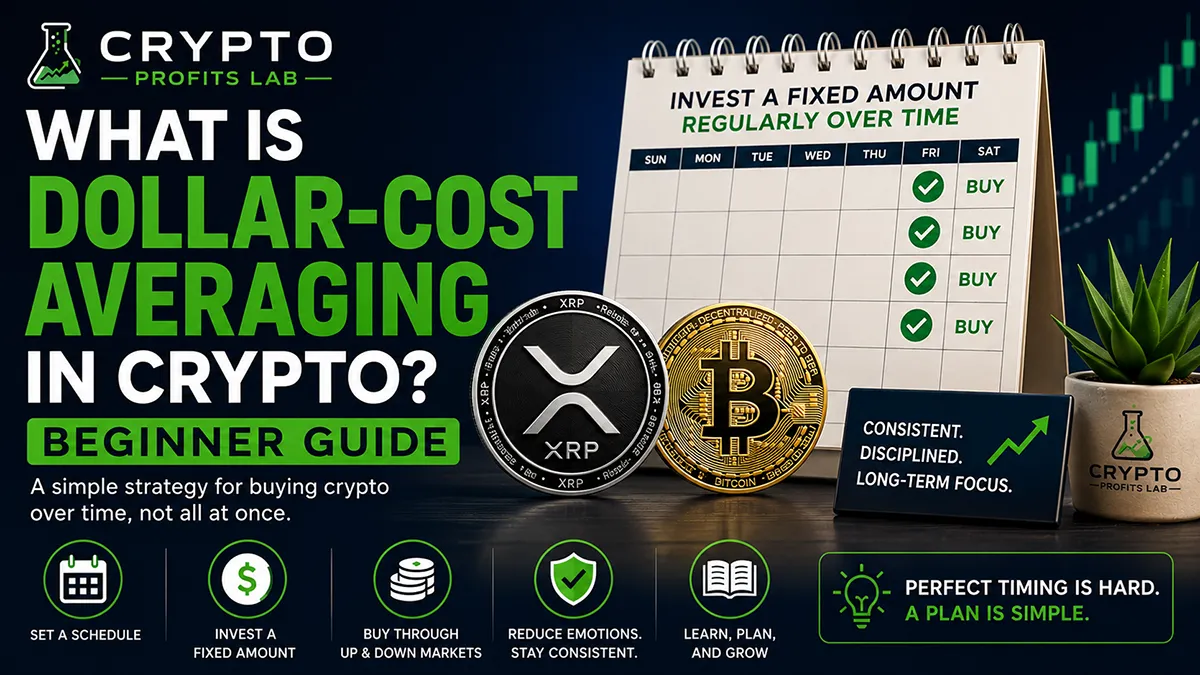
Dollar cost averaging crypto is a simple strategy where you invest a fixed amount of money into cryptocurrency on a regular schedule instead of trying to buy everything at the perfect time.
For beginners, this can make crypto investing feel less stressful. Instead of guessing whether Bitcoin, Ethereum, XRP, or another coin is about to rise or fall, you follow a consistent plan. You might buy $25 every week, $100 every month, or another amount that fits your budget and risk tolerance.
Crypto prices can move fast. A coin can rise sharply, fall suddenly, and recover again before a beginner knows what happened. That is why dollar cost averaging crypto is popular with people who want a more disciplined approach to volatile markets.
DCA does not guarantee profits. It does not remove risk. It simply spreads your purchases over time, which may help reduce emotional decision-making and lower the pressure of trying to time the market perfectly.
In this guide, we’ll explain how dollar cost averaging crypto works, why beginners use it, when it may help, when it may not help, and what safety tips you should understand before using this strategy.
What Does Dollar Cost Averaging Crypto Mean?
Dollar cost averaging crypto means buying a fixed dollar amount of cryptocurrency at regular intervals regardless of the current price.
For example, instead of investing $1,200 into Bitcoin all at once, you might invest $100 per month for 12 months. If the price is high, your $100 buys less Bitcoin. If the price is low, your $100 buys more Bitcoin.
The goal is not to predict the exact bottom. The goal is to build a position over time using a consistent schedule.
A simple DCA plan may look like this:
- Buy $25 of Bitcoin every Friday.
- Buy $100 of Ethereum once per month.
- Buy $50 of a chosen crypto every two weeks.
- Continue the plan for a set period.
- Review your plan regularly.
If you are new to crypto, start with what cryptocurrency is and how blockchain technology works. Dollar cost averaging makes more sense once you understand what you are buying.
Why Beginners Use Dollar Cost Averaging Crypto
Beginners use dollar cost averaging crypto because it helps reduce the pressure of market timing. Many new investors struggle with the same question: “Should I buy now or wait?”
Crypto does not make that question easy. Prices move 24/7, news changes quickly, and emotions can take over. A beginner may wait for a dip, miss a rally, buy after a pump, or panic during a pullback.
DCA creates a simple rule-based process.
Instead of trying to guess every move, you decide:
- What crypto you want to buy
- How much you want to invest
- How often you want to buy
- How long you want the plan to run
- When you will review the strategy
This can help beginners stay consistent during both good and bad markets.
Dollar cost averaging crypto is especially useful for people who want exposure to crypto but do not want to stare at charts all day.
How Dollar Cost Averaging Works
Dollar cost averaging works by spreading purchases across time. Because you invest the same dollar amount each period, you naturally buy more when prices are lower and less when prices are higher.
Here is a simple example:
| Month | Investment | Bitcoin Price | Approximate BTC Bought |
|---|---|---|---|
| Month 1 | $100 | $50,000 | 0.002 BTC |
| Month 2 | $100 | $40,000 | 0.0025 BTC |
| Month 3 | $100 | $25,000 | 0.004 BTC |
| Month 4 | $100 | $50,000 | 0.002 BTC |
In this example, the investor buys more Bitcoin when the price is lower and less Bitcoin when the price is higher. Over time, the average purchase price becomes blended across multiple entries.
This does not guarantee a profit. If the asset continues falling for a long time, the portfolio can still lose value. However, DCA can help reduce the risk of putting all your money in right before a major drop.
For an outside investing reference, Investor.gov explains dollar cost averaging as investing equal portions at regular intervals regardless of market ups and downs.
Dollar Cost Averaging Crypto vs Lump Sum Investing
Dollar cost averaging crypto is different from lump sum investing.
Lump sum investing means putting all your planned money into an asset at once. Dollar cost averaging means spreading that money across scheduled purchases.
Here is a simple comparison:
| Strategy | How It Works | Main Benefit | Main Risk |
|---|---|---|---|
| Lump Sum | Invest all at once | More exposure if price rises quickly | Bad timing if price drops soon after |
| Dollar Cost Averaging | Invest gradually | Less pressure to time the market | May underperform if price rises steadily |
If crypto prices rise strongly after you buy, lump sum investing may perform better because all your money was invested earlier. If prices fall after you buy, DCA may feel better because you still have money available to buy lower.
Neither strategy is perfect. The better choice depends on your goals, emotions, risk tolerance, and time horizon.
For beginners, DCA may be easier because it creates a plan instead of a one-time emotional decision.
Why Dollar Cost Averaging Fits Crypto Volatility
Dollar cost averaging crypto is popular because crypto is highly volatile. Prices can move dramatically in short periods, especially with altcoins.
If you buy everything at once, your entry point matters a lot. If you spread purchases over time, you reduce the importance of any single entry price.
Crypto volatility can be caused by:
- Bitcoin price movement
- Regulation news
- Exchange issues
- Social media hype
- Market sentiment
- Token unlocks
- Whale activity
- Macroeconomic news
- Bull and bear market cycles
Before using DCA, read our guide on crypto volatility. Volatility is one of the main reasons beginners consider DCA in the first place.
DCA does not remove volatility. It simply gives you a calmer way to participate in a volatile market.
Dollar Cost Averaging and Bull vs Bear Markets
DCA behaves differently in bull markets and bear markets.
During a bull market, prices are generally rising. A DCA investor may wish they bought more earlier because each later purchase may happen at a higher price.
During a bear market, prices are generally falling. A DCA investor may buy more crypto at lower prices over time, but they must also be comfortable watching the portfolio decline in value along the way.
This is why understanding bull vs bear market crypto is important.
A simple way to think about it:
- DCA during bull markets can reduce emotional overbuying.
- DCA during bear markets can help build slowly at lower prices.
- DCA during sideways markets can create a blended average cost.
- DCA still requires patience and risk management.
The strategy works best when you can stick to a plan without reacting emotionally to every price move.
What Crypto Assets Work Best With DCA?
Beginners should be careful about which assets they choose for dollar cost averaging crypto. DCA does not turn a bad investment into a good one. If a project fails, averaging into it may simply increase your losses.
Many beginners start by studying larger, more established assets like Bitcoin and Ethereum. These assets are still risky, but they have longer histories, deeper liquidity, and stronger recognition than many small altcoins.
Some investors also research coins like XRP, Solana, or Chainlink, but every coin has its own risks.
Before choosing any asset for DCA, ask:
- What does this project do?
- How long has it existed?
- What is the market cap?
- Is there strong liquidity?
- What is the token supply?
- Is the project still active?
- Can I safely store it?
- Am I comfortable if it falls 50% or more?
DCA should be used with assets you have researched, not random coins promoted on social media.
Market Cap and Dollar Cost Averaging Crypto
Market cap matters when choosing crypto assets for a DCA plan. A low-priced coin is not automatically cheap, and a high-priced coin is not automatically expensive.
Market cap is calculated by multiplying price by circulating supply. It helps beginners understand the relative size of a crypto project.
If a coin has a massive supply, even a small price increase may require a large market cap. This is especially important when people make unrealistic price predictions.
Before building a DCA plan, read our guide on market cap crypto. Market cap can help you avoid the mistake of buying a coin only because the price per token looks low.
Dollar cost averaging crypto works best when combined with research, not wishful thinking.
Dollar Cost Averaging Bitcoin
Bitcoin is one of the most common assets people use for DCA. Because Bitcoin has the longest track record in crypto and a fixed maximum supply, many beginners study it first.
A Bitcoin DCA plan may be simple:
- Buy a fixed dollar amount weekly or monthly.
- Use a trusted exchange.
- Keep records of purchases.
- Review your average cost over time.
- Move long-term holdings to secure storage when appropriate.
Bitcoin is still volatile. It can rise and fall sharply. DCA does not guarantee that Bitcoin will increase in value.
However, for beginners who believe in Bitcoin long term but do not want to guess the perfect entry point, DCA can be a practical approach.
Dollar Cost Averaging Ethereum
Ethereum is another popular asset for DCA. Ethereum supports smart contracts, decentralized apps, DeFi, NFTs, and Layer 2 networks like Optimism and Arbitrum.
A beginner using DCA for Ethereum should also understand crypto gas fees. Gas fees matter if you move ETH off an exchange, use DeFi apps, swap tokens, or bridge assets.
Ethereum can be useful to study because it connects to many crypto topics:
DCA into Ethereum may appeal to people who believe in the broader smart contract ecosystem, but it still carries market risk.
Should You DCA Into Altcoins?
Some investors use DCA for altcoins, but beginners should be extra careful. Smaller altcoins can be more volatile, less liquid, and more likely to fail.
An altcoin may fall 80% or more during a bear market. Some never recover. Averaging into a weak altcoin can make losses worse.
Before using DCA with altcoins, consider:
- Is the project still active?
- Does the token have real utility?
- Is liquidity strong enough?
- Are there major token unlocks?
- Is the coin listed on trusted exchanges?
- Is the project mostly hype?
- Could the coin survive a long bear market?
DCA should not be used as an excuse to ignore research. If the project is weak, buying it on a schedule does not make it safer.
How to Start a Dollar Cost Averaging Crypto Plan
A beginner DCA plan should be simple. The more complicated it is, the harder it may be to follow.
Here is a basic process:
- Choose the crypto asset you want to study and buy.
- Decide how much you can afford to invest.
- Choose a schedule, such as weekly or monthly.
- Use a trusted exchange.
- Enable strong account security.
- Track your purchases.
- Review your plan every few months.
- Store long-term holdings safely.
- Avoid changing the plan because of emotion.
If you are still learning how to buy crypto, start with how to buy crypto for beginners and the best crypto exchange for beginners.
Do not make your first DCA plan too aggressive. Start small and learn the process.
How Often Should You Buy?
There is no perfect DCA schedule. Some people buy weekly. Others buy every two weeks or once per month.
The best schedule is one you can follow consistently without stress.
Common DCA schedules include:
- Weekly
- Every two weeks
- Monthly
- Every payday
- Every quarter
Weekly purchases may create more average entry points, but they may also create more transactions to track. Monthly purchases are simpler, but they create fewer entry points.
For beginners, monthly or payday-based investing may be easier. The key is consistency.
Avoid choosing a schedule that pressures you financially. Crypto should not interfere with bills, emergency savings, or essential expenses.
How Much Should Beginners Invest?
Beginners should only invest money they can afford to lose. Crypto is risky, and DCA does not remove that risk.
A good DCA amount should be:
- Small enough to avoid stress
- Consistent with your budget
- Separate from emergency savings
- Not needed for bills
- Not borrowed money
- Easy to continue during downturns
For example, a beginner might start with a small weekly or monthly amount while learning.
The exact amount depends on your income, expenses, debt, savings, and risk tolerance. No article can choose that number for you.
A smaller plan you can follow is better than an aggressive plan you abandon during the first downturn.
Benefits of Dollar Cost Averaging Crypto
Dollar cost averaging crypto has several potential benefits for beginners.
Potential benefits include:
- Reducing pressure to time the market
- Building discipline
- Creating a repeatable plan
- Lowering emotional decision-making
- Spreading entry points over time
- Buying more when prices are lower
- Making investing feel more manageable
- Helping beginners stay consistent
DCA can be especially helpful for people who struggle with fear of missing out. Instead of making one large emotional purchase, you follow a schedule.
This can make crypto investing feel less chaotic.
Risks and Limits of Dollar Cost Averaging Crypto
DCA also has limitations. It is not a magic strategy.
Risks and limits include:
- It does not guarantee profits.
- It does not protect against bad assets.
- It may underperform lump sum investing in rising markets.
- It can still lead to losses.
- It requires discipline.
- Fees can add up.
- Tax tracking may become more complicated.
- It may create false confidence.
The biggest risk is averaging into a project that continues falling because the fundamentals are weak.
Before using dollar cost averaging crypto, make sure you understand what you are buying and why.
Fees and DCA
Fees matter when using a DCA strategy. If you buy very small amounts too often, trading fees or spreads may reduce your returns.
Centralized exchanges may charge fees through:
- Trading fees
- Spreads
- Debit card fees
- Deposit fees
- Withdrawal fees
Decentralized exchanges may involve gas fees, swap fees, and slippage.
For most beginners, a trusted centralized exchange is usually simpler than a decentralized exchange. Before using both types, read centralized and decentralized exchanges.
If you plan to move crypto on-chain, gas fees matter. A small DCA purchase can become inefficient if the withdrawal or network fee is too high.
Should You Automate Your DCA Plan?
Many exchanges allow recurring purchases. This can make dollar cost averaging crypto easier because purchases happen automatically on a schedule.
Automation can help remove emotion, but it should still be monitored.
Before automating, check:
- Purchase fees
- Spread costs
- Minimum purchase amounts
- Supported assets
- Payment method fees
- Account security
- How to pause or cancel
- Tax reporting tools
Automation should not mean ignoring your account. You should still review your purchases, security settings, and overall strategy.
A recurring buy can be helpful, but only if it fits your budget and investment plan.
Wallet Safety for DCA Investors
If you use DCA over time, your crypto balance may grow. That means wallet safety becomes more important.
At first, beginners may keep small amounts on an exchange while learning. Over time, they may choose to move long-term holdings to a personal wallet.
A crypto wallet gives you more control, but it also gives you more responsibility.
Important wallet safety habits include:
- Never share your seed phrase.
- Use official wallet apps only.
- Protect your crypto seed phrase.
- Learn hot wallet vs cold wallet.
- Consider a hardware wallet for larger balances.
- Use cold storage crypto for long-term holdings when appropriate.
- Send test transactions before moving large amounts.
DCA helps build a position. Wallet security helps protect it.
Account Security for DCA Investors
If you buy crypto through an exchange, account security is critical. A DCA plan is only useful if your account remains protected.
Use strong security habits:
- Create a strong unique password.
- Enable crypto 2FA.
- Avoid SMS 2FA when better options are available.
- Watch for phishing emails.
- Bookmark the official exchange website.
- Do not click random login links.
- Use withdrawal allowlists if available.
- Keep your email account secure.
Scammers target beginners, especially during bull markets. Review crypto scams to avoid before trusting messages, links, or investment offers.
DCA and Crypto Passive Income
Some investors combine DCA with passive income strategies like staking, lending, or yield farming. Beginners should be careful with this.
Buying crypto on a schedule is one decision. Locking it into a protocol or platform is another layer of risk.
Before using passive income strategies, study:
Staking may involve lockups or validator risk. Lending may involve platform risk. Yield farming may involve smart contract risk, liquidity risk, and impermanent loss.
Do not chase yield just because you are accumulating coins through DCA.
Common Dollar Cost Averaging Crypto Mistakes
Beginners often make similar mistakes with DCA.
Common mistakes include:
- DCA into coins they do not understand
- Starting with too much money
- Stopping the plan during normal volatility
- Ignoring fees
- Using weak exchange security
- Forgetting wallet safety
- Averaging into scam projects
- Confusing DCA with guaranteed profit
- Not tracking purchases
- Chasing random altcoins
- Ignoring market cap and token supply
The most important rule is simple: DCA is a process, not a guarantee.
A good plan still requires research, patience, and risk management.
When Dollar Cost Averaging May Not Be Best
Dollar cost averaging crypto may not be the best fit for every situation.
DCA may not be ideal if:
- You need the money soon.
- You cannot handle price swings.
- You are buying an asset you do not understand.
- Fees are too high for small purchases.
- You are using borrowed money.
- You keep changing the plan emotionally.
- You are averaging into a failing project.
DCA can reduce timing stress, but it cannot fix poor asset selection or poor risk management.
Before starting, make sure your plan is realistic and financially comfortable.
How to Review a DCA Plan
A DCA plan should not be ignored forever. Review it regularly.
A simple review may include:
- Is the project still strong?
- Has the market cap changed significantly?
- Are fees too high?
- Is my position size too large?
- Am I still comfortable with the risk?
- Is my wallet security strong?
- Has my financial situation changed?
- Do I need to rebalance?
- Am I still following the original reason I bought?
Reviewing does not mean reacting emotionally to every price move. It means checking whether your plan still makes sense.
A quarterly review may be enough for many beginners.
Final Thoughts: Dollar Cost Averaging Crypto
Dollar cost averaging crypto is a beginner-friendly strategy that can help reduce the pressure of trying to time the market. Instead of investing everything at once, you buy a fixed dollar amount on a regular schedule.
This strategy can help beginners build discipline, reduce emotional decisions, and participate in crypto without needing to guess every short-term price move.
However, DCA does not guarantee profits. It does not remove volatility, protect against scams, or turn weak projects into good investments. You still need to understand market cap, crypto volatility, bull and bear markets, wallet safety, exchange security, and the asset you are buying.
For many beginners, the best DCA plan is simple: start small, use a trusted exchange, protect your account, track your purchases, and store long-term holdings safely.
Dollar cost averaging crypto can be a useful tool, but it works best when combined with education, patience, and responsible risk management.
Dollar Cost Averaging Crypto FAQ
What is dollar cost averaging crypto?
Dollar cost averaging crypto is a strategy where you invest a fixed dollar amount into cryptocurrency at regular intervals, regardless of the current price. For example, you might buy $50 of Bitcoin every week or $100 of Ethereum every month. The goal is to reduce timing pressure and build a position gradually.
Is dollar cost averaging crypto good for beginners?
Dollar cost averaging crypto can be useful for beginners because it creates a simple, repeatable plan. Instead of trying to predict short-term price movements, beginners can invest on a schedule. However, DCA does not guarantee profits and should only be used with assets the investor understands.
Can you lose money with dollar cost averaging crypto?
Yes, you can lose money with dollar cost averaging crypto. If the asset keeps falling or the project fails, regular purchases may still result in losses. DCA can reduce timing risk, but it does not remove market risk, asset selection risk, exchange risk, wallet risk, or scam risk.
How often should you use dollar cost averaging in crypto?
Common DCA schedules include weekly, every two weeks, monthly, or every payday. The best schedule depends on your budget, fees, income timing, and comfort level. Beginners should choose a schedule they can follow consistently without creating financial stress or interfering with essential expenses.
Is dollar cost averaging better than buying crypto all at once?
Dollar cost averaging may feel safer for beginners because it spreads purchases over time and reduces the impact of one bad entry point. Buying all at once may perform better if prices rise quickly after purchase. Neither approach is always best, and the right choice depends on risk tolerance and market conditions.
What crypto is best for dollar cost averaging?
Many beginners study larger assets like Bitcoin and Ethereum first because they have longer histories, deeper liquidity, and stronger recognition than many smaller altcoins. However, no crypto is risk-free. Before using DCA, beginners should research market cap, token supply, project utility, security, and long-term risks.
Does dollar cost averaging work during a bear market?
Dollar cost averaging can help some investors build gradually during a bear market because purchases happen at different price levels. However, bear markets are risky, and some crypto projects never recover. Beginners should avoid assuming every lower price is a bargain and should continue researching fundamentals.
Should I automate dollar cost averaging crypto purchases?
Automation can make DCA easier by scheduling recurring purchases through an exchange. However, beginners should still monitor fees, account security, asset performance, and whether the plan still fits their budget. Automated investing should not mean ignoring risk, market changes, or wallet safety.
Do fees matter when dollar cost averaging crypto?
Yes, fees matter. Frequent small purchases can become expensive if trading fees, spreads, card fees, withdrawal fees, or gas fees are high. Beginners should compare exchange costs and avoid making purchases so small that fees take a large percentage of the investment.