Liquidity Pools in Crypto: A Beginner’s Guide
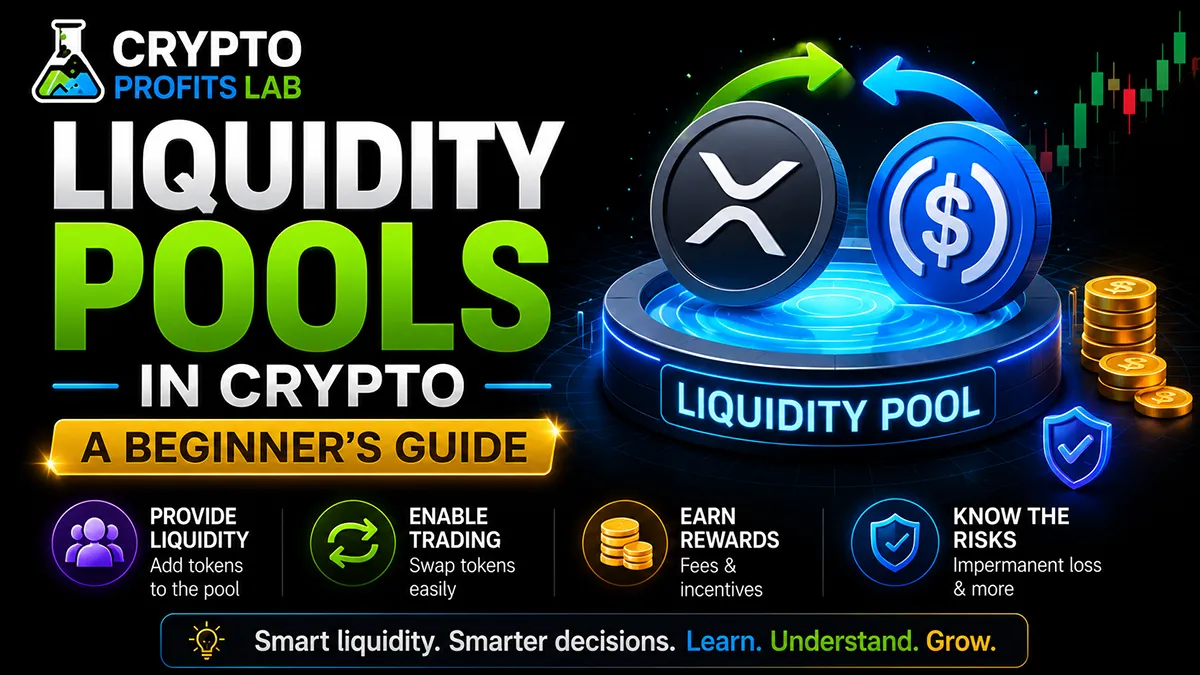
Liquidity Pools in Crypto are among the most important concepts to understand before using DeFi, decentralized exchanges, yield farming, or many crypto reward platforms.
At first, the term can sound technical. A “pool” may sound simple, but in crypto it usually refers to a group of tokens locked in a smart contract, allowing people to trade, lend, borrow, or earn rewards.
For beginners, the easiest way to think about it is this: liquidity pools help crypto trading happen without a traditional buyer and seller meeting at the exact same time.
Instead of waiting for another person to take the other side of a trade, users can trade against a pool of tokens. The pool is supplied by other users called liquidity providers.
Liquidity Pools in Crypto can be useful, but they are not risk-free. They can involve smart contracts, token price changes, gas fees, scams, low liquidity, and impermanent loss.
This guide explains Liquidity Pools in Crypto in simple terms, how they work, why they matter, how people may earn rewards, and what beginners should watch out for before adding money to a pool.
Quick Answer: What Are Liquidity Pools in Crypto?
Liquidity Pools in Crypto are collections of crypto tokens locked in a smart contract, enabling users to trade or use DeFi services.
A smart contract is blockchain code that runs automatically when certain conditions are met. In a liquidity pool, the smart contract holds tokens and allows users to swap one token for another.
For example, a liquidity pool may hold ETH and USDC. One user can trade ETH for USDC, while another can trade USDC for ETH. The pool makes this possible by holding both assets.
People who add tokens to the pool are called liquidity providers. They may earn a share of trading fees or extra rewards, but they also take risks.
For beginners, the main point is simple: liquidity pools make DeFi work, but they should be understood before using them.
Key Takeaways
- Liquidity Pools in Crypto help users trade on decentralized exchanges.
- A liquidity pool usually holds two or more tokens.
- The tokens are controlled by a smart contract.
- Users who add tokens are called liquidity providers.
- Liquidity providers may earn trading fees or rewards.
- Liquidity pools are common in DeFi and yield farming.
- Risks include impermanent loss, token price drops, scams, gas fees, and smart contract bugs.
- High rewards do not automatically mean a pool is safe.
- Beginners should not add crypto to a pool they do not understand.
- Learning about liquidity pools helps beginners better understand DeFi.
Liquidity Pools in Crypto Beginner Facts Table
| Topic | Beginner-Friendly Explanation |
|---|---|
| Main idea | A pool of tokens used for trading or DeFi activity |
| Where used | Decentralized exchanges, DeFi apps, yield farming |
| Who adds tokens | Liquidity providers |
| How users trade | Users swap against the pool |
| Main reward | Trading fees or extra token rewards |
| Main risk | Impermanent loss and token price movement |
| Other risks | Smart contract bugs, scams, low liquidity, gas fees |
| Beginner difficulty | Medium |
| Best first step | Learn DeFi, DEXs, liquidity, and wallet safety |
| Guaranteed income? | No |
Why Liquidity Pools in Crypto Matter
Liquidity Pools in Crypto matter because they power many decentralized finance tools.
DeFi stands for decentralized finance. It includes blockchain-based apps for trading, lending, borrowing, staking, and earning rewards without a traditional bank or broker.
If this is new to you, start with What Is DeFi?.
In traditional markets, exchanges often use order books. An order book lists buyers and sellers at different prices. A trade happens when someone agrees to buy and someone agrees to sell.
Many decentralized exchanges work differently.
Instead of depending only on order books, they use liquidity pools. These pools allow users to swap tokens directly through a smart contract.
This is one reason Liquidity Pools in Crypto are so important. They are part of the foundation of decentralized exchanges, yield farming, and many crypto reward systems.
What Is Liquidity?
Before understanding liquidity pools, beginners should understand liquidity itself.
Liquidity refers to how easily an asset can be bought or sold without causing a significant price change.
A coin with high liquidity is usually easier to trade. A coin with low liquidity may be harder to buy or sell at a fair price.
For example, Bitcoin usually has strong liquidity on major exchanges. A newly minted token may have low liquidity. If you try to buy or sell a low-liquidity token, the price may move more than expected.
To learn more, read Crypto Liquidity.
Liquidity Pools in Crypto are designed to provide liquidity for decentralized trading. Without liquidity, users may not be able to swap tokens easily.
What Is a Liquidity Provider?
A liquidity provider is a person or entity that adds crypto tokens to a liquidity pool.
For example, if a pool uses ETH and USDC, a liquidity provider may deposit both ETH and USDC into the pool.
In return, the liquidity provider may receive a share of trading fees. Some DeFi platforms may also offer extra reward tokens.
This is why liquidity pools are often connected to passive income and yield farming.
However, liquidity providers are not simply earning free money. They are taking a risk to support the pool.
Those risks can include:
- Token price changes
- Impermanent loss
- Gas fees
- Smart contract bugs
- Low trading volume
- Scam tokens
- Platform failure
- Tax complexity
Liquidity Pools in Crypto can create rewards, but those rewards come with trade-offs.
How Liquidity Pools Work Step by Step
Here is a simple step-by-step explanation.
Step 1: A pool is created
A DeFi protocol or user creates a liquidity pool for a token pair.
For example, a pool may contain ETH and USDC.
The pool is controlled by a smart contract.
Step 2: Liquidity providers add tokens
Users add tokens to the pool.
In many pools, the provider adds an equal value of both tokens. For example, they may add $500 worth of ETH and $500 worth of USDC.
Step 3: Traders use the pool
Other users can swap tokens using the pool.
A trader may swap ETH for USDC. Another trader may swap USDC for ETH.
The pool adjusts token balances as trades happen.
Step 4: The pool charges fees
Many liquidity pools charge a small trading fee.
That fee may be shared with liquidity providers.
Step 5: Liquidity providers may withdraw
Liquidity providers can often remove their share of the pool later.
When they withdraw, they may receive a different mix of tokens than they originally deposited.
This is where impermanent loss can become important.
For a direct outside explanation, Uniswap explains liquidity pools as token pairings in smart contracts used for swaps on decentralized exchanges.
Liquidity Pools and Decentralized Exchanges
A decentralized exchange, often called a DEX, lets users trade crypto using blockchain-based tools rather than a company-run order book.
If you need a simple introduction, read What Is a DEX?.
Liquidity Pools in Crypto are common on decentralized exchanges because they let users swap tokens without waiting for a specific buyer or seller.
For example, if a user wants to swap Token A for Token B, they can trade against the pool. The pool already holds the tokens needed for the swap.
This can make trading faster and more open, but it also creates responsibility.
Users must connect a wallet, approve transactions, check fees, understand slippage, and avoid fake websites.
A DEX can be useful, but beginners should learn how to use one before using it.
Liquidity Pools and Yield Farming
Yield farming is a DeFi strategy in which users earn rewards by using crypto across different protocols.
Liquidity pools are often part of yield farming.
A user may deposit tokens into a pool and earn trading fees. The platform may also offer extra tokens as rewards. The user may then claim those rewards or move funds to another opportunity.
Read What Is Crypto Yield Farming? before trying any yield farming strategy.
Liquidity Pools in Crypto can make yield farming possible, but they can also make it risky.
High APY numbers can attract beginners, but those numbers do not explain the full picture.
A yield farming pool may include:
- Volatile tokens
- Low liquidity
- Impermanent loss
- Changing rewards
- Gas fees
- Smart contract risk
- Scam risk
The reward rate is only one part of the decision.
Liquidity Pools and Impermanent Loss
Impermanent loss is one of the most important risks in liquidity pools.
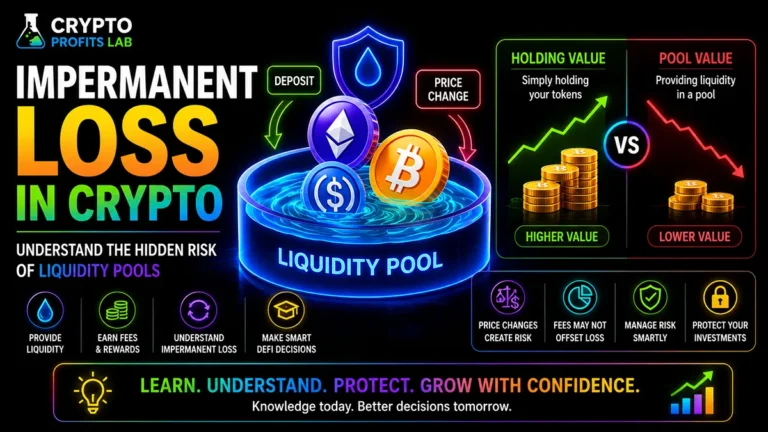
Impermanent loss can happen when you provide tokens to a liquidity pool and token prices change. Your pool position may become worth less than if you had simply held the tokens separately in your wallet.
This is not always easy for beginners to understand, but it matters a lot.
Read Impermanent Loss in Crypto before adding crypto to any liquidity pool.
Here is a simple version.
If you deposit two tokens into a pool and one token changes price sharply compared with the other, the pool may rebalance in a way that leaves you with less value than simply holding.
Trading fees may help offset losses, but they do not guarantee a profit.
Liquidity Pools in Crypto are not safe just because they offer rewards.
Liquidity Pools and Crypto Slippage
Slippage is another important concept.
Slippage is the difference between the price you expected and the price you actually received when a trade is completed.
Read Crypto Slippage for a full beginner’s explanation.
Liquidity pools affect slippage because deeper pools usually handle trades better. A small pool may create more slippage because one trade can move the price more.
For example, swapping $50 in a large pool may have little impact on the price. Swapping $5,000 in a tiny pool may move the price sharply.
This is why beginners should be careful with small tokens and thin liquidity.
Liquidity Pools in Crypto can help trading, but low-quality pools can still create bad trade execution.
Liquidity Pools and Gas Fees
Gas fees are blockchain transaction fees.
When you add liquidity, remove liquidity, swap tokens, approve a token, or claim rewards, you may pay gas fees.
Read What Are Crypto Gas Fees? before using DeFi tools.
Gas fees matter because they can reduce or erase rewards.
For example, if you earn $12 in rewards but pay $20 in gas fees, the strategy does not make sense.
Gas fees can be especially painful for small accounts. Beginners should review network costs before using liquidity pools.
Liquidity Pools in Crypto are not only about reward rates. Fees are part of the real return.
Liquidity Pools vs Staking
Liquidity pools and staking are often confused because both may offer crypto rewards.
They are not the same.
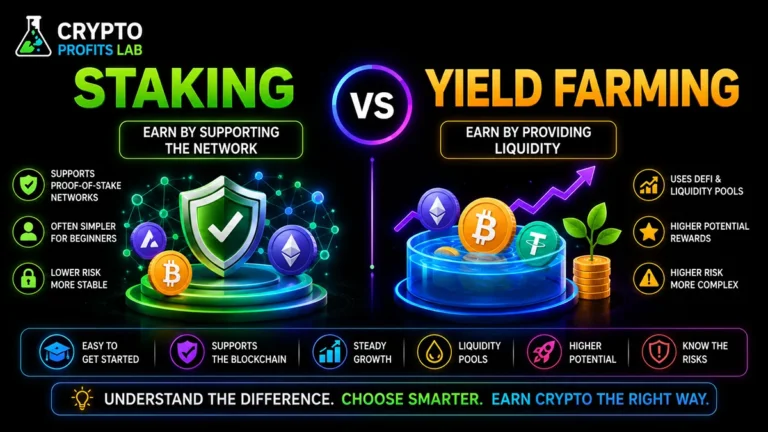
Staking usually means using crypto to help support a proof-of-stake blockchain. Liquidity pools usually help decentralized trading by providing tokens for swaps.
Read Staking vs Yield Farming for a full comparison.
Here is a simple table:
| Topic | Staking | Liquidity Pools |
|---|---|---|
| Main purpose | Support proof-of-stake networks | Support trading and DeFi liquidity |
| Typical assets | One staked asset | Usually two or more tokens |
| Main reward | Network staking rewards | Trading fees or DeFi rewards |
| Main risk | Token price, lockups, validator risk | Impermanent loss, pool risk, smart contracts |
| Beginner difficulty | Often easier | Usually more complex |
For many beginners, staking is easier to understand than liquidity pools.
Liquidity Pools and Stablecoins
Stablecoins are crypto assets designed to track another asset, often the U.S. dollar.
Some liquidity pools use stablecoins. A pool may include USDC and USDT or another stablecoin pair.
Stablecoin pools may reduce impermanent loss risk because the tokens are designed to remain close to their nominal value. But that does not mean they are risk-free.
Read What Are Stablecoins? before using stablecoin pools.
Stablecoin risks can include:
- Losing the peg
- Platform failure
- Smart contract bugs
- Regulatory changes
- Low trading volume
- Withdrawal issues
Liquidity Pools in Crypto can look safer when stablecoins are involved, but beginners should still research the platform and understand the risks.
Liquidity Pool Rewards
Liquidity providers may earn rewards in several ways.
The most common reward is a share of trading fees. If many users trade through the pool, fees may add up.
Some platforms also offer token incentives. These are extra tokens paid to encourage users to provide liquidity.
This can make the reward rate look attractive.
But beginners should ask:
- What token pays the reward?
- Is the reward rate fixed or variable?
- Can the reward token lose value?
- Are there claim fees?
- Are rewards sustainable?
- Is there enough trading volume?
- Could impermanent loss reduce the return?
Read Crypto Rewards for Beginners to understand the basics of rewards before chasing liquidity pool income.
Liquidity Pools in Crypto may create rewards, but rewards are not guaranteed profits.
APR, APY, and Liquidity Pools
Liquidity pool platforms may show APR or APY.
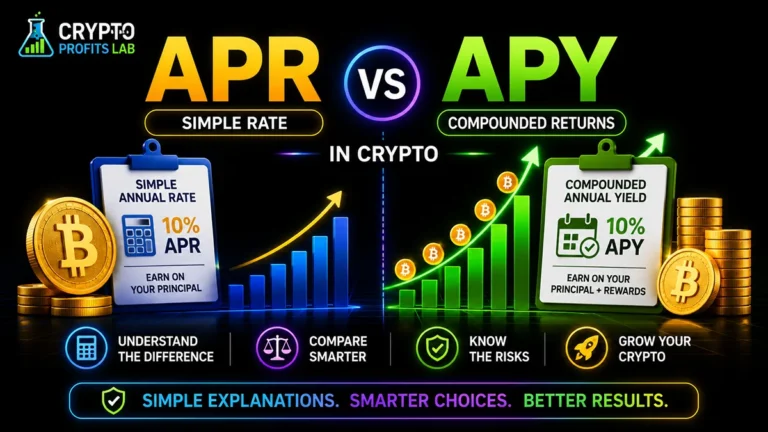
APR usually shows a simple annual rate. APY includes compounding.
Read APR vs APY in Crypto before comparing reward offers.
A pool showing 30% APY may sound better than one showing 8% APR, but the higher number may entail more risk.
APY does not automatically include:
- Impermanent loss
- Gas fees
- Token price loss
- Smart contract risk
- Scam risk
- Tax complexity
A high reward rate should make beginners ask more questions, not fewer.
Common Beginner Mistakes With Liquidity Pools
Liquidity Pools in Crypto can be confusing, and beginners often make similar mistakes.
Mistake 1: Chasing the highest APY
The highest APY may come from the riskiest pool.
High rewards may be used to attract users to a weak or volatile token.
Mistake 2: Not understanding both tokens
If you provide liquidity, you are exposed to the tokens in the pool.
Do not add tokens you would not want to hold.
Mistake 3: Ignoring impermanent loss
Impermanent loss can reduce or erase rewards.
Beginners should understand this before depositing.
Mistake 4: Forgetting gas fees
Gas fees can make small liquidity pool positions unprofitable.
Mistake 5: Using unknown DeFi websites
Fake DeFi websites can steal funds through bad wallet approvals or phishing.
Mistake 6: Connecting a main wallet
Do not connect your main long-term wallet to random DeFi apps.
A separate testing wallet may reduce risk.
Mistake 7: Thinking stablecoin pools are risk-free
Stablecoin pools may reduce some price risk, but they still have platform, smart contract, and peg risks.
Mistake 8: Treating liquidity pools like bank accounts
Liquidity pools are not insured savings accounts.
They involve crypto market risk.
Safety and Risk Section
Liquidity Pools in Crypto require strong safety habits.
Before using any liquidity pool, beginners should understand:
- Wallet safety
- DeFi website risk
- Smart contract risk
- Token risk
- Impermanent loss
- Gas fees
- Scam tokens
- Fake pools
- Low liquidity
- Tax records
Use these safety habits:
- Use official links only.
- Never share your seed phrase.
- Avoid unknown wallet approvals.
- Start with small amounts if testing.
- Research both tokens in the pool.
- Check whether the protocol is reputable.
- Avoid pools with unrealistic APY.
- Understand how to remove liquidity before adding it.
- Track fees and rewards.
- Do not use money you cannot afford to lose.
- Consider a separate wallet for DeFi testing.
- Keep your long-term holdings safer.
For more protection, read Crypto Safety Tips, Crypto Scams to Avoid, and Crypto Rug Pulls.
If you hold larger amounts, learn about using a Hardware Wallet for safer long-term storage.
How to Evaluate Liquidity Pools Step by Step
Here is a beginner checklist before using any pool.
Step 1: Understand the pool
Can you explain what the pool does in one sentence?
If not, keep learning.
Step 2: Research both tokens
Do not focus only on the reward rate.
You need to understand both assets in the pool.
Step 3: Check pool liquidity
A larger, more active pool may offer better trading conditions than a smaller pool.
Low liquidity can increase risk.
Step 4: Review reward source
Ask where rewards come from.
Are they from trading fees, token incentives, lending activity, or something else?
Step 5: Estimate fees
Include gas fees, swap fees, deposit fees, claim fees, and withdrawal fees.
Step 6: Understand impermanent loss
Do not provide liquidity without understanding how price movement can affect your position.
Step 7: Check platform safety
Look for official documentation, community trust, history, and security information.
Step 8: Decide if it fits your experience level
If you are still learning basic wallets and exchanges, liquidity pools may be too advanced for now.
Liquidity Pools in Crypto are useful to understand even if you decide not to use them yet.
Are Liquidity Pools Good for Beginners?
Liquidity pools are not usually the best first step for complete beginners.
They are better understood after learning:
- Crypto wallets
- DeFi
- DEXs
- Gas fees
- Slippage
- Liquidity
- Impermanent loss
- Crypto scams
- Tokenomics
If you are still learning how to buy and store crypto, start with simpler topics first.
Read How to Buy Crypto for Beginners and Best Crypto Wallet for Beginners before using DeFi.
Liquidity Pools in Crypto can be part of a more advanced learning path, but they should not be rushed.
Are Liquidity Pools Passive Income?
Liquidity pools are often described as passive income, but that phrase can be misleading.
Yes, a liquidity provider may earn fees or rewards after depositing tokens. But the position still needs monitoring.
The pool can change. Token prices can move. Rewards can drop. Gas fees can rise. A protocol can be attacked. A fake token can collapse.
Read Is Crypto Passive Income Safe? before treating liquidity pool rewards as easy income.
Liquidity Pools in Crypto are better described as a risk-based DeFi strategy rather than a guaranteed passive income.
Final Thoughts
Liquidity Pools in Crypto are an important part of DeFi.
They allow users to trade on decentralized exchanges, support token swaps, and create potential rewards for liquidity providers. Without liquidity pools, many DeFi platforms would not function as they do today.
But liquidity pools are not beginner-proof.
They can involve impermanent loss, gas fees, slippage, smart contract risk, token volatility, scams, and tax complexity.
The smartest approach for beginners is to learn before depositing funds. Understand DeFi, DEXs, liquidity, yield farming, gas fees, slippage, impermanent loss, and wallet safety first.
Crypto Profits Lab is built to make crypto education cleaner and simpler for beginners. Liquidity pools are a perfect example of why that matters. The goal is not to chase the highest reward. The goal is to understand the risk clearly enough to make smarter decisions.
Liquidity Pools in Crypto FAQ
What are Liquidity Pools in Crypto?
Liquidity Pools in Crypto are collections of tokens locked in a smart contract, enabling users to trade or use DeFi services. They are common on decentralized exchanges and allow users to swap tokens without a traditional order book. People who add tokens to the pool are called liquidity providers and may earn fees or rewards.
How do liquidity pools work?
Liquidity pools work by holding tokens inside a smart contract. Traders swap against the pool instead of matching directly with another person. As trades happen, the pool’s token balances change. Liquidity providers add assets to the pool and may earn a share of trading fees, but they also bear risks.
Can beginners use liquidity pools?
Beginners can learn about liquidity pools, but they should be careful before using them. Liquidity pools involve DeFi wallets, smart contracts, gas fees, token risk, slippage, and impermanent loss. Complete beginners should first understand wallets, DEXs, DeFi, crypto safety, and basic trading before depositing money into any pool.
Do liquidity pools guarantee income?
No, liquidity pools do not guarantee income. Liquidity providers may earn trading fees or reward tokens, but token prices can fall, impermanent loss can occur, gas fees can reduce returns, and platforms can fail. A high APY does not mean a safe or guaranteed profit.
What is impermanent loss in liquidity pools?
Impermanent loss is a risk that can happen when token prices change after you add funds to a liquidity pool. Your pool position may become worth less than if you had simply held the tokens separately. It can become real if you withdraw while the price difference still exists.
Are stablecoin liquidity pools safe?
Stablecoin liquidity pools may have lower price movement risk than pools with volatile tokens, but they are not risk-free. Stablecoins can lose their peg, DeFi platforms can fail, smart contracts can have bugs, and fees can reduce returns. Beginners should still research the risks of the pool, platform, and token.
How do liquidity providers make money?
Liquidity providers may earn a share of trading fees when users swap tokens through a pool. Some platforms also pay extra reward tokens to attract liquidity. However, those rewards can be reduced by impermanent loss, token price drops, gas fees, claim fees, and other risks.
What is the difference between staking and liquidity pools?
Staking typically supports a proof-of-stake blockchain and often involves a single asset. Liquidity pools usually support trading on DeFi platforms and often involve two or more tokens. Staking is often easier for beginners to understand, while liquidity pools can involve impermanent loss, slippage, and more complex DeFi risks.
Why do liquidity pools have high APY?
Some liquidity pools show high APY because the pool is risky, rewards are temporary, or the platform is trying to attract liquidity. High APY may involve volatile tokens, low liquidity, or reward tokens that can lose value. Beginners should ask why the rate is high before depositing funds.
What is the best rule for Liquidity Pools in Crypto?
The best rule for Liquidity Pools in Crypto is to understand the risk before chasing rewards. Do not add funds to a pool unless you understand both tokens, the platform, fees, impermanent loss, slippage, and wallet approvals. If you cannot explain how the pool could lose money, keep learning first.