What Is Crypto Slippage? Beginner Guide
Crypto slippage is one of those terms beginners often see after they start buying, selling, or swapping crypto.
At first, it can sound confusing. You may think you are buying a coin at one price, but when the trade finishes, the final price is slightly different. Sometimes the difference is small. Sometimes it can be large enough to surprise you.
That difference is called crypto slippage.
For beginners, crypto slippage matters because it can affect how much crypto you receive, how much you pay, and whether a trade is actually worth making. It is especially important when using decentralized exchanges, trading smaller tokens, or buying during fast-moving market conditions.
The good news is that crypto slippage is not hard to understand once it is explained in plain English.
This guide will show you what crypto slippage means, why it happens, how it affects beginners, and how to reduce the risk of getting a worse trade than expected.
Quick Answer: What Is Crypto Slippage?
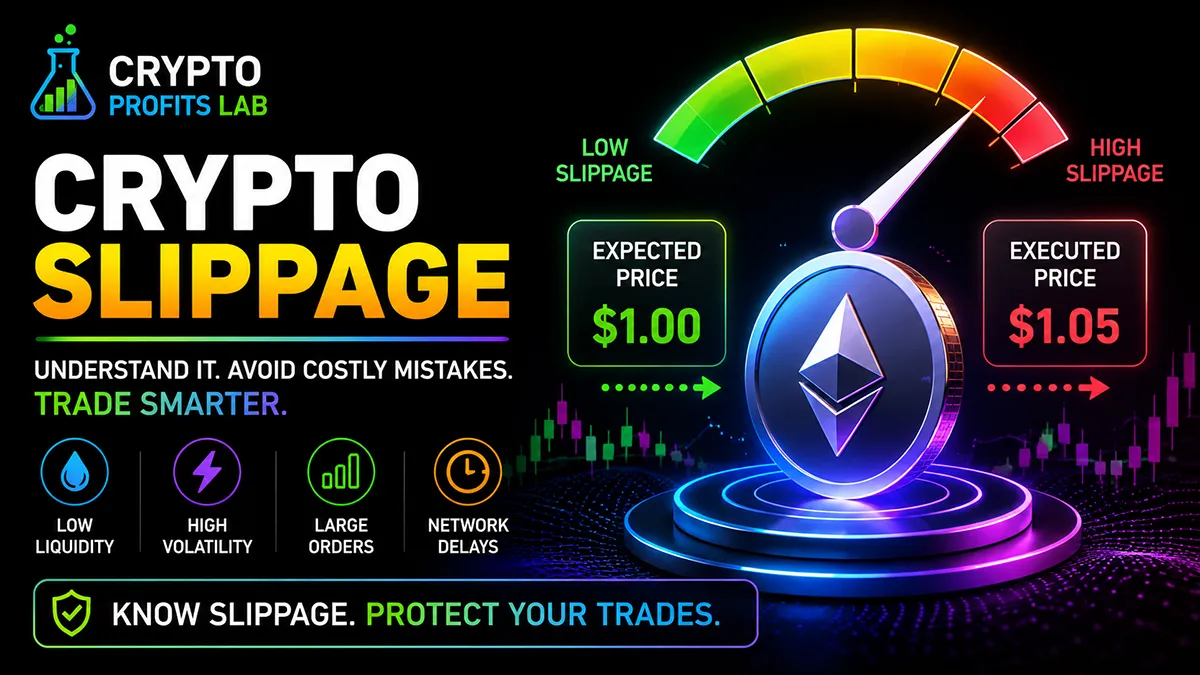
Crypto slippage is the difference between the price you expect when placing a crypto trade and the price you actually get when the trade is completed.
For example, you may expect to buy a token at $1.00, but the order finishes at $1.03. That 3-cent difference is slippage.
Crypto slippage can happen because crypto prices move quickly, liquidity can be low, and trades may take time to process. It can happen on centralized exchanges and decentralized exchanges, but it is especially common when swapping tokens on a DEX.
Crypto slippage is not always bad. Sometimes you may get a slightly better price than expected. However, beginners usually notice slippage when they receive less crypto than they thought they would.
Key Takeaways
- Crypto slippage is the gap between the expected trade price and the final execution price.
- It can happen when prices move quickly before your trade is completed.
- Low liquidity can make slippage worse.
- Large trades usually create more slippage than small trades.
- Slippage can happen on both centralized and decentralized exchanges.
- DEX swaps often show a slippage tolerance setting before you confirm the trade.
- High slippage can make a trade more expensive than expected.
- Beginners should check liquidity, order type, fees, and trade size before confirming a transaction.
Crypto Slippage Beginner Facts Table
| Topic | Beginner-Friendly Explanation |
|---|---|
| Main meaning | Difference between expected trade price and final trade price |
| Where it happens | Centralized exchanges, decentralized exchanges, and swaps |
| Main causes | Fast price movement, low liquidity, large orders, network delays |
| Good or bad? | Can be positive or negative, but beginners usually worry about negative slippage |
| Common on DEXs? | Yes, especially with smaller tokens or low-liquidity pools |
| Can it be avoided completely? | Not always, but it can often be reduced |
| Related topic | Liquidity, market orders, gas fees, and volatility |
| Beginner risk level | Moderate to high if trading small tokens or using high slippage tolerance |
| Best habit | Preview the trade carefully before clicking confirm |
What Is Crypto Slippage in Simple Terms?
Crypto slippage means the trade price changes between the moment you start an order and the moment it finishes.
Think of it like checking the price of gas at a station sign while driving. The sign says $3.50 per gallon. But by the time you pull in and pay, the station changes the price to $3.55. You expected one price, but you got another.
That is the basic idea of crypto slippage.
In crypto, prices can move very quickly. A coin may be worth $1.00 when you start the trade, but $1.02 a few seconds later. If your order completes at the new price, you experience slippage.
This is especially important for complete beginners because crypto trades can feel instant, but many things happen in the background. Exchanges match orders. Decentralized exchanges use liquidity pools. Blockchains process transactions. Prices continue moving while all of this happens.
If you are still learning the basic buying process, read How to Buy Crypto for Beginners before using advanced trade settings.
Why Crypto Slippage Happens
Crypto slippage happens because markets are always moving.
A price shown on your screen is usually a snapshot. It tells you what the price looks like at that moment. But if the market changes before your trade finishes, the final price can be different.
Here are the most common reasons.
Fast price movement
Crypto markets can move quickly, especially during news events, big market swings, or sudden buying and selling.
If a coin moves from $1.00 to $1.05 while your order is being processed, your final price may be higher than expected.
This is one reason beginners should understand Crypto Volatility. Volatility means prices can move sharply in a short time.
Low liquidity
Liquidity means how easy it is to buy or sell an asset without causing a big price change.
Bitcoin and Ethereum usually have deep liquidity on major exchanges. Smaller tokens may not. If there are not enough buyers and sellers, your trade may push the price more than expected.
Low liquidity is one of the biggest causes of crypto slippage.
To understand this better, read Crypto Liquidity. That article explains why some coins are easier to trade than others.
Large trade size
A larger trade can cause more slippage because it may need to fill across multiple prices.
For example, a small $50 buy order may not move the market much. A $50,000 buy order on a low-liquidity token could move the price significantly.
This is why slippage is not only about the coin. It is also about the size of your order compared to available liquidity.
Market orders
A market order tells an exchange to buy or sell immediately at the best available price.
That sounds convenient, but it can increase slippage risk. If the order book changes quickly, your market order may fill at a worse price than expected.
Beginners should learn the difference between order types in Market Order vs Limit Order Crypto.
Network delays
On a blockchain, a transaction may not confirm instantly. During busy times, your transaction can sit pending while prices keep moving.
This is especially important when using decentralized exchanges. If the price changes before the transaction confirms, crypto slippage may occur.
Network fees can also affect timing. Learn more in What Are Crypto Gas Fees?.
How Crypto Slippage Works Step by Step
Here is a simple step-by-step example.
Step 1: You choose a crypto trade
Imagine you want to buy a token that is currently priced at $1.00.
You enter $500 and expect to receive about 500 tokens before fees.
Step 2: The market changes
Before your trade finishes, other people are buying the same token.
The price moves from $1.00 to $1.02.
Step 3: Your order executes at the new price
Instead of receiving 500 tokens, you receive about 490 tokens before fees.
You did not receive the amount you expected because the price moved before the trade completed.
That difference is crypto slippage.
Step 4: You review the final trade
After the trade is finished, your account shows the actual amount received.
At that point, the trade is complete. If you accepted the terms and the order executed within the allowed range, you usually cannot reverse it.
This is why beginners should slow down and review trade previews before confirming.
For a simple outside explanation of the concept, Coinbase Help explains slippage as the difference between the expected order price and the price when the order actually executes.
Crypto Slippage on Centralized Exchanges
A centralized exchange is a company-run platform where users buy and sell crypto. Examples include major crypto trading platforms that hold user accounts and match buyers with sellers.
On a Crypto Exchange, slippage usually happens through the order book.
An order book is a list of buy and sell orders. If you place a market order, the exchange fills your order using available prices in the book.
For highly traded coins, the difference may be tiny. For thinly traded coins, the difference can be larger.
Here is a simple example:
| Expected Price | Final Price | Result |
|---|---|---|
| $100.00 | $100.10 | Small negative slippage |
| $100.00 | $99.90 | Small positive slippage |
| $100.00 | $103.00 | Large negative slippage |
| $100.00 | $97.00 | Large positive slippage |
Negative slippage means you got a worse price than expected. Positive slippage means you got a better price.
Beginners usually focus on negative slippage because it can reduce the value of a trade.
Crypto Slippage on Decentralized Exchanges
A decentralized exchange, often called a DEX, lets users swap crypto directly through smart contracts instead of using a traditional company-run order book.
If you are new to this idea, read What Is a DEX?.
On many DEXs, trades happen through liquidity pools. A liquidity pool is a collection of tokens supplied by users so other people can trade.
When you swap one token for another, the pool’s balance changes. If your trade is large compared to the pool, the price can move against you.
This is why crypto slippage can be more noticeable on a DEX than on a major centralized exchange.
DEX platforms often include a slippage tolerance setting. This setting tells the system how much price movement you are willing to accept before the transaction fails.
For example:
| Slippage Tolerance | What It Means |
|---|---|
| 0.1% | Very tight, but transaction may fail more easily |
| 0.5% | Common for liquid tokens |
| 1.0% | More flexible, but accepts more price movement |
| 3.0% or higher | Riskier, often used for volatile or low-liquidity tokens |
A higher tolerance may help a transaction go through, but it can also allow a worse final price.
Slippage Tolerance Explained
Slippage tolerance is the maximum amount of price difference you are willing to accept.
If you set slippage tolerance at 1%, your trade can complete as long as the final price is within 1% of the quoted price. If the price moves beyond that, the transaction should fail instead of completing at a much worse price.
This setting is common when swapping tokens on a DEX.
A beginner mistake is thinking higher slippage tolerance is always better because it helps transactions complete. That is not always true. A high setting may expose you to a worse price, especially with risky tokens.
A lower setting may protect you from a bad trade, but it can also cause more failed transactions during volatile market conditions.
The goal is not to use the highest setting. The goal is to use a reasonable setting based on liquidity, volatility, and trade size.
Crypto Slippage vs Trading Fees
Crypto slippage and trading fees are not the same thing.
A trading fee is a known cost charged by the exchange or protocol. Slippage is a price difference that happens because the trade executes at a different price than expected.
Here is the difference:
| Cost Type | What It Means | Can You Preview It? |
|---|---|---|
| Trading fee | Fee charged by the platform | Usually yes |
| Network fee | Blockchain transaction cost | Usually yes |
| Crypto slippage | Difference between expected and final price | Usually estimated, not guaranteed |
| Spread | Difference between buy and sell prices | Often visible or built into pricing |
A trade can have fees and slippage at the same time.
For example, you may pay a trading fee, a network fee, and still receive a slightly worse price because of slippage.
Beginners should look at the full trade preview, not just the coin price.
Crypto Slippage vs Spread
The spread is the difference between the highest price someone is willing to pay and the lowest price someone is willing to sell for.
Slippage is the difference between the price you expected and the price you actually received.
They are related, but they are not identical.
A wide spread can lead to worse execution. Low liquidity can cause both wide spreads and slippage. This is one reason beginners should be careful with small or unknown tokens.
If you are buying a popular coin on a major exchange, the spread may be small. If you are buying a low-volume token, the spread may be much wider.
That wider spread can make the trade more expensive before slippage even happens.
Why Low Liquidity Makes Slippage Worse
Low liquidity means there is not much crypto available to buy or sell near the current price.
Imagine a small store with only five bottles of water on the shelf. If one person buys all five, the store may need to restock at a higher price. In a crypto market, a large buy order can consume available sell orders and move the price up.
That is similar to how low liquidity can create crypto slippage.
The thinner the market, the easier it is for one trade to move the price.
This is why beginners should be extra careful with:
- New tokens
- Small market cap coins
- Meme coins
- Low-volume trading pairs
- Tokens promoted heavily on social media
- DEX pools with little liquidity
If you are researching meme coins, read Meme Coins before trading them. They can move quickly and may have higher slippage risk.
Crypto Slippage and Meme Coins
Meme coins can be fun to watch, but they can also be risky.
Many meme coins have sudden price spikes, low liquidity, and emotional trading. That combination can create large crypto slippage.
A beginner may see a meme coin rising fast and rush to buy. By the time the trade finishes, the price may already be much higher. If the token drops right after, the beginner can be stuck with a worse entry price.
Some meme coins may also have unusual token mechanics or low-quality liquidity pools. In extreme cases, a beginner may have trouble selling without major price impact.
Before buying any small token, understand what a Crypto Token is and how tokens can differ from major coins like Bitcoin or Ethereum.
How to Reduce Crypto Slippage
You cannot always remove crypto slippage completely, but you can reduce the risk.
Here are beginner-friendly ways to protect yourself.
Use limit orders when possible
A limit order lets you choose the highest price you are willing to pay or the lowest price you are willing to sell for.
This gives you more control than a market order.
The trade may not fill immediately, but it can help prevent a worse price than expected.
Trade more liquid coins
Major coins usually have better liquidity than small tokens.
Bitcoin, Ethereum, and popular large-cap assets often have deeper markets. Smaller tokens may have thinner liquidity and larger slippage.
Avoid rushing during hype
When everyone is rushing into a trade, prices can move quickly.
Slow down. Read the trade preview. Check the final amount. Do not let fear of missing out make the decision for you.
Make smaller trades
A large trade can create more price impact.
Breaking a trade into smaller parts may reduce slippage in some cases, especially with low-liquidity tokens. However, this can also increase fees if each trade requires a separate transaction.
Check DEX liquidity
Before swapping on a DEX, look at the liquidity pool size when available.
A large pool usually handles trades better than a tiny pool. A tiny pool may create large slippage even on a modest trade.
Use reasonable slippage tolerance
Do not set slippage tolerance extremely high unless you fully understand the risk.
A high setting may make your transaction more likely to complete, but it can also let the trade finish at a much worse price.
Avoid suspicious tokens
Some tokens are designed to trap or punish buyers and sellers with unusual fees or bad liquidity.
Use Crypto Safety Tips before connecting your wallet or approving a token swap.
Common Beginner Mistakes With Crypto Slippage
Crypto slippage often hurts beginners because they move too fast.
Here are the mistakes to avoid.
Mistake 1: Only looking at the token price
The price shown on screen is not the full story.
You also need to check the final estimated amount, fees, liquidity, spread, and slippage tolerance.
Mistake 2: Using market orders for everything
Market orders are convenient, but they can create worse execution in fast-moving or low-liquidity markets.
Limit orders can help beginners control price better.
Mistake 3: Setting slippage tolerance too high
Some beginners increase slippage tolerance because a transaction keeps failing.
That may solve one problem but create another. A very high setting can allow a bad final price.
Mistake 4: Trading low-liquidity tokens without checking pool depth
Small tokens can look exciting, but low liquidity can make buying or selling much more expensive than expected.
Always check whether there is enough liquidity for the trade size.
Mistake 5: Ignoring gas fees
On some blockchains, failed transactions can still cost network fees.
This means a tight slippage setting may protect your price, but repeated failed transactions can still cost money.
Mistake 6: Chasing fast-moving candles
A fast green candle can trigger emotional buying.
By the time your trade executes, the price may have moved sharply. This is one of the easiest ways beginners run into crypto slippage.
Safety and Risk Section
Crypto slippage is not just a trading detail. It is also a safety issue.
Scammers and risky token promoters often take advantage of beginners who do not understand how swaps work. They may encourage people to buy quickly, raise slippage tolerance, or ignore warning signs.
Be careful if someone tells you:
- “Set slippage to 15% or the trade will not work.”
- “Buy now before it is too late.”
- “This token is guaranteed to pump.”
- “You can only buy through this unknown link.”
- “Do not worry about liquidity.”
These are red flags.
A legitimate trade should make sense before you confirm it. You should understand what you are buying, where you are buying it, how much you expect to receive, and what risks are involved.
Crypto slippage becomes more dangerous when combined with hype, low liquidity, and unsafe wallet behavior.
If you are using DeFi platforms, first read What Is DeFi?. DeFi can be useful, but it also requires more personal responsibility than using a simple beginner exchange.
When Crypto Slippage Matters Most
Crypto slippage matters most when the trade is large, the coin is volatile, or liquidity is low.
For small trades on liquid assets, slippage may be barely noticeable. For low-liquidity tokens, it can have a major impact.
Here are situations where beginners should pay extra attention:
| Situation | Slippage Risk |
|---|---|
| Buying Bitcoin on a major exchange | Usually lower |
| Buying a new meme coin on a DEX | Often higher |
| Using a market order during volatility | Higher |
| Trading a low-volume token | Higher |
| Swapping during network congestion | Higher |
| Making a large trade in a small pool | Much higher |
The more risky the setup, the more carefully you should review the trade.
Simple Crypto Slippage Example
Let’s say you want to swap $1,000 of ETH for a smaller token.
The DEX preview says you should receive 10,000 tokens.
You click confirm.
Before the transaction completes, the token price rises. Your final trade gives you 9,700 tokens instead.
You expected 10,000 but received 9,700.
That 300-token difference is caused by crypto slippage.
Now imagine you had set a very high slippage tolerance. The transaction may complete even if the final amount is much worse. That is why beginners should not blindly increase tolerance just to force a trade through.
Does Crypto Slippage Always Mean You Lost Money?
Not always.
Slippage can be negative or positive.
Negative slippage means you got a worse price than expected. Positive slippage means you got a better price than expected.
For example, if you expected to buy at $1.00 but the trade completed at $0.99, that would be positive slippage.
However, beginners usually hear about crypto slippage because of negative experiences. They expected one amount and received less.
The safest habit is to assume slippage is a real cost risk and review every trade before confirming.
Should Beginners Avoid DEXs Because of Slippage?
Beginners do not need to avoid decentralized exchanges forever, but they should learn first.
A DEX gives users more control, but also more responsibility. There may be no customer support, no undo button, and no simple refund if you confirm the wrong transaction.
Crypto slippage is one part of that responsibility.
Beginners may want to start with small test trades, use well-known tokens, and avoid unknown links. It is also smart to understand wallets before using DeFi tools. Start with What Is a Crypto Wallet? if you are still learning how self-custody works.
Final Thoughts
Crypto slippage is a simple idea that can have a real impact on your trades.
It means the price you expected is not always the price you get. This can happen because prices move quickly, liquidity is low, the trade is large, or the transaction takes time to process.
For beginners, the most important lesson is to slow down before confirming a trade.
Check the estimated amount. Review the fees. Understand the slippage tolerance. Be careful with small tokens and hype-driven trades. Avoid setting tolerance too high just because a transaction fails.
Crypto slippage is not something to fear, but it is something to respect.
The more you understand it, the better prepared you are to trade carefully, avoid beginner mistakes, and make smarter crypto decisions.
FAQ
What is crypto slippage?
Crypto slippage is the difference between the price you expect when placing a trade and the price you actually receive when the trade is completed. It can happen because crypto prices move quickly, liquidity changes, or the order takes time to execute. Slippage can be positive or negative, but beginners usually worry about getting a worse price than expected.
Is crypto slippage bad?
Crypto slippage is not always bad because it can sometimes result in a better price. However, negative slippage can hurt beginners by making a trade more expensive or reducing the amount of crypto received. It becomes riskier when trading low-liquidity tokens, using market orders, or setting slippage tolerance too high on a decentralized exchange.
What causes crypto slippage?
Crypto slippage is usually caused by fast price movement, low liquidity, large trade size, market orders, or blockchain transaction delays. When the market changes between the time you preview a trade and the time it completes, the final price can be different. Smaller tokens and volatile markets often have higher slippage risk.
How do I avoid crypto slippage?
You may not be able to avoid crypto slippage completely, but you can reduce it. Use limit orders when available, trade liquid assets, avoid large orders in small markets, check the trade preview, and use reasonable slippage tolerance. Beginners should also avoid rushing into hype-driven tokens where prices and liquidity can change quickly.
What is slippage tolerance in crypto?
Slippage tolerance is the maximum price difference you are willing to accept before a trade fails. For example, a 1% tolerance means the trade can complete if the final price is within 1% of the quote. A higher setting may help transactions complete, but it can also allow a worse final price.
Why is slippage common on decentralized exchanges?
Slippage is common on decentralized exchanges because many DEX trades use liquidity pools instead of traditional order books. If a trade is large compared to the pool, it can move the price. Smaller pools, volatile tokens, and network delays can all make slippage worse during a token swap.
Can crypto slippage happen on Coinbase or other exchanges?
Yes, crypto slippage can happen on centralized exchanges too. It is more likely when using market orders, trading volatile assets, or buying coins with low trading volume. Major assets on large exchanges often have lower slippage, but no exchange can guarantee that every trade will execute at the exact price first shown.
Is high slippage tolerance dangerous?
High slippage tolerance can be dangerous because it allows a trade to complete even if the final price is much worse than expected. Some risky tokens may require high tolerance because of low liquidity or unusual token mechanics. Beginners should be careful and avoid raising tolerance without understanding the potential cost.
Does slippage include gas fees?
No, slippage and gas fees are different. Gas fees are blockchain transaction costs paid to process a transaction. Slippage is the difference between the expected trade price and final execution price. A DEX swap can include both gas fees and slippage, so beginners should review the full transaction before confirming.