TVL in Crypto: A Beginner’s Guide
TVL in Crypto is one of the most common terms beginners see when learning about DeFi, liquidity pools, staking platforms, lending protocols, and yield farming.
At first, TVL may look like just another crypto abbreviation. But it is actually a useful number that can help beginners understand how much value is being used inside a crypto protocol, blockchain, or DeFi app.
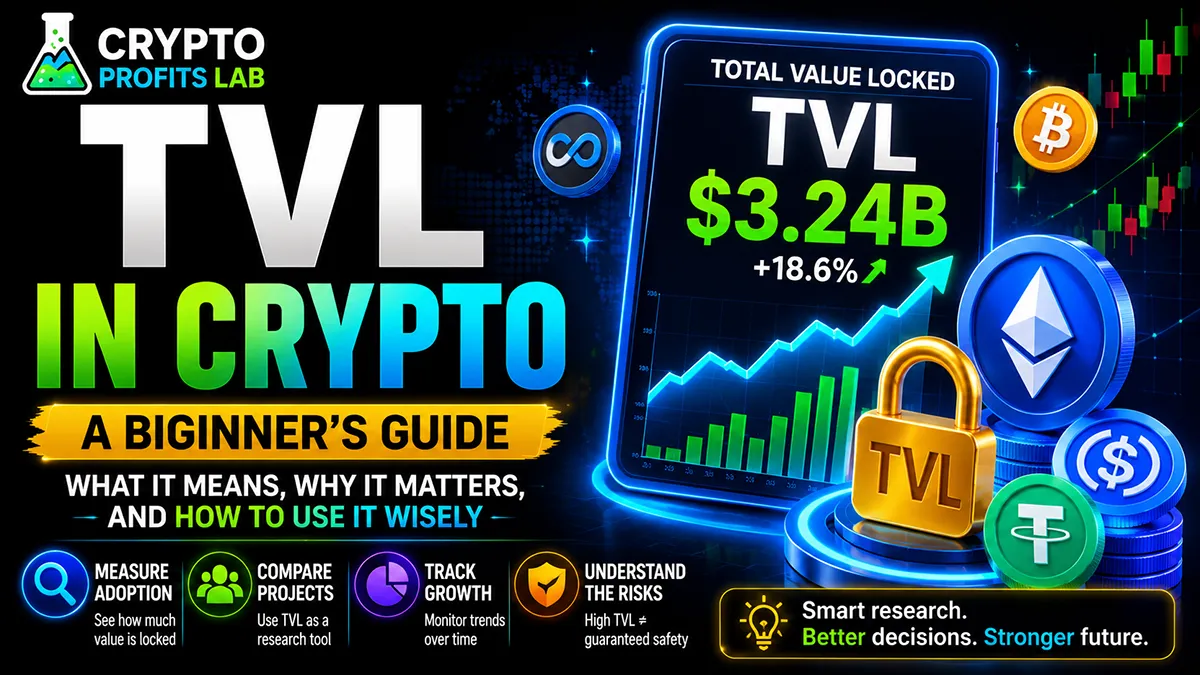
TVL stands for total value locked.
In simple terms, TVL shows the estimated value of crypto assets deposited into a protocol. These assets may be used for lending, borrowing, trading, staking, liquidity pools, or other DeFi activity.
For beginners, TVL in Crypto can be helpful because it gives a quick snapshot of how much money is inside a platform. But TVL should never be used alone. A high TVL does not automatically mean a project is safe, and a low TVL does not always mean a project is bad.
This guide explains TVL in Crypto in plain English, how it works, why it matters, what it can and cannot tell you, and how beginners can use it carefully when researching DeFi projects.
Quick Answer: What Is TVL in Crypto?
TVL in Crypto means total value locked. It is the estimated dollar value of crypto assets deposited into a blockchain, DeFi protocol, liquidity pool, lending platform, or staking system.
For example, if users deposit $100 million worth of crypto into a DeFi protocol, that protocol may be described as having $100 million in TVL.
TVL can help beginners see how much value users have committed to a platform. It is often used as a rough sign of DeFi activity, trust, liquidity, and adoption.
However, TVL is not a safety guarantee. A protocol can have high TVL and still pose risks such as smart contract bugs, token price drops, scams, hacks, poor incentives, or withdrawal issues.
Key Takeaways
- TVL in Crypto stands for total value locked.
- TVL shows the estimated value of crypto deposited into a protocol or blockchain.
- It is commonly used in DeFi, lending, staking, liquidity pools, and yield farming.
- A higher TVL may indicate greater user activity or greater deposited value.
- A lower TVL may suggest a smaller or newer protocol.
- TVL does not prove a project is safe.
- TVL can change quickly when token prices rise or fall.
- Beginners should use TVL with other research, not as the only decision factor.
- DeFi platforms with high rewards and low TVL may be riskier.
- TVL in Crypto is useful, but it must be understood in context.
TVL in Crypto Beginner Facts Table
| Topic | Beginner-Friendly Explanation |
|---|---|
| Full meaning | Total value locked |
| Simple definition | Estimated value of crypto deposited into a protocol |
| Common use | DeFi, liquidity pools, lending, staking, yield farming |
| Measured in | Usually U.S. dollars |
| High TVL means | More value is deposited, but not guaranteed safety |
| Low TVL means | Smaller, newer, or less-used protocol |
| Main limitation | TVL can change with token prices |
| Biggest beginner mistake | Treating TVL as a safety score |
| Best use | One research tool among many |
| Related topics | DeFi, liquidity, staking, yield farming, impermanent loss |
Why TVL in Crypto Matters
TVL in Crypto matters because DeFi is built around users depositing assets into protocols.
DeFi stands for decentralized finance. It includes crypto tools that let users trade, lend, borrow, stake, provide liquidity, or earn rewards without a traditional bank or broker.
If DeFi is new to you, start with What Is DeFi?.
TVL gives beginners a way to estimate the value locked in a DeFi protocol. If a lending app has billions of dollars in TVL, that may show that many users or large holders are using it. If a brand-new project has only a small amount of TVL, it may still be unproven.
But beginners must be careful.
A high TVL can create confidence, but confidence is not the same as safety. A protocol can be popular and still have risks. A project can grow quickly and still be vulnerable to bugs, bad tokenomics, or market stress.
TVL in Crypto is helpful as a starting point, not a final answer.
What Total Value Locked Means
Total value locked means the estimated value of crypto assets deposited into a protocol.
Those assets may be used in different ways.
A lending protocol may have users deposit crypto so others can borrow it. A decentralized exchange may allow users to deposit tokens into liquidity pools so that others can trade them. A staking platform may have users lock crypto to help support a blockchain network.
TVL in Crypto usually tries to answer one simple question:
How much value is currently committed to this protocol or ecosystem?
For example:
| Protocol Type | What May Count Toward TVL |
|---|---|
| Lending protocol | Crypto deposited by lenders |
| DEX | Assets inside liquidity pools |
| Yield farm | Tokens deposited into reward strategies |
| Staking platform | Crypto staked or delegated |
| DeFi ecosystem | Total deposits across many protocols |
The exact calculation can differ between platforms, which is one reason beginners should not treat TVL as a perfect number.
How TVL in Crypto Works Step by Step
Here is a simple step-by-step explanation.
Step 1: Users deposit crypto
Users add crypto assets to a protocol.
This could include ETH, stablecoins, wrapped assets, tokens, or other supported crypto.
For example, a user may deposit USDC into a lending protocol or add ETH and USDC to a liquidity pool.
Step 2: The protocol holds those assets
The protocol may hold the assets inside smart contracts.
A smart contract is blockchain code that runs automatically. If you are new to this idea, read Smart Contracts.
Step 3: The value is measured
The platform estimates the dollar value of the assets deposited.
If users deposit 10,000 ETH, with each ETH worth $3,000, that portion would represent about $30 million in value.
Step 4: The TVL number updates
TVL can change when users deposit more assets, withdraw assets, or when token prices change.
This is important because TVL can rise even if no new users deposit money. If token prices rise, the dollar value of existing deposits may increase as well.
Step 5: Researchers compare TVL
People may compare TVL across protocols, blockchains, and categories.
For a direct external reference, DeFiLlama’s data definitions define TVL as the value held in protocol smart contracts and compare it to assets under management.
This makes TVL in Crypto useful, but not perfect.
Simple TVL Example
Imagine a DeFi lending app has these deposits:
| Asset | Amount Deposited | Price | Estimated Value |
|---|---|---|---|
| ETH | 1,000 ETH | $3,000 | $3,000,000 |
| USDC | 2,000,000 USDC | $1 | $2,000,000 |
| SOL | 10,000 SOL | $150 | $1,500,000 |
The total value locked would be about $6.5 million.
This is a simplified example. Real protocols may use many assets, multiple blockchains, price feeds, wrapped tokens, and more complicated calculations.
For beginners, the simple idea is enough: TVL in Crypto estimates how much value users have deposited.
TVL in Crypto and DeFi
TVL is most commonly used in DeFi.
DeFi protocols often need deposited assets to function. A lending app requires deposits to lend. A DEX needs liquidity pools for swaps. A yield farm needs deposited assets to create reward strategies.
This is why TVL became a popular DeFi metric.
If a DeFi protocol has growing TVL, it may suggest more users are depositing funds. If TVL drops sharply, it may suggest users are withdrawing funds, token prices are falling, or confidence is weakening.
However, TVL in Crypto does not tell the whole story.
A protocol could have high TVL because it offers temporary rewards. Users may leave when rewards end. Another protocol may have lower TVL but stronger long-term usage.
TVL is a useful clue, not a complete analysis.
TVL and Liquidity Pools
Liquidity pools are one of the most common places where TVL appears.
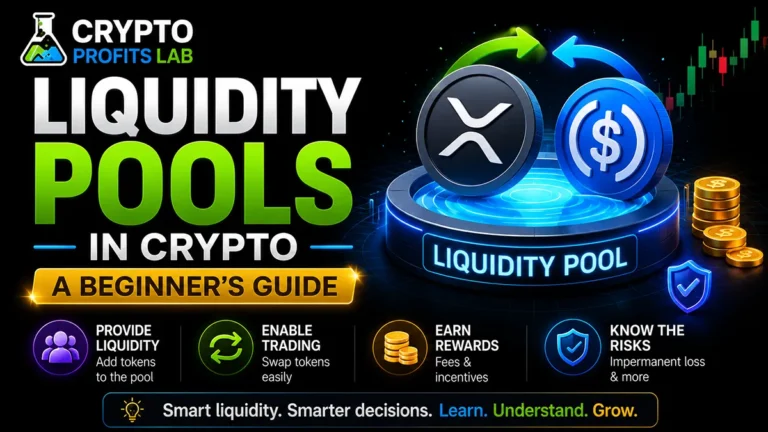
A liquidity pool is a group of crypto assets locked in a smart contract, allowing users to trade. If you need a full beginner’s explanation, read Liquidity Pools in Crypto.
For example, an ETH/USDC pool may hold ETH and USDC. The value of those deposited assets may count toward the protocol’s TVL.
TVL matters for liquidity pools because larger pools can often support smoother trades with less price impact. Smaller pools may have more slippage and higher risk for larger trades.
Read Crypto Slippage if you want to understand how trade prices can change during execution.
TVL in Crypto can help beginners see whether a pool has meaningful deposited value, but it should not replace deeper research.
TVL and Yield Farming
Yield farming is a DeFi strategy in which users earn crypto rewards by depositing assets into protocols.
TVL is often shown on yield farming platforms because users want to know how much money is already in a pool or strategy.
Read What Is Crypto Yield Farming? before trying any yield farm.
A high TVL may show that many users have deposited assets. A low TVL may suggest the farm is new, risky, or less popular.
But there is another important point.
Some yield farms attract TVL by offering high rewards. When rewards drop, users may withdraw quickly. This can make TVL fall.
That is why TVL in Crypto should be compared with reward sustainability, token quality, fees, and platform safety.
TVL and Staking
Staking is another area where users may see TVL-like numbers.
Staking usually means locking or delegating crypto to help support a proof-of-stake blockchain. In return, users may earn rewards.
To learn more, read Crypto Staking and What Is Proof of Stake?.
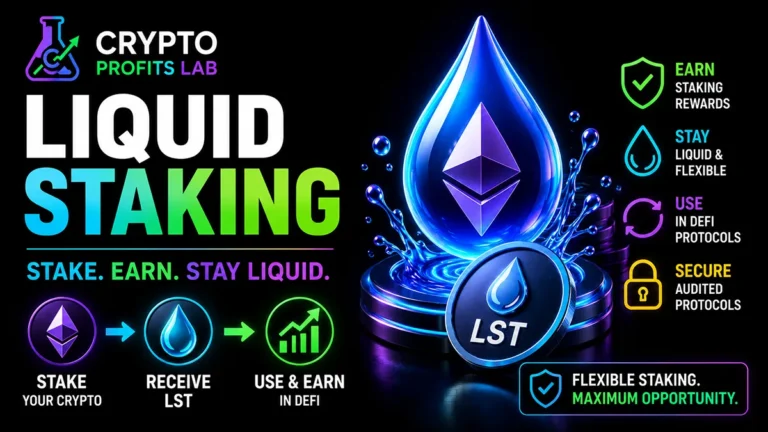
Staking TVL may represent the value of crypto staked in a protocol, validator system, or liquid staking platform.
Beginners should know that staking and liquidity pools are not the same. Staking usually supports network security. Liquidity pools usually support trading.
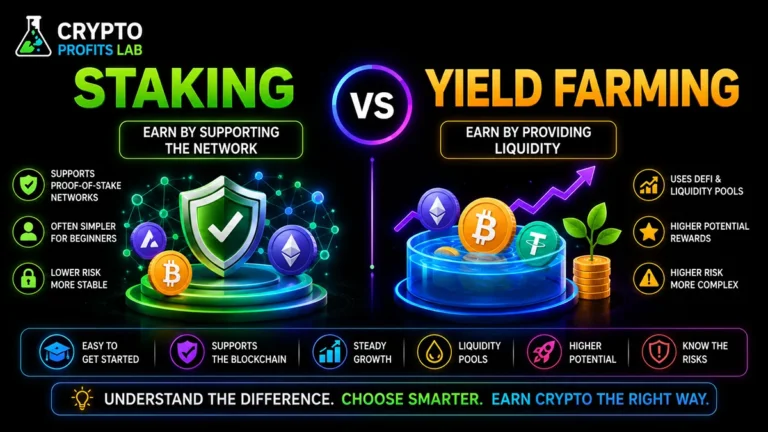
Read Staking vs Yield Farming for a full comparison.
TVL in Crypto helps show how much value is at stake, but it does not eliminate staking risks such as lockups, validator issues, token price drops, or platform risk.
TVL and Crypto Lending
Crypto lending platforms may use TVL to show how much crypto is deposited into the platform.
A lending protocol may allow users to deposit assets for other users to borrow. Depositors may earn rewards or interest, while borrowers pay borrowing costs.
Read What Is Crypto Lending? before using any lending product.
In lending, TVL may help show how much value is available in the system. More deposits may suggest deeper markets and more user activity.
But lending has risks.
Borrowers may fail. Collateral values can fall. Platforms can freeze withdrawals. Smart contracts can fail. A high TVL does not guarantee that lending is safe.
TVL in Crypto should be used with caution when evaluating lending platforms.
TVL and Stablecoins
Stablecoins are crypto assets designed to track the value of another asset, often the U.S. dollar.
Many DeFi protocols use stablecoins because they are easier to price than volatile tokens. Stablecoins often appear in lending markets, liquidity pools, and yield strategies.
Read What Are Stablecoins? before assuming stablecoins are risk-free.
Stablecoin-heavy TVL can look safer because the value may be less volatile than a pool full of small tokens. But stablecoins still have risks.
A stablecoin can lose its peg. A platform can fail. Regulations can change. Smart contracts can have bugs.
TVL in Crypto indicates how much value is deposited, but it does not indicate whether every asset within the protocol is safe.
Why High TVL Can Be Helpful
A higher TVL can sometimes be a positive sign.
It may suggest:
- More users trust the protocol.
- More assets are available for DeFi activity.
- Liquidity may be deeper.
- The protocol may be more established.
- Larger investors may be participating.
- The platform may have more market attention.
For example, a DEX with deeper liquidity may offer better trading conditions than a small pool with low activity.
However, beginners should avoid turning TVL into a shortcut.
High TVL does not guarantee safety, honesty, security, or future returns.
Crypto history includes examples of large platforms and protocols that still failed, were hacked, or lost user confidence.
TVL in Crypto is useful, but it should never replace basic risk checks.
Why Low TVL Can Be Risky
Low TVL may indicate that a protocol is small, new, or lightly used.
This can create risks.
A low-TVL liquidity pool may have high slippage. A small lending protocol may have limited activity. A new yield farm may be untested. A low-TVL token project may be easier to manipulate.
This does not mean every low-TVL project is a scam.
Some legitimate projects start small. But beginners should treat low TVL as a reason to ask more questions.
Low TVL may mean:
- Less liquidity
- More price impact
- Higher slippage
- Less user confidence
- More experimental technology
- Higher chance of sudden withdrawals
- Less public review
TVL in Crypto can help beginners spot when a project may be too small or too risky for their experience level.
Why TVL Can Be Misleading
TVL can be helpful, but it can also mislead beginners.
Here are the main reasons.
Token prices can change
If token prices rise, TVL can rise even without new deposits.
If token prices fall, TVL can drop even if users do not withdraw.
Incentives can inflate TVL
A protocol may offer high rewards to attract deposits.
When the rewards stop, users may leave.
Double counting can happen
In DeFi, assets can move through multiple protocols. Some calculations may count related values in ways that make numbers harder to compare.
TVL does not measure safety
TVL does not tell you whether a smart contract is secure, whether the team is trustworthy, or whether the tokenomics are healthy.
TVL does not show user distribution
A protocol may have high TVL controlled by a small number of large wallets.
For these reasons, TVL in Crypto should always be viewed as one research tool, not a final decision.
TVL vs Market Cap
Beginners often confuse TVL and market cap.
They are different.
Market cap usually means the token price multiplied by the circulating supply. TVL usually means the value deposited into a protocol.
Read Crypto Market Cap for a full beginner’s explanation.
Here is a simple comparison:
| Metric | What It Measures |
|---|---|
| Market cap | Estimated value of a crypto asset based on price and circulating supply |
| TVL | Estimated value deposited into a protocol or DeFi ecosystem |
A token can have a high market cap but low TVL. A protocol can have high TVL even if its token does not perform well.
TVL in Crypto refers to the total value deposited. Market cap is about token valuation.
TVL vs Trading Volume
TVL and trading volume are also different.
Trading volume shows how much buying and selling happens over a period of time.
TVL shows how much value is deposited.
A DEX could have high TVL but low trading volume. That may mean many assets are being deposited, but little trading is happening. Another protocol could have lower TVL but high activity.
Beginners should compare both when possible.
TVL tells you how much value is locked. Volume tells you how much activity is happening.
When researching a DEX or liquidity pool, both numbers can matter.
TVL and Impermanent Loss
Impermanent loss is a risk for liquidity providers.
It can happen when token prices change after you add assets to a liquidity pool. Your pool position may become worth less than simply holding the tokens separately.
Read Impermanent Loss in Crypto before adding liquidity.
TVL in Crypto does not protect you from impermanent loss.
A pool can have high TVL and still expose liquidity providers to price movement risk. A high TVL may help trading conditions, but it does not guarantee that providing liquidity will be profitable.
Beginners should understand impermanent loss before chasing pool rewards.
Common Beginner Mistakes With TVL
TVL can help beginners, but it can also create false confidence.
Mistake 1: Thinking high TVL means safe
High TVL does not guarantee safety.
A protocol can have high deposits and still have smart contract risk, platform risk, or bad incentives.
Mistake 2: Ignoring the assets inside TVL
Not all TVL is equal.
A protocol backed by strong stablecoins may differ from one backed by volatile small tokens.
Mistake 3: Ignoring why TVL is growing
TVL may grow because users trust the platform, but it may also grow because rewards are temporarily high.
Mistake 4: Ignoring TVL drops
A sharp TVL drop can be a warning sign.
It may mean users are withdrawing, token prices are falling, or confidence is weakening.
Mistake 5: Comparing TVL across unrelated projects
A lending protocol, DEX, and staking platform may use TVL differently.
Compare similar projects when possible.
Mistake 6: Using TVL as the only research metric
TVL should be combined with security, tokenomics, liquidity, fees, team history, and risk research.
Safety and Risk Section
TVL in Crypto is not a safety score.
A beginner should never deposit into a protocol only because the TVL is high.
Before using any DeFi protocol, consider these risks:
- Smart contract bugs
- Hacks or exploits
- Scam websites
- Fake tokens
- Bad wallet approvals
- Rug pulls
- Token price crashes
- Stablecoin depegs
- Liquidity problems
- High gas fees
- Withdrawal issues
- Tax complexity
Use these safety habits:
- Use official websites only.
- Never share your seed phrase.
- Avoid unknown wallet approvals.
- Research the protocol history.
- Check whether the platform has been reviewed or audited.
- Understand the assets inside the protocol.
- Be careful with extremely high rewards.
- Start small if testing.
- Keep your main wallet away from risky apps.
- Track deposits, rewards, and fees.
- Learn how withdrawals work before depositing.
For more protection, read Crypto Safety Tips, Crypto Scams to Avoid, and Crypto Rug Pulls.
If you hold larger amounts, learn how a Hardware Wallet can help protect long-term storage.
How Beginners Can Use TVL Step by Step
Here is a beginner-friendly research process.
Step 1: Find the protocol’s TVL
Look for TVL on the protocol website, analytics dashboards, or DeFi tracking tools.
Step 2: Compare similar protocols
Compare lending protocols with lending protocols. Compare DEXs with DEXs. Compare liquidity pools with similar liquidity pools.
Step 3: Check whether TVL is rising or falling
A steady trend may be different from a sudden spike or crash.
Sudden changes deserve extra research.
Step 4: Understand what assets make up TVL
A protocol with mostly stablecoins may have a different risk than one with small volatile tokens.
Step 5: Check rewards and incentives
Ask whether TVL is being attracted by temporary high rewards.
Step 6: Review safety risks
Look at smart contract risk, audits, team history, wallet approvals, and community trust.
Step 7: Decide whether you understand the protocol
If you cannot explain how the protocol works, do not deposit yet.
TVL in Crypto is most useful when combined with patience and common sense.
Should Beginners Trust TVL?
Beginners can use TVL, but they should not blindly trust it.
TVL is an estimate. It can change quickly. It can be influenced by token prices, incentives, deposits, withdrawals, and calculation methods.
A high TVL may be a helpful sign, but it is not a guarantee. A low TVL may be a warning sign, but it is not automatic proof that a project is bad.
The best approach is balanced.
Use TVL as one clue. Then check the platform, assets, risks, fees, rewards, security, and withdrawal rules.
TVL in Crypto is a research tool, not a promise.
Final Thoughts
TVL in Crypto is one of the most useful metrics for beginners to understand DeFi.
It stands for total value locked and shows the estimated value of crypto assets deposited into a protocol, blockchain, liquidity pool, lending platform, or staking system.
TVL can help you see how much value users have committed to a protocol. It can also help you compare similar DeFi platforms.
But TVL is not a safety guarantee.
It can rise because token prices rise. It can fall because users withdraw or markets drop. It can be boosted by temporary rewards. It does not automatically reveal smart contract risks, scams, poor tokenomics, or withdrawal issues.
Crypto Profits Lab is built to make crypto easier for beginners, and TVL is a great example of why simple explanations matter. When you clearly understand TVL, you can research DeFi projects with more confidence and avoid treating a single metric as the whole story.
TVL in Crypto FAQ
What does TVL in Crypto mean?
TVL in Crypto means total value locked. It shows the estimated value of crypto assets deposited into a protocol, blockchain, liquidity pool, lending platform, or staking system. TVL is commonly used in DeFi to measure how much value users have committed. It is helpful, but it does not guarantee safety or profit.
Why is TVL important in DeFi?
TVL is important in DeFi because many DeFi platforms depend on deposited assets to function. Lending apps, liquidity pools, yield farms, and decentralized exchanges all need user funds. A higher TVL may indicate greater usage or deeper liquidity, but beginners should still assess security, token quality, fees, and platform risk.
Is high TVL always good?
High TVL can be a positive sign, as it may indicate greater deposited value and user activity. However, it is not always good or safe. TVL can be inflated by temporary rewards, rising token prices, or large deposits from a few wallets. Beginners should use TVL with other research, not alone.
Can TVL in Crypto go down?
Yes, TVL in Crypto can go down when users withdraw funds, token prices fall, rewards become less attractive, or confidence in a protocol weakens. A falling TVL is not always a disaster, but a sharp drop should make beginners research carefully before depositing funds or using the platform.
What is the difference between TVL and market cap?
TVL measures the value deposited into a protocol or DeFi ecosystem. Market cap measures the estimated value of a crypto asset based on token price and circulating supply. A project can have a high market cap but low TVL, or high TVL even if its token price performs poorly.
Does TVL prove a crypto project is safe?
No, TVL does not prove that a crypto project is safe. A protocol can have high TVL and still face smart contract bugs, hacks, token crashes, scams, or withdrawal problems. TVL is only one research metric. Beginners should also check audits, platform history, liquidity, fees, and wallet safety.
How is TVL calculated?
TVL is usually calculated by adding the estimated dollar value of crypto assets deposited into a protocol or smart contract. For example, if users deposit ETH, stablecoins, and other tokens, those assets are priced and added together. Exact calculations can differ between platforms, so TVL should be treated as an estimate.
Is TVL useful for liquidity pools?
Yes, TVL can be useful for liquidity pools because it helps show how much value is deposited in the pool. Higher TVL may support smoother trading and lower price impact. However, liquidity providers still face risks such as impermanent loss, token price changes, gas fees, and smart contract problems.
Should beginners use TVL before yield farming?
Yes, beginners should look at TVL before yield farming, but they should not rely on it alone. A yield farm with very low TVL may be riskier, while high TVL does not guarantee safety. Beginners should also check rewards, token quality, fees, impermanent loss, platform history, and wallet risks.
What is the best rule for TVL in Crypto?
The best rule for TVL in Crypto is to treat it as one research clue, not a safety guarantee. TVL can help you understand how much value has been deposited, but it cannot prove that a project is safe. Always combine TVL with research into risks, fees, security, assets, and withdrawal rules.