Crypto Fork Explained: Hard Forks and Soft Forks
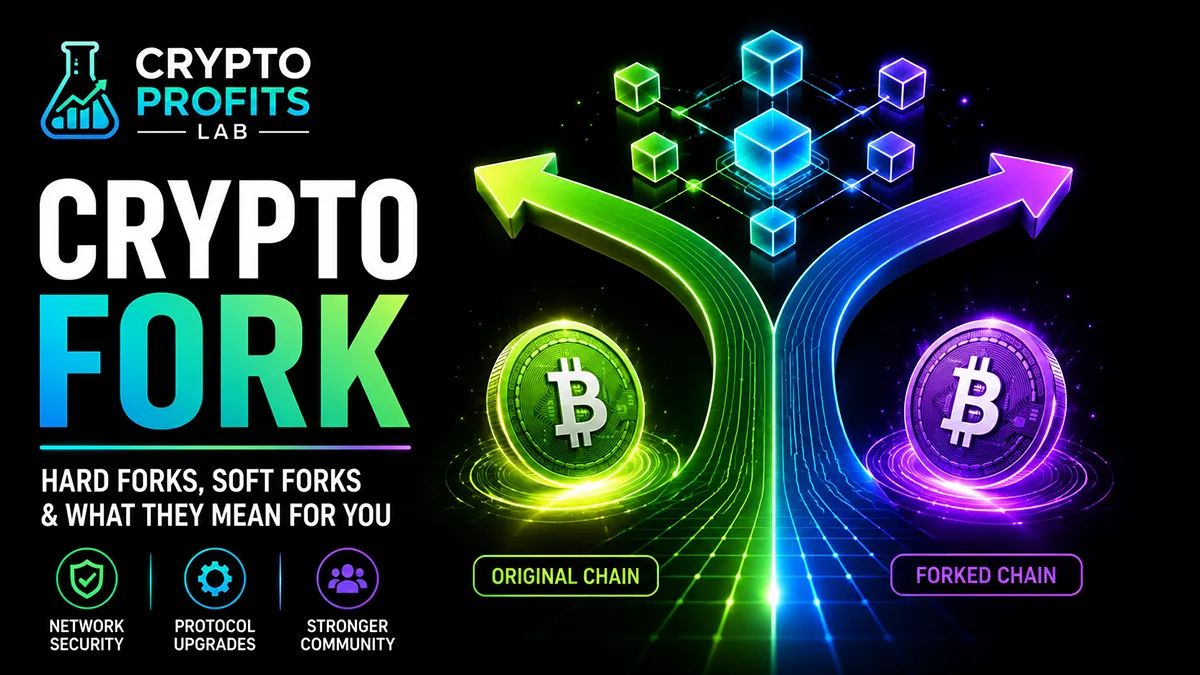
A blockchain can change over time. Developers may fix bugs, add features, improve security, or update the rules used to confirm transactions. When those shared rules change, the event may be called a crypto fork.
A blockchain follows a common set of software rules. If those rules change, everyone using the network must decide whether to follow the new version, remain with the old version, or support both.
This guide explains how a crypto fork works, why forks happen, and what a fork may mean for your wallet, exchange account, and coins.
Crypto Fork Quick Answer
A crypto fork is a change to the rules of a blockchain network. These rules tell computers how to verify transactions, create blocks, and agree on the valid version of the blockchain.
Some forks are planned upgrades that nearly everyone accepts. Other forks happen because a community disagrees about how the blockchain should operate. If groups follow incompatible rules and both groups continue, one blockchain can divide into two separate networks.
Not every fork creates a new coin. Many simply upgrade an existing network. A permanent hard fork, however, can produce a new blockchain and a separate cryptocurrency.
Key Takeaways
- A crypto fork changes the operating rules of a blockchain.
- A hard fork can create two separate blockchains when participants follow incompatible rules.
- A soft fork introduces stricter rules that can remain compatible with older software.
- Not every fork creates a new cryptocurrency.
- Exchanges may pause deposits and withdrawals during a major network change.
- Forked coins are not guaranteed to have value.
- Never share a seed phrase or private key to claim a forked asset.
- Waiting for official wallet and exchange guidance is usually safer than acting quickly.
Crypto Fork Facts for Beginners
| Question | Simple Answer |
|---|---|
| What changes during a fork? | The software rules that determine which transactions and blocks are valid. |
| Does every fork create a new coin? | No. Many forks are routine upgrades that keep one main blockchain. |
| What is a hard fork? | A rule change that older software may not accept. |
| What is a soft fork? | A stricter rule change designed to remain compatible with older software. |
| Can a blockchain split temporarily? | Yes. Competing blocks can briefly create different branches. |
| Can a fork affect my wallet? | It may affect wallet support, deposits, withdrawals, and transaction safety. |
| Are forked coins automatically valuable? | No. Value depends on demand, security, development, and exchange support. |
How a Blockchain Works Before a Fork
To understand a crypto fork, it helps to understand the basic role of a blockchain.
A blockchain is a shared digital record. Transactions are grouped into blocks, and those blocks are connected in order. Many computers store and verify the same history rather than relying on one company to maintain a central database.
Our beginner’s guide to blockchain technology explains this process in more detail.
The computers that store, check, and share blockchain data are called nodes. Nodes run software that contains the network’s rules. Those rules may explain:
- What makes a transaction valid
- How large a block may be
- How new coins are created
- How miners or validators approve blocks
- Which version of the blockchain should be accepted
You can learn more in our guide to crypto nodes.
For the network to operate smoothly, participants need compatible rules. A crypto fork happens when those rules are updated or when different groups begin following different versions.
Why Do Crypto Forks Happen?
A fork does not always mean a blockchain is failing. It is often how an open-source network updates its software.
Fixing a Bug or Security Weakness
Developers may discover a flaw affecting transactions, wallets, smart contracts, or network stability. Updated rules can prevent the flaw from being used.
Adding New Features
A blockchain may need new capabilities as its users and applications grow. A fork can introduce new transaction types, smart-contract features, privacy tools, or developer functions.
Ethereum has completed many coordinated network upgrades. Our guide to what Ethereum is explains why the network supports smart contracts and decentralized applications.
Improving Speed or Capacity
Some blockchains experience congestion when too many people try to use them at once. Developers may propose changes that help the network process more activity or use block space more efficiently.
A crypto fork may be part of that solution, but a rule change alone does not guarantee faster or cheaper transactions. The result depends on the design, adoption, security, and demand.
Changing Consensus Rules
Consensus is the method a blockchain uses to agree on valid transactions and blocks. A fork may adjust how miners or validators participate, how rewards are distributed, or what conditions must be met before a block is accepted.
Our guide to proof of stake explains one common consensus method in simple terms.
Resolving a Community Disagreement
Developers, miners, validators, businesses, and users may disagree on block size, fees, governance, monetary policy, or the project’s future direction.
If both sides refuse to accept the same rules, a crypto fork can divide the network. Each side may continue with its own blockchain, software, community, and coin.
Hard Fork vs. Soft Fork
The two main types of blockchain forks are hard forks and soft forks.
| Feature | Hard Fork | Soft Fork |
|---|---|---|
| Compatibility | Older software may reject the new rules | Older software may still accept blocks under the stricter rules |
| Upgrade need | Participants usually update to follow the new chain | Some older nodes may continue operating |
| Permanent split possible? | Yes | Less likely |
| New coin possible? | Yes, if both chains continue | Usually no |
| Common use | Major upgrades or disputed changes | Narrower, backward-compatible changes |
For a technical explanation of Bitcoin chain splits and consensus rules, see the Bitcoin Developer Guide.
What Is a Hard Fork?
A hard fork changes the network rules in a way that older software may not accept.
Updated nodes may begin accepting a new block type, while nodes using the older rules reject that block as invalid. The two groups are no longer fully compatible.
If nearly everyone upgrades, the old chain may quickly lose activity. The network then continues mainly under the updated rules, and no important second coin may remain.
If a large group continues to use the old rules while another group follows the new rules, the blockchain can split permanently. Both chains share the same history up to the split, but they record different transactions afterward.
This is why a hard crypto fork can create a separate cryptocurrency, but it does not always do so.
What Is a Soft Fork?
A soft fork introduces stricter rules while keeping a form of backward compatibility.
Suppose older software accepts blocks up to a certain size. Updated software may enforce a smaller limit. Blocks that follow the smaller limit can still fit within the old rules, even though the updated nodes are more restrictive.
A soft fork usually aims to preserve a single blockchain and a single coin. It still requires planning, testing, communication, and enough support from network participants.
A Simple Analogy
Imagine a road allowing vehicles up to 10 feet tall. A soft fork lowers the limit to 9 feet, so vehicles meeting the new limit also meet the old one.
A hard fork changes the rules to require a new electronic pass. Drivers using old and new passes may no longer be able to follow the same route. This illustrates why one change can remain compatible while another may create a lasting split.
How a Crypto Fork Happens Step by Step
Every network handles upgrades differently, but the process often follows a similar pattern.
Step 1: Someone Proposes a Change
Developers or community members identify a problem or improvement. They publish a proposal explaining what should change and why.
Step 2: The Proposal Is Reviewed
Developers, node operators, miners, validators, wallets, and exchanges review the technical effects and prepare for the possible change.
Step 3: Developers Build and Test the Software
The new rules are added to the updated software and tested before real funds are affected. Some projects use test networks, called testnets, for this purpose.
Step 4: An Activation Point Is Selected
The new rules may activate at a specific date, time, block height, or network condition. A block height is the number assigned to a block based on its place in the chain.
Step 5: Participants Choose Whether to Upgrade
Node operators, miners, validators, exchanges, and wallet providers install the new software if they support the change.
Step 6: The Rules Activate
Updated software begins enforcing the new rules. Older software continues to follow the previous rules.
If both versions still accept the same valid chain, the network remains together. If they reject one another’s blocks, the blockchain can divide.
Step 7: The Network Stabilizes
Participants watch block production, transactions, node participation, and exchange operations.
A planned crypto fork may complete smoothly. A disputed fork may take longer because the market must determine whether both chains have enough users, infrastructure, and security to continue.
Temporary Forks and Permanent Forks
Not every fork is a major software upgrade.
A blockchain can briefly split into two branches when miners or validators produce competing blocks at nearly the same time. The network’s consensus rules determine which branch becomes accepted.
The less-supported branch is eventually abandoned. Transactions from that branch may return to the pending transaction pool and later appear in another block.
This is one reason crypto confirmations matter. More confirmations generally mean that more blocks have been added after a transaction, reducing the chance that a short reorganization will affect it.
A permanent crypto fork is different. It happens when groups intentionally continue following incompatible rules, and both chains remain active.
Does a Fork Create Free Coins?
A permanent hard fork can sometimes give eligible holders access to assets on both chains.
Because the chains share the same history before the split, wallet addresses and balances may also be copied. If you controlled coins before the fork, a matching balance may exist on each chain afterward.
That does not guarantee profit. The new asset may have little demand, weak security, few developers, limited wallet support, low trading volume, or no major exchange support.
The market decides whether the new coin has value. Taxes may also apply, so keep accurate records.
What Happens to Your Crypto Wallet?
A crypto wallet does not hold coins like a physical wallet holds cash. It manages the private keys that allow you to control assets recorded on a blockchain.
If two chains share the same history before a split, the same private key may initially control corresponding balances on both chains.
Wallet Support Risk
Your current wallet may support only one chain. You may need updated software or a different wallet to view or move assets on the other chain.
Private Key Risk
A website may claim it can help you collect forked coins by entering your seed phrase or private key. This is extremely dangerous.
Anyone who gets that information may be able to steal the original coins and any other assets controlled by the wallet.
Read our guide to a crypto private key to understand why this information must remain secret.
Replay Risk
In some forks, a transaction made on one chain may also be valid on the other. This is called replay risk.
A transfer intended for one network could be repeated on the second network unless the fork includes replay protection or the coins have been safely separated.
Beginners should wait for clear instructions from trusted wallet providers and the official project team.
How Crypto Exchanges Handle Forks
Exchanges often pause deposits and withdrawals before a major fork. They may need time to:
- Update node software
- Decide which chain to support
- Protect customer balances
- Check for replay risks
- Monitor network stability
- Set new confirmation requirements
An exchange may support the updated chain, the original chain, both forked assets, or neither forked asset.
If your coins are held on an exchange, the exchange controls the private keys. Its policy determines whether users receive access to a new asset.
Our guide to a crypto exchange explains how centralized trading platforms hold and transfer cryptocurrency.
Always read the exchange’s official announcement. Do not rely only on screenshots, influencer posts, or messages in unofficial groups.
Real-World Examples
Bitcoin and Bitcoin Cash
Bitcoin Cash separated from Bitcoin in 2017 after a disagreement about transaction capacity and block-size rules.
Supporters of Bitcoin Cash adopted different rules, and both networks continued. They share the same history before the split but have separate transactions, communities, prices, and development afterward.
This event is a well-known example of a permanent hard crypto fork.
Read what Bitcoin is for a beginner-friendly explanation of the original network.
Ethereum and Ethereum Classic
Ethereum experienced a major community decision after the DAO incident in 2016.
One chain adopted a change connected to the incident. Another group continued with the earlier history, and that network became Ethereum Classic.
Planned Network Upgrades
Many blockchain upgrades are technically described as hard forks, even when the community strongly supports the change.
In these cases, nearly everyone installs the new software, the older version loses support, and no important competing coin develops.
The term “hard fork” describes software compatibility. It does not automatically mean there is a hostile split.
Common Beginner Mistakes
Assuming Every Fork Creates a Valuable Coin
A new asset needs users, developers, security, wallets, exchanges, and demand. Many forked coins lose value quickly.
Sharing a Seed Phrase to Claim Coins
A seed phrase is the master backup to a wallet. No legitimate support agent needs it. Never type it into an unfamiliar website.
Downloading Unknown Wallet Software
New fork-related wallet apps may contain malware. Use official sources and wait for independent security reviews.
Sending Funds While Services Are Paused
Deposits and withdrawals may be unavailable during an upgrade. Sending funds to an unsupported network can cause delays or permanent loss.
Confusing a Fork With an Airdrop
An airdrop distributes tokens according to rules chosen by a project. A fork changes the rules of a blockchain and may create a separate chain.
Buying Only Because a Fork Is Announced
Prices can rise before a publicized event and fall immediately afterward. A fork announcement does not guarantee profit.
Safety and Risk Checklist
A crypto fork can create legitimate improvements, but it can also attract scams and confusion.
- Verify the announcement through the official project website and developer channels.
- Check your wallet provider’s official support page.
- Read your exchange’s fork policy.
- Never share your seed phrase or private key.
- Avoid links sent through unsolicited messages.
- Confirm the exact network before sending funds.
- Check whether deposits and withdrawals are open.
- Learn whether replay protection exists.
- Wait until the network is stable.
- Test with a small amount before transferring a large balance.
- Keep transaction and tax records.
- Be skeptical of guaranteed-profit claims.
Our guide to crypto scams to avoid explains common tricks used against beginners.
Main Risks of a Crypto Fork
Technical Risk
New software may contain bugs. Wallets, exchanges, nodes, and blockchain explorers may need time to operate correctly.
Security Risk
A newly created chain may have fewer miners or validators than the original network. Lower participation can make attacks easier.
Replay Risk
A transaction intended for one chain may be copied to the other chain if both networks use similar transaction rules and lack adequate protection.
Liquidity and Volatility Risk
A forked coin may have few buyers and sellers. The displayed price may not represent what you could receive when selling, and prices may change sharply before and after the event.
Scam Risk
Fake claim sites, counterfeit wallets, phishing emails, and impersonated support accounts often appear around well-publicized forks.
Governance Risk
A divided community may struggle to maintain developers, users, validators, miners, and funding. One or both chains may weaken over time.
How to Evaluate a Forked Coin
Ask these questions before treating a forked asset as a serious investment:
- Does the project have active developers?
- Is the source code public and regularly updated?
- Do reputable wallets support the network?
- Do established exchanges support deposits and withdrawals?
- Is there enough participation from miners or validators?
- Does the chain solve a clear problem?
- Is there real user activity?
- Is replay protection available?
- Are the supply rules clearly explained?
- Is the project supported by more than price speculation?
A crypto fork can create a working network, but a new chain is not automatically useful, secure, or valuable.
Should You Do Anything Before a Fork?
Many ordinary holders do not need to act. Confirm that your wallet or exchange supports the upgrade, avoid transfers near activation, keep a secure wallet backup, and ignore unsolicited offers to claim coins.
After the event, wait until the network is stable and deposits or withdrawals have reopened. Use official wallet software, test transfers with a small amount, and keep records of any asset you receive.
A crypto fork can be confusing, but rushing is rarely necessary.
Final Thoughts
A crypto fork is a change to the operating rules of a blockchain. It may fix a security problem, add features, improve performance, adjust consensus rules, or reflect a disagreement over the network’s future.
A hard fork can divide participants using incompatible software and may create two continuing blockchains. A soft fork introduces stricter rules designed to remain compatible with older software and usually keeps one main chain.
The most important beginner lesson is not how quickly to claim a possible new coin. It is about verifying information, protecting private keys, understanding wallet and exchange policies, and waiting until the network is stable.
Crypto Profits Lab focuses on clear, practical education without unnecessary hype. Learning how forks work can help you understand blockchain upgrades while avoiding common scams and costly mistakes.
Crypto Fork Frequently Asked Questions
What is a crypto fork in simple terms?
A crypto fork is a change to the software rules used by a blockchain. Those rules determine how transactions and blocks are verified. If most participants adopt the new rules, the network may continue as one blockchain. If groups follow incompatible rules and both remain active, the original blockchain can divide into two separate networks.
What is the difference between a hard fork and a soft fork?
A hard fork changes blockchain rules in a way that older software may reject, so a permanent chain split is possible. A soft fork introduces stricter rules that older software may still recognize as valid. Both require planning and community support, but a hard fork is more likely to create separate networks when participants do not upgrade together.
Does every crypto fork create a new coin?
No. Many forks are coordinated software upgrades, and almost everyone moves to the updated rules. In that situation, only one main chain continues. A separate coin usually appears only when two groups maintain different blockchains after a hard fork, and both networks gain enough technical and market support to remain active.
Can I receive free coins after a hard fork?
You may have a matching balance on both chains if you controlled eligible coins before a permanent split. However, the new asset may have little value, limited wallet support, or no exchange market. Access also depends on custody and replay protection. Never reveal your seed phrase or private key to claim forked coins.
Is a crypto fork dangerous?
The event itself is not automatically dangerous, but it can create temporary technical and security risks. Exchanges may pause transfers, wallets may need updates, and replay attacks may be possible. Scammers also create fake claim websites and wallet apps. Waiting for official instructions and using small test transactions can reduce avoidable risk.
Why do exchanges pause deposits during a fork?
Exchanges pause deposits and withdrawals to update software, identify the supported chain, protect customer balances, and monitor network stability. They may also need to prevent replay problems and set new confirmation requirements. Users should wait until the exchange confirms that transfers are open for the exact coin and network involved.
Can Bitcoin or Ethereum fork again?
Yes. Any actively developed blockchain can change its rules through a future upgrade. Whether the change creates a lasting second chain depends on software compatibility and community adoption. A future fork does not automatically create a valuable new coin, and ordinary holders may not need to take any action.
How should a beginner prepare for a crypto fork?
Verify the event through official project, wallet, and exchange sources. Back up your wallet securely, avoid unfamiliar claim sites, and never share private keys. Check whether deposits and withdrawals will pause and whether replay protection exists. Unless you must transact, waiting until the network and major services stabilize is often the safest approach.