What Is FDV in Crypto? Fully Diluted Valuation Explained
If you have ever looked up a cryptocurrency on a price-tracking website, you may have noticed two large numbers near each other: market cap and FDV. Sometimes they are fairly close. Other times, FDV is several times larger than the current market cap.
For a beginner, that difference can be confusing.
FDV in crypto stands for fully diluted valuation. It is a way to estimate what a cryptocurrency project would be worth at today’s token price if a broader supply figure—often total supply or maximum supply—were included in the calculation.
The number is theoretical. It does not predict what a project will actually be worth in the future. However, understanding FDV in crypto can help you notice when a large amount of token supply has not yet entered circulation.
That makes FDV especially useful when researching newer tokens with vesting schedules, investor allocations, staking rewards, or future token unlocks.
Quick Answer: What Is FDV in Crypto?
FDV in crypto is short for fully diluted valuation. It estimates a cryptocurrency project’s valuation using the current token price and a broader supply figure than the one used for the current market cap.
A simple version of the formula is:
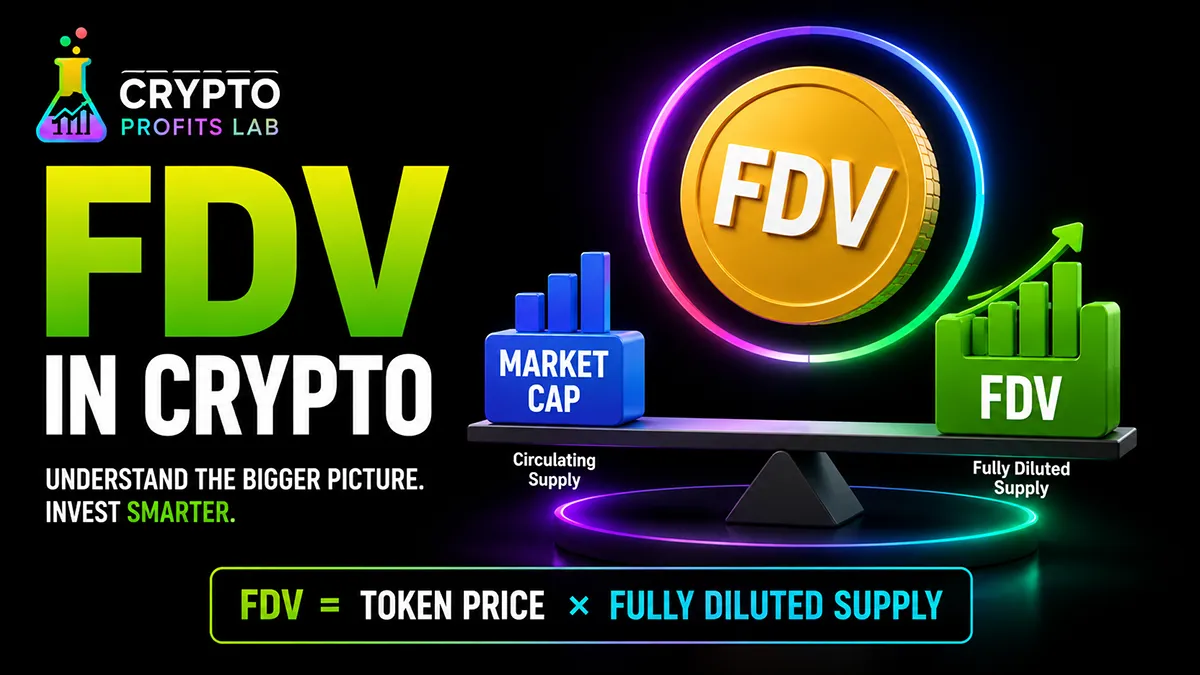
FDV = Current Token Price × Fully Diluted Supply
Depending on the cryptocurrency and the data provider, the supply figure may be based on total supply or maximum supply.
For example, imagine a token costs $2, and its fully diluted supply is 1 billion tokens. Its FDV would be about $2 billion.
If only 100 million tokens are currently circulating, its current market cap would be about $200 million.
That difference tells you something important: a substantial amount of supply is not yet reflected in the circulating market cap.
It does not mean the token will fall in price. It means you should investigate where the remaining tokens are, when they may become available, and who may receive them.
Key Takeaways
- FDV means fully diluted valuation.
- FDV in crypto uses the current token price and a broader supply figure to estimate a theoretical valuation.
- Market cap usually uses circulating supply, while FDV looks at a fuller potential supply.
- A large gap between market cap and FDV can signal that many tokens are still locked, reserved, or not yet circulating.
- Future supply can enter the market through token unlocks, vesting, rewards, emissions, or minting.
- A high FDV does not automatically mean a project is bad.
- A low FDV does not automatically mean a project is undervalued.
- FDV is most useful when combined with market cap, circulating supply, tokenomics, unlock schedules, liquidity, and demand.
FDV in Crypto: Beginner Facts
| Term | Beginner-Friendly Meaning |
|---|---|
| FDV | Fully diluted valuation |
| Market cap | Current price multiplied by circulating supply |
| Circulating supply | Coins or tokens currently considered available to the public |
| Total supply | Tokens that currently exist, generally excluding permanently burned units |
| Maximum supply | The highest number of units that can ever exist if a hard cap applies |
| Token unlock | Release of previously restricted tokens |
| Vesting | A schedule controlling when allocated tokens become available |
| Dilution | An increase in available supply that can reduce each existing token’s share of the broader supply |
Why FDV in Crypto Matters
The easiest way to understand FDV in crypto is to compare it with current market capitalization.
Market cap tells you about the valuation based on tokens circulating today. FDV gives you a theoretical look at a broader supply.
Suppose a fictional token called BrightCoin trades for $1. It has 100 million tokens in circulation but a maximum supply of 1 billion.
Its market cap is:
$1 × 100 million = $100 million
Its fully diluted valuation, using the 1 billion supply figure, would be:
$1 × 1 billion = $1 billion
The project therefore has a $100 million market cap but a $1 billion FDV.
That gap does not tell you whether BrightCoin is a good or bad investment. It does tell you that only a fraction of the broader supply is currently represented in the market cap.
Before going further, it helps to understand circulating supply in crypto and market cap in crypto. Those concepts form the foundation for understanding FDV.
How Is FDV in Crypto Calculated?
The basic calculation is simple:
Fully Diluted Valuation = Current Token Price × Fully Diluted Supply
However, the phrase “fully diluted supply” needs some explanation.
Different market-data providers may use total supply, maximum supply, or another verified supply figure depending on how a cryptocurrency is designed. Some cryptocurrencies have a hard maximum supply. Others do not.
This is why it is important to understand what supply figure a data provider is using instead of treating FDV as a perfect future valuation.
CoinGecko explains the calculation and its relationship with token supply in its guide to fully diluted valuation.
The key beginner lesson is simple: FDV in crypto is a hypothetical calculation based on today’s price. It is not a promise about tomorrow’s value.
A Simple FDV Example
Imagine a token has these numbers:
- Current price: $0.50
- Circulating supply: 200 million
- Fully diluted supply: 1 billion
The current market cap would be:
$0.50 × 200 million = $100 million
The FDV would be:
$0.50 × 1 billion = $500 million
In this example, the FDV is five times the current market cap.
That means a large portion of the broader token supply is not currently circulating.
If the remaining tokens are released gradually over ten years, the situation may be very different from a project releasing most of them over the next six months.
This is why FDV in crypto becomes much more useful when you combine it with the project’s token release schedule.
FDV vs. Market Cap: What Is the Difference?
Market cap and FDV answer different questions.
Market cap asks:
“What is the approximate value of the tokens currently in circulation at today’s price?”
FDV asks:
“What would the project’s valuation look like at today’s price if the fuller supply figure were used?”
| Metric | Market Cap | FDV |
|---|---|---|
| Uses current token price | Yes | Yes |
| Uses circulating supply | Yes | Usually no |
| Uses broader supply | No | Yes |
| Reflects current circulating valuation | More closely | No |
| Highlights future supply gap | Limited | Yes |
| Predicts future price | No | No |
The biggest mistake is treating fully diluted valuation as a forecast.
If a token has a $10 billion FDV today, that does not mean its market cap will eventually become $10 billion. The token price can change dramatically before additional supply enters circulation.
Why Can FDV Be Much Higher Than Market Cap?
A large FDV-to-market-cap gap usually means a relatively small portion of the broader token supply is currently circulating.
Tokens may be:
- Locked for founders or team members
- Allocated to early investors
- Reserved for a project treasury
- Scheduled for ecosystem incentives
- Set aside for staking or validator rewards
- Subject to vesting schedules
- Reserved for future development
- Not yet created or distributed
None of these situations is automatically negative.
The important question is what happens next.
A transparent project should make it reasonably possible to understand its supply structure. Our guide to tokenomics explains how supply, distribution, utility, and incentives fit together.
What Does “Low Float, High FDV” Mean?
You may hear the phrase “low float, high FDV.”
“Float” informally refers to the portion of tokens available in the market. A low-float token has a relatively small amount of its broader supply circulating.
Imagine only 5% of a token’s maximum supply is circulating. Strong early demand for that small available supply could support a relatively high token price. When that price is multiplied by the much larger supply figure, the resulting FDV can become very large.
FDV in crypto is useful here because it reminds beginners to look beyond the token price and current market cap.
A low-float, high-FDV structure does not guarantee a price decline. It does mean future supply deserves careful attention.
Does a High FDV Mean a Crypto Is Overvalued?
Not necessarily.
A high FDV in crypto is a reason to investigate further, not an automatic sell signal.
A large project with meaningful use, strong demand, sustainable economics, and a long token release schedule may support a much larger valuation than a small project with weak demand.
Instead of asking only, “Is the FDV high?” ask:
- How does FDV compare with market cap?
- How quickly will additional supply enter circulation?
- Who receives those tokens?
- Is real demand growing?
- How liquid is the market?
- Does the token have a useful role?
- Are the tokenomics understandable and transparent?
Those questions provide context that the FDV number cannot provide by itself.
Does a Low FDV Mean a Crypto Is Undervalued?
No.
A low fully diluted valuation does not prove that a token is cheap or that its price will rise.
A smaller project may have a low FDV because demand is limited, liquidity is weak, adoption is low, or investors see significant risk.
FDV in crypto works best as a research tool. It can show you where more investigation may be useful, but it cannot tell you what to buy.
How Token Unlocks Affect FDV
A token unlock makes previously restricted tokens transferable according to a project’s release rules.
The FDV calculation may not suddenly rise just because an unlock occurs. If those locked tokens were already included in the supply figure used for FDV, they were already part of the theoretical valuation.
What can change is circulating supply.
As locked tokens become available, the gap between current market cap and fully diluted valuation may narrow if other factors remain similar.
The market effect depends on what recipients do with the tokens. They may hold, stake, use, or sell them.
That is why our guide to token unlocks in crypto is an important companion to FDV research.
How Vesting Connects to FDV in Crypto
Vesting controls when allocated tokens become available.
For example, a development team might receive an allocation that unlocks gradually over four years instead of receiving every token on the first day.
Those tokens can still matter when evaluating FDV even while they are locked.
A slow vesting schedule can make a large FDV gap less immediate than a schedule with large near-term releases. However, vesting itself does not remove risk.
Beginners should look at the size of allocations, release dates, and who controls the tokens. Read our guide to crypto vesting for a simple explanation of how these schedules work.
How Token Burns Can Affect FDV
Some crypto projects permanently remove tokens from usable supply through token burns.
A burn can reduce the supply figure used in valuation calculations if the burned tokens are permanently excluded. That means fully diluted valuation can change even if the token price stays the same.
However, burns should not be viewed as guaranteed price boosters.
A project could burn tokens while demand is falling. Another project could have no burn mechanism while its usage is growing.
Our crypto burn guide explains why reducing supply and increasing value are not the same thing.
Step by Step: How Beginners Can Use FDV in Crypto
You do not need advanced financial training to make FDV useful. Use this simple process.
Step 1: Check the Current Market Cap
Start with the market cap. This tells you the approximate valuation based on circulating supply and the current token price.
Step 2: Check the FDV
Next, find the fully diluted valuation. Do not judge it yet. Just compare it with the market cap.
Step 3: Compare the Two Numbers
If FDV and market cap are close, a large percentage of the broader supply may already be circulating.
If FDV is several times higher, more investigation is useful.
For example:
- Market cap: $500 million
- FDV: $550 million
That is a relatively small gap.
Now compare:
- Market cap: $500 million
- FDV: $5 billion
That is a much larger gap.
Step 4: Check the Circulating Supply
Look at how much of the total or maximum supply is currently circulating.
Our circulating supply in crypto guide explains how to interpret this number without confusing it with total or maximum supply.
Step 5: Find the Unlock and Vesting Schedule
Determine when non-circulating tokens may become available.
Pay particular attention to large releases scheduled in the near future.
Step 6: See Who Receives the Tokens
Tokens released as network rewards can create different incentives from tokens unlocking for early investors, founders, or insiders.
Distribution matters.
Step 7: Check Liquidity and Demand
A token may have an impressive valuation but limited ability to absorb large amounts of selling.
Our guide to crypto liquidity explains why available buyers and sellers matter.
Step 8: Read the Project Documentation
Look for supply schedules, allocation tables, and release details in the project’s official documentation.
Our crypto whitepaper guide explains what beginners should look for when reading project documents.
Step 9: Treat FDV as One Data Point
Finally, do not let a single metric make the decision for you.
Combine valuation with utility, adoption, security, distribution, liquidity, competition, and project transparency.
That is the safest way to use FDV in crypto as a beginner.
Common Beginner Mistakes With FDV
Mistake 1: Treating FDV as a Future Market Cap
FDV is not a forecast. It uses today’s token price in a hypothetical supply calculation. The price can change long before the full supply becomes available.
Mistake 2: Ignoring the Unlock Timeline
Two projects can have the same market-cap-to-FDV gap but very different supply schedules. One may release tokens over ten years while another has major unlocks within months.
Mistake 3: Assuming High FDV Is Always Bad
A high number needs context. Demand, usage, release schedules, liquidity, and project maturity all matter.
Mistake 4: Assuming Low FDV Is Always Good
Small valuations can reflect weak demand or significant project risk. “Low” does not automatically mean undervalued.
Mistake 5: Comparing Unrelated Projects Only by FDV
A blockchain network, DeFi protocol, meme token, and infrastructure project can have very different economics. Compare similar projects when possible.
Mistake 6: Ignoring Supply Definitions
Check whether the data provider uses total supply, maximum supply, or another supply figure. The calculation is only as useful as its inputs.
Mistake 7: Forgetting That FDV Changes With Price
FDV moves when token price moves. It is not a fixed number permanently attached to the project.
Risk and Safety: What FDV Cannot Tell You
FDV in crypto cannot tell you whether a project is legitimate, secure, profitable, or likely to succeed.
It cannot detect a malicious smart contract, protect your wallet, guarantee demand, or tell you whether future token recipients will sell.
For those questions, broader research is necessary.
Beginners should learn basic crypto safety tips and common crypto scams to avoid before risking money on unfamiliar tokens.
Be especially careful when a project uses an attractive low token price to suggest that enormous gains are easy. Token price by itself says very little about valuation.
FDV in crypto helps put those price claims into a larger supply context, but it still cannot remove investment risk.
FDV in Crypto and Token Price Targets
Beginners sometimes make price predictions by asking whether a token can reach $1, $10, $100, or even $1,000.
FDV can help test what those prices would imply for the project’s broader valuation.
Suppose a token has a maximum supply of 10 billion units.
At $1 per token, its fully diluted valuation would be $10 billion.
At $10, it would be $100 billion.
At $100, it would be $1 trillion.
That does not prove any particular price is impossible. It simply translates a token-price target into a much larger valuation so you can compare the idea with other projects and market conditions.
Using FDV in crypto this way is more informative than saying, “The token is only 20 cents, so $100 should be easy.”
FDV, Supply, and Tokenomics Work Together
FDV should not be studied by itself.
Supply tells you how many tokens exist or may exist.
Circulating supply tells you how many are currently considered available to the public.
Market cap puts a value on the circulating portion.
FDV applies today’s price to a broader supply figure.
Tokenomics explains why the tokens exist, how they are allocated, how new supply enters the system, and what incentives influence users.
When you understand all of these pieces, crypto valuation starts to feel much less mysterious.
That is the approach Crypto Profits Lab is built around: explaining one concept at a time in plain language so beginners can understand what the numbers actually mean.
Final Thoughts
FDV in crypto is a simple calculation with an important purpose.
It helps you look beyond today’s circulating market cap and notice how much additional token supply may exist outside the current market.
The metric is especially useful when a project has a small circulating supply, large insider allocations, long vesting schedules, or major future token unlocks.
But FDV is not a price prediction, quality score, or automatic warning.
Use it as one part of a larger research process.
Check market cap. Check circulating supply. Study tokenomics. Look at unlock schedules. Understand who receives future tokens. Consider liquidity and demand.
Once you do that, FDV in crypto becomes much more useful than a large number sitting on a crypto tracking page.
FDV in Crypto Frequently Asked Questions
What does FDV mean in crypto?
FDV means fully diluted valuation. It estimates a cryptocurrency project’s valuation by multiplying the current token price by a broader supply figure, often total or maximum supply depending on the asset and data provider. The result is theoretical because the token price could change substantially before all potential tokens become available. FDV is best used alongside market cap, circulating supply, tokenomics, and unlock schedules.
Is FDV the same as market cap?
No. Market cap usually multiplies the current token price by circulating supply, while FDV applies the current price to a broader supply figure. Market cap therefore gives a closer picture of the valuation represented by tokens currently circulating. FDV highlights what the valuation would look like under a fuller-supply assumption. Neither metric predicts future price, and both should be interpreted with supply and demand in mind.
Is a high FDV in crypto bad?
A high FDV in crypto is not automatically bad. It may indicate that a project has a large theoretical valuation, especially if much of its supply has not yet entered circulation. The more useful question is how FDV compares with market cap and how quickly additional tokens may be released. Strong demand and gradual emissions can create a very different situation from weak demand and large near-term unlocks.
What is a good market cap to FDV ratio?
There is no universal market-cap-to-FDV ratio that makes a cryptocurrency good or safe. A ratio closer to 1 generally means market cap and fully diluted valuation are closer together, often because more of the broader supply is circulating. A much lower ratio can indicate substantial future supply. Vesting schedules, token utility, demand, liquidity, distribution, and project maturity still need to be considered.
Can FDV in crypto change?
Yes. FDV in crypto can change whenever the token price changes, and it can also change if the supply figure used in the calculation changes. Minting, token burns, protocol updates, or revised supply data can affect the fully diluted supply. Because crypto prices can move quickly, FDV can rise or fall quickly even when a project’s planned supply schedule has not changed.
Does a token unlock increase FDV?
Not necessarily. If the tokens being unlocked were already included in the fully diluted supply, the unlock itself may not increase FDV. Instead, the unlock increases circulating supply and can reduce the gap between current market cap and fully diluted valuation. The token price may also change around an unlock, which can affect both valuations. Always check the project’s actual supply methodology and release schedule.
Is FDV useful for comparing cryptocurrencies?
FDV can be useful for comparing projects with similar purposes and token structures. It helps reveal valuation differences that current market cap alone may hide. However, comparing unrelated cryptocurrencies only by FDV can be misleading because networks and tokens can have very different utility, emissions, economics, and demand. Use FDV as one comparison point rather than as a ranking system.
Why is FDV higher than market cap?
FDV is often higher than market cap because market cap uses circulating supply while fully diluted valuation uses a broader supply figure. When many tokens are locked, reserved, vested, or scheduled for future release, the broader supply can be much larger than the amount circulating today. The larger the difference, the more important it becomes to understand when that additional supply may enter the market.