What Is Proof of Work? A Beginner’s Guide
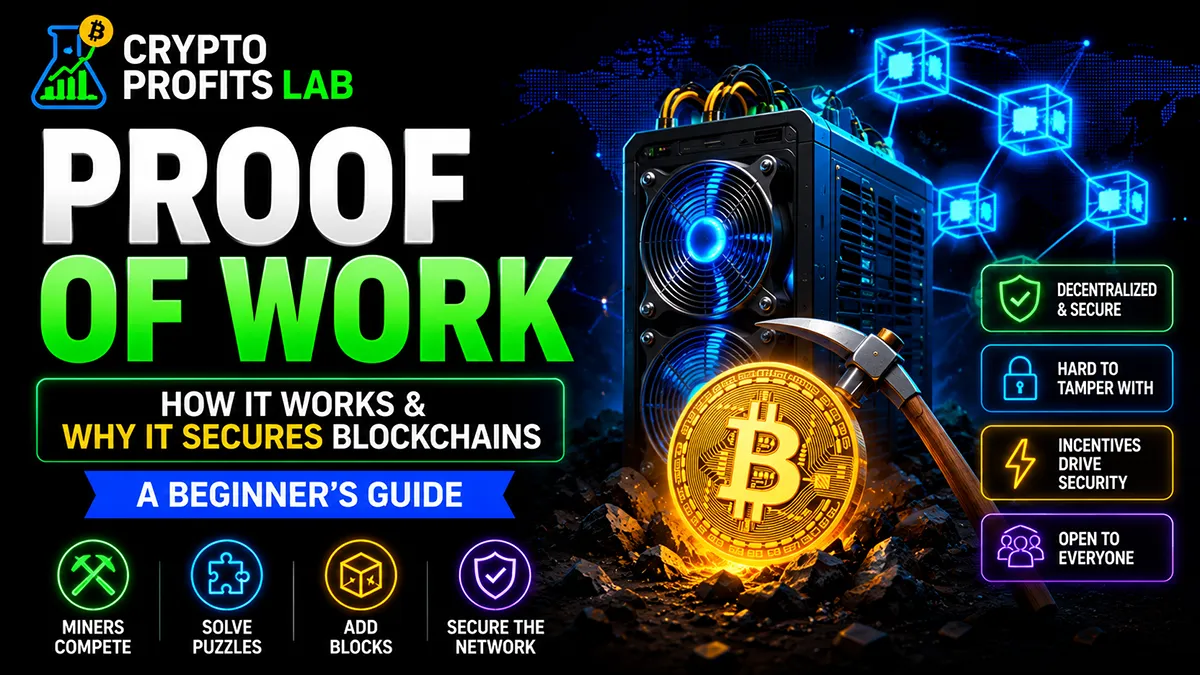
Proof of work is one of the most important ideas behind Bitcoin and several other cryptocurrencies. It helps a blockchain decide which transactions are valid, who may add the next block, and how the network can operate without a bank or central company controlling the record.
The name can sound technical. The basic idea is much simpler: computers must perform costly, verifiable work before they can add new information to the blockchain. Producing a valid result takes time, electricity, and computing power, while checking that result is quick and easy for the rest of the network.
This beginner’s guide explains how the system works, why mining is involved, what makes it secure, how it differs from proof of stake, and what risks new crypto users should be aware of.
Quick Answer
Proof of work is a blockchain consensus method in which miners compete to solve a difficult mathematical puzzle. The first miner to find a valid result earns the opportunity to propose the next block of transactions.
Other computers on the network can quickly verify the result. If the block follows the rules, it is added to the blockchain. The successful miner may receive newly issued coins and transaction fees as a reward.
Bitcoin uses this system to secure its transaction history and make changing old records extremely expensive.
Key Takeaways
- Miners use computing power to compete for the right to add a block.
- The mining puzzle is difficult to solve but easy for other computers to verify.
- A valid block must follow the network’s rules, not merely contain a winning hash.
- Mining rewards encourage participants to spend resources securing the network.
- Bitcoin adjusts mining difficulty so blocks arrive at a relatively steady average rate.
- Rewriting older blocks becomes harder as additional blocks are added after them.
- Proof of work can provide strong security, but it also requires substantial energy and specialized equipment.
- Ordinary users do not need to mine cryptocurrency to buy, hold, send, or receive it.
Proof of Work Beginner Facts
| Beginner question | Simple answer |
|---|---|
| What is its purpose? | It helps a blockchain agree on valid transactions and the next block. |
| Who performs the work? | Miners use computers or specialized mining machines. |
| What are miners searching for? | A block hash that satisfies the network’s current target. |
| Is the puzzle solved by hand? | No. Mining machines repeatedly test values at very high speed. |
| What does the winner receive? | Usually a block reward and eligible transaction fees. |
| Can anyone verify the result? | Yes. Network nodes can check a valid result quickly. |
| Does Bitcoin use it? | Yes. Bitcoin is the best-known proof-of-work network. |
| Does Ethereum still use it? | No. Ethereum changed to proof of stake in 2022. |
| Is mining required for users? | No. Most users interact with the network without mining. |
Why a Blockchain Needs a Consensus Method
A blockchain is a shared record copied across many computers. Those computers need a reliable way to agree on which transactions occurred and in what order.
In a traditional payment system, a bank maintains the central ledger. It can approve payments, reject invalid requests, and update account balances. A decentralized blockchain does not depend on one central record keeper.
That creates an important question: how can thousands of independent computers agree when some participants may be unreliable or dishonest?
A consensus method provides the rules for reaching agreement. It helps the network reject invalid transactions, prevent the same coins from being spent twice, and choose one accepted transaction history.
Proof of work makes influence costly. A participant cannot simply claim that its preferred version of the ledger is correct. It must demonstrate that real computing resources were used to build that version.
For more background on the shared ledger itself, read Blockchain Technology Explained.
How Proof of Work Works Step by Step
The full process contains many technical details, but beginners can understand it through eight basic steps.
Step 1: Users Create Transactions
A user sends cryptocurrency from a wallet. The wallet signs the transaction and broadcasts it to the network.
Network nodes check basic rules, such as whether the digital signature is valid and whether the sender has the funds being spent. A valid crypto transaction then waits to be included in a block.
Step 2: Miners Build Candidate Blocks
Miners collect waiting transactions and organize them into candidate blocks. A block also includes other information, such as a reference to the previous block.
That reference connects each new block to the history before it. Learn more about the structure in What Is a Crypto Block?.
Step 3: Mining Machines Hash the Block Data
A hash function maps data to a fixed-length output that resembles a random string of letters and numbers. Even a tiny change to the original data produces a very different hash.
Miners repeatedly change a value in the block header, commonly called a nonce, and hash the data again. They are trying to produce an output below the target set by the network.
Step 4: Miners Compete for a Valid Result
There is no shortcut that guarantees the winning answer. Mining equipment must make repeated guesses.
A miner with more computing power can try more guesses each second, which improves its chance of finding a valid result. However, even a smaller miner may occasionally win because the process includes chance.
Step 5: One Miner Finds a Winning Hash
When a miner finds a hash that meets the target, it broadcasts the candidate block and result to the network.
Finding the result required many attempts. Verifying it is much easier. Other computers only need to hash the submitted block data and confirm that the result satisfies the target.
Step 6: Nodes Check the Entire Block
A winning hash does not allow a miner to ignore the rules. Nodes also verify transactions, block size, reward amount, previous block reference, and other network requirements.
If the miner tries to include invalid transactions or create more coins than permitted, nodes reject the block even if its hash satisfies the mining target.
Step 7: The Valid Block Joins the Chain
When the block passes the checks, nodes add it to their accepted blockchain history. The next round of miners begins building on top of it.
The successful miner may receive a block subsidy, meaning newly issued coins, plus qualifying transaction fees.
Step 8: More Blocks Increase Confidence
A newly included transaction has one confirmation. Each later block built on top of it adds another confirmation.
As more work accumulates after a transaction, replacing that part of the chain becomes increasingly difficult. This is why exchanges may wait for multiple crypto confirmations before crediting a deposit.
Understanding Hashes Without the Math
Imagine a machine that turns any information into a long code. The same input always produces the same code, but changing a single character yields a very different result.
The network requires a hash below a particular target. Miners cannot predict which nonce will create it, so they repeatedly change the nonce, calculate another hash, and compare the result with the target.
Real mining happens at an enormous speed. The basic idea is still repeated guessing: producing the winning result is difficult, while checking it is easy.
What Mining Has to Do With Proof of Work
Mining is the competitive process used to produce valid blocks. Miners pay for machines, electricity, cooling, maintenance, and internet access in exchange for a chance to earn rewards.
The name is an analogy. Miners are not digging coins out of the ground; they are performing the work required to order transactions and protect the blockchain.
Bitcoin miners commonly use specialized ASIC machines designed for a particular type of calculation. Other networks may use different equipment and algorithms.
Our crypto mining guide explains equipment, mining pools, expenses, and beginner risks in more detail.
Block Rewards and Transaction Fees
Miners need an economic reason to spend money securing the network. Bitcoin rewards a successful miner with newly issued bitcoin, called the block subsidy, plus eligible transaction fees.
The subsidy is reduced during scheduled halvings. As new issuance declines, transaction fees are expected to become more important to miner revenue.
A reward is not a guaranteed profit. Results depend on coin price, difficulty, equipment efficiency, electricity costs, fees, and downtime.
Where Proof of Work Came From
Earlier computer science systems used computational methods to discourage spam and other abuse. Bitcoin combined this idea with digital signatures, a peer-to-peer network, economic incentives, and a chain of timestamped blocks.
Satoshi Nakamoto described Bitcoin’s design in the Bitcoin white paper. The paper explains how a chain, supported by accumulated computational work, can enable participants to agree on a transaction history without relying on a central financial institution.
Bitcoin did not invent every individual component, but it combined them into the first widely successful decentralized cryptocurrency system.
What Is Mining Difficulty?
Mining difficulty describes how hard it is to find a valid block result.
When more computing power joins a network, valid hashes would be found faster if the target stayed unchanged. When miners leave, blocks will arrive more slowly.
Bitcoin addresses this by periodically adjusting the target. If recent blocks were found too quickly, the network makes the target harder. If they were found too slowly, the target would be easier.
The goal is not to make every block arrive at an exact time. Individual blocks can be fast or slow because mining involves probability. The adjustment aims to maintain a relatively stable average over time.
Difficulty adjustment helps the network continue operating as the amount of mining power changes.
How Proof of Work Helps Secure Bitcoin
The system protects the network by linking influence to real-world cost.
An attacker attempting to replace transaction history must build an alternative chain and produce enough valid work for the network to accept it in place of the existing history. Meanwhile, honest miners continue adding work to the normal chain.
Changing an old transaction would also change that block’s hash. The attacker would then need to redo the work for that block and every block after it, while trying to catch up with the active network.
This does not make attacks mathematically impossible. It makes them expensive, difficult, and less practical as more confirmations accumulate.
Security also depends on nodes enforcing the rules. Mining power can propose blocks, but independently operated nodes decide whether those blocks are valid under the software rules they follow.
What Is a 51% Attack?
A 51% attack refers to a situation in which one miner or a coordinated group controls a majority of a network’s active hashing power.
That level of control may allow the attacker to reorganize recent blocks, delay selected transactions, or spend the attacker’s own coins and then attempt to reverse that payment.
A majority miner generally cannot create coins from nothing, take coins from unrelated addresses without valid signatures, or change the protocol rules accepted by independent nodes.
Large networks can be costly to attack because obtaining and operating enough mining power is difficult. Smaller networks with less total hashing power may be more vulnerable.
This risk is one reason beginners should consider network security and confirmation requirements before accepting a large payment.
Proof of Work vs. Proof of Stake
Both systems help decentralized networks agree, but they make dishonest behavior costly in different ways.
| Feature | Proof of work | Proof of stake |
|---|---|---|
| Participants | Miners | Validators |
| Main resource | Computing power and energy | Cryptocurrency placed at stake |
| Block selection | Based partly on mining competition | Based on protocol selection among validators |
| Specialized hardware | Often important | Usually not required in the same way |
| Energy use | Generally higher | Generally lower |
| Penalty for dishonest behavior | Wasted equipment, energy, and lost rewards | Possible loss of staked assets and rewards |
| Well-known example | Bitcoin | Ethereum |
Proof of work has a long operating history through Bitcoin. Proof of stake aims to provide blockchain security without energy-intensive mining.
Neither label alone proves that a cryptocurrency is safe, decentralized, or valuable. The details of the network, coin distribution, software, governance, validators or miners, and economic incentives all matter.
Read What Is Proof of Stake? for a beginner-friendly explanation of the alternative model.
Benefits of Proof of Work
The main benefits include:
- Strong economic security: attacking a major network can require expensive machines, electricity, facilities, and ongoing costs.
- Easy verification: producing a winning hash is difficult, but nodes can check it quickly.
- Open competition: miners can participate when they obtain compatible equipment and energy.
- A clear history: replacing older blocks requires redoing a growing amount of work.
- Proven use: Bitcoin has operated globally for many years without a central transaction processor.
These benefits do not remove investment risk. A secure network can still have volatile prices, weak adoption, or poor liquidity.
Limitations and Criticisms
The main concerns are:
- Energy use: mining machines run continuously, and their impact depends partly on the energy source and equipment efficiency.
- Specialized hardware: competitive mining may require expensive equipment, making solo participation difficult.
- Concentration: large operations and mining pools can control significant portions of the total hash rate.
- Electronic waste: older machines may become unprofitable as newer equipment improves.
- Variable fees and speed: mining does not automatically make a blockchain fast or inexpensive.
- Business risk: falling coin prices or rising operating costs can make mining unprofitable.
Which Cryptocurrencies Use Proof of Work?
Bitcoin is the largest and best-known example. Other established examples include Litecoin and Dogecoin.
These networks do not all use identical mining rules. They can differ in hashing algorithm, block time, reward schedule, total supply, merged-mining arrangements, and confirmation expectations.
You can learn about individual networks in What Is Bitcoin?, What Is Litecoin?, and What Is Dogecoin?.
Ethereum previously used mining but moved to proof of stake. This is a useful reminder that a cryptocurrency’s design can change through major network upgrades.
Do You Need to Mine to Use Bitcoin?
No. Most beginners use a wallet or exchange to buy, hold, send, receive, track, or sell cryptocurrency.
Miners can process your transaction even when you own no mining equipment. You normally pay a network fee, and a miner may include the transaction in a block.
It is similar to using the internet without operating an internet service provider. You can use the network without maintaining its infrastructure.
How to Evaluate a Proof-of-Work Cryptocurrency
Beginners should look beyond the label and examine the complete project.
Step 1: Understand Its Purpose
Ask what problem the network solves. A copied mining system does not automatically create a useful asset.
Step 2: Review Its History and Security
Consider how long the network has operated, whether it has suffered major attacks, and whether development remains active.
Step 3: Check Mining Concentration
Look at the distribution among pools and whether one group controls an unusually large share of the hash rate.
Step 4: Understand Coin Issuance
Review the reward, supply rules, halving schedule, and role of transaction fees.
Step 5: Consider Adoption and Personal Risk
Security does not guarantee liquidity or price growth. Consider custody, fees, taxes, scams, and volatility before investing. Our crypto volatility guide explains why prices can move sharply.
Common Beginner Mistakes
Assuming Mining Creates Free Money
Mining rewards come with equipment, electricity, cooling, repairs, pool fees, and competition. Revenue is not the same as profit.
Believing More Energy Always Means More Value
Energy expenditure may help secure a network, but it does not guarantee demand, adoption, or price appreciation.
Confusing Miners With Network Owners
Miners propose blocks. Nodes independently verify whether those blocks follow the rules. Developers, users, businesses, and market participants also influence the wider ecosystem.
Thinking Every Mineable Coin Is Like Bitcoin
Many cryptocurrencies use mining, but they can have very different security, distribution, liquidity, and development quality.
Ignoring Confirmation Risk
A payment included in a single block may be settled sooner than a payment buried under several additional blocks, especially on a smaller network.
Buying Because Mining Sounds Technical
Technical complexity is not proof of investment quality. Beginners should understand the project’s purpose and risks before purchasing.
Safety and Risk for Beginners
Proof of work can protect a blockchain’s transaction history, but it does not protect users from every type of loss.
You can still lose money through:
- Sending crypto to the wrong address or network.
- Sharing a private key or seed phrase.
- Using a fake wallet or exchange.
- Falling for a cloud-mining scam.
- Buying fraudulent mining equipment.
- Investing more than you can afford to lose.
- Holding a coin with weak demand or liquidity.
- Misunderstanding taxes, fees, or withdrawal limits.
Be especially careful with businesses promising guaranteed mining income. Legitimate mining returns change with coin prices, difficulty, fees, uptime, and operating costs. No company can honestly guarantee that market conditions will remain profitable.
Use strong passwords, enable two-factor authentication where available, verify website addresses, and keep wallet recovery information private.
Proof of Work Final Thoughts
Proof of work allows independent computers to agree on a blockchain history by requiring miners to spend real computing resources. Miners compete to find valid block hashes, while nodes verify that each proposed block follows the network’s rules.
The design is best known for securing Bitcoin. Its strengths include costly attack requirements, simple verification, and a long operating history. Its main criticisms include energy consumption, specialized hardware, mining concentration, and high operating costs.
Beginners do not need to become miners to use a proof-of-work cryptocurrency. The more important goal is understanding what the system does, what it does not guarantee, and how its risks compare with other consensus methods.
Crypto Profits Lab focuses on making concepts like this understandable without pretending that crypto is simple or risk-free. Learning the basics before buying can help you make calmer, more informed decisions.
Proof of Work Frequently Asked Questions
What Is Proof of Work in Simple Terms?
Proof of work is a method that lets a blockchain choose valid blocks through a computing competition. Miners repeatedly calculate hashes until one finds a result that meets the network target. Other computers can verify the result quickly. The required cost makes it difficult for dishonest participants to rewrite transaction history without controlling enormous computing resources.
Why Does Bitcoin Need Proof of Work?
Bitcoin needs a way for independent computers to agree on one transaction history without relying on a bank. Proof of work helps order transactions, discourage double spending, and determine who may propose the next block. It also makes changing older records expensive because an attacker would need to redo the work and catch up with honest miners.
Is Proof of Work the Same as Crypto Mining?
They are closely related but not identical. Proof of work is the consensus and security method. Mining is a competitive activity that participants perform using that method. Miners assemble candidate blocks, search for acceptable hashes, and broadcast valid results. The successful miner may earn newly issued coins and transaction fees for helping secure the network.
Does Proof of Work Waste Energy?
Mining uses substantial energy because machines continuously perform calculations. Whether that energy is considered waste depends partly on how people value the network’s services and what energy sources are used. The criticism is still important: the system has real environmental and economic costs, and users should not assume that energy use automatically makes a cryptocurrency valuable.
Can Proof of Work Be Hacked?
No security system is completely invulnerable. An attacker with sufficient hash power may reorganize recent blocks or attempt double-spending. However, attacking a large network can require enormous equipment and energy costs. Digital signatures and node rules also limit what mining power can do. A majority miner generally cannot spend coins without the owners’ private keys.
Is Proof of Stake Better Than Proof of Work?
There is no universal answer. Proof of stake usually uses less energy and does not require the same mining equipment. Proof of work has a longer operating history through Bitcoin and ties security to external resource costs. The better choice depends on a network’s goals, implementation, decentralization, security assumptions, and economic design rather than the label alone.
Can I Make Money Mining Bitcoin at Home?
Home mining is possible in some locations, but profitable Bitcoin mining usually requires specialized ASIC equipment, low electricity costs, cooling, reliable uptime, and careful calculations. Noise and heat can also be significant. Beginners should compare realistic revenue with every expense and avoid sellers or cloud-mining services that promise guaranteed profits.
What Happens When All Bitcoin Is Mined?
Bitcoin’s new-coin subsidy continues to decline through scheduled halvings until issuance approaches its fixed limit. Miners can still receive transaction fees for including payments in blocks. The long-term security model expects fees to become increasingly important. Future mining economics will depend on transaction demand, Bitcoin’s price, network difficulty, hardware efficiency, and energy costs.