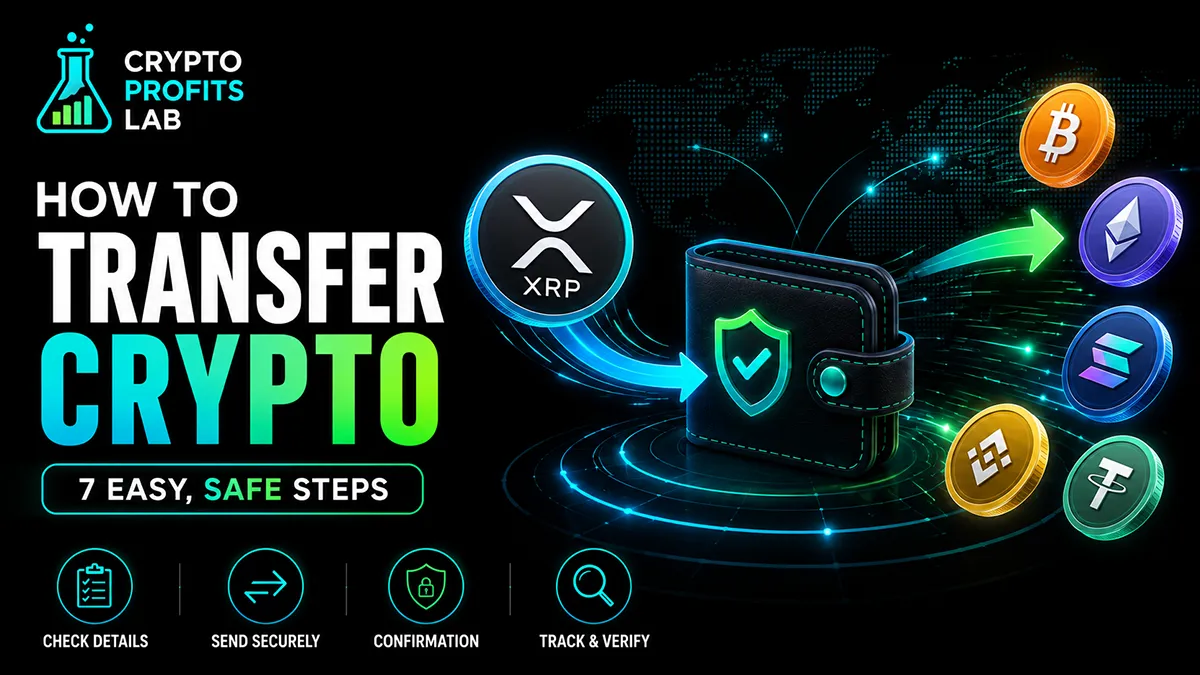
How to Transfer Crypto: 7 Easy, Safe Steps
Moving cryptocurrency can feel stressful the first time because a confirmed transaction may not be reversible. That makes careful checking more important than speed.
The good news is that learning how to transfer crypto is not complicated. You need the correct coin, receiving address, blockchain network, and sufficient funds to cover the fee. A small test transaction can reduce the chance of an expensive mistake.
This guide explains the process in plain English, including addresses, networks, fees, memos, confirmations, and transfer safety.
Quick Answer
To transfer cryptocurrency, open the sending wallet or exchange, select the coin, choose Send or Withdraw, paste the recipient’s wallet address, select the matching network, enter the amount, review the fee, and confirm the transaction.
When learning how to transfer crypto, always verify the first and last characters of the address, confirm the blockchain network, and send a small test amount before moving a large balance. After sending, use the transaction ID to track the payment on a blockchain explorer. This is how to transfer crypto in its simplest form.
Key Takeaways
- Crypto transfers usually cannot be canceled once they are confirmed on the blockchain.
- The coin and network selected by the sender must be supported by the receiving wallet.
- A wallet address identifies the destination, but some exchanges also require a memo or destination tag.
- Network fees vary by blockchain, demand, and transaction type.
- A small test transaction is one of the safest ways to confirm the details.
- Never send crypto because a stranger, “support agent,” government official, or romantic contact tells you to do it.
- Save the transaction ID so you can check the transfer status.
- A repeatable checklist makes it easier to learn how to transfer crypto safely.
Beginner Facts About Crypto Transfers
| Question | Beginner Answer |
|---|---|
| What do you need? | A sending account, a receiving address, the correct network, the transfer amount, and enough crypto for the fee |
| Can a transfer be reversed? | Usually not after it is confirmed on the blockchain |
| How long does it take? | From seconds to much longer, depending on the network, fee, congestion, and platform processing time |
| What is a test transaction? | A small transfer sent first to verify the address and network |
| What is a network fee? | A payment to the blockchain network for processing the transaction |
| What is a transaction ID? | A unique record used to look up the transfer on a blockchain explorer |
| Is a memo always required? | No, but certain coins and exchange deposits require one |
| Can addresses be reused? | Sometimes, although wallet guidance varies by coin and privacy needs |
The rest of this guide shows how to transfer crypto without assuming prior blockchain experience.
What Does It Mean to Transfer Crypto?
A crypto transfer moves digital assets from one blockchain address or platform account to another. The transfer could be between two wallets you control, from an exchange to a personal wallet, from a wallet to an exchange, or from your wallet to another person.
Your crypto wallet does not physically hold coins, unlike a leather wallet that holds cash. It manages the keys that let you interact with assets recorded on a blockchain. When you send crypto, you authorize the network to update its records.
A crypto transaction normally includes the sending address, receiving address, amount, network fee, and a digital signature. Once validators or miners add the transaction to the blockchain, the receiving wallet can reflect the new balance.
Understanding how to transfer crypto also means understanding that exchanges may add their own processing steps. An exchange can review a withdrawal, delay it for security, set a minimum amount, or charge a withdrawal fee before broadcasting the transaction to the network.
What You Need Before You Start
Before opening the Send screen, gather the following information:
- The exact cryptocurrency you are sending
- The receiving wallet address
- The blockchain network that the receiver supports
- Any required memo, tag, or payment ID
- The amount you want to send
- Enough remaining balance to pay the fee
- Access to your security method, such as two-factor authentication
A crypto wallet address is a long string of letters and numbers that identifies the destination. Many wallets also show it as a QR code. Because addresses can look similar, copying and pasting is safer than typing one manually.
You also need to understand the crypto network used for the transfer. The same token may appear on more than one blockchain. For example, a platform may let you withdraw a stablecoin using Ethereum, Polygon, Solana, or another network. The receiving platform must support the exact network you select.
How to Transfer Crypto in 7 Steps
The screens will look different between wallets and exchanges, but the basic process is usually similar. Use the following steps as a safety checklist rather than rushing through the prompts.
Step 1: Confirm the Coin You Are Sending
Start by checking the asset’s full name and ticker symbol. Bitcoin uses BTC, Ether uses ETH, and XRP uses XRP. Some assets have similar names or symbols, so do not rely only on a logo.
Confirm that the receiving wallet or exchange supports that exact asset. Sending an unsupported token can make recovery difficult or impossible.
When learning how to transfer crypto, remember that a token can exist in more than one form. A token originally issued on Ethereum may also have a bridged or wrapped version on another network. The receiving platform must support the form you are sending.
Step 2: Get the Receiving Address
Open the receiving wallet or exchange and select Receive or Deposit. Choose the exact coin, then copy the displayed address.
Do not copy an address from an old message, screenshot, search result, or random website. Get it directly from the receiving account whenever possible.
Compare the address format with what the sending platform expects. Bitcoin, Ethereum, XRP, and other networks use different address styles. A wallet may warn you when the format is invalid, but you should not depend on that warning alone.
For an important transfer, compare at least the first six and last six characters after pasting. Malware can sometimes replace a copied address with an attacker’s address, so visual checking remains important.
Step 3: Select the Correct Network
This is one of the most important parts of how to transfer crypto. The sending network and receiving network must match.
Suppose an exchange offers several withdrawal networks for the same token. Choosing a cheaper network may look attractive, but it is only safe when the receiving wallet supports that network for that asset.
Do not assume that two networks are compatible because they use a similar address format. Ethereum-compatible networks often use addresses beginning with “0x,” but the assets can still arrive on a different blockchain than you intended.
If the receiving deposit page says “Send only on the Ethereum network,” choose Ethereum on the withdrawal page. If it says Polygon, choose Polygon. When uncertain, stop and check the receiving platform’s official help documentation.
Step 4: Add a Memo or Destination Tag When Required
Some coins use a shared exchange address and require an extra identifier so the platform knows which customer should receive the deposit. This identifier may be referred to as a memo, destination tag, payment ID, or message.
XRP, XLM, ATOM, and several other assets may require this additional information when sending to an exchange. A self-custody wallet may not require it.
Leaving out a required memo does not always destroy the funds, but it may prevent automatic crediting. You might need to contact the receiving exchange, prove ownership, wait for support, and possibly pay a recovery fee.
Step 5: Enter the Amount and Review the Fee
Enter the amount you want to transfer. Some apps let you choose the amount in crypto or in your local currency.
Next, review the network or withdrawal fee. Crypto fees can change based on the blockchain, current demand, transaction size, and platform rules. Exchanges may charge a fixed withdrawal fee that differs from the live network cost.
Check whether the fee is added to the amount or deducted from it. If the recipient must receive an exact amount, this detail matters.
Also, look for a minimum withdrawal or minimum deposit. Sending less than the receiving platform’s minimum may delay or prevent the balance from being credited.
Step 6: Send a Small Test Transaction
A test transaction is a small transfer sent before the main transfer. It verifies that the coin, address, network, and memo are correct.
This step adds an extra fee, but it can be worth the cost when moving a large amount or using a destination for the first time. Wait until the test amount appears in the receiving account before sending the rest.
For beginners asking how to transfer crypto safely, the test transaction is one of the most useful habits to develop. It turns one high-risk action into two easier checks.
Make sure the test amount is above any withdrawal and deposit minimums. A test that is too small may not be credited, even if the address and network are correct.
Step 7: Review, Confirm, and Track the Transfer
Before confirming, review every field one final time:
- Correct coin
- Correct receiving address
- Correct network
- Correct memo or tag
- Correct amount
- Acceptable fee
- Trusted destination
The wallet or exchange may ask for a password, email confirmation, security key, or crypto 2FA. Complete the security check only after reviewing the details.
After submitting, save the transaction ID, often called a transaction hash or TXID. You can paste it into a blockchain explorer to check whether the transaction is pending, confirmed, or completed.
This completes the basic process for how to transfer crypto. Do not panic if the receiving balance does not update immediately. The network and the receiving platform may each need time to process the transaction.
How Crypto Transfers Work Behind the Scenes
When you press Send, your wallet creates a transaction request and uses your private key to produce a digital signature. The private key should remain secret and should never be entered into a transfer form.
The signed request is broadcast to the network. Miners or validators check that it is valid and that the funds are available. After the transaction is included in a block, it begins receiving crypto confirmations.
Understanding how to transfer crypto becomes easier when you see the sequence: your wallet signs, the network verifies, and the receiving service decides when enough confirmations have occurred.
How Long Does a Crypto Transfer Take?
There is no universal transfer time. A transaction may arrive in seconds on one network and take much longer on another.
Speed depends on the blockchain, network congestion, the fee, exchange reviews, and the number of confirmations required. A completed exchange withdrawal may still be pending credit by the receiving platform.
Use the transaction ID to distinguish between a blockchain delay and a platform delay.
What Are Network Fees?
A network fee pays miners or validators for processing and securing a transaction. It is normally separate from the amount received.
Fees vary by blockchain and demand. Ethereum fees are often called gas fees. An exchange may also charge its own withdrawal fee.
When learning how to transfer crypto, do not choose a network only because it is cheaper. The receiving wallet must support that exact network.
How to Transfer Crypto From an Exchange to a Wallet
Many beginners first move assets from a centralized exchange to a personal wallet. The basic process is:
- Open your wallet and select Receive.
- Choose the correct coin and network.
- Copy the address.
- Open the exchange withdrawal page.
- Paste the address and select the matching network.
- Enter any required memo.
- Send a test amount.
- Confirm and track the withdrawal.
A hardware wallet can keep private keys offline, but it does not remove the need to verify the address and network. Also, understand the difference between a hot wallet and cold wallet before deciding where to store funds.
How to Transfer Crypto From a Wallet to an Exchange
Open the exchange deposit page first. Select the asset and network, then copy the address and any required memo.
Next, open your wallet, choose Send, paste the deposit information, enter the amount, and review the fee.
When following instructions on how to transfer crypto for an exchange deposit, pay attention to deposit warnings, minimum amounts, and maintenance notices. An exchange may support a blockchain without supporting every token on it.
How to Transfer Crypto Between Your Own Wallets
Moving assets between two wallets you control follows the same blockchain process as paying another person. Open the receiving wallet, copy its address, and create the transfer from the sending wallet.
The blockchain does not automatically know that both addresses belong to you. Fees and confirmations still apply.
The safest way to learn how to transfer crypto between personal wallets is to practice with a small amount. Make sure you can access the receiving wallet and its recovery method before moving a larger balance.
Common Beginner Mistakes
Choosing the Wrong Network
The sender selects one network while the receiver expects another. The address may look valid, but the asset can arrive on an unsupported chain.
Sending the Wrong Token
A wallet can support a blockchain without supporting every token on that blockchain.
Forgetting the Memo or Destination Tag
This commonly affects exchange deposits that use a single address for multiple customers.
Skipping the Test Transaction
Sending the full balance at once removes the chance of catching an address, network, or memo mistake.
Ignoring Minimum Amounts
The sending exchange may have a withdrawal minimum, and the receiver may have a deposit minimum.
Sending the Entire Balance
The wallet may need some of the blockchain’s native coin to pay the fee.
Assuming Support Can Reverse It
Support may investigate, but it usually cannot cancel a confirmed blockchain transfer.
Safety and Risk: How to Transfer Crypto Carefully
Crypto transfers require caution because confirmed transactions are usually final. Slow down whenever money, unfamiliar instructions, or urgency is involved.
Use these safety practices:
- Send a test amount first.
- Confirm the address through a trusted communication method.
- Check the first and last characters after pasting.
- Verify the network on both the sending and receiving screens.
- Never share a private key or crypto seed phrase.
- Use strong account security and two-factor authentication.
- Bookmark official exchange and wallet websites.
- Avoid public Wi-Fi for important transfers.
- Keep wallet software and devices updated.
- Review our broader crypto safety tips.
No genuine support agent needs your seed phrase to receive or trace a transaction. Anyone requesting it is trying to gain control of your wallet.
Be especially careful when someone tells you to buy and send cryptocurrency to “protect” your money, pay a government bill, unlock a prize, recover an investment, or prove that your wallet works. The FTC’s cryptocurrency scam guidance explains common warning signs and why payments sent to scammers are difficult to recover.
Read our guide to crypto scams to avoid before responding to unexpected investment offers or urgent payment requests.
What to Do if a Transfer Is Pending
Check the transaction on a blockchain explorer.
If it does not appear, the wallet or exchange may not have broadcast it. If it is pending, the network may be congested, or the selected fee may be low. Some wallets support fee replacement, depending on the blockchain.
If it is confirmed but the exchange has not credited it, compare the confirmation count with the exchange’s requirement. Contact the receiving platform with the transaction ID after the required confirmations have passed.
Knowing how to transfer crypto includes knowing when to wait. Creating another transaction does not fix the first one.
What to Do if You Sent Crypto to the Wrong Address
If the withdrawal has not been broadcast, the exchange may let you cancel it. Act immediately.
After blockchain confirmation, the transfer normally cannot be reversed. If the address belongs to an exchange or known person, contact them with the transaction ID, asset, network, amount, and date. Recovery is not guaranteed.
Never pay an online “recovery expert” who promises guaranteed results. Recovery scams often target people who have already lost money.
A Simple Transfer Checklist
Use this checklist every time until the process becomes familiar:
- I selected the correct asset.
- I copied the address from the receiving account.
- I checked the first and last characters of the address.
- I selected the same network on both sides.
- I entered the memo or destination tag if required.
- I checked the minimum deposit and withdrawal amounts.
- I reviewed the fee.
- I sent a test transaction.
- I confirmed the test arrived.
- I saved the transaction ID.
- I did not share my private key or seed phrase.
- No stranger pressured me to make the transfer.
This checklist summarizes how to transfer crypto with fewer avoidable risks.
How to Transfer Crypto: Final Thoughts
Learning how to transfer crypto is mainly about building a careful routine. Confirm the asset, copy the receiving address from a trusted source, match the network, include any required memo, review the fee, and send a small test transaction.
Do not let urgency replace verification. Crypto gives users more direct control, but that control comes with responsibility for addresses, networks, private keys, and security.
Once you understand how to transfer crypto and follow the same checklist every time, the process becomes easier and less stressful. Start small, keep clear records, and treat every confirmation screen as your final chance to catch a mistake.
How to Transfer Crypto: Frequently Asked Questions
Can I cancel a crypto transfer after sending it?
Usually, you cannot cancel a crypto transfer after it has been confirmed on the blockchain. A withdrawal may sometimes be canceled while an exchange still shows it as pending and before it is broadcast. Once miners or validators include the transaction in a block, reversal generally requires the recipient to send the funds back.
What happens if I use the wrong crypto network?
The assets may arrive on a blockchain that the receiving wallet or exchange does not support. Recovery depends on whether the destination’s private keys can access that network and whether the receiving service offers a recovery process. Do not send another transaction until you have documented the address, network, token, amount, and transaction ID.
Why should I send a test transaction first?
A test transaction confirms that the wallet address, blockchain network, asset, and memo are correct before you risk a larger amount. The test creates an additional network fee, but it can prevent a much larger loss. Make sure the test is above the receiving platform’s minimum deposit amount.
Do I need a memo or destination tag for every transfer?
No. Most wallet-to-wallet transfers use only a receiving address. Some exchanges require a memo, destination tag, or payment ID for coins such as XRP, XLM, or ATOM because many customers share one deposit address. Always copy all fields shown on the receiving deposit screen to ensure proper account credit.
How do I know whether a crypto transfer is complete?
Find the transaction ID in the sending wallet or on the exchange, then enter it into the correct blockchain explorer. The explorer shows whether the transaction is pending, failed, or confirmed. A receiving exchange may wait for additional confirmations before crediting your account, even after the blockchain shows the transfer as successful.
Is it cheaper to transfer crypto at a certain time?
It can be cheaper when network demand is lower, especially on blockchains where users compete for limited block space. However, fee patterns are not guaranteed. Check the estimated fee before confirming, compare current conditions, and never choose an unsupported network simply because it costs less.
Can I transfer crypto directly to another person?
Yes. Ask the recipient for an address that supports the exact asset and network you plan to use. Confirm the address through a trusted channel, send a small test amount, and wait for it to arrive. Never send funds solely because someone contacted you unexpectedly or promised guaranteed profits.
Is transferring crypto between my own wallets safe?
It can be safe when you control both wallets, verify the receiving address, select the correct network, and protect both recovery phrases. The blockchain still treats it as a normal transaction, so fees and confirmation times apply. Test the destination first, especially when using a new wallet or device.
What is the safest way to learn how to transfer crypto?
Start with a small amount sent between accounts you control. Verify the asset, address, network, memo, fee, and minimum deposit before confirming. Wait for the test transfer to arrive, then repeat the same checklist for the larger amount. Never practice by sending money to a stranger or an unfamiliar investment platform.