
What Are Crypto Confirmations? A Beginner’s Guide
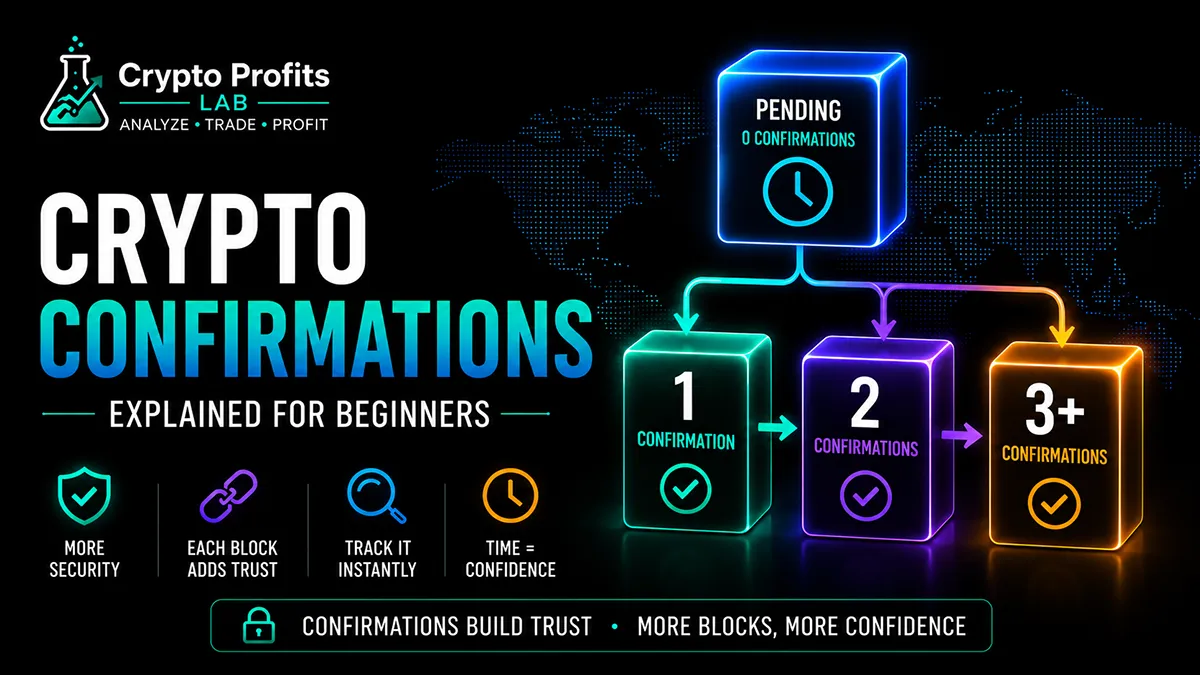
Sending cryptocurrency can feel surprisingly simple. You paste an address, choose an amount, review the fee, and press Send. A few seconds later, the wallet may show the transfer as pending. Then a number begins to appear: one confirmation, two confirmations, three confirmations, and so on.
Those numbers are called crypto confirmations. They show how deeply a transaction has been recorded in a blockchain’s history.
Understanding crypto confirmations helps beginners know whether a payment is still pending, why an exchange has not credited a deposit, and when a transaction is becoming increasingly difficult to reverse. The basic idea is simple, but the details vary between networks.
This guide explains the process in plain English. You will learn where confirmations come from, why different services require different amounts, how to track them, and how to avoid common mistakes when waiting for a transfer.
Quick Answer: What Are Crypto Confirmations?
Crypto confirmations are signs that a cryptocurrency transaction has been added to a blockchain and is followed by additional blocks.
The first confirmation usually happens when the transaction is included in an accepted block. Each later block adds another confirmation. More confirmations generally increase confidence that the transaction will remain part of the blockchain’s recognized history.
There is no universal confirmation number for every cryptocurrency. The required amount depends on the network, the transaction value, and the policy of the receiving wallet, merchant, or exchange.
Key Takeaways
- A transaction is usually unconfirmed while it waits to be included in a block.
- The first confirmation normally appears when the transaction is included in a valid block.
- Each new block added afterward increases the confirmation count.
- More crypto confirmations generally reduce the chance that a recent transaction will be replaced by a competing chain history.
- Different networks create blocks at different speeds.
- Exchanges can require more confirmations than personal wallets.
- A successful transaction on a blockchain may still be pending credit by an exchange.
- A blockchain explorer lets you check the current confirmation count.
- Confirmations show network acceptance, not whether a token, website, or investment is trustworthy.
Crypto Confirmations Facts for Beginners
| Term | Simple meaning |
|---|---|
| Pending transaction | A transfer that has been broadcast but is not fully confirmed |
| First confirmation | The transaction has been included in an accepted block |
| Confirmation count | The number of blocks including and following the transaction’s block |
| Block time | The approximate time between new blocks |
| Finality | The point at which a transaction is considered extremely difficult or impossible to reverse under the network’s rules |
| Chain reorganization | A recent sequence of blocks is replaced by another valid sequence |
| Transaction ID | A unique code used to track a transfer |
| Blockchain explorer | A public search tool for transactions, addresses, and blocks |
| Exchange requirement | The number of confirmations a platform waits for before crediting a deposit |
Why Cryptocurrency Transactions Need Confirmations
A blockchain is a shared record maintained by many computers. When you send cryptocurrency, the network needs time to receive the instruction, verify it, place it in order, and agree that it belongs in the official history.
A crypto transaction does not become fully settled merely because your wallet displays “sent.” The wallet first broadcasts the signed instruction to the network. Nodes examine it, and a miner or validator eventually includes it in a block.
Crypto confirmations give users and services a practical way to measure how established that transaction has become.
Without this waiting process, a merchant or exchange could accept a transaction that later disappears from the recognized chain. Confirmations reduce that risk by allowing more blocks to build on top of the transaction.
How Crypto Confirmations Work Step by Step
The process differs slightly between Bitcoin, Ethereum, Solana, XRP Ledger, and other systems. However, the following sequence explains the general idea.
Step 1: You Create and Sign a Transaction
You enter the recipient’s crypto wallet address, select an asset, choose an amount, and approve the transfer.
Your wallet uses your private key to create a digital signature. The signature proves that you are authorized to spend the funds without revealing the private key itself.
The wallet then broadcasts the transaction to the selected crypto network.
Step 2: Nodes Check the Transaction
Computers called crypto nodes receive the transaction and check whether it follows the network’s rules.
They may verify:
- The digital signature
- The sender’s available funds
- The transaction format
- The fee or gas settings
- Whether the same funds were already spent
- Any smart-contract conditions
If the transaction is invalid, nodes reject it. If it is valid, they share it with other participants.
At this point, the transfer may still have zero crypto confirmations.
Step 3: The Transaction Waits for a Block
On many blockchains, valid transactions wait in a temporary pool before a miner or validator selects them.
A transaction can remain pending because the network is busy, the fee is too low, or the sending exchange has not yet broadcast the withdrawal. The wallet may show the transfer, but the blockchain may not have included it yet.
You can often distinguish these situations by checking whether a transaction ID exists on a blockchain explorer.
Step 4: A Miner or Validator Includes It
A miner or validator selects the transaction and places it inside a proposed crypto block.
The proposed block must follow the network’s rules. Other participants verify it, and the block becomes part of the accepted blockchain history when the consensus process approves it.
This normally creates the first confirmation.
Step 5: New Blocks Add More Confirmations
The next accepted block is built after the block containing your transaction. That new block adds another confirmation.
As more blocks follow, the transaction becomes buried deeper in the chain. Changing it would generally require replacing its block and the blocks built after it while also overcoming the network’s consensus rules.
This is why crypto confirmations increase over time even though your original transaction does not change.
Step 6: The Receiving Service Credits the Funds
A personal wallet may display incoming funds after the first confirmation or even while the transaction is still pending.
A crypto exchange may wait for a specific number before crediting the deposit. The platform sets that policy based on the network, the asset, current conditions, and its internal risk controls.
The blockchain can therefore show success while the exchange still shows “pending deposit.”
What Does One Confirmation Mean?
One confirmation usually means that the transaction has been included in one accepted block.
That is an important improvement over zero confirmations, as the network has recorded the transaction in its ordered history. However, the most recent block can be more vulnerable to replacement than an older block.
For small transfers, one confirmation may be enough for a wallet or merchant. For larger payments or exchange deposits, the recipient may wait for additional crypto confirmations.
One confirmation does not mean that every service must immediately release the funds.
Why More Confirmations Increase Confidence
Blockchains can sometimes produce competing versions of a recent block. For example, two miners may find valid Bitcoin blocks at nearly the same time. Different nodes can briefly see different blocks first.
The network then follows its consensus rules and eventually settles on one history. A transaction in the unselected block may return to the pending pool and enter a later block.
Every new block added after your transaction makes this kind of replacement less likely. An attacker or competing chain would have more work to redo and more accepted history to overcome.
The Bitcoin Developer Guide provides a more technical explanation of how blocks connect and why additional chain depth increases confidence in a transaction.
This does not mean that a fixed number of crypto confirmations makes every transaction mathematically impossible to reverse. It means the practical risk typically decreases as the chain grows.
How Many Crypto Confirmations Are Needed?
There is no single correct number for every situation.
The required amount depends on several factors:
- The cryptocurrency network
- The speed at which new blocks are produced
- The security of the network
- The value of the transaction
- The recipient’s risk tolerance
- Whether the transfer is going to an exchange
- Current network conditions
- The possibility of a recent chain reorganization
A low-value payment may be accepted quickly. A large exchange deposit may require more crypto confirmations because the platform wants additional protection before allowing trading or withdrawals.
Always check the receiving service’s deposit page rather than assuming a number based on another platform.
Why Confirmation Times Differ Between Networks
Different blockchains use different block times and consensus systems.
Bitcoin blocks are produced at an average interval measured in minutes. Ethereum blocks arrive much more frequently. Other networks may report confirmation or finality within seconds.
The proof-of-stake process used by many modern blockchains also differs from Bitcoin’s proof-of-work system.
A shorter block time can cause the confirmation count to rise quickly, but the number alone does not make two networks equally secure. Ten confirmations on one blockchain are not automatically equivalent to ten on another.
The network’s design, validator or miner participation, finality rules, and operating history all matter.
Confirmations Versus Finality
Crypto confirmations and finality are related, but they are not always identical.
Confirmations measure how many blocks have included and followed a transaction. Finality refers to the point at which the network considers a transaction settled under its rules.
Some blockchains use probabilistic finality. The transaction becomes increasingly unlikely to change as more blocks are added.
Other networks use explicit finality mechanisms in which validators agree that a block is final. After that point, reversing it may require severe rule violations, large penalties, or an extraordinary network event.
Beginners do not need to memorize every consensus model. The practical lesson is to follow the receiving service’s requirements and check the explorer’s status.
Why an Exchange May Require Many Confirmations
An exchange control customer balances within its own database. When it receives an on-chain deposit, it decides when to credit that amount to your account.
The exchange may wait because:
- Recent blocks can sometimes be reorganized
- The deposit is unusually large
- The network has experienced instability
- The asset has a higher risk profile
- The exchange uses conservative security policies
- Its wallet system processes deposits in scheduled batches
More crypto confirmations give the exchange greater confidence before it lets the customer trade or withdraw the credited funds.
This delay does not necessarily mean that anything is wrong.
Why a Confirmed Transaction May Not Appear in Your Account
A transaction can have several confirmations on the blockchain, while the receiving platform still does not show the funds.
Common reasons include:
- The exchange requires more confirmations
- A destination tag or memo was missing
- The deposit was below the minimum amount
- The exchange temporarily paused deposits
- The exchange selected a different network from the sender
- The platform is experiencing a wallet-system delay
- The asset requires manual review
First, verify the recipient address, asset, and network on the explorer. Then check the exchange’s deposit rules.
If the blockchain shows success and the required number of crypto confirmations has been reached, contact the receiving platform with the transaction ID. Never provide a seed phrase or private key.
How to Check Crypto Confirmations
You can check the status without connecting your wallet.
1. Find the Transaction ID
Open the sending wallet or exchange history and select the transfer.
Look for a transaction ID, transaction hash, or TXID. Copy the complete value.
2. Identify the Correct Blockchain
Use an explorer designed for the network that processed the transaction.
A Bitcoin transaction should be searched on a Bitcoin explorer. An Ethereum transaction should be searched on an Ethereum explorer. A transfer on Polygon, Arbitrum, or another network needs that network’s explorer.
3. Search the Transaction
Paste the transaction ID into the explorer’s search field.
The result may show:
- Pending, confirmed, finalized, failed, or dropped
- Sender and recipient addresses
- Asset and amount
- Transaction fee
- Block number
- Timestamp
- Current confirmation count
4. Compare the Result With the Receiver’s Policy
Check how many crypto confirmations the receiving wallet or exchange requires.
If the explorer count is lower, wait. If the requirement has been met and the deposit is still missing, contact the platform.
Pending, Confirmed, and Finalized: What Is the Difference?
These words are often used together, but they describe different stages.
Pending
The network has received the transaction, but it has not yet been included in an accepted block.
A pending transfer usually has zero crypto confirmations.
Confirmed
The transaction has been included in a block. Additional blocks may continue increasing the confirmation count.
Finalized
The network or receiving service considers the transaction settled in accordance with its rules.
A wallet may use “confirmed” loosely, while an explorer may display a more specific finalized status. Read the platform’s definitions when they are available.
Why a Transaction Can Stay Unconfirmed
A transaction may remain at zero confirmations because:
- The network is congested
- The fee is below current market conditions
- The wallet has not broadcast it correctly
- The sending exchange has only created an internal withdrawal request
- The transaction conflicts with another transaction
- A node or explorer is temporarily delayed
On networks with variable fees, paying too little can reduce the chance that a miner or validator selects the transaction quickly.
Our guide to crypto gas fees explains why demand and transaction complexity can affect costs.
Do not send the same payment again until you understand the original status. You could accidentally pay twice.
Can Crypto Confirmations Go Backward?
Yes, the displayed count can occasionally decrease or reset during a chain reorganization.
A chain reorganization happens when the network replaces a recent sequence of blocks with another valid sequence. A transaction may move to a different block, return to pending status, or temporarily disappear.
Small reorganizations can occur naturally on some proof-of-work networks when two valid blocks are produced close together.
Deep reorganizations are less common and may indicate a serious network problem or attack.
This possibility is one reason recipients wait for multiple crypto confirmations.
Are Zero-Confirmation Payments Safe?
A zero-confirmation payment is a transaction that has been broadcast but has not entered a block.
The recipient can often see it in the network’s pending pool, but it does not yet have the protection of block inclusion. Depending on the network, the sender may be able to replace it, conflict with it, or use an inadequate fee.
Some merchants accept small zero-confirmation payments for speed, but doing so involves more risk.
Beginners should generally wait until the receiving service confirms the policy.
Do Fees Affect Confirmation Speed?
Fees can affect how quickly a transaction enters a block, especially when network space is limited.
Miners or validators may prioritize transactions offering more attractive fees. A low-fee transfer can remain pending while higher-fee transactions move ahead.
However, paying a high fee does not create instant crypto confirmations. The transaction still depends on block production and network acceptance.
After the first confirmation, the later confirmation count usually rises as new blocks are created. The original fee does not normally control how quickly those later blocks arrive.
Common Beginner Mistakes
Mistaking “Sent” for “Confirmed”
A wallet can mark a transaction as sent immediately after broadcasting it.
Always check whether the transfer has entered a block before treating it as complete.
Using the Wrong Explorer
A transaction ID from one blockchain may not appear on another network’s explorer.
Confirm the exact network before searching.
Assuming Every Exchange Uses the Same Requirement
One exchange may credit an asset sooner than another.
Use the destination platform’s current deposit instructions.
Sending a Second Transaction Too Quickly
A delayed transfer can make beginners panic and resend the payment.
Check the original transaction ID first to avoid paying twice.
Ignoring the Memo or Destination Tag
Crypto confirmations do not fix a missing memo. The exchange may receive the funds but be unable to automatically identify the correct customer account.
Believing Confirmation Proves an Investment Is Safe
A blockchain can confirm a payment to a scammer or a malicious smart contract.
Confirmation proves that the network processed the instruction, not that the recipient was trustworthy.
Sharing Wallet Secrets With Support
A legitimate support team may ask for a transaction ID. It should never need your private key, password, or recovery phrase.
Crypto Confirmations Safety and Risk
Confirmations help measure transaction settlement, but they do not remove every risk.
Wrong Address Risk
A transfer to the wrong address can receive many crypto confirmations and still be unrecoverable.
Verify the address before sending and consider a small test transfer.
Wrong Network Risk
An asset sent through an unsupported network may be confirmed on-chain but not credited by the receiving platform.
Match the asset and network on both sides.
Smart-Contract Risk
A malicious contract can receive a fully confirmed transaction.
Read wallet approvals and use trusted websites.
Explorer Privacy
A transaction ID does not reveal your private key, but it exposes public information such as addresses, amounts, timing, and transaction history.
Share it only when useful.
Fake Support Risk
Scammers monitor public posts from people waiting for deposits. They may claim that your wallet needs to be validated or synchronized.
Use official support channels and review our crypto safety tips before responding to anyone.
A Beginner’s Checklist Before Waiting for Confirmations
Before assuming that a transfer is delayed, verify:
- The wallet or exchange created a transaction ID.
- The transaction appears on the correct explorer.
- The recipient address matches.
- The selected network matches the destination.
- Any required memo or tag was included.
- The amount meets the platform’s minimum deposit.
- The transaction has not failed or been dropped.
- The receiving service’s confirmation requirement has been reached.
- Deposits are currently enabled for the asset.
- Contact the official support channel if help is needed.
This checklist separates blockchain delays from exchange-account problems.
Final Thoughts
Crypto confirmations show how firmly a transaction has been recorded in blockchain history. The first confirmation usually appears when the transaction enters a valid block, and subsequent blocks add more confidence.
The most important lesson is that confirmation requirements are not universal. A personal wallet, merchant, and exchange may all treat the same transaction differently.
Use a blockchain explorer, follow the receiving platform’s rules, and avoid sending a second payment before confirming the first. Most delays become easier to understand once you identify the network, transaction ID, block status, and required number of crypto confirmations.
Crypto Confirmations Frequently Asked Questions
How long do crypto confirmations take?
The time depends on the blockchain’s block speed, network congestion, transaction fee, and the receiving service’s requirements. A fast network may add confirmations within seconds, while Bitcoin confirmations usually take longer on average. Exchanges may also wait for several blocks before crediting a deposit. Check the transaction on the correct explorer and compare its count with the receiving platform’s policy.
How many crypto confirmations are considered safe?
There is no universal number that is safe for every network and transaction. The appropriate amount depends on the blockchain’s security model, the value being transferred, and the recipient’s risk tolerance. A wallet may accept one confirmation, while an exchange may require several or more. Follow the destination platform’s stated requirements rather than applying a single number to all cryptocurrencies.
Why does my transaction have zero confirmations?
Zero confirmations usually mean the transaction has been broadcast but has not yet been included in an accepted block. Network congestion, a low fee, a wallet problem, or an exchange withdrawal delay can cause this. Search the transaction ID on the correct explorer. If no public record exists, the sending platform may not have broadcast the transfer yet.
Can a confirmed crypto transaction be reversed?
A confirmed transaction is usually difficult to reverse, and the difficulty generally increases as more blocks are added. However, recent blocks can sometimes be replaced during a chain reorganization. Smaller or weakly secured networks may face greater risks. Most users cannot cancel a normal confirmed transfer, so verifying the address, asset, network, and amount before sending remains essential.
Why does an exchange need more confirmations than my wallet?
An exchange accepts deposits for many customers and may allow credited funds to be traded or withdrawn. It therefore uses its own risk policy before updating your account balance. A personal wallet can display an incoming transaction sooner because it does not make the same custody and withdrawal decisions. The exchange’s requirement may also vary by asset and network conditions.
Do more confirmations make a transaction faster?
No. Confirmations measure how many blocks have included and followed a transaction. They do not speed up the original transfer. A competitive fee may help the transaction enter its first block sooner, but later confirmations arrive as the network creates additional blocks. More confirmations increase confidence rather than increasing the transaction’s processing speed.
Can a transaction lose confirmations?
Yes. A recent transaction can lose confirmations during a blockchain reorganization if the network replaces a short sequence of blocks with another valid sequence. The transaction may move into a different block, return to pending, or be included again later. This is uncommon on well-established networks after many blocks, but it explains why large recipients often wait longer.
Are crypto confirmations proof that a payment is legitimate?
Crypto confirmations prove that the network accepted and recorded a transaction. They do not prove that the recipient is honest, that the token is genuine, or that the website is safe. A payment to a scam address can be fully confirmed. Always verify the recipient and purpose of the transaction before signing, because blockchain settlement does not provide fraud protection.