What Is Blockchain Technology? Beginner Guide

Blockchain technology is one of the most important ideas behind cryptocurrency, but it can sound confusing when you first hear it. Beginners often see terms like blocks, ledgers, miners, validators, nodes, wallets, smart contracts, and decentralization all at once. That can make crypto feel more complicated than it needs to be.
The simple version is this: blockchain technology is a way to record information across a network of computers so that the record is shared, difficult to change, and not controlled by a single database in the usual way.
Bitcoin uses a blockchain to record transactions. Ethereum uses a blockchain to run smart contracts and decentralized apps. Stablecoins, NFTs, DeFi apps, crypto bridges, and many altcoins also rely on blockchain systems in different ways.
This guide explains blockchain technology in plain English. You will learn what it is, how it works, why it matters, how it connects to crypto wallets and transactions, and what risks beginners should understand before buying or using crypto.
This article is for education only. It is not financial, investment, tax, legal, or technical advice.
Quick Answer: What Is Blockchain Technology?
Blockchain technology is a digital record-keeping system that stores information in groups called blocks. Each block is connected to the block before it, creating a chain of records. This is why it is called a blockchain.
In cryptocurrency, a blockchain records transactions. For example, when someone sends Bitcoin, the network records that transaction on the Bitcoin blockchain. The record is shared across many computers, not stored in one private company database.
The main idea is trust through verification. Instead of a single central authority determining what happened, the network follows rules to agree on the transaction history.
If you are completely new to crypto, start with What Is Cryptocurrency? first. Then use this guide to understand the technology behind many crypto assets.
Key Takeaways
- Blockchain technology is a shared digital record system.
- It stores information in blocks that are linked together.
- Many cryptocurrencies use blockchains to record transactions.
- A blockchain can be public, private, permissioned, or permissionless.
- Bitcoin uses a blockchain for decentralized digital money.
- Ethereum uses a blockchain for smart contracts and apps.
- Wallets let users interact with blockchains.
- Blockchain records can be transparent, but user safety still matters.
- The technology is powerful, but not every crypto project is trustworthy.
Beginner Facts Table
| Topic | Simple Explanation |
|---|---|
| Blockchain | A shared digital record made of linked blocks |
| Block | A group of transaction data |
| Chain | The connection between blocks |
| Node | A computer that participates in the network |
| Miner | A participant that helps secure some proof-of-work blockchains |
| Validator | A participant that helps secure some proof-of-stake blockchains |
| Wallet | A tool used to access and move crypto |
| Private key | Secret information that controls crypto access |
| Smart contract | A program that runs on a blockchain |
| Main risk | Scams, wallet mistakes, bad projects, and volatility |
Why Blockchain Technology Matters
Blockchain technology matters because it allows people to record and verify digital information in a different way.
In traditional systems, one company, bank, platform, or government database usually controls the record. If you send money through a bank, the bank updates its records. If you buy stock through a brokerage, the brokerage and related financial systems track the ownership.
Crypto works differently. A blockchain can allow a network of participants to share and verify the record together.
This does not mean every blockchain is fully decentralized. It also does not mean every crypto project is safe. But the idea is important because it changes how digital ownership can work.
Without blockchain technology, Bitcoin would not be possible in the same way. There would be no shared public transaction history for users to verify. Ethereum would not be able to run decentralized apps in the same way. DeFi platforms, NFTs, and many crypto tokens would not work the same way either.
That is why blockchain is one of the first topics every beginner should learn.
How Blockchain Technology Works
Blockchain technology works by recording information in blocks and linking those blocks together using cryptography. Cryptography is a method of protecting information with secure codes and mathematical rules.
NIST’s Blockchain Technology Overview explains that blockchains are tamper-evident and tamper-resistant digital ledgers shared across a network.
Here is the beginner version:
- A user starts a transaction.
- The transaction is shared with the network.
- Network participants check whether it follows the rules.
- Valid transactions are grouped into a block.
- The block is added to the chain.
- The updated record is shared across the network.
- The transaction becomes part of the blockchain history.
A blockchain is not just a list of transactions. It is a system for helping many participants agree on the same record.
That agreement is important. If one computer has false information, the rest of the network can reject it if it does not follow the rules.
What Is a Block?
A block is a package of information. In crypto, that information usually includes transactions.
For example, a block may record that one wallet sent Bitcoin to another wallet. It may also include other details, such as timestamps, transaction data, and a connection to the previous block.
Each block links to the block before it. This link helps create the chain. If someone tries to change an old block, the change can affect the blocks after it. That makes tampering easier to detect.
This is one reason blockchain technology is often described as tamper-resistant. It does not mean changing data is impossible in every situation. It means the system is designed to make unauthorized changes difficult, visible, or expensive depending on the network.
For beginners, the easiest way to understand a block is to think of it as a page in a record book. A blockchain is the full book, with each page linked to the page before it.
What Is a Blockchain Ledger?
A ledger is a record of transactions. Banks use ledgers. Businesses use ledgers. Crypto networks use digital ledgers.
The difference is that a blockchain ledger is often shared across many computers. These computers can compare records and follow rules to agree on what is valid.
This shared record is one of the main reasons blockchain technology became important. It allows users to verify activity without relying solely on a single central database.
In Bitcoin, the ledger records Bitcoin transactions. In Ethereum, the ledger records ETH transfers, token activity, smart contract interactions, and more.
This is why blockchain explorers exist. A blockchain explorer lets users look up public transaction history, wallet addresses, blocks, and fees. The information is public, but that does not mean every wallet owner’s real-world identity is automatically known.
Transparency is useful, but privacy is not perfect. Beginners should understand that many blockchain transactions are publicly viewable.
Step-by-Step: A Simple Crypto Transaction
To better understand blockchain technology, imagine a beginner sending crypto from one wallet to another.
Here is a simple example:
- Sarah opens her crypto wallet.
- She enters Mark’s public wallet address.
- She chooses how much crypto to send.
- Her wallet creates a transaction.
- Sarah approves the transaction with her wallet.
- The transaction is sent to the blockchain network.
- The network checks that Sarah has enough funds.
- The transaction is added to a block.
- The block is confirmed by the network.
- Mark’s wallet balance updates.
This process may seem fast and simple from the user’s side, but a lot happens in the background.
The wallet does not physically move coins from one device to another. Instead, the blockchain record updates to show that control of value has changed.
This is why wallet safety matters. The blockchain follows valid transactions. If a scammer tricks Sarah into signing a bad transaction, the network may still process it if the transaction follows the rules.
To understand wallet safety, read Crypto Wallet, Crypto Private Key, and Crypto Seed Phrase.
Blockchain Technology and Bitcoin
Bitcoin is the most famous example of blockchain technology in action. It uses a blockchain to record transactions without relying on a central bank.
Bitcoin’s blockchain is public. Anyone can run software to participate in the network, depending on technical setup and goals. The network uses proof of work, which is connected to mining.
Mining is the process where specialized computers compete to add new blocks and help secure the network. This process also releases new bitcoin in accordance with Bitcoin’s rules.
Bitcoin matters because it proved that a decentralized digital money system could operate for years without one company controlling the ledger.
To learn more, read What Is Bitcoin? and Crypto Mining for Beginners.
Blockchain Technology and Ethereum
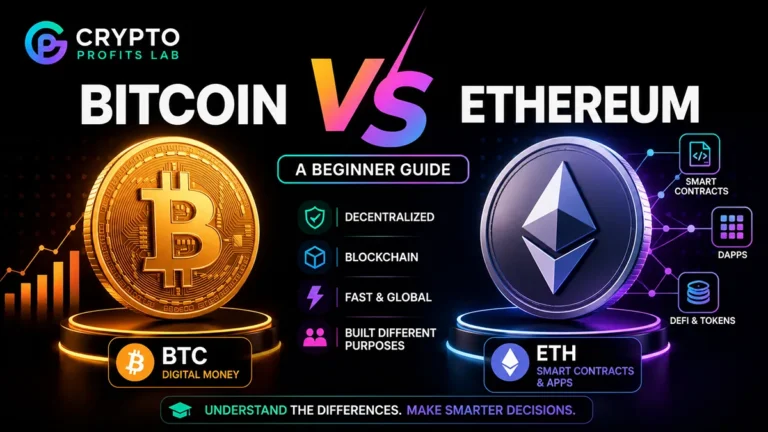
Ethereum uses blockchain technology differently from Bitcoin. Bitcoin is primarily a decentralized digital currency. Ethereum is designed for programmable blockchain activity.
Ethereum can run smart contracts. A smart contract is a program that lives on a blockchain and follows coded rules. Smart contracts power many decentralized apps, DeFi tools, NFTs, token launches, and blockchain-based services.
This makes Ethereum one of the most important networks for beginners to understand after Bitcoin.
For example, a decentralized exchange can use smart contracts to let users swap tokens. A lending app can use smart contracts to manage deposits and borrowing. An NFT marketplace can use smart contracts to track digital collectibles.
To learn more, read What Is Ethereum? and Smart Contracts.
Public vs Private Blockchains
Not all blockchains work the same way. Some are public. Some are private. Some require permission to join or validate transactions.
A public blockchain is open for anyone to view and often to participate in. Bitcoin and Ethereum are common examples.
A private blockchain is controlled by a specific organization or group. It may be used by companies, institutions, or internal systems.
A permissionless blockchain usually allows open participation.
A permissioned blockchain limits who can participate in certain roles.
Here is a simple comparison:
| Type | Beginner Explanation | Example Use |
|---|---|---|
| Public blockchain | Open network anyone can view | Bitcoin, Ethereum |
| Private blockchain | Controlled by an organization | Business record systems |
| Permissionless | Anyone can participate under network rules | Public crypto networks |
| Permissioned | Approved users have specific roles | Enterprise blockchain systems |
For crypto beginners, public blockchains are usually the most relevant because they are where Bitcoin, Ethereum, stablecoins, DeFi, and many altcoins operate.
Blockchain Technology and Crypto Wallets
A crypto wallet is how users interact with a blockchain. The wallet helps create addresses, sign transactions, and manage access to crypto assets.
A wallet has two important ideas:
A public address can receive crypto.
A private key or seed phrase controls access.
This is different from a bank account. A bank may reset your password if you prove your identity. A self-custody wallet usually does not work that way. If you lose your recovery phrase, there may be no support team that can restore your funds.
Blockchain technology gives users more direct control, but that control comes with responsibility.
Beginners should not rush into self-custody with large amounts. Learn the difference between wallet types first:
- Custodial Wallet vs Non-Custodial Wallet
- Hot Wallet vs Cold Wallet
- Hardware Wallet
- Best Crypto Wallet for Beginners
A wallet mistake can be expensive because blockchain transactions are usually irreversible.
Consensus: How the Network Agrees
Consensus means agreement. A blockchain network needs a way to agree on which transactions are valid and which block comes next.
Different blockchains use different consensus systems.
Bitcoin uses proof of work. Miners use computing power to compete for the next block.
Many newer networks use proof of stake. Validators lock or stake tokens and help confirm transactions in accordance with the network’s rules.
Here is a beginner comparison:
| Consensus Type | How It Works | Beginner Example |
|---|---|---|
| Proof of work | Miners use computing power | Bitcoin |
| Proof of stake | Validators use staked coins | Ethereum after its upgrade |
| Other models | Different networks use different methods | Some private or newer chains |
Consensus is important because the network needs rules for updating the ledger. Without consensus, different participants could disagree about which transactions are real.
Beginners do not need to master every consensus model right away. Just understand that blockchain technology uses rules to help many computers agree on one shared record.
Why Blockchains Are Difficult to Change
One of the main benefits of blockchain technology is that confirmed records can be difficult to change. This is not because the data is hidden. In public crypto networks, much of the transaction history is visible.
The protection comes from how blocks are linked, how the network reaches consensus, and how much work or stake is required to rewrite history.
If someone tries to change an old transaction, they may need to change later blocks too. On a strong public network, it can be extremely difficult because many participants are watching and following the rules.
This does not mean every blockchain is equally secure. A small or poorly designed network may be easier to attack. A centralized project may have more control than beginners realize.
That is why market size, decentralization, developer activity, and network security matter when researching crypto projects.
For research basics, read Market Cap Crypto and What Is Tokenomics?.
Blockchain Technology Beyond Bitcoin
Many beginners first learn about blockchain technology through Bitcoin, but the idea has expanded far beyond one coin.
Common crypto uses include:
- Digital money
- Stablecoins
- Smart contracts
- DeFi platforms
- NFTs
- Gaming assets
- Tokenized communities
- Crypto bridges
- Supply chain tracking
- Digital identity experiments
- Payment networks
Some use cases are more developed than others. Some are still experimental. Some are mostly hype.
Beginners should not assume that every project that uses the word “blockchain” is valuable. The technology can be useful, but the project still needs real users, good security, a clear purpose, and a fair token design.
Helpful next reads include What Are Stablecoins?, What Is DeFi?, and What Are NFTs?.
Blockchain Technology and Smart Contracts
Smart contracts are among the most important applications of blockchain technology. They allow code to run on a blockchain and follow rules automatically.
For example, a smart contract can help process a token swap, manage a lending pool, mint an NFT, or distribute rewards. This is the foundation for many DeFi apps and token systems.
Smart contracts are powerful, but they are not risk-free. Code can have bugs. Fake websites can trick users into approving dangerous transactions. A project can be poorly designed even if it uses a blockchain.
This is why beginners should learn before using DeFi or connecting wallets to apps.
If you want to understand this area, read Smart Contracts, What Is Uniswap?, and What Is Aave?.
Blockchain Fees and Gas
Many blockchains charge transaction fees. These fees help pay for network activity and discourage spam.
On Ethereum, these fees are often called gas fees. Gas fees can change depending on network demand. When many people are using the network, fees may rise.
Beginners should pay attention to fees before sending crypto, swapping tokens, minting NFTs, or using DeFi apps. A small transaction can become expensive if fees are high.
Different networks have different fee models. Bitcoin fees work differently from Ethereum gas fees. Some newer networks try to offer lower fees, but they may have other tradeoffs.
Before using apps, read What Are Crypto Gas Fees?.
Safety and Risk: What Beginners Should Know
Blockchain technology can improve transparency and verification, but it does not remove risk. Beginners must understand that scams, mistakes, weak projects, and volatility still exist.
Common risks include:
- Sending crypto to the wrong address
- Choosing the wrong network
- Losing a seed phrase
- Sharing a private key
- Using fake wallet apps
- Clicking phishing links
- Approving malicious smart contracts
- Buying hype-driven tokens
- Trusting fake support messages
- Ignoring taxes and records
- Assuming every blockchain project is safe
A blockchain transaction is usually hard to reverse. If you send crypto to the wrong address or sign a bad transaction, you may not be able to recover it.
Before using crypto, read Crypto Scams to Avoid and Crypto Safety Tips.
Common Beginner Mistakes
The first mistake is thinking blockchain technology is the same as cryptocurrency. Cryptocurrency is one use of blockchain. The blockchain is the record system behind many crypto assets.
The second mistake is assuming blockchain means safe. A scam token can still exist on a real blockchain.
The third mistake is ignoring wallets. Understanding blockchain without understanding wallets can still lead to mistakes.
The fourth mistake is believing every transaction is private. Many public blockchains show transaction history.
The fifth mistake is using the wrong network. A token may exist on Ethereum, Solana, Polygon, Arbitrum, or another chain. Sending on the wrong network can create problems.
The sixth mistake is chasing technical buzzwords. A project can mention blockchain, AI, DeFi, and Web3 and still have weak fundamentals.
The safest approach is to learn slowly and ask simple questions before taking action.
Step-by-Step Beginner Learning Path
If you are new, use this learning path:
- Learn What Is Cryptocurrency?.
- Understand this blockchain technology guide.
- Study What Is Bitcoin?.
- Learn What Is Ethereum?.
- Read Crypto Wallet.
- Study Crypto Seed Phrase.
- Learn Crypto Scams to Avoid.
- Review Best Crypto Exchange for Beginners.
- Read How to Buy Crypto for Beginners.
- Build a plan with Crypto Portfolio for Beginners.
This order helps beginners understand the system before risking money.
How to Research Blockchain Projects
Once you understand blockchain technology, you can research individual projects more carefully.
Ask these questions:
- What problem does the project solve?
- Does it need a blockchain?
- Who uses it?
- Is the network active?
- Is the token necessary?
- What is the market cap?
- How does the token supply work?
- Who controls upgrades or key decisions?
- Are there security audits?
- Is the community educational or mostly hype?
- Where can the asset be stored safely?
- What could go wrong?
These questions are useful for researching altcoins, DeFi tokens, NFTs, and newer networks.
To go deeper, read What Are Altcoins? and Crypto Portfolio for Beginners.
Final Thoughts
Blockchain technology is the shared digital record system behind Bitcoin, Ethereum, many altcoins, stablecoins, DeFi apps, NFTs, and smart contracts. It helps networks record transactions, verify ownership, and reduce dependence on one central database.
For beginners, the most important point is not to memorize technical terms. The goal is to understand the basic idea: a blockchain is a shared record that many participants can verify.
That simple idea has created a large crypto ecosystem. But it has also created new risks. Scams, wallet mistakes, bad projects, and market volatility are still real.
Crypto Profits Lab is built to make crypto easier for beginners by explaining one concept at a time. Start with the basics, protect your wallet, avoid hype, and learn before buying.
FAQ: Blockchain Technology for Beginners
What is blockchain technology in simple terms?
Blockchain technology is a shared digital record system. It stores information in blocks, links those blocks together, and shares the record across a network of computers. In crypto, blockchains usually record transactions and ownership. Beginners can think of it as a digital record book that many network participants can check, rather than relying on a single central database.
Is blockchain technology the same as cryptocurrency?
No. Blockchain technology is the system that records and verifies information. Cryptocurrency is a digital asset that may use a blockchain. Bitcoin, Ethereum, stablecoins, and many altcoins use blockchains, but blockchains can also be explored for other uses. The easiest way to understand it is that blockchain is the record system, while cryptocurrency is one major use case.
How does blockchain technology make crypto work?
Blockchain technology helps crypto work by recording transactions and allowing a network to agree on the correct history. When someone sends crypto, the network checks the transaction and adds it to the blockchain if it’s valid. This creates a shared record of ownership. Wallets use private keys to authorize transactions, while the blockchain records the result.
Why is blockchain technology important?
Blockchain technology is important because it enables digital records to be shared and verified, and to be difficult to change, without relying on a single central database. This made Bitcoin possible and later helped support Ethereum, smart contracts, DeFi, NFTs, stablecoins, and many other crypto tools. It gives users a new way to think about digital ownership and online value transfer.
Is blockchain technology safe?
Blockchain technology can be secure, but safety depends on the network, design, wallet habits, and user behavior. Strong blockchains are difficult to alter, but users can still lose money to scams, fake websites, incorrect wallet approvals, wrong-network transfers, or lost seed phrases. Beginners should learn wallet safety and avoid assuming every blockchain project is trustworthy.
What is a block in a blockchain?
A block is a group of information added to a blockchain. In cryptocurrency networks, a block usually contains transaction data. Each block connects to the block before it, forming a chain. This structure helps make changes easier to detect. Beginners can think of each block like a page in a digital record book, with each page linked to the previous one.
What is the difference between Bitcoin and blockchain technology?
Bitcoin is a cryptocurrency. Blockchain technology is the record system Bitcoin uses to track transactions. Bitcoin was the first major example of blockchain being used successfully as a decentralized digital currency. Other projects use blockchain in different ways, including Ethereum for smart contracts and apps. Bitcoin is one use case, while blockchain is the broader technology concept.
Do all cryptocurrencies use blockchain technology?
Many cryptocurrencies use blockchain technology, but not every digital asset works exactly the same way. Most major crypto assets use some form of distributed ledger or blockchain-like system to record transactions. Beginners should research each project because networks can differ in security, decentralization, consensus method, fees, token supply, and wallet support.
Can blockchain transactions be reversed?
Most blockchain transactions are difficult or impossible to reverse once confirmed. That is why beginners must double-check wallet addresses, networks, fees, and transaction details before sending crypto. If funds are sent to the wrong address or a scammer tricks a user into signing a transaction, recovery may not be possible. Careful wallet habits are essential.
How should beginners start learning blockchain technology?
Beginners should start with simple concepts: what cryptocurrency is, how blockchain records transactions, why Bitcoin matters, how Ethereum uses smart contracts, and how wallets control access. After that, learn seed phrases, scams, exchanges, market cap, volatility, and tokenomics. A slow learning path is safer than rushing into coins, DeFi apps, or unknown blockchain projects.