What Is Chainlink? A Beginner’s Guide
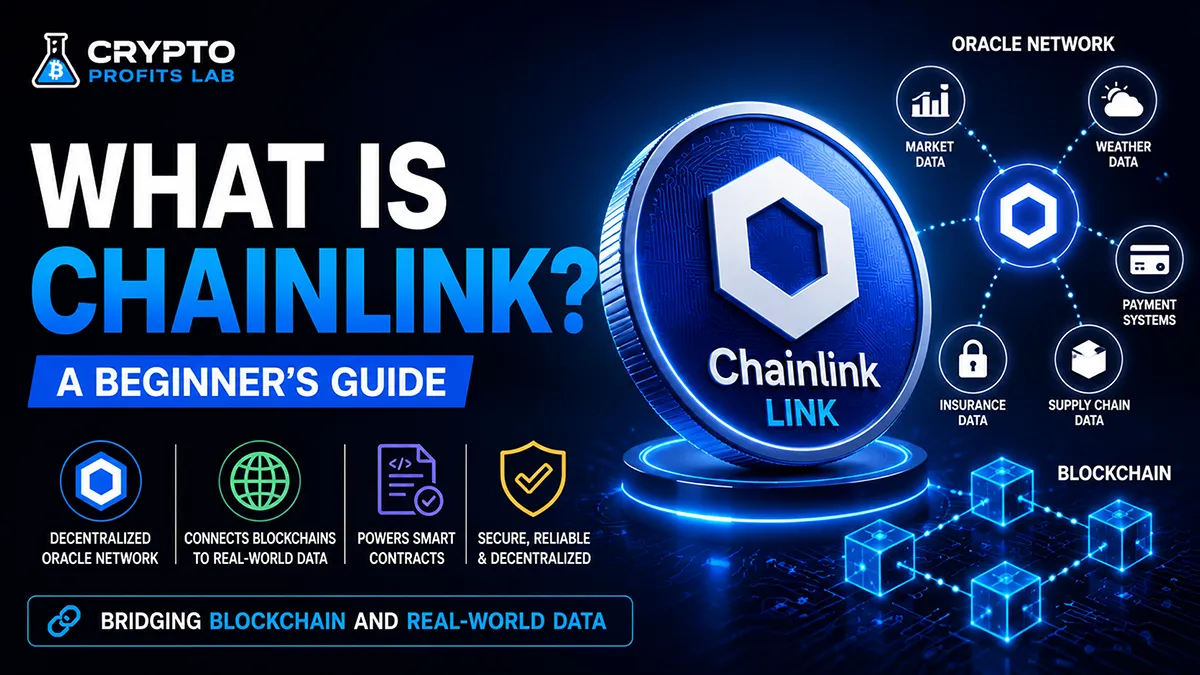
What is Chainlink and why does it matter in crypto? Chainlink is a decentralized oracle network that helps blockchains connect with real-world data, outside systems, and information that smart contracts cannot access on their own.
For beginners, Chainlink can feel different from coins like Bitcoin, Ethereum, Solana, or Cardano. Those projects are usually explained as blockchains or cryptocurrencies. Chainlink is more like infrastructure. It helps smart contracts use trusted data so decentralized applications can do more than simply move tokens around.
This guide explains What is Chainlink in plain English. You will learn what blockchain oracles are, what LINK is used for, why real-world data matters, how Chainlink supports decentralized finance, and what beginners should know before buying or using LINK.
If you are still learning the basics of digital assets, start with this beginner guide to what is cryptocurrency before going deeper into Chainlink.
What is Chainlink?
What is Chainlink? Chainlink is a decentralized oracle network that connects blockchain smart contracts to data and services outside the blockchain.
A smart contract is a program that runs on a blockchain. Smart contracts can follow rules, move tokens, and execute transactions automatically. However, blockchains are limited because they cannot easily access outside information by themselves.
For example, a smart contract may need to know:
- The current price of Bitcoin or Ethereum
- The result of a sports event
- Weather data for an insurance product
- Proof that an asset is backed by reserves
- Data from another blockchain
- Information from an external API
This is where Chainlink becomes important. Chainlink provides a way for smart contracts to receive data from outside sources without relying on one central provider.
In simple terms, What is Chainlink? It is a network that helps smart contracts securely access real-world data and off-chain information.
To better understand why this matters, read this guide to blockchain technology.
Chainlink vs LINK: What Is the Difference?
A common beginner mistake is thinking Chainlink and LINK are exactly the same thing. They are closely connected, but they do not mean the same thing.
Chainlink is the decentralized oracle network. LINK is the cryptocurrency token used inside the Chainlink ecosystem.
You can think of Chainlink as the infrastructure and LINK as the asset that supports parts of that infrastructure. LINK may be used to pay node operators, support network services, and participate in certain Chainlink-related functions.
| Term | Meaning | Beginner Explanation |
|---|---|---|
| Chainlink | Decentralized oracle network | The system that connects blockchains to outside data |
| LINK | Native token | The token used in the Chainlink ecosystem |
| Oracle | Data connector | A service that brings outside information to a blockchain |
| Smart contract | Blockchain program | Code that runs automatically on a blockchain |
What is Chainlink from a beginner’s point of view? Chainlink is the network that delivers outside data. LINK is the token connected to that network.
Why Do Blockchains Need Oracles?
Blockchains are powerful, but they have an important limitation. A blockchain can verify information that happens inside its own network, but it cannot automatically know what is happening outside of it.
This is sometimes called the oracle problem. Smart contracts need reliable outside data, but blockchains are designed to avoid trusting one central source. If one bad data source feeds false information to a smart contract, that smart contract may make the wrong decision.
Imagine a lending app that needs the current price of ETH. If the app receives incorrect price data, it could liquidate users unfairly, allow bad loans, or create major losses.
Oracles help solve this problem by bringing outside data onto the blockchain. Chainlink improves this process by using decentralized oracle networks rather than relying on only one data provider.
What is Chainlink solving? It helps smart contracts access data while reducing the risk of depending on a single centralized source.
How Does Chainlink Work?
What is Chainlink from a technical perspective? Chainlink uses oracle networks to collect, verify, and deliver data to smart contracts.
Here is a simplified version of how it works:
- A smart contract needs outside data.
- Chainlink oracle nodes gather the requested data.
- Data may come from multiple independent sources.
- The network aggregates the information.
- The smart contract receives the result.
- The application can then act based on that data.
This process helps reduce the risk of relying on one source. Instead of trusting a single website, database, or company, a Chainlink oracle network can use multiple nodes and data providers.
For beginners, the key idea is simple: Chainlink helps blockchains use outside information in a more secure and reliable way.
If you want to understand how smart contracts fit into the larger crypto market, read what is Ethereum, because Ethereum helped popularize smart contracts.
What Are Blockchain Oracles?
A blockchain oracle is a system that brings outside information to a blockchain. Without oracles, smart contracts would be limited to information already stored on-chain.
Oracles can provide many types of data, including:
- Crypto prices
- Interest rates
- Weather data
- Sports results
- Random numbers
- Reserve information
- Cross-chain messages
- Real-world event data
However, oracles must be reliable. If the data is wrong, the smart contract using that data may produce the wrong result.
Chainlink is one of the best-known oracle networks because it focuses on providing decentralized oracle services for smart contracts and blockchain applications.
Who Created Chainlink?
Chainlink was created by Sergey Nazarov and Steve Ellis. The project grew from the idea that smart contracts needed secure access to external data in order to become useful for real-world applications.
Before oracle networks became popular, many smart contracts were limited in what they could do. They could process blockchain-native data, but they struggled to connect safely with outside systems.
Chainlink helped make the oracle problem a major part of crypto education. Instead of only asking whether a blockchain is fast or cheap, developers also had to ask whether their apps could access reliable data.
This is one reason Chainlink is often described as important crypto infrastructure rather than just another coin.
What Is LINK Used For?
LINK is the token associated with Chainlink. It has several important roles inside the Chainlink ecosystem.
First, LINK can be used to pay Chainlink node operators for providing oracle services. These operators help deliver data and support smart contract activity.
Second, LINK may be involved in staking-related functions. Chainlink staking is designed to support network security and allow participants to help back oracle services.
Third, LINK is traded as a crypto asset. Some people buy LINK because they believe Chainlink infrastructure will become more important as blockchain adoption grows.
Fourth, LINK may be used across Chainlink services and ecosystem incentives depending on the specific product or network design.
What is Chainlink without LINK? Chainlink is the oracle network, but LINK is the token connected to the network’s incentives and ecosystem.
What Can Chainlink Be Used For?
What is Chainlink used for in the real crypto world? Chainlink supports many use cases because smart contracts often need reliable external data.
DeFi Price Feeds
Decentralized finance, or DeFi, is one of Chainlink’s most important use cases. DeFi apps often need accurate market prices for assets like ETH, BTC, stablecoins, and other tokens.
Price feeds can help lending platforms, decentralized exchanges, derivatives apps, and collateral systems function more reliably.
For a beginner overview of decentralized finance risks, read crypto yield farming and crypto lending.
Proof of Reserve
Proof of Reserve helps show whether certain assets may be backed by reserves. This can be useful for stablecoins, wrapped assets, exchanges, and other crypto products that depend on trust and transparency.
Proof of Reserve does not remove all risk, but it can improve visibility into certain backing claims.
Cross-Chain Communication
The crypto market has many blockchains. Ethereum, Solana, Avalanche, Polygon, and other networks all have different ecosystems. Chainlink helps support cross-chain communication through tools designed to move information between blockchains.
This matters because users and developers increasingly want applications that can work across multiple networks.
To learn more about moving assets across blockchains, read what is a crypto bridge.
Automation
Some smart contracts need actions to happen automatically when conditions are met. Chainlink automation services can help trigger smart contract functions without requiring users to manually start every action.
This can be useful for DeFi apps, gaming projects, NFT platforms, and other blockchain-based systems.
Verifiable Randomness
Some blockchain apps need random numbers. Games, NFT mints, raffles, and other applications may need randomness that users can verify.
Chainlink provides tools that can support verifiable randomness for smart contracts.
Why Chainlink Matters
What is Chainlink’s biggest purpose? Its purpose is to help smart contracts become more useful.
A smart contract that cannot access outside data is limited. It can handle on-chain activity, but it cannot easily react to real-world events. Chainlink gives developers tools to build applications that depend on prices, reserves, automation, randomness, and cross-chain data.
Chainlink matters because many blockchain use cases depend on information that does not naturally live on a blockchain. DeFi apps need prices. Insurance products may need weather data. Cross-chain apps need messages from other networks. Games may need randomness. Tokenized assets may need reserve information.
For an official resource, visit the official Chainlink website.
Chainlink vs Ethereum
What is Chainlink compared with Ethereum? Ethereum and Chainlink are not direct competitors in the same way that Ethereum and Solana might be compared.
Ethereum is a smart contract blockchain. Chainlink is an oracle network that can provide data and services to smart contracts.
| Feature | Ethereum | Chainlink |
|---|---|---|
| Main role | Smart contract blockchain | Decentralized oracle network |
| Native asset | ETH | LINK |
| Main use | Apps, tokens, DeFi, NFTs | Data feeds, oracles, automation, cross-chain services |
| Beginner view | Platform for decentralized apps | Data infrastructure for smart contracts |
Ethereum provides the environment where many smart contracts run. Chainlink helps smart contracts access outside data. In many cases, Chainlink can support applications built on Ethereum and other networks.
Chainlink vs Solana
Solana and Chainlink also serve different roles in crypto. Solana is a high-performance blockchain. Chainlink is oracle infrastructure.
Solana focuses on fast transactions, low fees, apps, NFTs, and token activity. Chainlink focuses on connecting smart contracts with external data and off-chain services.
| Feature | Solana | Chainlink |
|---|---|---|
| Main role | Blockchain network | Oracle network |
| Native asset | SOL | LINK |
| Main strength | Speed and low fees | Reliable data for smart contracts |
| Common uses | Payments, DeFi, NFTs, games | Price feeds, reserves, automation, cross-chain data |
If you want to understand Solana separately, read what is Solana.
Chainlink vs Cardano
Cardano is a proof-of-stake blockchain. Chainlink is an oracle network. They are different types of crypto projects.
Cardano focuses on ADA transactions, staking, smart contracts, and long-term blockchain development. Chainlink focuses on helping smart contracts access outside data and services.
| Feature | Cardano | Chainlink |
|---|---|---|
| Main role | Smart contract blockchain | Oracle infrastructure |
| Native asset | ADA | LINK |
| Staking | ADA can be delegated | LINK staking exists in Chainlink’s ecosystem |
| Beginner focus | Blockchain and staking | Data and smart contract connectivity |
For more context, read what is Cardano.
Is Chainlink a Blockchain?
What is Chainlink if it is not simply a blockchain? Chainlink is best understood as a decentralized oracle network. It does not compete with every blockchain as a base layer. Instead, it can serve smart contracts across different blockchain ecosystems.
This makes Chainlink different from projects like Bitcoin, Ethereum, Solana, or Cardano. Those projects are blockchain networks. Chainlink provides services that blockchain applications can use.
A beginner-friendly way to think about it is this:
- Ethereum is a smart contract platform.
- Solana is a fast blockchain network.
- Cardano is a proof-of-stake blockchain.
- Chainlink is oracle infrastructure that helps smart contracts use outside data.
This role is why Chainlink can be important even when it is not the main chain where users send transactions.
Is Chainlink Safe?
Chainlink is a major crypto infrastructure project, but using or investing in LINK still requires caution. The project may be widely known, but LINK is still a volatile digital asset.
The biggest beginner risks usually come from price volatility, scams, fake websites, bad wallet habits, and misunderstanding what Chainlink does.
Common Chainlink risks include:
- Buying LINK during hype without understanding the project
- Sending LINK to the wrong wallet address
- Losing your seed phrase
- Using fake wallet apps or fake websites
- Keeping too much crypto on an exchange
- Confusing Chainlink with a regular blockchain
- Assuming infrastructure adoption guarantees token price gains
A good beginner rule is to move slowly. Test small transactions first. Use trusted wallets and exchanges. Never share your seed phrase. Be careful with fake support messages and suspicious links.
For more protection, review crypto safety tips, crypto scams to avoid, crypto 2FA, and crypto seed phrase.
How to Store Chainlink
To hold LINK, you need a crypto wallet that supports the network version of LINK you are using. Many beginners buy LINK on a centralized exchange first, then decide whether to keep it there or move it to a personal wallet.
A wallet does not physically store coins. Instead, it stores the recovery information and private keys that let you access your crypto on the blockchain.
There are two main wallet types:
- Hot wallets are connected to the internet and are convenient for regular use.
- Cold wallets are offline hardware wallets and are usually better for long-term storage.
Hot wallets can be useful for smaller LINK balances or regular activity. Cold wallets are usually safer for larger long-term balances because they help keep private keys offline.
If you are new to wallets, start with this guide to crypto wallets. Then compare hot wallets vs cold wallets and learn why a hardware wallet may be worth considering.
How to Buy Chainlink
What is Chainlink buying like for beginners? Most people buy LINK through a crypto exchange. An exchange lets you create an account, deposit money, and purchase LINK.
A simple beginner process looks like this:
- Choose a reputable crypto exchange.
- Create your account.
- Complete identity verification if required.
- Turn on two-factor authentication.
- Deposit funds using an approved payment method.
- Search for LINK or Chainlink.
- Buy a small amount first.
- Decide whether to keep LINK on the exchange or move it to your own wallet.
Before withdrawing LINK, pay close attention to the network you are using. Sending tokens on the wrong network can cause problems or permanent loss.
For step-by-step help, read how to buy crypto for beginners. If you are still choosing a platform, review best crypto exchange for beginners and centralized vs decentralized exchanges.
Chainlink and Market Volatility
Chainlink may be an important infrastructure project, but LINK is still a volatile crypto asset. Its price can rise or fall quickly based on market sentiment, Bitcoin trends, DeFi activity, adoption news, regulation, liquidity, and investor behavior.
Beginners should not assume LINK is safe just because Chainlink is widely used in crypto. Even useful projects can experience major price swings.
Before buying LINK, consider:
- Your risk tolerance
- Your investment timeframe
- Your storage plan
- Your understanding of wallet security
- Your ability to handle price drops
- Whether you are buying for learning, trading, or long-term holding
For more context, read crypto volatility, market cap in crypto, and bull vs bear market crypto.
If you prefer a slower buying strategy, this guide to dollar cost averaging crypto may also help.
Pros and Cons of Chainlink
What is Chainlink’s biggest strength? Its biggest strength is that it solves an important problem for smart contracts: access to reliable external data.
What is Chainlink’s biggest challenge? Its biggest challenge for beginners is that it is harder to understand than a simple payment coin. Chainlink is infrastructure, so its value proposition depends on adoption, usage, and the long-term growth of smart contracts.
| Pros | Cons |
|---|---|
| Important oracle infrastructure | Harder for beginners to understand |
| Supports many smart contract use cases | LINK price can be volatile |
| Used for data feeds and automation | Adoption does not guarantee price gains |
| Helps DeFi apps access market data | Competes with other oracle solutions |
| Supports cross-chain development | Wallet and network mistakes can be costly |
Chainlink can be useful to understand, but it is not risk-free. Beginners should learn what oracles are before buying LINK.
Beginner Checklist Before Using Chainlink
Before buying LINK or using Chainlink-related tools, go through this checklist:
- Understand the difference between Chainlink and LINK.
- Learn what blockchain oracles do.
- Understand why smart contracts need outside data.
- Turn on 2FA for exchange accounts.
- Never share your seed phrase.
- Test small transactions first.
- Double-check wallet addresses before sending LINK.
- Confirm the correct network before withdrawals.
- Avoid fake Chainlink staking websites or support accounts.
- Consider a hardware wallet for larger long-term balances.
This checklist may seem basic, but it can prevent many beginner mistakes.
Final Thoughts: What Is Chainlink?
What is Chainlink? Chainlink is a decentralized oracle network that helps smart contracts connect with real-world data, external systems, automation services, cross-chain information, and other off-chain resources.
Chainlink is important because many blockchain applications need more than on-chain transactions. DeFi platforms need price data. Games may need verifiable randomness. Cross-chain apps need messaging tools. Tokenized assets may need reserve information. Chainlink helps support these kinds of smart contract use cases.
LINK is the token connected to the Chainlink ecosystem, but beginners should understand the project before buying it. Chainlink may be important infrastructure, but LINK still carries crypto market risk.
The best approach is to learn slowly. Understand oracles, protect your wallet, avoid suspicious links, and do not assume that a useful technology automatically means guaranteed investment returns. Once you understand how Chainlink works, you will have a stronger foundation for understanding smart contracts and decentralized applications.
Chainlink Frequently Asked Questions
What is Chainlink in simple terms?
What is Chainlink? Chainlink is a decentralized oracle network that helps smart contracts access real-world data. Blockchains cannot easily pull outside information by themselves, so Chainlink provides data services for prices, reserves, automation, randomness, and cross-chain communication. Beginners can think of Chainlink as infrastructure that connects blockchain apps to information outside the blockchain.
Is Chainlink the same as LINK?
Chainlink and LINK are related, but they are not the same thing. Chainlink is the decentralized oracle network, while LINK is the token connected to the ecosystem. LINK may be used for payments to node operators, staking-related functions, and ecosystem incentives. When someone says they bought Chainlink, they usually mean they bought LINK.
What is Chainlink used for?
Chainlink is used for price feeds, proof of reserve, automation, verifiable randomness, and cross-chain communication. These services help smart contracts interact with real-world data and outside systems. DeFi platforms may use Chainlink price feeds, while other applications may use Chainlink tools for reserve data, app automation, gaming randomness, or blockchain interoperability.
Why do smart contracts need Chainlink?
Smart contracts need Chainlink because blockchains cannot automatically access outside data in a reliable way. A lending app, for example, may need accurate crypto prices before issuing loans or liquidating collateral. Chainlink helps bring external data on-chain through decentralized oracle networks, reducing reliance on one centralized data source.
Is Chainlink a blockchain?
Chainlink is not usually described as a standard blockchain like Bitcoin, Ethereum, Solana, or Cardano. It is best understood as decentralized oracle infrastructure. Chainlink can support smart contracts across different blockchain ecosystems by delivering data and services. This makes it different from base-layer blockchains that primarily process transactions and host applications.
Is Chainlink a good investment?
Chainlink may be an important crypto infrastructure project, but LINK is still a volatile digital asset. Whether it is a good investment depends on your goals, risk tolerance, research, timeframe, and portfolio strategy. Beginners should understand oracles, LINK token utility, market volatility, wallet security, and competition before buying. No crypto asset offers guaranteed returns.
Can beginners buy Chainlink safely?
Beginners can buy LINK through reputable crypto exchanges, but safety depends on good habits. Use strong passwords, turn on 2FA, avoid suspicious links, and learn wallet basics before transferring funds. Start with small amounts until you understand wallet addresses, network selection, transaction confirmations, and seed phrase protection. Crypto transactions are usually irreversible.
What is Chainlink’s biggest advantage?
What is Chainlink’s biggest advantage? Its biggest advantage is that it helps smart contracts access reliable external data. This is important because many blockchain apps need prices, reserves, randomness, automation, or cross-chain information. Chainlink’s oracle infrastructure makes more advanced smart contract applications possible, although users should still consider token volatility and project risks.
Does Chainlink help DeFi?
Yes, Chainlink is widely associated with DeFi because many decentralized finance apps need accurate price data. Lending platforms, derivatives markets, stablecoin systems, and trading tools may depend on reliable data feeds. Chainlink price feeds can help these applications function more securely, but DeFi still carries risks such as smart contract bugs, liquidity problems, and user mistakes.