Crypto Slashing: What Stakers Need to Know
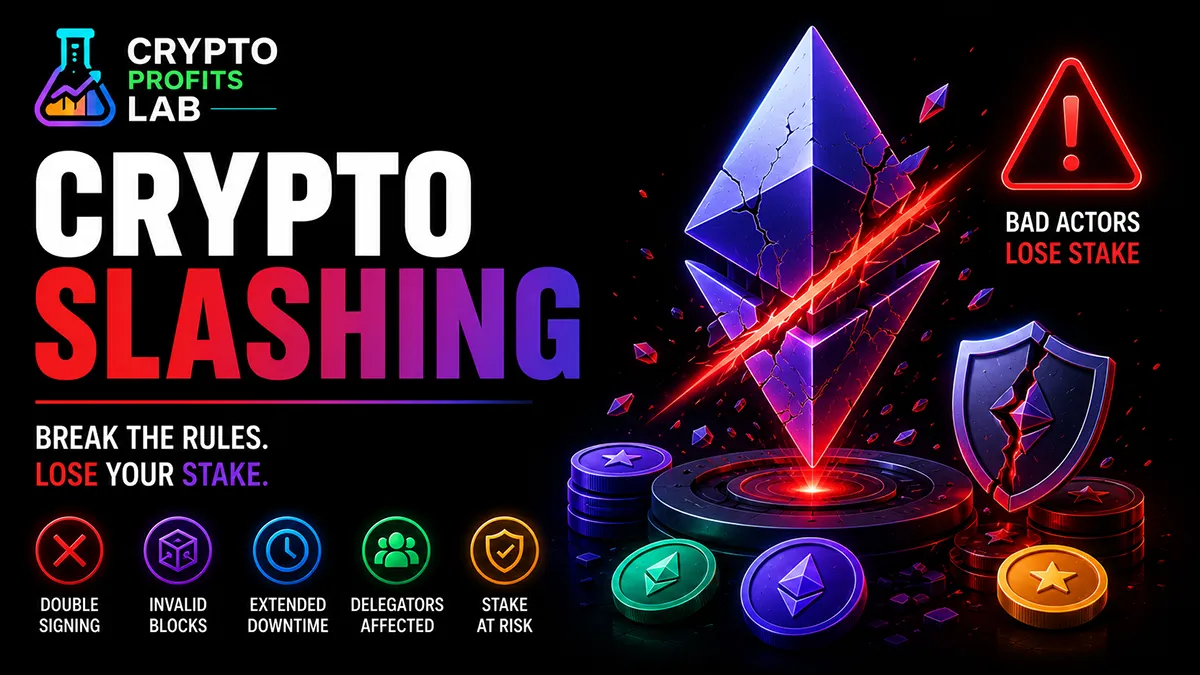
Staking can help a proof-of-stake blockchain operate securely while giving participants a chance to earn rewards. However, staking is not a savings account, and those rewards come with responsibilities.
One important risk is crypto slashing.
Crypto slashing is a penalty that can remove some or all of the cryptocurrency connected to a validator when serious network rules are broken. Depending on the blockchain and staking method, the validator operator, people who delegated to that validator, or both may share the loss.
This guide explains why slashing exists, what can trigger it, and how beginners can lower their exposure before staking.
Quick Answer
Crypto slashing is a penalty used by some proof-of-stake blockchains to punish validators for behavior that threatens the network.
A validator may be slashed for signing conflicting messages, approving invalid information, or committing another offense defined by that blockchain. Some networks also apply smaller penalties or temporary removal for extended downtime.
The amount lost varies by network, offense, and staking arrangement. A solo validator may bear the loss directly, while someone using a pool, exchange, or delegation service may be affected by the provider’s rules.
Crypto slashing helps make dishonest behavior expensive, but it also creates a real financial risk for stakers.
Key Takeaways
- Crypto slashing can destroy or remove part of the stake connected to a validator.
- Slashing rules differ across proof-of-stake blockchains.
- Serious offenses usually receive stronger penalties than ordinary downtime.
- A validator may also be removed or temporarily blocked from participating.
- Delegators can sometimes share a validator’s penalty.
- Staking through an exchange or pool does not automatically eliminate slashing risk.
- Duplicate validator keys and conflicting signatures are major operational dangers.
- Restaking can introduce additional penalty conditions.
- Staking rewards are never guaranteed to exceed possible losses.
- Beginners should research the operator, custody model, and penalty policy before staking.
Crypto Slashing Beginner Facts
| Question | Beginner-Friendly Answer |
|---|---|
| What is slashed? | Some or all of the cryptocurrency placed at stake. |
| Who receives the penalty? | Usually the validator, but delegators or pool participants may also be affected. |
| Does every blockchain use slashing? | No. Rules and penalty systems vary by network. |
| Is downtime always slashable? | Not always. Some networks use smaller inactivity penalties or temporary removal instead. |
| Can an honest mistake cause a loss? | Yes. Bad key management or duplicate validator setups can create conflicting signatures. |
| Can the full stake be lost? | On some networks and under severe conditions, losses can be very large. |
| Does a staking service protect users? | Only when its written terms provide specific protection, and that protection may have limits. |
| Is slashing the same as a falling token price? | No. Slashing reduces token quantity; market volatility changes token value. |
| Can a slashed validator keep validating? | It may be removed, jailed, or forced to exit, depending on the network. |
| Can beginners reduce the risk? | Yes, by choosing reliable operators, understanding custody, and avoiding complex strategies they do not understand. |
What Is Crypto Slashing?
Crypto slashing is a rule-based penalty in which a proof-of-stake blockchain removes some or all of the assets associated with a validator after a serious violation.
Proof of stake is a method that blockchains can use to choose validators and confirm the network’s history. Validators commit cryptocurrency as financial security. They can earn rewards for following the rules, but their stake can be placed at risk when they act against the protocol.
Our guide to proof of stake explains that system from the beginning.
The Ethereum.org guide to proof-of-stake rewards and penalties explains that slashing removes a validator from the network and destroys part of its stake. It also explains that losses can become larger when many validators are slashed around the same time.
Crypto slashing creates an economic reason to behave honestly. A validator that attempts to manipulate the network may lose the same assets it deposited to gain influence.
A Simple Slashing Example
Imagine a referee who places a $1,000 security deposit before working a game.
The referee earns payment for following the rules and reporting events honestly. If the referee submits two conflicting official scores for the same game, the organization can prove the misconduct and take part of the deposit.
The deposit gives the referee something valuable to lose.
A blockchain validator works differently, but the basic idea is similar. Staked crypto acts as financial collateral. Crypto slashing makes certain harmful actions expensive instead of relying only on trust.
Why Proof-of-Stake Networks Use Slashing
A public blockchain may have validators located around the world. Those validators do not need to know or trust one another personally.
The protocol needs a way to encourage consistent behavior.
Rewards encourage validators to stay online and perform useful work. Penalties discourage them from ignoring duties or trying to create conflicting versions of the blockchain.
Crypto slashing is normally reserved for behavior that can damage agreement about the network’s history. This is called consensus. Consensus means the network reaches agreement about which transactions and blocks are valid.
Without meaningful consequences, a dishonest validator could attempt harmful actions without placing much at risk. Slashing helps connect influence with financial responsibility.
How Crypto Slashing Works Step by Step
The exact process depends on the blockchain, but the general sequence is similar.
Step 1: A Validator Commits Stake
A validator locks or commits an eligible cryptocurrency according to the network’s rules.
The stake gives the validator an economic interest in the network and can qualify it to perform duties. Learn more about the role in our crypto validator guide.
Step 2: The Validator Signs Network Messages
Validators use special keys to sign messages.
A digital signature proves that a particular validator approved a block, vote, or other consensus message. It does not reveal the private signing key.
Step 3: The Network Detects a Rule Violation
Other participants can compare signed messages and identify provable conflicts.
For example, a validator may sign two different blocks for the same point in the process. Because both signatures are public evidence, the protocol can connect them to the validator.
Step 4: The Protocol Applies the Penalty
The blockchain follows its programmed rules.
The penalty may remove part of the validator’s stake, stop rewards, force the validator to exit, or temporarily prevent it from participating. The severity depends on the offense and the network.
Step 5: Delegators or Pool Members May Be Affected
On some networks, people who delegated assets to the validator share the economic result.
A pool or centralized provider may handle the loss differently. It might pass the penalty to users, absorb some of it, use insurance, or apply terms that are difficult to understand.
Step 6: The Validator Exits or Recovers
Some networks permanently eject a seriously offending validator. Others may temporarily jail a validator and allow it to return after a waiting period or corrective action.
A slashed validator does not necessarily receive immediate access to its remaining stake.
What Actions Can Trigger Crypto Slashing?
There is no universal list for every blockchain. The protocol defines which actions are slashable.
Common examples include the following.
Double Signing
Double signing occurs when a validator signs conflicting blocks or votes for the same network position.
This can happen deliberately, but it can also result from an operator running the same validator keys on two machines at once. Each machine may sign a different message, creating proof of a violation.
Duplicate setups are therefore not always safe backups.
Surround Votes or Conflicting Attestations
Some protocols require validators to vote in a way that preserves one consistent chain history.
Signing votes that conflict with earlier votes can violate those rules. The technical details differ by network, but the purpose is to prevent validators from helping finalize incompatible histories.
Approving Invalid Information
A validator may be penalized for supporting invalid blocks, false data, or other prohibited network messages.
The rules depend on the validator’s responsibilities. A service secured through restaking may define additional tasks and offenses beyond the original blockchain.
Extended Downtime
Downtime means a validator is unavailable and misses required duties.
Some networks slash for prolonged downtime. Others apply smaller inactivity penalties, remove the validator from the active set, or temporarily jail it without using the same severe penalty as double signing.
Beginners should not assume that every missed block causes crypto slashing.
Coordinated Misconduct
Some systems increase penalties when many validators commit the same offense together.
This discourages a large operator, shared hosting provider, software bug, or coordinated attacker from causing a widespread failure. It also means concentration can make a single operational problem more serious.
Slashing vs Ordinary Staking Penalties
Not every loss of staking rewards is crypto slashing.
A validator can face several types of negative outcomes:
| Outcome | What It Usually Means |
|---|---|
| Missed reward | The validator did not complete a rewarded duty. |
| Inactivity penalty | A small amount is deducted for being offline or failing to participate. |
| Jailing | The validator is temporarily removed from active duties. |
| Slashing | Stake is removed for a defined serious offense. |
| Forced exit | The validator is removed from the active validator set. |
| Market loss | The token price falls, even if validator performance is perfect. |
These terms are sometimes used loosely by exchanges or staking websites. Read the provider’s definitions instead of assuming every penalty works the same way.
Can Delegators Lose Crypto Through Slashing?
Yes, on some networks.
Delegation allows a token holder to assign staking power to a validator without operating the validator equipment. The holder may receive a portion of rewards, but the assets can be exposed to the validator’s performance and behavior.
If that validator commits an offense, the network may reduce both the validator’s own stake and assets delegated to it.
The result varies by protocol. Some networks limit delegator exposure, some share losses directly, and others have changed their rules over time.
Before delegating, find out:
- Whether delegated assets can be slashed
- Which offenses affect delegators
- How penalties are calculated
- Whether the validator has its own stake at risk
- Whether you can change validators
- Whether switching requires an unbonding period
- Whether the provider offers any reimbursement
A validator’s high reward rate should not be considered separately from its operating quality and penalty history.
Can a Staking Pool Be Slashed?
A crypto staking pool combines assets from multiple participants while an operator or group of operators manages validators.
When a pool validator commits a slashable offense, the effect depends on the pool’s design.
A decentralized pool may automatically reduce the value represented by participants’ positions. A centralized exchange may absorb the loss, pass it to customers, or follow special terms. A provider may advertise protection, but exclusions and coverage limits can apply.
Crypto slashing risk does not disappear simply because the staking process has one button.
Slashing and Liquid Staking
Liquid staking gives users a token representing a staked position.
If the underlying validators lose assets, that loss can reduce the value backing the liquid staking token. The market price may also fall below the value it is intended to represent, especially during stress or heavy selling.
This creates two separate risks:
- The underlying stake can be penalized.
- The liquid token can lose market value or liquidity.
A liquid staking token is convenient, but it is not a guarantee against crypto slashing.
Slashing and Restaking
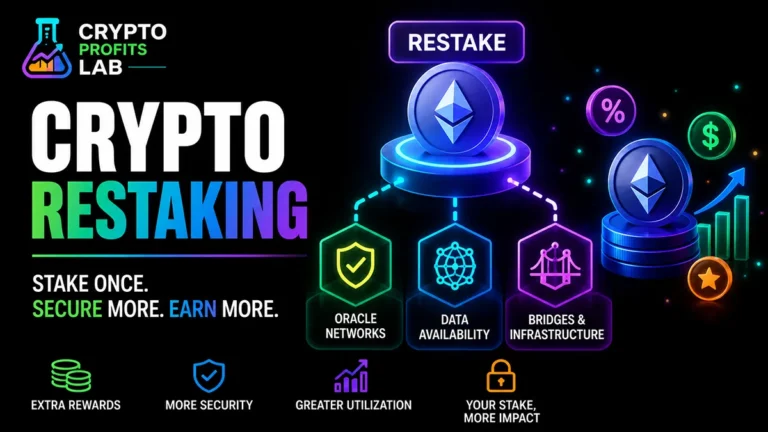
Crypto restaking uses already-staked assets to help secure additional decentralized services.
This may create extra reward opportunities, but it can also create extra penalty conditions. The original blockchain has its rules, while each added service may introduce another set of responsibilities.
Restakers should understand:
- Which services are being secured
- Which actions are slashable
- Whether one service can affect the full position
- Who chooses operators
- How losses are divided
- Whether slashing is already active
- How withdrawals and unbonding work
Adding more reward sources can also add more ways for the stake to be reduced.
How Much Can Be Lost?
There is no single crypto slashing percentage.
The possible loss depends on:
- The blockchain
- The type of offense
- The number of validators involved
- The validator’s effective stake
- The amount delegated
- The pool or provider’s loss-sharing rules
- Whether additional restaking conditions apply
A small isolated offense may produce a limited loss on one network, while coordinated or severe misconduct can produce a much larger penalty. Some systems can remove a substantial portion of the stake.
Do not rely on a general statement such as “slashing is rare.” Even a low-probability event matters when the possible loss is large, or the provider controls a large balance.
How Validator Operators Reduce Slashing Risk
Professional operators may use several safeguards:
- Slashing-protection databases that check new signatures against earlier ones
- Careful key management that prevents the same active key from running on two machines
- Monitoring for missed duties, software failures, and network problems
- Tested procedures for updates, migrations, backups, and recovery
- Diverse software and infrastructure that reduce shared failure risk
These protections require careful coordination. A rushed migration or incorrect backup setup can place two copies of one validator online and create conflicting signatures.
How Beginners Can Lower Slashing Risk
Most beginners will not run a validator directly. They will delegate, join a pool, use liquid staking, or stake through an exchange.
These steps can improve decision-making.
Step 1: Understand the Network
Read the blockchain’s official staking and penalty rules.
Find out whether downtime, double signing, invalid votes, or other behavior can reduce delegated funds.
Step 2: Identify the Staking Structure
Determine whether you are:
- Running a solo validator
- Delegating from your own wallet
- Joining a pool
- Depositing with an exchange
- Receiving a liquid staking token
- Participating in restaking
Each arrangement places control and risk in different locations.
Step 3: Research the Operator
Review uptime, experience, commission, self-stake, security practices, client diversity, and any recorded incidents.
A high annual rate does not compensate for poor operations.
Step 4: Read the Loss Policy
Find the written terms for crypto slashing.
Check whether the provider reimburses losses, whether protection is discretionary, and whether exclusions apply to software bugs, network events, or user actions.
Step 5: Avoid Concentrating Everything
Placing every staked asset with one operator creates a single point of exposure.
Diversification may reduce provider-specific risk, although it cannot remove market or protocol risk.
Step 6: Start Small
Test the staking, reward, unstaking, and withdrawal process with an amount that is not needed for expenses.
Starting small also makes it easier to learn without placing a large balance at risk.
Common Beginner Mistakes
Assuming Staking Rewards Are Guaranteed
Staking rewards can change, and penalties can reduce them.
Compare the possible reward with market, custody, liquidity, and crypto slashing risks.
Choosing Only by the Highest APY
A high rate may reflect a risky validator, promotional incentive, volatile token, or more complex strategy.
Review our APR vs APY in crypto guide before comparing advertised returns.
Believing an Exchange Removes All Risk
An exchange may simplify staking, but it adds custody and counterparty risk.
It may also change reward rates, pause withdrawals, or apply its own loss policy.
Ignoring Validator Concentration
A large operator may run many validators on the same infrastructure.
A shared failure can affect many users at once.
Treating Redundant Validators Like Normal Backups
Running one signing key simultaneously on two machines can lead to double signing.
Validator redundancy requires specialized procedures.
Confusing Slashing With Token Volatility
Crypto slashing reduces the amount of staked crypto. Price volatility changes what the remaining crypto is worth.
Both can occur at the same time.
Restaking Before Understanding Basic Staking
Restaking adds services, operators, contracts, and penalty rules.
Beginners should understand ordinary crypto staking before adding another layer.
Wallet and Security Risks
Slashing is not the only way to lose staked assets. Phishing, stolen recovery phrases, malicious approvals, and compromised exchange accounts can cause even larger losses.
Use these protections:
- Never share a seed phrase or private key.
- Use official staking websites and wallet applications.
- Bookmark verified pages instead of clicking search advertisements.
- Enable strong two-factor authentication on custodial accounts.
- Read every wallet prompt before signing.
- Keep recovery words offline.
- Consider a hardware wallet when compatible.
- Use a small test transaction with a new service.
- Verify withdrawal addresses and networks.
- Ignore private messages offering staking support.
Our crypto safety tips guide covers the basic habits that protect beginners from common scams and mistakes.
Is Staking Worth the Slashing Risk?
There is no answer that fits every person or asset.
Staking can support a proof-of-stake network and provide possible rewards. The decision still depends on the asset’s quality, market risk, provider, fees, lockup period, tax situation, and penalty exposure.
A small expected yield should not be used to justify holding a token you do not believe in or using a service you do not trust.
Learn where crypto rewards for beginners come from and compare the complete risk, not just the advertised percentage.
Crypto Slashing Frequently Asked Questions
What is crypto slashing in simple terms?
Crypto slashing is a penalty that removes some or all of the cryptocurrency connected to a proof-of-stake validator after a serious network-rule violation. It helps discourage dishonest or conflicting behavior. Depending on the blockchain and staking arrangement, the validator operator, delegators, pool participants, or a service provider may bear the financial loss.
What causes a validator to be slashed?
Common triggers include double signing, signing conflicting votes, supporting invalid information, or violating another consensus rule defined by the blockchain. Some networks also slash for extended downtime, while others use smaller inactivity penalties or temporary jailing. Because the rules differ, stakers should read the official documentation for the exact network they use.
Can I be slashed when delegating crypto?
Yes, some proof-of-stake networks apply a validator’s penalty to assets delegated to that validator. Other networks limit delegator losses or use different systems. A wallet remaining under your control does not necessarily mean the delegated stake is free from protocol penalties. Check the network’s delegation rules and the validator’s operating history before committing assets.
Can a crypto exchange protect users from slashing?
An exchange may choose to absorb some validator penalties or offer limited protection, but this is a business policy rather than a universal blockchain guarantee. Coverage may have exclusions, caps, or discretionary terms. Users should read the exchange’s staking agreement to learn whether crypto slashing losses are passed to customers and how reimbursements are handled.
Is validator downtime the same as slashing?
Not always. Many networks treat ordinary downtime less severely than deliberate or conflicting behavior. A validator may miss rewards, receive a small inactivity penalty, or be temporarily removed. Some blockchains do slash for extended downtime. The word slashing should be reserved for the penalty defined by that network rather than every reduction in rewards.
Can a validator lose its entire stake?
It may be possible under certain networks or extreme conditions. The maximum loss depends on the protocol, offense, and whether many validators are penalized together. Some incidents cause only a small deduction, while coordinated misconduct can create much larger losses. Never assume that only the validator’s rewards, rather than its principal stake, are at risk.
Does liquid staking remove slashing risk?
No. A liquid staking token represents an underlying staked position, so validator penalties can reduce the assets supporting that token. The token can also face smart contract, liquidity, and depegging risks. Liquid staking can make a position easier to trade or use, but it does not remove the original staking and validator risks.
How can beginners reduce crypto slashing risk?
Beginners can choose established operators, review performance and penalty history, understand whether delegated funds are slashable, read provider reimbursement terms, avoid concentrating everything with one validator, and start with a small amount. They should also learn the unstaking process and protect their wallet, because scams and stolen keys remain separate risks.
Final Thoughts
Crypto slashing is one of the mechanisms that makes proof-of-stake security meaningful.
Validators can earn rewards when they follow the rules, but they also place valuable assets at risk. Serious conflicting or dishonest behavior can lead to lost stake, removal from the validator set, and losses for delegators or pool participants.
Beginners do not need to fear all staking, but they should not treat it like guaranteed interest. Learn the network’s rules, understand who operates the validator, review how losses are shared, and begin with a small amount.
Crypto Profits Lab provides cleaner, simpler explanations so beginners can understand both the potential rewards and the risks before staking crypto.
Educational content only. This article does not provide financial, legal, tax, or investment advice.