Crypto Vesting Explained: A Beginner’s Guide to Token Lockups
Crypto projects often create a large supply of tokens before all of those tokens are available for trading. Some may be sold to the public, while others are reserved for founders, employees, early investors, advisors, community rewards, or future development.
Crypto vesting controls when those reserved tokens become available.
For beginners, this matters because a project can look attractive today while a large amount of its supply is still locked. When those tokens are released later, the circulating supply may rise. That does not automatically cause the price to fall, but it can change the balance between buyers and sellers.
This guide explains crypto vesting in plain English, including cliffs, linear schedules, token unlocks, risks, and the questions beginners should ask before buying a token.
Educational note: This article is for general education and does not provide financial, tax, or legal advice.
Quick Answer: What Is Crypto Vesting?
Crypto vesting is a system that locks certain tokens and releases them according to a schedule or set of conditions.
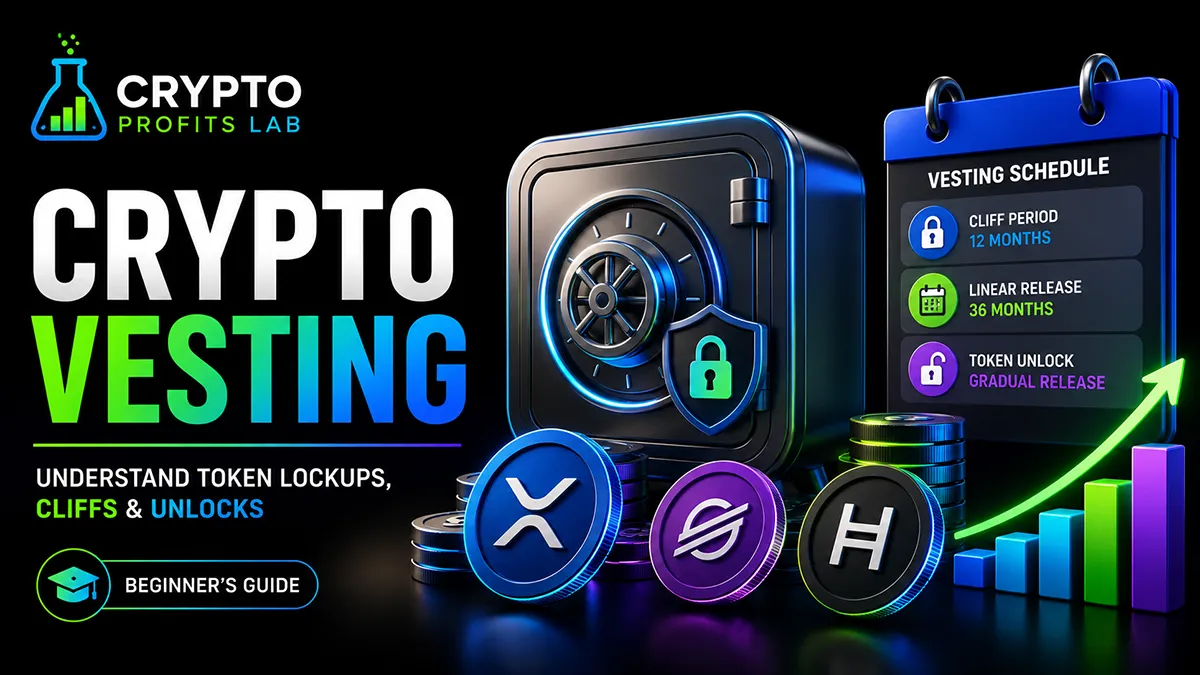
A project might give tokens to team members but prevent those tokens from being sold immediately. For example, the team could wait one year before receiving any tokens, then receive a small portion each month for the next three years.
The waiting period can encourage long-term participation and reduce the chance that insiders sell their entire allocation shortly after launch. However, crypto vesting does not prove that a project is safe, honest, or valuable. It is only one part of the project’s overall design.
Key Takeaways
- Crypto vesting delays access to tokens assigned to founders, team members, investors, advisors, or other groups.
- A cliff is a waiting period during which no scheduled tokens are released.
- Linear vesting releases tokens gradually in equal portions.
- A token unlock is the event when previously locked tokens become available.
- Unlocks may increase circulating supply, but price effects depend on demand, liquidity, expectations, and holder behavior.
- Beginners should compare the circulating supply with the total supply and review future unlock dates.
- A long schedule may encourage commitment, but it does not guarantee that a project is trustworthy.
- Vesting information should be checked in official project documents rather than social media posts alone.
Vesting Facts for Beginners
| Question | Beginner-Friendly Answer |
|---|---|
| What is being locked? | Tokens assigned to specific people, organizations, reward programs, or project funds |
| Who may receive vested tokens? | Founders, employees, advisors, early investors, partners, and community members |
| What is a cliff? | A waiting period before the first release |
| What is linear vesting? | A schedule that releases equal portions over time |
| What is an unlock? | The point when locked tokens become accessible or transferable |
| Does an unlock always lower the price? | No. The result depends on demand, selling activity, liquidity, and expectations |
| Where can a schedule be found? | Official project documentation, tokenomics pages, whitepapers, governance proposals, or vesting dashboards |
| Is vesting a safety guarantee? | No. It is one research factor, not proof that a project is legitimate |
What Does Token Vesting Actually Do?
Crypto vesting separates token ownership from immediate access.
A founder may be promised one million tokens, but that does not necessarily mean all one million can be transferred or sold on the first day. The tokens may be held in a vesting contract, locked wallet, treasury system, or another arrangement that releases them over time.
This distinction is important. A person can have a future right to tokens without having full control of them today.
The process is often connected to a project’s tokenomics, which explains how a token’s supply, distribution, utility, and incentives are designed. If you are new to the subject, it also helps to understand the difference between a coin and a crypto token.
Vesting schedules can be enforced by computer code, managed by a custodian, or administered through a project-controlled process. Smart-contract-based schedules can make releases easier to verify, but they can still contain coding errors or administrative controls.
Why Do Crypto Projects Use Vesting?
Projects use vesting mainly to connect token rewards with long-term participation.
Encourage Team Commitment
A team member who receives every token immediately could leave and sell. A multi-year schedule may encourage continued work, similar to employee stock benefits that become available gradually.
Limit Immediate Insider Selling
Founders, advisors, and early investors may receive tokens at lower prices than public buyers. Locking those allocations can reduce how much they can sell at launch, although it cannot prevent selling after an unlock.
Manage Distribution
A project may release supply over months or years instead of making every token available on day one. Gradual releases can be easier to absorb, but the size and purpose of each allocation still matter.
Support Rewards
Developers, validators, users, or community members may earn tokens over time or after completing goals.
Improve Transparency
A detailed schedule shows who receives tokens, how many are locked, and when releases are expected. Beginners should still verify that the published rules are followed.
How Token Vesting Works Step by Step
The details differ between projects, but the process usually follows these steps.
Step 1: Divide the Token Supply
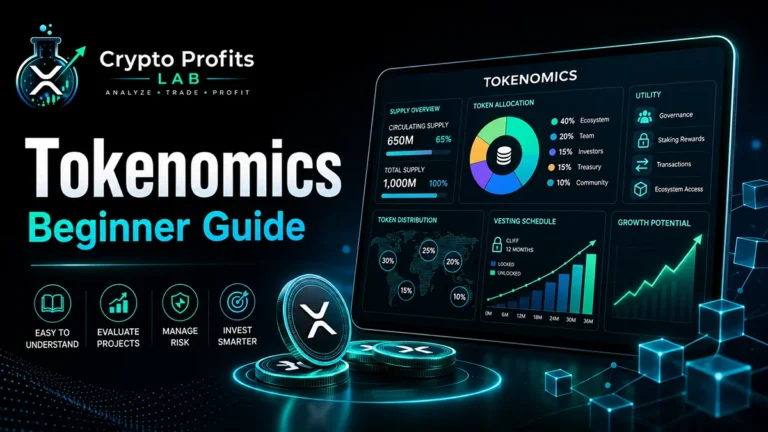
The project assigns portions of the total supply to groups such as the public, team, investors, treasury, advisors, and community rewards.
Example:
- 40% for community rewards
- 20% for the team
- 15% for early investors
- 10% for a foundation
- 10% for partnerships
- 5% for advisors
Step 2: Choose Which Allocations Are Locked
Public-sale tokens may be available immediately while team and investor tokens follow different schedules. A statement such as “four-year vesting” is incomplete unless it identifies the affected group.
Step 3: Set the Start Date
The schedule might begin at the token launch, a funding date, an employee’s start date, or another event. The start date determines when the cliff and later releases occur.
Step 4: Apply a Cliff
A cliff is a period with no scheduled releases. With a 12-month cliff, a recipient generally receives none of the allocation during the first year.
Step 5: Release Tokens
After the cliff, tokens may unlock daily, monthly, quarterly, annually, or after milestones. Linear schedules release equal portions, while other schedules vary the amount.
Step 6: Make Tokens Accessible
Unlocked tokens may be transferred automatically or become claimable through an official interface. Our guide to token unlocks in crypto explains this event in more detail.
Step 7: Watch What Recipients Do
Recipients may hold, stake, transfer, use, or sell the tokens. An unlock creates access; it does not automatically create a sale.
Main Types of Vesting Schedules
Beginners will commonly see five types.
Cliff Vesting
No tokens are released during an initial waiting period. A percentage may unlock at the end of the cliff, so check the size of that first release.
Linear Vesting
Equal portions unlock over time. For example, 1/36 of an allocation may be released each month for three years.
Graded Vesting
Tokens unlock in unequal stages, such as 10% after year one, 20% after year two, and larger percentages later.
Milestone-Based Vesting
Releases depend on a goal, such as completing a product, audit, or development target. Check who decides whether the milestone has been met.
Hybrid Vesting
A hybrid schedule combines time and performance conditions. It may align several goals, but it can also be harder to verify.
A Simple Vesting Example
Imagine a project assigns 120,000 tokens to a developer.
The schedule includes:
- A 12-month cliff
- A 36-month linear release after the cliff
- No tokens available during the first year
- Approximately 3,333 tokens released each month for the next 36 months
At the end of the first year, the first monthly portion may unlock. Another portion then unlocks each month until the entire allocation has been released.
Now imagine that 100 developers have the same arrangement. The monthly release would be much larger than one person’s allocation suggests.
This is why beginners should look at the project-wide schedule, not just a single wallet or team member.
Vesting vs. Lockups vs. Token Unlocks
These terms are related, but they are not identical.
| Term | Meaning |
|---|---|
| Vesting | The process that determines when a recipient earns or gains access to tokens |
| Lockup | A restriction that prevents tokens from being transferred or sold for a period |
| Token unlock | The event when previously restricted tokens become available |
| Allocation | The portion of supply assigned to a person, group, or purpose |
| Circulating supply | Tokens currently available to the public market, subject to the project’s reporting method |
| Total supply | The number of tokens that exist, minus any tokens permanently removed under the project’s definition |
A lockup may simply block transfers until one date. A vesting schedule often releases an allocation gradually. In everyday crypto discussions, however, people sometimes use the words interchangeably.
Always read the project’s own definitions.
How Vesting Can Affect Token Supply
Crypto vesting matters because many market statistics focus on the supply available today, while investors also need to consider the supply that may become available later.
Suppose a token has:
- 100 million tokens circulating today
- 500 million tokens created in total
- 400 million tokens still locked or reserved
Its current market may be based on only one-fifth of the total created supply. Future releases could increase the amount available for trading.
This does not mean the token is automatically overpriced. The remaining tokens may unlock over many years, support useful rewards, or never be sold. However, ignoring future supply can create an incomplete picture.
Our beginner guide to market cap in crypto explains how price and circulating supply work together.
Does Crypto Vesting Affect Price?
Crypto vesting can affect price, but there is no rule that every unlock causes a decline.
Price depends on both supply and demand. An unlock can increase the number of tokens that holders can sell. If demand does not grow and many recipients sell, downward pressure may increase.
Other outcomes are possible:
- Recipients may hold the tokens.
- The market may have expected the unlock months earlier.
- New demand may absorb the additional supply.
- The unlocked amount may be small compared with normal trading volume.
- Positive project developments may outweigh supply concerns.
- Poor market conditions may cause a decline even without an unlock.
Liquidity also matters. A large release may be easier to absorb in an active market than in a thinly traded one. Learn why this matters in our guide to crypto liquidity.
Beginners should avoid treating an unlock calendar as a guaranteed price-prediction tool.
How to Find a Crypto Vesting Schedule
Start with official sources rather than social media summaries.
1. Read the Tokenomics Page
Look for allocation percentages, release dates, and definitions for circulating, locked, and reserved supply.
2. Review the Whitepaper
A crypto whitepaper may explain how the supply is distributed. Check its publication date because later updates may replace the original schedule.
For another plain-English definition, see Coinbase’s explanation of vesting in crypto.
3. Identify Every Major Allocation
Check team, investor, advisor, foundation, treasury, community, airdrop, partnership, and market-making allocations.
4. Record Important Dates
Write down:
- The start date
- The cliff length
- The first unlock date
- The amount released
- The release frequency
- The final release date
A simple calendar can make a complicated schedule easier to understand.
5. Compare Current and Future Supply
Note how much is circulating today and how much may enter circulation later. Also check emissions, burns, or an unlimited supply.
6. Verify Activity When Possible
If addresses are public, a blockchain explorer may show balances and transfers.
On-chain data can improve transparency, but it can be difficult to interpret. A transfer from a vesting contract does not prove that the tokens were sold.
7. Check for Changes
Governance votes, contract migrations, or agreements may alter a schedule. Compare dated announcements with the original documents.
How to Evaluate a Crypto Vesting Schedule
Evaluate the schedule as part of the whole project.
Ask:
- How much supply goes to founders, investors, and advisors?
- How long is the cliff?
- Are releases gradual or concentrated on a few dates?
- Are dates, percentages, and recipient groups clearly disclosed?
- Can an administrator, company, or governance vote change the rules?
- Does the token have a real use that may create demand?
- Is there enough trading liquidity to absorb future releases?
- Does the allocation match claims such as “community-owned”?
A long schedule does not remove concentration risk. If insiders control a large allocation, they may still gain substantial selling power or governance influence as tokens unlock.
Crypto Vesting and Tokenomics
Crypto vesting is one part of tokenomics, not the complete picture.
Tokenomics may also include:
- Total and maximum supply
- Circulating supply
- New token emissions
- Token burns
- Staking rewards
- Fees
- Governance rights
- Treasury holdings
- Utility
- Distribution among holders
- Future unlocks
A project could have a reasonable vesting schedule but weak token utility. Another could have useful technology but an extremely concentrated supply.
Beginners should combine supply research with an understanding of the product, team, security, governance, and competition.
Warning Signs to Watch For
Clear dates, complete allocation percentages, gradual releases, and verifiable contracts are helpful signs.
Be more cautious when:
- Team or investor allocations are hidden.
- Different documents show different schedules.
- The project uses vague phrases without dates or percentages.
- A large share unlocks shortly after launch.
- Administrators can release tokens early without clear limits.
- Tokens move before the stated date without explanation.
- Promoters claim that locked tokens make an investment risk-free.
- A website asks you to connect a wallet merely to view public information.
Vesting can reduce one type of risk while leaving many others unchanged.
Common Beginner Mistakes
Mistake 1: Looking Only at Circulating Supply
A token may appear scarce today while a much larger amount is scheduled for release. Compare current supply with total allocations and future unlocks.
Mistake 2: Assuming Long Vesting Proves Quality
A weak or dishonest project can publish a long schedule. Research the product, team, security, utility, and distribution too.
Mistake 3: Treating Every Unlock as a Guaranteed Sell-Off
Recipients can hold, stake, transfer, use, or sell unlocked tokens. The market may also anticipate a known event.
Mistake 4: Ignoring Who Receives the Tokens
A community-reward release may be different from an investor release. Identify the recipient group and the purpose of the allocation.
Mistake 5: Clicking Fake Claim Links
Scammers may create fake “vesting claim” pages that request wallet access. Use official channels, verify the domain, and review our guide to crypto scams to avoid.
Mistake 6: Relying on Old Documents
An original whitepaper may no longer show the active schedule. Check later announcements, governance proposals, and contract migrations.
Crypto Vesting Safety and Risk
Vesting can improve transparency, but it introduces several risks.
Smart Contract Risk
Some schedules use smart contracts. A coding error could delay releases or expose funds. An audit reduces uncertainty but is not a guarantee.
Administrative Risk
A project may be able to pause, change, cancel, or accelerate releases. Find out who controls those functions.
Concentration and Liquidity Risk
Founders or investors may eventually control a large supply. Their releases may be difficult for a low-liquidity market to absorb.
Volatility Risk
Prices can move sharply before or after an unlock. Our guide to crypto volatility explains why fast price changes are common.
Data and Scam Risk
Third-party calendars may be outdated, and fake dashboards may request wallet permissions. Confirm key details through official sources and never enter a seed phrase.
A functioning vesting schedule cannot rescue a project that lacks users, security, funding, or useful technology.
A Beginner Checklist Before Buying
Use this checklist:
- Find the official tokenomics and vesting documents.
- Record circulating, total, and maximum supply.
- List team, investor, advisor, treasury, and community allocations.
- Note each major cliff and upcoming unlock.
- Compare the release with current circulating supply and normal trading volume.
- Check whether releases are automatic, claimable, or administrator-controlled.
- Look for previous schedule changes.
- Verify public transfers with a blockchain explorer when possible.
- Avoid unknown claim pages and wallet requests.
- Never invest money you cannot afford to lose.
The checklist cannot predict price. It helps reveal supply risks that a chart may not show.
Final Thoughts
Crypto vesting is a structured way to delay and gradually release tokens. It is commonly used for founders, employees, advisors, investors, and reward programs.
For beginners, the most important lesson is simple: the supply available today may be only part of the supply that can enter the market later.
A schedule can encourage long-term participation and make token distribution easier to understand. It can also create future supply pressure, concentration risk, smart contract risk, and opportunities for misleading claims.
Do not judge a project by the words “locked” or “vested” alone. Read the dates, percentages, recipient groups, control rules, and official updates. Then compare crypto vesting with the project’s utility, liquidity, security, and wider tokenomics.
Clear education is more useful than hype. Crypto Profits Lab is designed to help beginners understand these details one step at a time before making decisions.
Crypto Vesting Frequently Asked Questions
What is crypto vesting in simple terms?
Crypto vesting is a process that delays when certain tokens become available to their recipients. A project may promise tokens to founders, employees, advisors, or early investors but release those tokens gradually. The schedule can include a waiting period, regular releases, or performance conditions. Vesting may encourage longer-term participation, but it does not guarantee that the token or project is safe.
What is a cliff in a crypto vesting schedule?
A cliff is a waiting period before the first scheduled tokens become available. For example, a 12-month cliff may prevent a team member from receiving any vested tokens during the first year. After the cliff, a portion may unlock at once, or releases may begin gradually. Beginners should check the first unlock amount because a large cliff release can create a noticeable supply event.
What is linear crypto vesting?
Linear crypto vesting releases an allocation in equal portions over a defined period. A project might release 1/36 of a team allocation every month for three years after a cliff. The schedule is relatively easy to follow and avoids releasing everything on one date. However, beginners should still compare each release with circulating supply, trading volume, and demand.
Does a token unlock always make the price fall?
No. A token unlock only makes previously restricted tokens accessible under the schedule. Recipients may sell, hold, stake, transfer, or use them. Price also depends on demand, liquidity, market conditions, and whether traders expected the event. A large unlock can increase selling risk, but the date alone cannot reliably predict what the market price will do.
Where can I find a project’s crypto vesting schedule?
Start with the project’s official website, tokenomics page, whitepaper, documentation, governance forum, and verified announcements. Some projects also publish contract addresses or dashboards that show future releases. Third-party calendars can be useful for discovery, but their information may be incomplete or outdated. Confirm important dates and amounts with official sources before relying on them.
Is crypto vesting a sign that a project is legitimate?
Crypto vesting can be a positive transparency feature, but it is not proof of legitimacy. A fraudulent or weak project can still publish a professional-looking schedule. Evaluate the team, product, code security, token utility, allocation concentration, liquidity, governance, and official documentation. Be cautious when promoters claim that locked tokens remove all risk or guarantee future price gains.
What happens when vested tokens unlock?
When vested tokens unlock, the recipient gains the access described by the schedule. The tokens may be sent automatically, become claimable, or simply become transferable from a locked address. An unlock does not prove that a sale occurred. On-chain transfers and exchange deposits may provide more context, but they still need careful interpretation before conclusions are drawn.
Why should beginners care about crypto vesting?
Beginners should care because today’s circulating supply may be much smaller than the supply scheduled for future release. Large team or investor allocations can affect ownership concentration, governance influence, and potential selling pressure. Understanding crypto vesting helps a beginner compare current market statistics with future supply and identify questions that a simple price chart cannot answer.