
What Is a Crypto Block? A Complete Beginner’s Guide
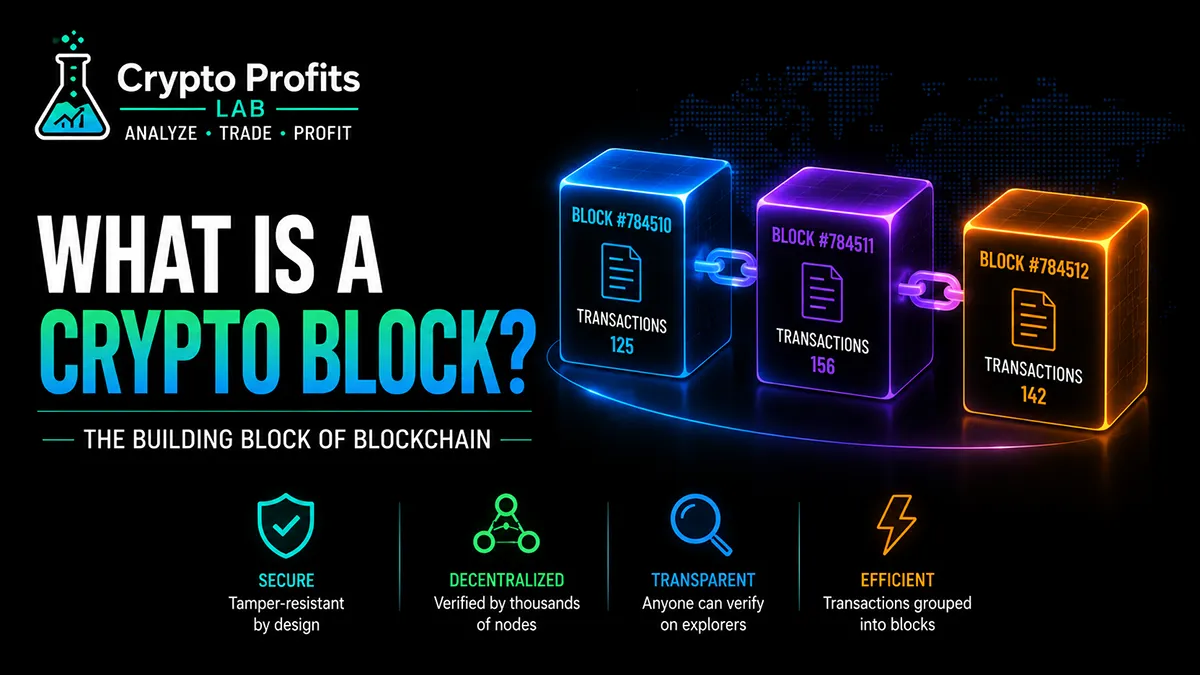
Every cryptocurrency transaction needs somewhere to be recorded. On many blockchains, transactions are grouped into digital packages called blocks. Each block is checked by the network, added in a specific order, and connected to the block that came before it.
A crypto block is therefore one of the basic building pieces of a blockchain. Understanding it makes many other crypto concepts easier to grasp, including confirmations, mining, validators, transaction fees, block explorers, and network security.
This guide explains the subject in plain English. You will learn what a block contains, how a new block is created, why blocks are linked together, and what beginners should look for when checking a transaction.
Quick Answer: What Is a Crypto Block?
A crypto block is a digital package of verified transaction data and network information. A miner or validator proposes the block; other network participants verify it, and the blockchain appends it to the existing history if it follows the rules.
Most blocks also contain a cryptographic reference to the previous block. That reference helps form an ordered chain and makes hidden changes to older records much easier for the network to detect.
A block does not physically hold coins. It records information showing how ownership and balances changed.
Key Takeaways
- A crypto block groups transactions and related network data.
- Blocks are added to a blockchain in a specific order.
- Each block usually points back to the previous block through a cryptographic hash.
- Miners or validators help propose and confirm new blocks.
- A transaction receives its first confirmation when it enters a block.
- Newer blocks add more confirmations to earlier transactions.
- Block size, block time, and fees vary between networks.
- A blockchain explorer lets anyone inspect public block information.
- A confirmed block is difficult to change, but “immutable” does not mean magically impossible under every circumstance.
Crypto Block Facts for Beginners
| Term | Simple meaning |
|---|---|
| Block | A digital package of transactions and network data |
| Block header | A compact section containing important block information |
| Previous block hash | A reference connecting one block to the block before it |
| Transaction | A signed instruction that moves value or performs an action |
| Block height | The block’s position in the blockchain |
| Block time | The approximate time between new blocks |
| Miner | A participant that creates blocks on many proof-of-work networks |
| Validator | A participant that proposes or confirms blocks on many proof-of-stake networks |
| Confirmation | Evidence that a transaction has been included in the blockchain |
| Genesis block | The first block in a blockchain |
| Block reward | New coins and fees earned for creating a valid block on some networks |
Why Blocks Are Needed
A public blockchain may receive thousands of transaction requests from users, wallets, exchanges, and applications. The network needs a reliable way to organize those requests and agree on a shared history.
Blocks solve that organizational problem by grouping activity into ordered batches. Instead of every computer storing an unrelated stream of messages, the network can agree that one set of transactions belongs in one block and the next set belongs in the following block.
This structure is a core part of blockchain technology. The chain provides participants with a common sequence they can independently verify.
Without blocks or another ordering system, two computers could disagree about which payment happened first. That disagreement matters when someone tries to spend the same funds twice.
How a Crypto Block Is Created Step by Step
The exact process differs between Bitcoin, Ethereum, Solana, XRP Ledger, and other systems. However, the following simplified sequence explains the basic idea.
Step 1: Users Create Transactions
A user starts by approving a crypto transaction in a wallet or exchange.
The transaction may send coins, transfer tokens, interact with a smart contract, or perform another supported action. The wallet signs the instruction with the user’s private key and broadcasts it to the network.
At this stage, the transaction is not yet part of a confirmed crypto block.
Step 2: Nodes Receive and Check the Transaction
Computers called crypto nodes receive the transaction and check whether it follows the network’s rules.
A node may verify:
- The digital signature
- The sender’s available balance
- The transaction format
- Whether the same funds were already spent
- The fee or gas information
- Smart-contract conditions, when relevant
Valid transactions are shared with other nodes. Invalid transactions are rejected.
On many networks, valid pending transactions wait in a temporary queue before being selected for a block. Bitcoin users often refer to this queue as the mempool.
Step 3: A Miner or Validator Selects Transactions
A miner or validator chooses transactions to include in a proposed crypto block.
The selection method varies. Some participants prioritize transactions that offer higher fees. Others follow network-specific rules for ordering and processing activity.
The proposed block must fit within the network’s size, gas, or computation limits. This prevents one block from containing unlimited data.
Step 4: The Block Receives Important Metadata
The block contains more than a list of transactions. It also includes information the network needs to identify, connect, and verify.
Depending on the blockchain, this can include:
- A reference to the previous block
- A summary of the included transactions
- A timestamp or time-related value
- The block producer’s information
- Difficulty or validator data
- A nonce or other consensus-related value
- The block number or height
This metadata helps the network confirm that the new block belongs in the correct place.
Step 5: Consensus Determines Whether the Block Is Accepted
Consensus is the process the network uses to agree on a valid history.
Bitcoin uses proof of work. Miners compete to find a valid result that allows them to propose the next block. Our guide to crypto mining for beginners explains this process in simpler detail.
Many newer networks use proof of stake. Validators are selected under the protocol’s rules to propose or confirm blocks.
Once enough participants accept the proposed crypto block, it becomes part of the blockchain’s recognized history.
Step 6: The Block Is Shared Across the Network
The accepted block is broadcast to other nodes on the crypto network.
Each node can independently verify the block before updating its local copy of the blockchain. If a block breaks the rules, honest nodes can reject it even if someone tries to broadcast it widely.
This independent verification is one reason a blockchain does not require a single company to maintain the only official database.
Step 7: The Next Block Builds on It
The next accepted block includes a reference to the preceding block. That link creates the “chain” in blockchain.
When more blocks are added, earlier transactions receive more confirmations. A transaction included five blocks ago may be described as having six confirmations if its own block counts as the first confirmation.
What Information Is Inside a Crypto Block?
The contents vary by network, but most blocks have two broad parts: transaction data and block metadata.
Transaction Data
The transaction section records activity included in the block. In a simple payment network, this mostly consists of transfers between addresses.
On a smart-contract platform, a block can also contain:
- Token transfers
- Decentralized exchange trades
- Lending deposits
- NFT activity
- Contract approvals
- Application interactions
A crypto block may contain many transactions, only a few, or occasionally no regular user transactions at all.
Block Header
The block header is a compact collection of important information used to identify and verify the block.
In Bitcoin, the header includes the block version, the previous block hash, a Merkle root summarizing transactions, a time value, the difficulty target, and a nonce. The official Bitcoin Developer Guide’s blockchain section provides a more technical explanation of how Bitcoin blocks and headers connect.
Other blockchains use different fields, but the general purpose is similar: identify the block, connect it to history, and provide data needed for verification.
How Blocks Are Linked Together
The linking process uses cryptographic hashes.
A hash is a fixed-length output created from data. Even a tiny change to the original data produces a very different hash.
A block typically contains a reference to the previous block’s data. If someone secretly changes an older block, its hash changes. The next block’s stored reference would no longer match, and the inconsistency would continue through later blocks.
That does not make rewriting history mathematically impossible. Instead, it makes unauthorized changes obvious and usually extremely difficult because the attacker would also need to overcome the network’s consensus and security mechanisms.
This is why a crypto block should be understood as tamper-resistant rather than protected by magic.
What Is the Genesis Block?
The genesis block is the first block in a blockchain.
Because no earlier block exists, the genesis block does not point to a normal previous block. It acts as the starting point from which the rest of the blockchain grows.
The Bitcoin genesis block was created when the network launched. Other blockchains have their own starting blocks and launch histories.
A genesis block is usually built into the network’s software or initial configuration so that all participants begin from the same foundation.
What Is Block Height?
Block height describes a block’s position in the chain.
The genesis block is commonly assigned height 0. The next block has height 1, followed by a block with height 2, and so on.
If a blockchain explorer shows block height 900,000, it means 900,000 blocks came before that block when counting from height 0.
Block height helps users and developers refer to a precise point in network history. It can also be used to schedule protocol changes, rewards, or other events.
What Is Block Time?
Block time is the average or target amount of time between new blocks.
Bitcoin aims for an average of roughly ten minutes, although individual blocks may arrive sooner or later. Other networks may produce blocks in seconds.
A shorter block time can make transactions appear more quickly, but speed alone does not determine security or finality. Different networks also have different confirmation rules and consensus designs.
A crypto block arriving quickly does not always mean an exchange will credit a deposit immediately. The exchange may wait for several confirmations before allowing the funds to be used.
What Is Block Size?
Block size describes how much data a block can contain. Some networks use a byte limit, while others use gas or computation limits.
More capacity can allow more transactions, but it may also require greater storage, bandwidth, and processing power. When users compete for limited block space, fees can rise.
Our guide to crypto gas fees explains this relationship in more detail.
What Is a Block Reward?
A block reward compensates a miner or validator for helping produce a valid crypto block. It may include newly created coins, transaction fees, or other protocol incentives.
Bitcoin miners can receive newly issued bitcoin plus eligible fees, while other networks distribute rewards differently. Some also burn part of their fees.
What Is a Block Confirmation?
A transaction is confirmed when it is included in an accepted block.
Every additional block built after it increases the confirmation count. More confirmations generally increase confidence that the transaction will remain in the recognized history.
The number required depends on the network and the receiving service. A small wallet payment may be accepted quickly, while an exchange may wait longer for a large deposit.
You can check confirmations with a blockchain explorer. Search the transaction ID and review the block number, status, timestamp, and confirmation count.
Why Can Two Blocks Appear at Nearly the Same Time?
Two miners or validators can occasionally produce competing blocks at nearly the same moment. Different nodes may briefly see different versions first, and the protocol applies its consensus rules to choose the accepted history.
The unselected block may be called “stale” or “orphaned,” depending on the network. Its valid transactions can return to the pending queue and enter a later crypto block.
Can a Crypto Block Be Changed or Deleted?
A finalized block is designed to be difficult to change.
To alter an older block on a decentralized network, an attacker may need to recreate later history and overcome the honest participants’ computing power, stake, or consensus weight.
The difficulty generally grows as more blocks are added after the target block. That is why exchanges often wait for multiple confirmations.
However, beginners should avoid claiming that every blockchain record is absolutely immutable. Small or poorly secured networks can face reorganizations, attacks, software bugs, or governance decisions.
The more accurate description is that well-secured blockchain records are highly resistant to unauthorized alteration.
Bitcoin Blocks Versus Ethereum Blocks
Bitcoin and Ethereum both use blocks, but their formats and purposes differ.
A Bitcoin block mainly records Bitcoin transactions and proof-of-work information. An Ethereum block can record ETH transfers, token activity, smart-contract execution, application interactions, and validator data.
The phrase “crypto block” describes a general concept, not a single, identical format used by every blockchain.
How to View a Crypto Block
Public blockchain information can usually be viewed without an account:
- Identify the blockchain.
- Open a reputable explorer for that network.
- Search a block number, block hash, transaction ID, or wallet address.
- Review the timestamp, producer, transactions, fees, and confirmations.
An explorer may also show block size, gas used, rewards, difficulty, or validator information. You never need to enter a crypto private key or recovery phrase to view public data.
Common Beginner Mistakes
Thinking a Block Stores Physical Coins
A block does not hold digital coins like a box holds cash. It records transactions and state changes recognized by the network.
Wallet balances are calculated from blockchain records.
Confusing a Block With the Entire Blockchain
A crypto block is one part of the ledger. The blockchain is the ordered history made from many connected blocks.
Think of a block as one page and the blockchain as the full book.
Assuming Every Block Has the Same Size
Capacity differs across networks and can change through protocol upgrades.
The number of transactions also varies because some transactions require more data or computation than others.
Believing One Confirmation Is Always Enough
One confirmation may be acceptable for some situations but not others.
Exchanges, merchants, and wallets can set different requirements based on the asset, amount, and network risk.
Assuming the Fastest Network Is Automatically Best
Speed is only one factor. Security, decentralization, cost, reliability, wallet support, and exchange support also matter.
A fast block time does not guarantee that a network is safe or appropriate for every use.
Trusting a Screenshot Instead of the Blockchain
A screenshot can be edited. A scammer may send a fake image claiming a payment was confirmed.
Verify the transaction directly on a trusted explorer.
Entering a Recovery Phrase Into an Explorer
A real explorer does not need wallet secrets to display a crypto block or transaction.
Any site asking for a recovery phrase, seed phrase, or private key is dangerous.
Crypto Block Safety and Risk
Understanding blocks can help beginners avoid common scams and transaction mistakes.
Fake Confirmation Claims
A sender may claim that a transfer is complete before it is included in a block. Always check the transaction ID and confirmation status yourself.
A pending transaction is not the same as a confirmed payment.
Look-Alike Block Explorers
Scammers create websites that resemble popular explorers. A fake site may show false information or ask users to connect a wallet.
Type the explorer address carefully, use bookmarks, and avoid sponsored links when possible.
Weak or Small Networks
A crypto block on a small blockchain may not have the same security level as a block on a large, established network.
Research validator distribution, miner participation, operating history, and past incidents before moving significant value.
Chain Reorganizations
A chain reorganization occurs when the network replaces a recent sequence of blocks with another valid sequence in accordance with its consensus rules.
Small reorganizations can be normal on some networks. Deep reorganizations may signal a serious problem or attack.
Smart-Contract Risk
A transaction can be correctly included in a block even when the smart contract is malicious.
Blockchain confirmation proves that the network processed the instruction. It does not prove that the website, token, or investment was trustworthy.
Review our crypto safety tips and guide to crypto scams to avoid before approving requests from unfamiliar wallets.
How Blocks Connect to Layer 2 Networks
A Layer 2 crypto network may process many transactions off-chain and later submit summarized data for settlement. This can reduce fees and increase capacity.
Layer 2 designs vary, so confirm whether a transaction is on the base network or a Layer 2 before searching for it in an explorer.
Final Thoughts
A crypto block is a digital package that organizes transactions and connects them to blockchain history. Miners or validators propose blocks, nodes verify them, and consensus determines which blocks become part of the recognized chain.
The key idea is simple: transactions are grouped, checked, ordered, and linked.
Once you understand that process, confirmations, mining, block explorers, fees, hashes, and blockchain security become much easier to follow.
You do not need to memorize every header field or consensus rule. Start by learning how to find a block, verify a transaction, and recognize the difference between pending and confirmed activity.
Crypto Block Frequently Asked Questions
What is a crypto block in simple terms?
A crypto block is a digital package that contains verified transactions and important network information. After a miner or validator proposes it, network nodes check whether it follows the rules. When accepted, it is connected to the previous block and becomes part of the blockchain’s ordered history. A block records activity; it does not physically store cryptocurrency coins.
How many transactions fit in a single crypto block?
The number varies by blockchain and by the size or complexity of each transaction. Some networks limit blocks by bytes, while smart-contract networks may use gas or computation limits. A block with simple transfers can hold more transactions than one filled with complex application activity. Network upgrades can also change capacity, so there is no universal number for every blockchain.
How long does it take to create a crypto block?
Block time depends on the network. Bitcoin targets an average of about ten minutes, while many other blockchains produce blocks within seconds. Individual times can vary because of consensus rules, network conditions, and validator or miner participation. A quick block time does not always mean immediate finality because wallets and exchanges may require several confirmations.
What happens when a transaction enters a block?
When a transaction is included in an accepted block, it receives its first confirmation. The network records the transaction at a specific place in blockchain history. Each later block adds another confirmation, increasing confidence that the transaction will remain in the accepted chain. The recipient’s wallet or exchange may still wait for additional confirmations before making the funds fully available.
Can a crypto block be hacked?
An attacker may try to alter block history, exploit software, control participation in consensus, or reorganize recent blocks. Well-secured decentralized networks make this difficult through economic incentives, cryptography, and independent verification. However, no system should be described as completely immune. Smaller networks, weak validator sets, bridge contracts, wallets, and applications may have different security risks.
What is the difference between a block and a transaction?
A transaction is an individual instruction, such as sending cryptocurrency from one address to another. A block is a larger package that groups many transactions with network metadata. Transactions usually wait for selection before they are confirmed. Once included in an accepted block, they become part of the blockchain’s recorded history and begin receiving confirmations.
What is a block hash?
A block hash is a unique cryptographic output created from block data. It acts like a digital fingerprint. If the underlying data changes, the resulting hash changes as well. Networks use hashes to identify blocks and connect them to prior history. A block hash can usually be searched in a blockchain explorer to view the block’s public details.
Can a block contain no transactions?
Some blockchains can produce blocks with no regular user transactions. The block may still contain required protocol information or a reward-related transaction. An empty or nearly empty block can appear when a producer begins work before receiving transactions, when network activity is low, or because of timing and technical conditions. The exact meaning depends on the blockchain.