What Is a Crypto Pump and Dump? Beginner Warning Guide
A cryptocurrency can rise quickly for many legitimate reasons. New technology, an exchange listing, growing use, or positive market news may attract buyers. However, a sudden price increase can also be manufactured by people who plan to profit at the expense of later buyers.
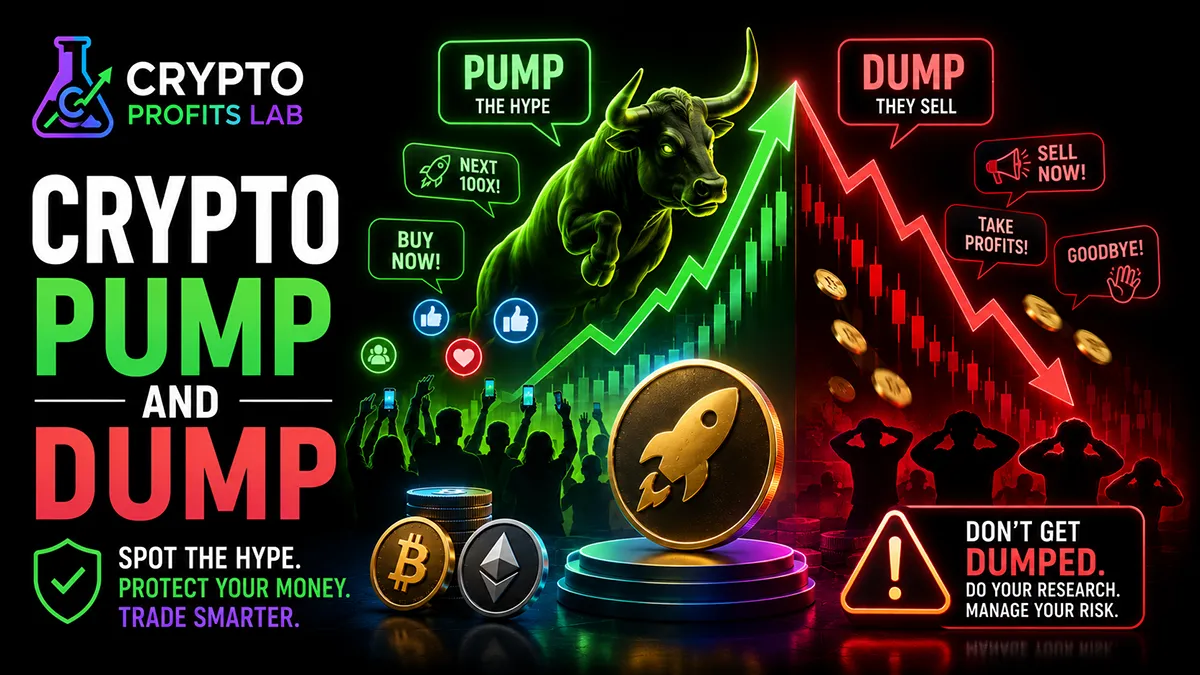
A crypto pump and dump is a coordinated scheme in which promoters create excitement around a coin or token, encourage other people to buy it, and then sell their own holdings after the price rises. Once the organizers sell, demand may disappear, and the price can collapse.
Beginners are especially vulnerable because the promotion often appears to be an exciting opportunity rather than a planned trap. This guide explains how the scheme works, how to recognize warning signs, and how to research a crypto asset before risking money.
Quick Answer
A crypto pump and dump happens when people promote a cryptocurrency to push its price higher, then sell their holdings into the buying activity they helped create.
The “pump” is the artificial excitement and buying pressure. The “dump” is the organizers selling at the higher price. Buyers who enter late may be left holding an asset that rapidly loses value.
These schemes commonly use social media posts, private chat groups, influencer promotions, fake news, exaggerated price predictions, and messages that pressure people to buy immediately. The safest response is to slow down, research the asset independently, examine liquidity and trading activity, and avoid buying only because the price is suddenly rising.
Key Takeaways
- A crypto pump and dump uses hype and coordinated buying to push an asset’s price higher.
- Organizers may already own the coin before they begin promoting it.
- The promoters typically sell while new buyers are still entering.
- Small, thinly traded tokens are easier to manipulate than highly liquid assets.
- A sudden price increase does not prove that a project has gained real value.
- Private “signal” groups may benefit their organizers more than ordinary members.
- Guaranteed profits, urgent deadlines, and secret opportunities are major warning signs.
- Trading volume, liquidity, token distribution, and project fundamentals all deserve review.
- Never risk money you cannot afford to lose on a fast-moving speculative token.
- A careful research process is more reliable than social media excitement.
Crypto Pump and Dump Beginner Facts
| Question | Beginner-Friendly Answer |
|---|---|
| What does “pump” mean? | Promoters create excitement and buying pressure to push the price upward. |
| What does “dump” mean? | Early holders sell their tokens after other buyers raise the price. |
| Who usually loses money? | Buyers who enter late and cannot sell before the price drops. |
| Are all sudden price increases manipulation? | No. Prices can rise for legitimate reasons, but sudden unexplained moves deserve caution. |
| Where are these schemes promoted? | Social media, messaging apps, private groups, livestreams, forums, and paid promotions. |
| Why are small tokens often targeted? | Low liquidity and limited trading volume can make their prices easier to move. |
| Can the organizers sell before the group? | Yes. Organizers may buy first and sell while members are still being told to purchase. |
| Is a pump group a safe trading service? | No. The group may be designed to use later buyers as exit liquidity for insiders. |
| Can losses be recovered? | Recovery is uncertain, especially after an irreversible crypto trade or transfer. |
| What is the safest response to urgent hype? | Pause, research independently, and avoid buying solely because others promise a quick gain. |
How Does a Crypto Pump and Dump Work?
A crypto pump and dump usually follows a planned sequence. The exact details vary, but the organizers need an asset, an audience, a believable story, and enough buyers to create a price increase.
Step 1: Organizers Choose a Target
The target is often a coin or token with:
- Low daily trading volume
- Limited liquidity
- A small market value
- Few active holders
- Trading on only a small number of platforms
- Little public information
- A price that can move sharply after modest buying
Liquidity describes how easily an asset can be bought or sold without causing a large price change. A market with low crypto liquidity may move dramatically when a wave of orders arrives.
The organizers may quietly purchase the token before announcing it to anyone else. This gives them a lower entry price and a supply they can later sell.
Step 2: The Promotion Begins
Promoters create excitement through posts, messages, videos, or private groups. They may claim:
- A major exchange listing is coming
- A partnership will soon be announced
- The token is the “next Bitcoin”
- A celebrity is secretly involved
- The project will increase by 10 times or 100 times
- The opportunity is available only for a few minutes
- Group members must buy at an exact time
- Anyone who sells early is betraying the community
A crypto pump and dump works best when buyers feel they may miss a rare opportunity. That emotional pressure is closely related to crypto FOMO, or the fear of missing out.
Step 3: Coordinated Buying Raises the Price
When many people place buy orders around the same time, the price may rise quickly. Screenshots of the increase are then used as additional promotion.
People outside the original group may notice the token on trending lists or price charts. They may buy because they assume important news has caused the move.
This new demand can make the crypto pump and dump appear successful and legitimate. However, the higher price may reflect temporary buying pressure rather than stronger technology, revenue, adoption, or usefulness.
Step 4: Insiders Begin Selling
The organizers may sell gradually during the rise or quickly near the top. Their goal is to find enough buyers for their holdings.
Late participants become what traders sometimes call “exit liquidity.” In plain English, their purchases provide the demand that allows earlier holders to sell.
The group may still be telling members to hold, buy more, or wait for a larger target while insiders are already leaving.
Step 5: The Price Falls
After large holders sell and promotion slows, buying demand may disappear. The price can fall faster than it rose.
Some buyers try to sell but discover:
- There are not enough buyers
- The bid price is much lower
- Slippage is severe
- Trading has been paused
- The token cannot be sold through the expected market
- Network fees make a tiny remaining balance impractical to move
The result is a classic crypto pump and dump: organizers profit, while many later buyers are left with large losses.
Why Crypto Markets Can Attract Pump-and-Dump Schemes
Cryptocurrency markets operate continuously, and thousands of digital assets can be promoted online. This creates several conditions that scammers may exploit.
New Tokens Can Be Created Quickly
Launching a token does not automatically require a strong business, useful product, or experienced development team. A token can exist even when the project behind it has little substance.
That is why beginners should understand the difference between a blockchain coin, a crypto token, and a genuine long-term project.
Social Media Spreads Hype Fast
A rumor can reach thousands of people within minutes. Repeated posts may create the false impression that many independent investors have discovered the same opportunity.
In reality, several accounts may be controlled by one group, paid to promote the asset, or copying the same message.
Prices Can Move Easily in Small Markets
A token with little trading activity may experience a major percentage increase after a relatively small amount of buying. A move from $0.001 to $0.003 looks like a 200% gain, even if very little money changed hands.
Percentage gains alone do not show whether buyers can sell at the displayed price.
Crypto Pump and Dump vs. Normal Market Volatility
Crypto prices can move sharply without manipulation. A legitimate market reaction may follow:
- A confirmed exchange listing
- A software upgrade
- Regulatory news
- A major security incident
- A partnership announced by both parties
- A change in token supply
- New adoption or usage data
- A broad market rally
Crypto volatility means prices can naturally rise or fall quickly. A fast move alone does not prove fraud.
The difference is the reason behind the activity.
A crypto pump and dump is more likely to depend on vague rumors, coordinated promotion, extreme promises, and pressure to buy before checking the facts.
Crypto Pump and Dump vs. a Rug Pull
These scams can overlap, but they are not identical.
A crypto pump and dump focuses on increasing the market price so early holders can sell at a profit. The token may continue trading afterward, even though its price collapses.
A crypto rug pull usually involves project insiders removing liquidity, abandoning the project, exploiting a smart contract, or otherwise leaving investors with an asset that may become unusable or nearly worthless.
Some projects combine both tactics. Insiders may promote the token, sell part of their holdings during the rise, and later remove liquidity. Beginners should evaluate both market manipulation risk and project-control risk.
Warning Signs of a Crypto Pump and Dump
The following clues deserve extra caution, especially when several appear together.
Guaranteed or Nearly Guaranteed Returns
No promoter can honestly guarantee that a speculative token will increase by a specific amount.
A Secret Coin Reveal
Some groups hide the token’s name until a scheduled time. Organizers may already own it and gain the largest advantage.
Pressure to Buy Immediately
Messages may use countdowns, limited entry windows, or instructions to buy without research.
Sudden Social Media Activity
An unknown token may receive hundreds of similar posts even though there is little real project news.
Unverified Partnerships or Listings
Promoters may use a company or exchange’s logo without proof. Verify claims through both organizations’ official channels.
Low Liquidity
A displayed price means little when only a small amount can be sold near that price. Low liquidity increases the danger of a crypto pump and dump.
Concentrated Token Ownership
If a few wallets hold a large share of the supply, they may be able to move the market by selling.
The project’s tokenomics can reveal supply limits, allocations, vesting, and distribution plans.
Anonymous or Unverifiable Promoters
Privacy is not proof of fraud, but anonymous leaders making extreme promises create additional risk.
Paid Promotion Without Disclosure
An influencer may present an advertisement as a personal discovery. Financial incentives can affect the recommendation.
Charts That Only Show the Rise
Promoters may crop charts to hide earlier collapses, low volume, or a short trading history. Learning basic crypto charts can help beginners place price movement in context.
7 Proven Ways to Avoid a Crypto Pump and Dump
A consistent research process is more useful than trying to predict the exact top.
Step 1: Ignore the Countdown
Do not let a private group, influencer, or social media post set your decision deadline.
Legitimate research opportunities do not disappear simply because you took time to understand the asset. If the only reason to buy is that the price is moving now, you are reacting to pressure rather than information.
A crypto pump and dump depends on people acting before they think.
Step 2: Identify the Original Source
Trace major claims back to the company, exchange, foundation, developer team, or regulator that supposedly made the announcement.
A screenshot, repost, or copied logo is not proof. Verify a claimed listing on the exchange’s official website.
Step 3: Examine Volume and Liquidity
High percentage gains can occur in very small markets.
Check:
- Daily trading volume
- Order-book depth
- Available trading pairs
- Number of active markets
- Difference between buy and sell prices
- How much the price changes when larger orders are placed
Also understand crypto slippage, which is the difference between the expected trade price and the price actually received.
A token can have a high market value yet be difficult to sell.
Step 4: Study the Token Distribution
Look for the total supply, circulating supply, insider allocation, treasury holdings, and upcoming unlocks.
A crypto whale is a person or organization holding enough of an asset to potentially influence the market. Large holders selling together can cause a severe decline.
Step 5: Research the Project, Not Just the Price
Read the project’s official documentation and crypto whitepaper. Look for a clear purpose, a realistic plan, a transparent team, a working product, security information, and evidence of actual use.
Ask:
- What problem does the project solve?
- Is the token necessary?
- Is there a working product?
- Who controls development and funds?
- Are claims measurable?
- Are risks disclosed?
- Does activity continue when the price is not rising?
Strong marketing cannot replace a weak project.
Step 6: Review the Promotion
Find out who benefits if you buy.
Look for disclosures that explain whether the promoter received money or tokens. Search older posts to see whether the person repeatedly promotes assets that later collapse.
Be cautious when every message focuses on price, urgency, and recruiting rather than technology or use.
Step 7: Set a Risk Limit Before Buying
Even after research, speculative assets can fall sharply. Decide in advance how much you could lose without harming your finances.
Do not borrow money, use emergency savings, or risk funds needed for bills. Avoid increasing the amount simply because a group predicts a larger gain.
The U.S. Commodity Futures Trading Commission warns consumers not to purchase digital coins or tokens based only on social media tips or sudden price spikes. Its virtual currency pump-and-dump advisory recommends researching the asset and separating hype from facts.
A Beginner Research Checklist
Before buying a token that is rising quickly, work through this checklist.
| Research Area | Questions to Ask |
|---|---|
| Source | Who announced the news, and can I independently confirm it? |
| Project | Is there a working product, a clear purpose, and a credible team? |
| Token supply | How many tokens exist, and who controls the largest holdings? |
| Liquidity | Can meaningful amounts be sold without crashing the price? |
| Volume | Is the activity broad and sustained, or sudden and concentrated? |
| Promotion | Are influencers or group organizers being paid? |
| Community | Are questions allowed, or are members pressured to buy? |
| Price history | Has the asset experienced similar spikes and collapses before? |
| Exchange | Is it traded on a reputable crypto exchange? |
| Personal risk | Can I afford to lose the entire amount? |
What to Do If You Already Bought During a Pump
Stop Following the Promoter Blindly
The same person who encouraged the purchase may have a financial reason to keep others buying. Do not assume new promises are neutral advice.
Review the Market Carefully
Check liquidity, volume, current orders, and whether the project has released any verifiable information. The displayed price may not match the amount you can actually receive.
Do Not Send More Money to “Unlock” a Sale
A scammer may claim that taxes, verification charges, or account fees must be paid before you can withdraw. This can be a second attempt to take money.
Use the Real Platform
Log in through the exchange’s official application or verified website. A crypto phishing scam may target people searching for help after a loss.
Preserve Evidence
Save:
- Group messages
- Usernames
- Website addresses
- Screenshots
- Wallet addresses
- Trade records
- Transaction hashes
- Dates and amounts
A crypto transaction hash can identify a specific blockchain transaction.
Report Suspicious Activity
Report the account or group to the social platform and the affected exchange. In the United States, victims can also report suspected fraud to appropriate financial and law-enforcement agencies.
Be Careful With Recovery Offers
Anyone promising guaranteed recovery for an upfront fee may be running another scam. Review the broader list of crypto scams to avoid before trusting a recovery contact.
Common Beginner Mistakes
Buying Because a Token Is Trending
Trending lists show activity, not quality. A manipulated asset may appear popular precisely because coordinated buying has begun.
Confusing Price With Value
A low token price does not make an asset cheap. Supply, market value, liquidity, and project fundamentals all matter. Learn how crypto market cap provides more context than token price alone.
Believing Every Influencer Is Independent
A promoter may own the token, receive payment, or gain referral income.
Joining “Guaranteed Profit” Groups
A paid group cannot remove market risk. Members may receive the signal only after organizers have already bought.
Chasing Losses
After the price falls, a buyer may purchase more because promoters promise a second pump. This can increase the loss.
Ignoring Sell Conditions
Buying may be easy while selling is difficult. Review liquidity, fees, slippage, network restrictions, and contract behavior first.
Risking Too Much
A highly speculative token should not determine whether you can pay bills or handle an emergency.
Safety and Risk Considerations
Not every promoted token is part of a crypto pump and dump. New projects can attract genuine attention, and communities can organize around real technology.
The danger increases when low liquidity, concentrated ownership, hidden compensation, urgent promotion, unrealistic promises, and sudden price movement appear together.
Security also matters. Use unique passwords, enable crypto two-factor authentication, verify websites, and never share a seed phrase or private key.
Final Thoughts
A crypto pump and dump turns excitement into an advantage for early insiders. The organizers usually know when the promotion will begin, what asset will be targeted, and when they intend to sell. Ordinary buyers do not have the same information.
The strongest protection is not predicting the perfect moment to exit. It is refusing to make financial decisions based on urgency, secrecy, guaranteed returns, or unexplained price spikes.
Crypto Profits Lab is designed to make crypto education cleaner, simpler, and more trustworthy for beginners. Careful research may feel slower than following a “hot tip,” but it gives you a better chance of separating real projects from manufactured hype.
Crypto Pump and Dump Frequently Asked Questions
Is a crypto pump and dump illegal?
Market manipulation and fraud can violate laws, but the exact legal treatment depends on the asset, conduct, platform, and country. A scheme may involve false statements, deceptive promotion, undisclosed compensation, or coordinated trading. Victims should preserve records and report suspicious activity to the platform and relevant authorities rather than trying to confront anonymous organizers.
How long does a crypto pump and dump last?
A crypto pump and dump may last minutes, hours, days, or longer. Private-group schemes can rise and collapse very quickly, while broader promotional campaigns may build over weeks. The duration does not make the opportunity safer. Organizers may sell gradually, and late buyers may not realize the promotion has ended until liquidity disappears.
Can a large cryptocurrency be pumped and dumped?
Large, highly liquid cryptocurrencies can still be subject to manipulation, rumors, and sharp price movements. However, moving a large market generally requires much more buying or selling than moving a small token. Thinly traded assets are commonly targeted because modest coordinated activity can have a larger effect on their displayed price.
Are crypto pump groups profitable for regular members?
Some members may profit, but the structure often favors organizers and early buyers. Organizers can purchase before announcing the token and begin selling while later members are still buying. A few visible winners may be used as advertising, while losing results receive less attention. Joining a group does not create equal access to timing or information.
How can I tell whether a price increase is real?
Look for independently confirmed news, sustained trading volume, adequate liquidity, broad market participation, and evidence of real project progress. Compare official announcements with social media claims. A legitimate price increase can still reverse, but unexplained spikes driven by urgent promotion, secret groups, or unrealistic promises deserve additional caution.
What is exit liquidity in a crypto pump and dump?
Exit liquidity refers to the buyers whose orders allow earlier holders to sell. During a crypto pump-and-dump, promoters may encourage new participants to keep buying while insiders sell their tokens. The phrase does not mean the late buyers agreed to this role. It describes how their demand provides sellers with an exit.
Should I buy a token after it drops from a pump?
A lower price does not automatically make the token a bargain. The project may have weak fundamentals, insiders may still hold large amounts, and demand may not return. Research the asset from the beginning rather than assuming it will revisit its previous high. Never buy solely because a chart shows that the token once traded higher.
What should I do if a friend sends me a pump signal?
Do not buy immediately. Ask where the information originated and verify every claim independently. Your friend may honestly believe the signal, but they may also be repeating promotion from someone who bought earlier. Explain that coordinated buying and urgent price promises can expose late participants to severe losses.