Crypto Oracle Explained: How Blockchains Receive Real-World Data
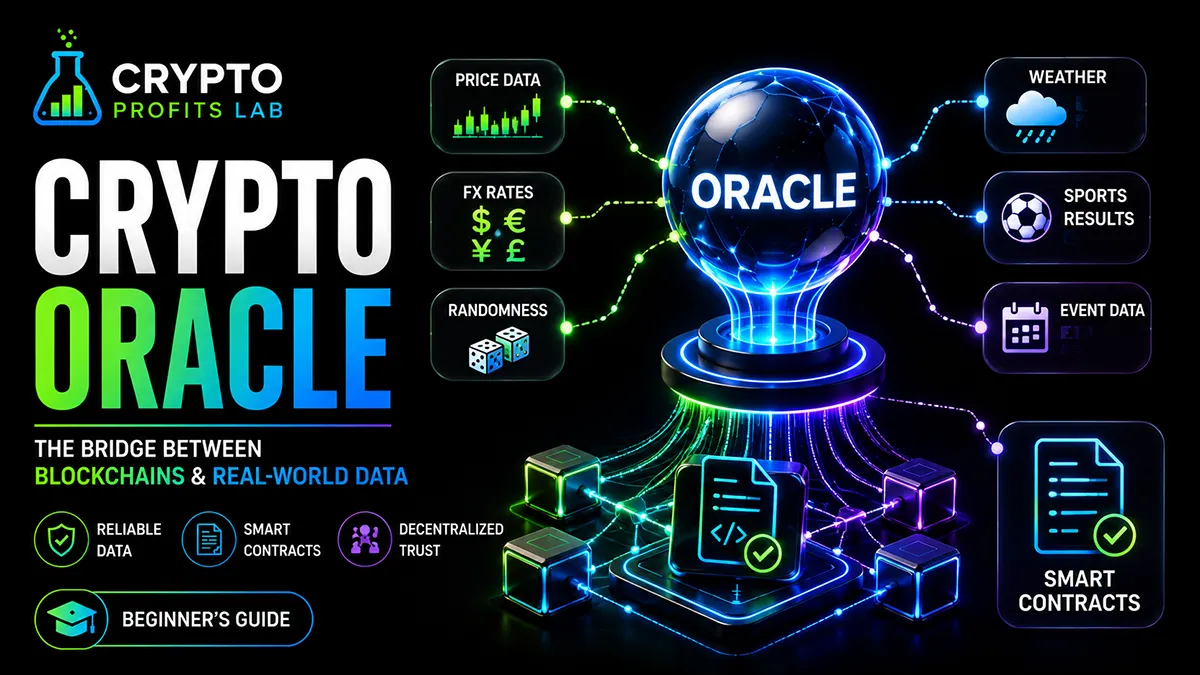
A blockchain can record transactions, track balances, and run programmed rules. However, it cannot automatically check a weather report, sports result, or current exchange rate outside its own network.
A crypto oracle connects a blockchain application with that outside information. It collects or processes data and delivers it in a form a smart contract can use.
This beginner’s guide explains how oracles work, why decentralized finance depends on them, and which risks users should understand.
Educational note: This article is for general educational purposes and does not provide financial, legal, or investment advice.
Quick Answer: What Is a Crypto Oracle?
A crypto oracle is a service that connects a blockchain application with data or systems outside the blockchain.
For example, a lending smart contract may need the current ETH price before deciding how much a user can borrow. The blockchain cannot safely visit a normal website and read that price by itself. An oracle can collect the data and publish it onchain for the contract to use.
In this context, “oracle” means a data bridge. It does not predict the future.
Key Takeaways
- A crypto oracle supplies outside data or services to blockchain applications.
- Smart contracts normally cannot retrieve off-chain information by themselves.
- Oracles may provide prices, weather data, event results, randomness, identity checks, or automated actions.
- A centralized oracle relies heavily on one provider or source.
- A decentralized oracle uses multiple nodes, data sources, or both to reduce single points of failure.
- Incorrect oracle data can cause a smart contract to make the wrong decision.
- An oracle does not make a risky project safe.
- Beginners should check which oracle a project uses and how it handles bad or unavailable data.
Crypto Oracle Facts for Beginners
| Question | Beginner-Friendly Answer |
|---|---|
| What does an oracle do? | It brings outside information or services to a blockchain application. |
| Why is it needed? | Smart contracts cannot normally fetch real-world data directly. |
| What data can it provide? | Prices, weather, sports results, randomness, proof of reserves, and more. |
| Is every oracle decentralized? | No. Some rely on one company, server, or data source. |
| Can an oracle be wrong? | Yes. Data may be inaccurate, delayed, manipulated, or unavailable. |
| Does an oracle store my crypto? | Usually no. Its main role is delivering data or computation. |
| Is Chainlink an oracle? | Chainlink provides decentralized oracle networks and related services. |
| Can beginners use oracles directly? | Most users interact with apps that use them behind the scenes. |
Why Smart Contracts Need Oracles
A smart contract is a program stored and executed on a blockchain. It follows rules written into its code.
A simple smart contract can use information already available on-chain. It might check a wallet balance, verify a transaction, or transfer tokens after a condition is met.
The problem begins when the contract needs information that is not stored on the blockchain.
Imagine a crop-insurance contract that promises to pay a farmer after rainfall drops below a certain level. The contract needs reliable weather data. It cannot simply open a weather website like a person using a browser.
The same limitation applies to:
- Crypto price data
- Sports scores
- Election or event results
- Shipping information
- Interest rates
- Random numbers
- Real-world asset values
- Proof that a payment occurred on another system
A crypto oracle gives the smart contract access to the required information without forcing every blockchain node to contact outside websites independently.
Ethereum’s documentation explains that blockchains restrict how outside data enters the system so network participants can agree on the same result. Oracles bridge that information gap by placing usable off-chain data on-chain.
A Simple Oracle Analogy
Think of a smart contract as a vending machine inside a room with no windows. It can count money and follow its programmed rules, but it cannot check the outdoor temperature.
A messenger who checks the temperature and brings the result inside acts like an oracle. A real system may use software, several data providers, independent nodes, digital signatures, and automated checks, but the basic purpose is the same.
How a Crypto Oracle Works Step by Step
The exact process varies, but a typical workflow follows these steps.
Step 1: A Smart Contract Needs Information
A blockchain application reaches a decision that depends on outside data. A lending app, for example, may need the dollar value of a deposited token.
Step 2: The Application Requests or Reads Data
Some applications request a specific answer. Others read a price feed that is updated regularly onchain.
Step 3: Oracle Nodes Collect Data
An oracle node is software that obtains information from exchanges, market-data providers, weather services, connected devices, or other databases.
In simple terms, a node is a computer or service that performs work for the network. Learn more in our guide to what a crypto node is.
Step 4: Reports Are Checked or Combined
A decentralized system may compare results from several nodes and sources. It might remove unusual readings and use the median of the remaining values.
Step 5: The Result Is Published Onchain
The selected result is sent to an oracle contract or data feed. Publishing it usually requires a crypto transaction and may involve network fees.
Step 6: The Smart Contract Uses the Result
The application reads the value and follows its code. A lending contract might calculate collateral value, while an insurance contract might approve a payout.
The contract follows the input it receives. It does not independently know whether the outside fact is true.
Onchain Data vs. Offchain Data
Understanding a crypto oracle is easier when you know the difference between onchain and offchain information.
Onchain Data
Onchain data is recorded or available within a blockchain network.
Examples include:
- Wallet balances
- Token transfers
- Smart contract activity
- Block timestamps
- Transaction history
- Data stored by another contract
You can often inspect this information with a blockchain explorer.
Offchain Data
Offchain data exists outside the blockchain.
Examples include:
- A market price from a trading platform
- A weather measurement
- A flight delay
- A sports score
- A bank payment
- A package-delivery update
- A reserve balance held by a company
- A random result produced outside the blockchain
A crypto oracle moves selected information between these two environments or helps an application use an off-chain service.
Main Types of Crypto Oracles
Oracle systems can be grouped in several ways, and one service may fit more than one category.
Input Oracles
Input oracles bring information onto a blockchain. Price feeds are a common example.
Output Oracles
Output oracles send blockchain information to an outside system. An onchain payment could trigger a notification, database update, or connected device.
Software Oracles
Software oracles retrieve digital information from APIs, exchanges, databases, or online services.
An API is a structured way for one program to request data from another.
Hardware Oracles
Hardware oracles use information from sensors or physical devices, such as temperature, location, movement, or delivery status.
Human Oracles
A person or approved group may report an event result that cannot be collected automatically. Clear identity and dispute rules are important.
Computational Oracles
These perform calculations or generate results off-chain when doing the work directly on a blockchain would be costly or impractical.
Verifiable randomness for games is one example.
Cross-Chain Oracles
Cross-chain systems help applications exchange information between blockchains.
This is related to, but not identical to, a crypto bridge.
Centralized vs. Decentralized Oracles
The difference between centralized and decentralized designs is important.
Centralized Oracle
A centralized crypto oracle depends mainly on one operator, server, or data source.
This design can be fast and simple. It may also be reasonable when one official organization is the only authoritative source for particular information.
However, it creates a single point of failure. If that provider is hacked, dishonest, offline, or mistaken, the application may receive bad data.
Decentralized Oracle
A decentralized crypto oracle may use multiple independent nodes, multiple data sources, or both.
The network compares or combines submissions before publishing a final answer. Some systems reward accurate reporting and penalize dishonest behavior.
Decentralization can improve reliability, but the label alone is not enough. Ten nodes that all copy data from the same source still depend on that source.
Ethereum’s oracle documentation notes that decentralization at both the node and source level is important because multiple nodes using one source can retain a centralized weakness.
What Is the Oracle Problem?
The oracle problem is the challenge of bringing trustworthy outside information into a blockchain without weakening the reliability that the blockchain is meant to provide.
A smart contract may execute exactly as written and still produce a harmful result if its input is wrong.
Suppose a lending contract is told that a token is worth $10 when its real market value is $1. The contract may allow someone to borrow far more than their collateral supports.
The code followed its rules. The input was the problem.
The main questions include:
- Did the information come from the intended source?
- Was it changed before reaching the blockchain?
- Is it current rather than outdated?
- Was the service available when needed?
- Can one operator manipulate the answer?
- What happens when sources disagree?
- Can the application pause during an emergency?
For a more technical explanation, see Ethereum.org’s guide to blockchain oracles.
A crypto oracle must balance accuracy, speed, cost, availability, and resistance to manipulation. Improving one feature may require tradeoffs in another.
Common Crypto Oracle Use Cases
Decentralized Lending
A lending protocol needs prices to value collateral and decide when a loan becomes unsafe.
Reliable data is critical to many DeFi lending systems.
Decentralized Exchanges
A decentralized exchange may use oracle data for derivatives, risk controls, or pricing comparisons.
Automated market makers can also produce on-chain prices from their liquidity pools.
Stablecoins
Some stablecoins use price feeds to evaluate collateral or support mechanisms intended to maintain a target value.
Insurance and Prediction Markets
Weather, flight, shipping, sports, or event data can determine whether a payout or market settlement should occur.
Unclear or disputed outcomes may be difficult to resolve.
Blockchain Gaming
Games may need verifiable random numbers for drawings, item traits, or winner selection.
Fair randomness is difficult because participants may try to predict or influence the result.
Automation
A smart contract may need a scheduled trigger or outside signal before performing an action.
Proof of Reserves and Real-World Assets
Oracle systems may report information about assets held outside a blockchain.
Publishing a number onchain does not by itself prove that the underlying assets exist, are unencumbered, or can be redeemed.
A Beginner Example: A Crypto Lending App
Imagine Mia deposits $2,000 worth of crypto into a lending app and borrows $1,000 in stablecoins.
The app requires her collateral to remain above a minimum value. Oracle nodes collect prices, the system combines the reports, and a reference price is published onchain.
The lending contract reads that price and may liquidate Mia’s collateral if its value falls too far.
If the reported price is incorrectly low, she could be liquidated unfairly. If it is incorrectly high, the platform might allow unsafe borrowing.
This is why price feeds are a core security concern.
A strong design may use several markets, independent nodes, outlier removal, frequent updates, and safeguards for unusual price movements.
How Oracle Manipulation Can Happen
Oracle manipulation occurs when an attacker causes an application to use a misleading value.
One method is manipulating the price on a market that the oracle watches. If the market has little liquidity, a large trade may temporarily push the price far from its normal level.
An attacker may then interact with a lending or trading contract before the price returns to normal.
Other risks include:
- Compromised oracle keys
- Dishonest node operators
- A hacked data provider
- Delayed price updates
- Incorrect calculations
- Poorly chosen data sources
- A broken API
- Smart contract bugs
- Governance abuse
- Network congestion
Official Ethereum security guidance warns that corrupted or manipulated oracle inputs can cause smart contracts to act on incorrect information.
How Projects Reduce Oracle Risk
Projects may combine several protections:
- Multiple independent data sources
- Multiple oracle nodes
- Aggregation methods such as a median
- Regular updates or price-change thresholds
- Time-weighted prices rather than one instant
- Circuit breakers for extreme or missing data
- Checks that reject stale information
- Monitoring and limited emergency controls
Each protection has tradeoffs. A pause function may reduce losses during an attack, but it also gives someone authority to stop the system.
How to Research a Project’s Oracle Setup
Beginners do not need to read code to ask useful questions.
1. Identify the Provider
Look in the project’s official documentation.
A protocol may use Chainlink, another oracle network, an onchain market, or a custom system.
2. Find Out What Decisions Depend on It
Price-based liquidations deserve special attention because an incorrect value can directly affect user funds.
3. Check the Sources and Operators
Determine whether the system uses several independent sources and node operators or depends heavily on one provider.
4. Check Update Frequency
A price that updates too slowly may become stale during a volatile market.
Our crypto volatility guide explains why rapid price changes are common.
5. Look for Backup Rules
Find out what happens when the feed stops, reports an extreme value, or disagrees with another source.
6. Review Audits and Incident History
Audits can identify weaknesses but do not guarantee safety.
Search official announcements for outages, exploits, emergency pauses, and compensation plans.
7. Understand Administrative Control
Check whether a team, committee, or governance group can replace the provider, change limits, or pause the protocol.
Safety and Risk for Beginners
Most beginners will not choose an oracle directly. They will use an exchange, wallet, lending protocol, game, or other app that depends on one.
That means oracle risk can be hidden behind a simple interface.
Before depositing funds into a DeFi application:
- Confirm that you are using the official website.
- Learn what happens during liquidation.
- Check which price source the protocol uses.
- Start with a small amount.
- Avoid borrowing near the maximum limit.
- Do not assume a high yield means low risk.
- Review smart contract and oracle incident history.
- Keep your wallet and seed phrase secure.
- Never approve a transaction you do not understand.
Read our crypto safety tips before connecting a wallet to an unfamiliar application.
A crypto oracle can improve what a smart contract can do, but it also adds another system that must work correctly.
Common Beginner Mistakes
Mistake 1: Thinking an Oracle Predicts Prices
An oracle normally reports data. It does not guarantee a future price.
Mistake 2: Assuming “Decentralized” Means Risk-Free
Several nodes may still depend on one data source, development team, or governance group.
Mistake 3: Ignoring Stale Data
An accurate price from an hour ago may be unsafe during a fast-moving market.
Mistake 4: Confusing the Oracle With the Blockchain
The blockchain records and processes submitted data. It does not automatically prove that an outside fact was correct.
Mistake 5: Trusting a Famous Provider Name
A reputable provider can be integrated incorrectly. The application’s code, settings, and backup procedures still matter.
Mistake 6: Clicking Fake Reward Links
Scammers may imitate well-known projects and promise oracle rewards or airdrops.
Review crypto scams to avoid and never share your seed phrase.
Mistake 7: Taking Too Much DeFi Risk
A user can be liquidated even when the oracle works correctly. Price volatility, fees, and loan rules still apply.
Beginner Oracle Research Checklist
Use this checklist before relying on an application that depends heavily on external data:
- What information does the application need?
- Which crypto oracle or data system provides it?
- Are there multiple independent data sources?
- Are there multiple node operators?
- How often is the value updated?
- Can the app detect stale or extreme data?
- What happens if the oracle goes offline?
- Can administrators replace or pause the feed?
- Has the protocol suffered an oracle-related incident?
- Could an incorrect value liquidate or lock user funds?
- Is the potential reward worth the combined risks?
You may not find every answer. Missing or vague information is itself useful information when deciding how much risk to take.
Final Thoughts
A crypto oracle connects blockchain applications with information or services that exist outside the blockchain.
Without oracles, smart contracts would be limited mainly to onchain data. With them, applications can use prices, weather, event results, randomness, cross-chain messages, and other inputs.
That added capability also creates added risk.
A smart contract can follow its code perfectly and still produce the wrong result when the data is inaccurate, delayed, unavailable, or manipulated.
Centralization, weak sources, bad settings, and poor backup rules can all matter.
Beginners do not need to understand every technical detail. Start with four questions:
- What data does the application need?
- Who supplies it?
- How is it checked?
- What happens when it fails?
Crypto Profits Lab focuses on clear, practical education so beginners can understand systems like a crypto oracle without hype or unnecessary jargon.
Crypto Oracle Frequently Asked Questions
What is a crypto oracle in simple terms?
A crypto oracle is a service that gives blockchain applications information from outside the blockchain. It may supply asset prices, weather data, event results, random numbers, or other information. Smart contracts use that data to make programmed decisions. The oracle acts as a bridge, but the reliability of its sources and delivery system remains important.
Why can’t a blockchain get real-world data by itself?
Blockchain nodes must agree on the same transactions and results. If every node independently contacted an outside website, they could receive different answers, experience delays, or fail to reach agreement. A crypto oracle uses a defined process to collect and publish outside information in a form that smart contracts can consistently read on-chain.
Is Chainlink a crypto oracle?
Chainlink provides decentralized oracle networks and other services that connect smart contracts with external data, computation, and cross-chain systems. It is one of several oracle solutions used across blockchain applications. A project saying it uses Chainlink does not remove all risk because the specific data feed, integration settings, smart contract code, and emergency procedures still matter.
What is the difference between an oracle and a smart contract?
A smart contract is blockchain-based code that follows programmed rules. An oracle supplies data or services that the smart contract cannot obtain directly. For example, an oracle might report an asset price, while the smart contract uses that price to calculate a loan limit. They perform different roles but often work together.
Can a crypto oracle be hacked or manipulated?
Yes. Attackers may compromise an operator, manipulate a weak market, exploit a smart contract, corrupt a data source, or take advantage of delayed updates. Projects try to reduce these risks through multiple sources, independent nodes, aggregation, freshness checks, circuit breakers, and monitoring. No protection makes an oracle system completely risk-free.
What is a decentralized oracle?
A decentralized oracle uses multiple independent participants, data sources, or both to deliver information to a blockchain. The system may compare and combine several reports before publishing a final value. This can reduce dependence on one operator, but beginners should still check whether the nodes truly use independent sources and whether one organization controls important settings.
Does every cryptocurrency need an oracle?
No. A basic cryptocurrency transfer can usually use information already available on its own blockchain. Oracles are needed when an application must use outside data, offchain computation, automation, or information from another network. Lending protocols, insurance applications, prediction markets, games, and some stablecoin systems are common examples.
How do I know which oracle a DeFi project uses?
Check the project’s official documentation, technical pages, audit reports, governance forum, and smart contract information. Search for terms such as price feed, oracle provider, data source, liquidation price, and fallback oracle. Avoid relying only on promotional posts. When the information is missing or unclear, treat that lack of transparency as an additional risk.