Crypto DAO Explained: A Beginner’s Guide to Community Governance
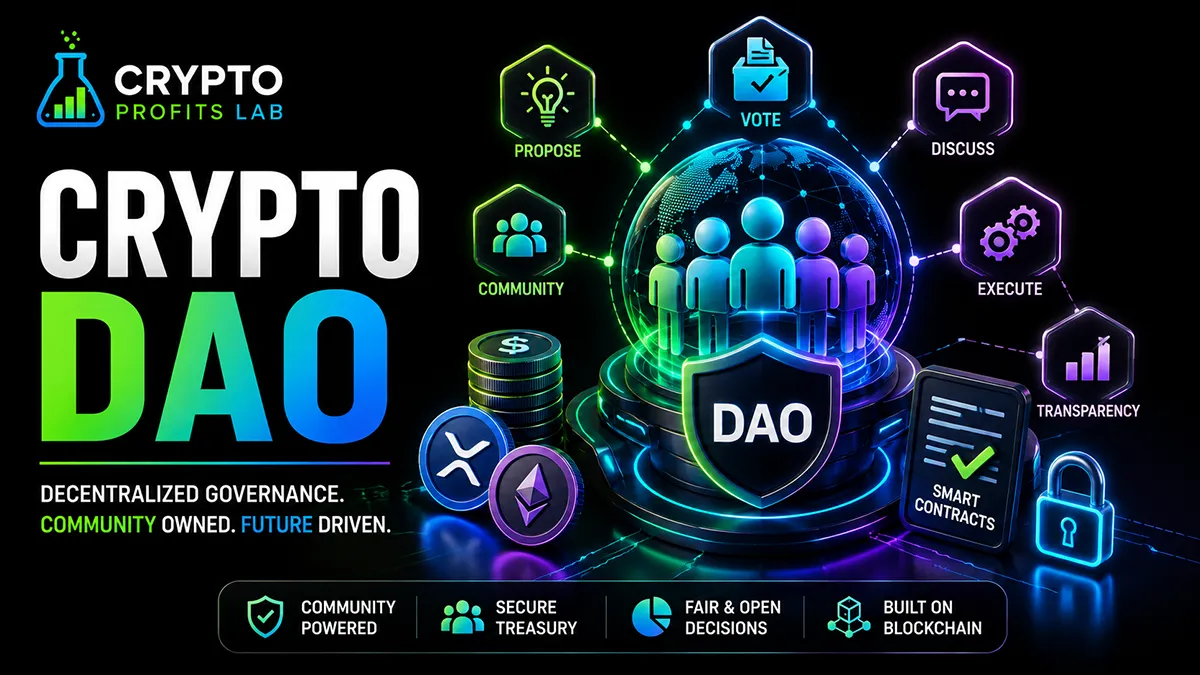
Crypto communities sometimes need to manage money, approve changes, fund development, or choose a shared direction. A normal company handles these decisions through owners, directors, and managers. A crypto DAO tries to organize at least some of that decision-making through blockchain tools and community participation.
DAO stands for decentralized autonomous organization. The name sounds complicated, but the basic idea is simple: a group of people coordinates around shared rules, digital assets, or a common goal without relying entirely on one traditional manager.
A crypto DAO may use smart contracts to hold funds, accept proposals, count votes, and carry out approved actions. Members may receive voting power through governance tokens, membership records, reputation, or other rules.
However, not every DAO is fully decentralized, fully automatic, or legally recognized as an organization. Beginners should look beyond the label and learn who controls the contracts, treasury, website, and important decisions.
This guide explains how DAOs work, how people join them, why projects use them, and which risks deserve attention.
Educational note: This article is for general education only. It is not financial, investment, tax, or legal advice.
Quick Answer: What Is a Crypto DAO?
A crypto DAO is a blockchain-based community or organization that uses shared rules to coordinate decisions, funds, or projects.
Members commonly submit proposals and vote on them. The voting rules may be written into smart contracts, which are programs that run on a blockchain.
A DAO might manage a decentralized finance protocol, issue grants, purchase digital assets, support a social community, or oversee a shared treasury.
The word “autonomous” does not mean that humans are unnecessary. People usually write the rules, discuss proposals, vote, perform work, maintain software, and respond to emergencies.
Ethereum.org’s official DAO guide describes DAOs as collectively owned organizations that work toward a shared mission using blockchain-based rules and community participation.
Key Takeaways
- DAO means decentralized autonomous organization.
- A crypto DAO coordinates people through blockchain-based rules, community processes, or both.
- Members may vote with governance tokens, membership credentials, reputation, or delegated voting power.
- A DAO treasury is a shared pool of digital assets controlled under defined rules.
- Some decisions happen onchain, while discussion and informal voting may happen offchain.
- A governance token may provide voting rights, but it does not automatically represent company ownership.
- Large token holders can have more influence when voting power is based on token balances.
- Smart contract bugs, phishing, low participation, and unclear authority can create serious risks.
- The word DAO is a description, not a guarantee of decentralization, security, fairness, or legal status.
Crypto DAO Facts for Beginners
| Question | Beginner-Friendly Answer |
|---|---|
| What does DAO stand for? | Decentralized autonomous organization |
| What is its main purpose? | To help a group coordinate decisions, funds, or projects using shared rules |
| How do members vote? | With tokens, membership records, reputation, delegated votes, or another defined method |
| What is a DAO treasury? | A shared pool of digital assets used for approved expenses or goals |
| Are all decisions automatic? | No. Humans usually discuss, propose, vote, and perform much of the work |
| Is every DAO decentralized? | No. Control can still be concentrated among founders, administrators, or large token holders |
| Is a DAO the same as a company? | Not necessarily. Legal treatment and organizational structure depend on the DAO and jurisdiction |
| Can a DAO lose money? | Yes. Contract bugs, scams, poor decisions, stolen keys, and market losses are possible |
Why Were DAOs Created?
Online communities can include people who live in different countries and have never met. They may still want to pool resources and work toward a common purpose.
A crypto DAO can use public addresses and smart contracts to make parts of its activity visible. Members may be able to inspect proposals, votes, treasury balances, and completed transactions through a blockchain explorer.
Projects use DAOs for several reasons:
- To give users a voice in protocol decisions
- To manage a shared treasury
- To fund developers, researchers, or community projects
- To coordinate contributors in different locations
- To create transparent proposal and voting records
- To reduce dependence on one executive or company
- To let a community manage a product after its launch
How Does a Crypto DAO Work?
Every DAO has its own design, but many follow a similar process.
Step 1: A Purpose Is Defined
The organizers decide what the group is meant to do.
A crypto DAO might govern a lending protocol, award grants, collect art, support public software, invest shared funds, or organize a membership community.
A clear purpose helps members judge whether a proposal belongs within the organization.
Step 2: Governance Rules Are Created
The rules explain who can make proposals, who can vote, how voting power is calculated, and what approval is required.
Rules may include:
- A minimum number of tokens to submit a proposal
- A voting period of several days
- A quorum requirement
- A simple majority or higher approval threshold
- A delay before approved actions are executed
- Emergency powers held by a security group
Quorum means the minimum participation needed for a vote to count.
Step 3: Smart Contracts Are Deployed
A crypto DAO may use contracts to manage governance tokens, proposals, votes, treasury funds, and approved transactions.
Because contract code can control valuable assets, security testing and audits are important. An audit can identify weaknesses, but it cannot guarantee that the code is safe.
Step 4: Membership or Voting Power Is Distributed
Members may receive governance tokens through purchases, rewards, contributions, an airdrop, or another process.
Other DAOs use NFTs, verified membership lists, reputation, or equal voting rights.
The distribution method affects who has influence from the beginning.
Step 5: Members Discuss an Idea
A proposal often begins in a forum, chat server, community call, or research post.
This early stage lets members ask questions, suggest changes, and estimate costs before a formal vote begins.
Step 6: A Formal Proposal Is Submitted
The proposal should explain the requested action, budget, expected benefit, risks, and implementation plan.
Examples include:
- Spending treasury funds
- Changing a protocol fee
- Hiring a service provider
- Funding a software upgrade
- Adding a supported asset
- Changing governance rules
Step 7: Members Vote
Eligible members vote according to the DAO’s rules. A crypto DAO may count votes directly onchain or use an offchain voting platform.
Onchain voting creates blockchain transactions and may require crypto gas fees. Offchain voting can be cheaper, but another process may be needed to execute the result.
Step 8: The Result Is Carried Out
An approved proposal may execute automatically, enter a waiting period, or require several authorized signers to complete it.
A waiting period gives users time to review an approved change before it takes effect.
This step-by-step process shows why “autonomous” can be misleading. Code may enforce certain rules, but people still create proposals, debate choices, and carry out work.
What Is a DAO Governance Token?
A governance token is a crypto token that may give its holder voting rights in a project.
One token may equal one vote, but that is only one possible system. Some projects use delegated voting, capped influence, time-based voting, or special membership rules.
Governance tokens may let holders vote on:
- Protocol upgrades
- Fees
- Treasury spending
- New products or markets
- Reward programs
- Risk limits
- Contributor payments
- Governance procedures
A token does not automatically provide shares in a company, a claim on profits, or legal ownership. Rights depend on the project’s rules and applicable law.
Beginners should study the project’s tokenomics to see how the supply was distributed. If founders, investors, or a few wallets control most tokens, community voting may be less balanced than it appears.
What Is a DAO Treasury?
A DAO treasury is a shared collection of assets intended to support the organization’s goals.
It may contain:
- The project’s governance token
- Stablecoins
- Ether or other cryptocurrencies
- Liquidity-provider tokens
- NFTs
- Tokens received from fees
- Assets contributed by members
The treasury may fund development, security reviews, marketing, events, grants, legal services, or community rewards.
A crypto DAO should have clear rules for approving payments and reporting expenses. Members should also understand how diversified the treasury is.
A treasury made mostly of the DAO’s own token may look valuable while the token price is rising. If that price falls sharply, the organization may have less practical spending power than expected.
Onchain and Offchain Governance
DAO governance can happen onchain, offchain, or through a combination of both.
Onchain Governance
Votes and results are recorded directly on a blockchain. Approved actions may be executed by smart contracts.
Offchain Governance
Discussion or voting happens through forums, websites, message signing, or community platforms without recording every vote as a normal blockchain transaction.
Hybrid Governance
Many organizations use offchain discussion and preliminary voting before submitting important decisions onchain.
The key question is not simply where the vote occurs. Beginners should determine which process has actual authority over contracts and treasury funds.
Common Types of DAOs
The label covers many different groups.
Protocol DAOs
These govern blockchain applications, especially DeFi protocols. Members may vote on fees, supported assets, risk settings, and upgrades.
Grant DAOs
These collect funds and award grants to developers, researchers, artists, educators, or community projects.
Collector DAOs
Members pool funds to acquire and manage art, NFTs, or other assets.
Social DAOs
These focus on community, networking, events, or shared interests. Membership may require a token, NFT, invitation, or contribution.
Investment DAOs
Members combine funds to evaluate and purchase assets. These groups may face significant legal, tax, custody, and securities questions.
Service DAOs
Contributors provide design, development, marketing, research, or other services and coordinate work through shared governance.
Media DAOs
Members create, fund, edit, or distribute media and may share responsibilities or rewards.
A crypto DAO can fit more than one category. Its actual contracts and operating procedures matter more than its label.
How to Join a Crypto DAO
Joining can range from reading a public forum to buying a governance token.
1. Research the Organization
Read the official website, documentation, governance forum, and crypto whitepaper when one is available.
Identify the DAO’s purpose, history, leadership, contracts, treasury, and major controversies.
2. Verify Official Links
Scammers create fake voting pages, token claims, and community invitations.
Start from the project’s verified website and compare addresses across several official sources.
3. Learn the Membership Rules
A DAO may be open to everyone, limited to token holders, or restricted to approved members.
Do not buy a token until you understand what it actually provides.
4. Observe Before Participating
Read recent proposals and meeting summaries. Notice whether members ask difficult questions and whether leaders respond clearly.
5. Protect Your Wallet
Use a dedicated crypto wallet with limited funds for unfamiliar applications.
Never share your crypto private key or seed phrase.
6. Start Small
You may be able to contribute research, comments, translations, design, moderation, or testing without committing significant money.
7. Review Every Transaction
A voting or membership website may ask for a wallet signature or token approval. Read the request carefully and reject anything unexpected.
How DAO Voting Power Works
Voting systems strongly affect whether governance is fair and useful.
One Token, One Vote
This common model gives more voting power to wallets holding more governance tokens.
It is easy to measure, but wealthy participants and early investors may dominate.
Delegated Voting
A holder assigns voting power to another address while usually keeping ownership of the tokens.
Delegation can improve participation by letting informed representatives vote. It can also concentrate influence in a few popular delegates.
One Member, One Vote
Each verified member receives equal voting power.
This reduces the direct influence of wealth but creates the challenge of preventing one person from creating many fake identities.
Reputation-Based Voting
Voting power depends on contributions, experience, or a reputation score.
This can reward active members, although the scoring system may be subjective or difficult to design.
Quadratic Voting
The cost of adding more votes to one choice rises faster than the number of votes.
The goal is to let people express strong preferences while limiting simple token dominance. The method can still be difficult for beginners to understand and can be vulnerable to fake identities.
No voting system is perfect. A crypto DAO should explain why its chosen method fits its purpose.
What Are Quorum and Voting Thresholds?
Quorum is the minimum amount of participation required for a proposal to be valid.
Without quorum, a small number of active wallets could make decisions for a much larger community.
A voting threshold is the level of support required for approval. A proposal might need more yes votes than no votes, a majority of all participating votes, or a larger supermajority.
Rules that are too easy may allow harmful changes. Rules that are too strict can prevent the DAO from acting at all.
Beginners should also check whether abstentions count, whether voting power is measured at a fixed snapshot, and whether large holders can move tokens between wallets to influence a vote.
Benefits of a Crypto DAO
A well-designed organization may offer several benefits.
Transparent Activity
Proposals, votes, treasury balances, and payments may be publicly visible.
Global Participation
People can contribute from many locations without working in one office.
Shared Decision-Making
Members can help guide priorities rather than depending entirely on a central executive.
Programmable Rules
Smart contracts can enforce spending limits, voting periods, and approval requirements.
Community Ownership
Users and contributors may have a more direct role in the products or communities they support.
These are possible benefits, not guaranteed outcomes. Transparency is useful only when members can understand the information, and voting is meaningful only when power is not secretly concentrated.
Crypto DAO Risks and Safety Concerns
A crypto DAO can fail through technology, governance, human behavior, or legal uncertainty.
Smart Contract Risk
A bug may allow funds to be stolen, frozen, or sent incorrectly. The early project commonly called “The DAO” suffered a major 2016 exploit, showing that governance code can carry serious financial risk.
Treasury Risk
Poor investments, weak controls, or falling token prices can reduce a treasury’s value.
Governance Attacks
An attacker may buy, borrow, or obtain enough voting power to approve a harmful proposal.
Concentrated Control
Founders, venture investors, delegates, or administrators may hold more influence than the public realizes. Large holders, sometimes called crypto whales, can be especially important in token-weighted systems.
Low Participation
Many token holders do not vote. A small active group may therefore control decisions even when token ownership is widely distributed.
Phishing and Fake Proposals
A malicious link may imitate an official governance page and request dangerous wallet access. Learn the warning signs of a crypto phishing scam.
Legal and Tax Uncertainty
Members may have responsibilities or liabilities depending on their location and activity. A DAO label does not automatically create legal protection.
Social Conflict
Public voting does not remove disagreements, politics, poor communication, or unequal expertise.
Before joining, decide what you could lose if the contracts, treasury, token price, or governance process fails.
Common Beginner Mistakes
Mistake 1: Assuming Every DAO Is Decentralized
Check who controls contract upgrades, treasury keys, websites, and emergency functions.
Mistake 2: Buying a Token Only to Join
The token may fall in value, offer limited rights, or be unnecessary for basic participation.
Mistake 3: Confusing Governance With Guaranteed Profit
Voting rights do not guarantee income, token appreciation, or ownership of a profitable business.
Mistake 4: Ignoring Token Distribution
A vote may appear open while a few wallets hold enough tokens to determine the result.
Mistake 5: Signing Without Reading
A fake voting page can request broad crypto token approval rather than a harmless message signature.
Mistake 6: Trusting the Community Chat
Scammers often impersonate moderators and send fake support messages. Official staff should never need your private key or seed phrase.
Mistake 7: Overlooking Previous Proposals
Past votes reveal how the organization handles disputes, spending, failed ideas, and emergencies.
Mistake 8: Treating an Audit as a Guarantee
Audits can miss bugs, and safe code cannot prevent every poor governance decision.
A Beginner Crypto DAO Research Checklist
Before joining, voting, or buying a governance token, ask:
- What is the DAO’s clear purpose?
- Who created it?
- How is membership determined?
- Who can submit proposals?
- How is voting power calculated?
- What quorum and approval thresholds apply?
- Who controls contract upgrades and emergency actions?
- How are treasury payments approved?
- Is the treasury diversified?
- How concentrated is the governance-token supply?
- Are votes onchain, offchain, or both?
- What happens after a proposal passes?
- Have the contracts been audited?
- Has the DAO experienced an exploit or major dispute?
- Are official contract addresses easy to verify?
- Could participation create legal or tax obligations?
- What information is missing?
You do not need a perfect answer to every question. However, unclear control and weak documentation should make you more cautious.
Final Thoughts
A crypto DAO is a way for people to coordinate decisions, funds, and shared projects using blockchain technology and community rules.
Its smart contracts may record votes, control a treasury, or execute approved actions. Its members may govern through tokens, reputation, delegated voting, or other systems.
The model can support transparent records and global participation, but the name alone proves very little.
Some DAOs are controlled by a small number of token holders. Others depend on administrators, multisignature wallets, websites, and informal leaders. Contract bugs, phishing, low voter turnout, poor spending, and legal uncertainty can all create losses.
A beginner should focus on practical questions: Who has real control? How are funds protected? What rights do members receive? What happens when something goes wrong?
Crypto Profits Lab explains concepts such as a crypto DAO in plain language so beginners can understand the tools, benefits, and risks before connecting a wallet or spending money.
Crypto DAO Frequently Asked Questions
What does crypto DAO mean?
A crypto DAO is a decentralized autonomous organization that uses blockchain tools to coordinate a community, project, or shared treasury. Members may submit proposals and vote according to written rules. Smart contracts can record votes or execute approved actions. However, humans still create policies, discuss choices, perform work, and handle many emergencies, so a DAO is rarely completely automatic.
Is a DAO the same as a cryptocurrency?
No. A DAO is an organization or coordination system, while a cryptocurrency is a digital asset. A crypto DAO may issue or use a governance token, but the token is only one part of the organization. The DAO may also include smart contracts, a treasury, members, forums, delegates, voting rules, contributors, and legal or administrative arrangements.
How does a crypto DAO make decisions?
Members usually submit proposals, discuss them, and vote under the organization’s governance rules. Voting power may depend on token balances, delegated tokens, membership, or reputation. A proposal may require minimum participation and a certain approval percentage. After it passes, smart contracts may execute it automatically, or authorized signers may complete the approved action after a waiting period.
Do I need to buy tokens to join a DAO?
Not always. Some organizations require a governance token or membership NFT, while others allow anyone to participate in discussions, working groups, events, or contribution programs. Buying a token can expose you to price loss and may provide fewer rights than expected. Read the official membership and governance documents before purchasing anything solely to join a community.
Can a crypto DAO be hacked?
Yes. Attackers may exploit smart contract bugs, steal administrative keys, manipulate governance, or trick members through phishing. A DAO can also lose funds through poor treasury decisions without a technical hack. Audits, transaction delays, multiple signers, limited permissions, and clear emergency procedures may reduce risk, but no design can remove every technical or human threat.
Are DAOs completely decentralized?
No. Decentralization varies widely. A crypto DAO may use public voting while founders control upgrades, a small group controls treasury signatures, or a few wallets hold most governance tokens. Review token distribution, administrative permissions, delegate concentration, proposal history, and execution rules. The DAO label should be treated as a starting point for research rather than proof of community control.
What is a DAO treasury?
A DAO treasury is a shared pool of digital assets used to fund the organization’s goals. Members may approve grants, development expenses, security work, events, contributor payments, or investments. Treasury control may be handled by smart contracts or a wallet requiring several signatures. Its displayed value can change sharply when it holds volatile tokens, especially the DAO’s own governance token.
Is joining a crypto DAO safe?
Joining is not automatically safe or unsafe. Risk depends on the contracts, membership requirements, wallet permissions, governance structure, treasury, and people involved. Observe the community before committing money, verify official links, use a wallet with limited funds, and read every signature request. Never share a seed phrase or private key with moderators, voting sites, or support accounts.