
APR vs APY in Crypto: A Beginner Guide
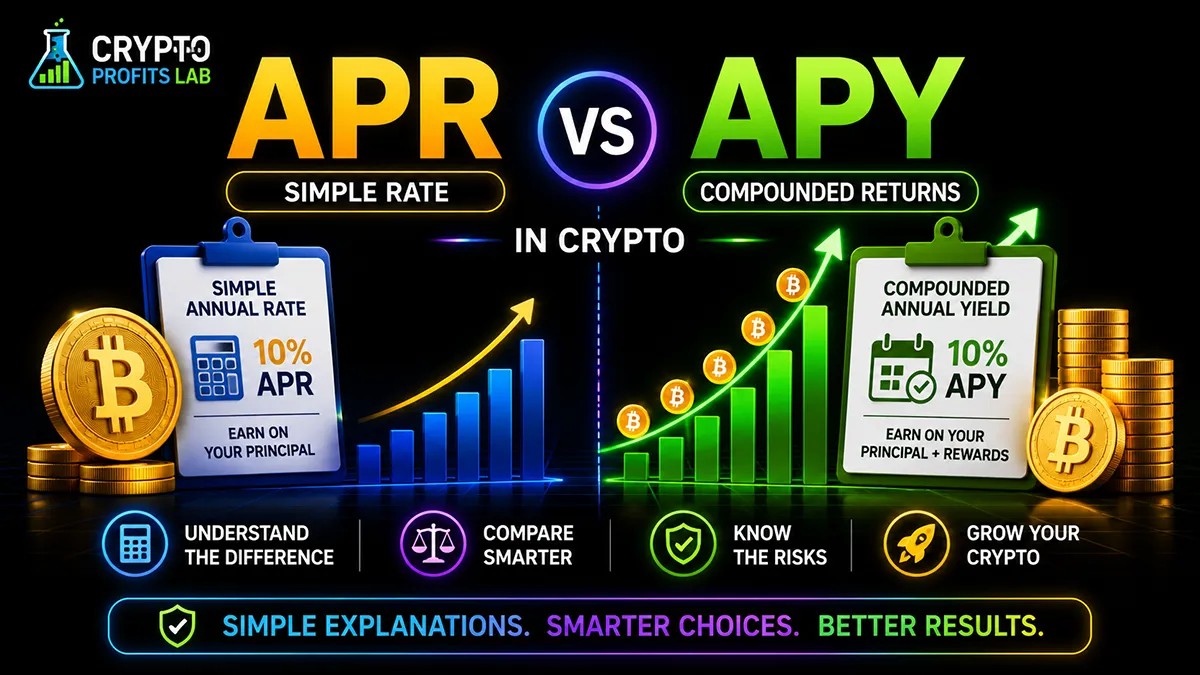
APR vs APY in Crypto is one of the most confusing topics for beginners looking to earn crypto rewards.
You may see a crypto platform showing “8% APR,” another showing “8% APY,” and another advertising a much higher number that looks too good to ignore. At first, these numbers may seem the same. They are not.
APR and APY both describe yearly rates, but they measure returns differently. APR is usually a simpler annual rate that does not include compounding. APY includes the effect of compounding, which means earning rewards on previous rewards.
That difference matters.
If you are comparing staking rewards, lending rewards, stablecoin rewards, or DeFi opportunities, misunderstanding APR vs APY in Crypto can make a reward look better than it really is. It can also cause beginners to chase high rates without understanding the risks behind them.
This guide explains APR vs APY in Crypto in simple terms, with clear examples, beginner mistakes, safety tips, and a step-by-step way to compare reward offers more carefully.
Quick Answer: What Is APR vs APY in Crypto?
APR vs APY in Crypto refers to comparing two different ways crypto platforms describe potential annual returns.
APR stands for annual percentage rate. In crypto earning products, APR typically represents the simple yearly reward rate before compounding. If a platform says 10% APR, it generally means the base annual rate is 10%, not counting the extra effect of reinvesting rewards.
APY stands for annual percentage yield. APY includes compounding. Compounding means rewards may earn additional rewards over time.
For beginners, the simple rule is this:
APR is the basic yearly rate. APY is the annual rate after compounding is taken into account.
However, crypto is not a bank account. Rates can change, token prices can fall, platforms can fail, and rewards are not guaranteed.
Key Takeaways
- APR vs APY in Crypto compares simple annual reward rates with compounded annual reward rates.
- APR usually does not include compounding.
- APY includes compounding.
- APY can look higher than APR even if the base reward rate is the same.
- Crypto reward rates can change at any time.
- A higher APY does not automatically mean a safer or better opportunity.
- Token price drops can erase reward gains.
- Fees, lockups, taxes, and platform risk matter.
- Beginners should understand where rewards come from before joining.
- The safest choice is not always the highest advertised percentage.
APR vs APY in Crypto Beginner Facts Table
| Topic | Beginner-Friendly Explanation |
|---|---|
| APR meaning | Annual percentage rate |
| APY meaning | Annual percentage yield |
| Main difference | APY includes compounding, APR usually does not |
| Compounding | Earning rewards on previous rewards |
| Where beginners see it | Staking, lending, stablecoin rewards, DeFi, exchanges |
| Is a high rate guaranteed? | No |
| Biggest mistake | Choosing only the highest percentage |
| Main risk | Token price loss, platform failure, fees, or lockups |
| Best beginner habit | Compare risk, not just reward rate |
| Important reminder | Crypto rewards are not the same as bank interest |
Why APR vs APY in Crypto Matters
APR vs APY in Crypto matters because reward numbers can influence beginner decisions.
A beginner may see a high APY and assume it is the best opportunity. But the highest number can also come with a higher risk. The reward may be paid in a volatile token. The platform may require a lockup. The rate may be temporary. The fees may be high. The product may involve DeFi risks that are not obvious at first.
Crypto platforms often use percentage rates to attract attention. Some use APR. Some use APY. Some use estimated rewards. Some use variable rates that can change based on market conditions.
That makes comparison difficult.
If one platform shows 12% APR and another shows 12% APY, the APY offer may include compounding while the APR offer may not. If one platform compounds daily and another compounds monthly, the final result may also differ.
But the reward rate is only one part of the decision.
For a broader beginner overview, read Crypto Rewards for Beginners. That article explains common reward types before you compare rates.
What APR Means in Crypto
APR stands for annual percentage rate.
In traditional finance, APR often describes the yearly cost of borrowing money. In crypto, you may also see APR used to describe estimated yearly rewards on staking, lending, or DeFi products.
For example, a crypto platform may say:
“Earn 8% APR.”
In simple terms, that usually means the platform is showing an annualized reward rate before compounding.
If you deposited $1,000 worth of crypto at 8% APR for one year, the simple estimate would be about $80 in rewards before fees, taxes, price changes, or other risks.
That sounds simple, but there are important warnings.
The crypto asset may fall in price. The reward rate may change. The platform may pause withdrawals. The rewards may be paid in a different token. There may be lockup rules.
This is why APR vs APY in Crypto should never be judged by the percentage alone.
APR is useful because it gives beginners a simple starting number. But it does not show the full effect of compounding, nor does it explain the risks behind the reward.
What APY Means in Crypto
APY stands for annual percentage yield.
APY includes compounding. Compounding means rewards can earn more rewards if they are reinvested or added back into the earning balance.
For example, if rewards are added to your balance every day, your new balance may earn rewards the next day. Over time, this can make the final yearly return higher than the simple APR.
In traditional finance, the Consumer Financial Protection Bureau provides an annual percentage yield explanation, describing APY as a measure of total interest based on the interest rate and compounding frequency.
In crypto, APY can be helpful because it shows the effect of compounding. However, beginners should be careful. Crypto APY is often an estimate, not a promise.
A platform may advertise a high APY, but the actual result can be different because of:
- Changing reward rates
- Token price movement
- Fees
- Failed transactions
- Lockup periods
- Platform rules
- DeFi risks
- Market volatility
APR vs APY in Crypto becomes easier when you remember this: APY may show a bigger number because it includes compounding, but a bigger number does not automatically mean a better deal.
Simple APR Example
Let’s use a simple example.
Imagine you stake $1,000 worth of crypto at 10% APR for one year.
If the rate stays the same and there is no compounding, the rough reward estimate is:
| Deposit | APR | Estimated Yearly Reward |
|---|---|---|
| $1,000 | 10% | $100 |
At the end of one year, you might have $1,100 worth of crypto before taxes, fees, and price changes.
But this example assumes the crypto price stays flat. In the real crypto market, the token price can move sharply.
If the token drops by 40%, the reward may not offset the price loss.
That is why beginners should read Crypto Volatility before focusing on rewards.
Simple APY Example
Now imagine the same $1,000 earns rewards that compound.
If the platform shows 10% APY, the estimate already includes compounding over the year. The exact result depends on how often rewards are compounded.
Compounding can happen:
- Daily
- Weekly
- Monthly
- Automatically
- Manually, when you claim and restake rewards
Here is a simplified comparison:
| Rate Type | Compounding Included? | Simple Meaning |
|---|---|---|
| 10% APR | Usually no | Base annual rate |
| 10% APY | Yes | Annual return with compounding included |
This is the core idea behind APR vs APY in Crypto.
APY can be higher than APR when rewards are compounded frequently. But in crypto, the final result still depends on price changes, platform rules, reward changes, and fees.
Step-by-Step: How to Compare APR vs APY in Crypto
Here is a beginner-friendly way to compare reward offers.
Step 1: Identify whether the platform shows APR or APY
Look carefully at the label.
Does it say APR? APY? Estimated APY? Variable APR? Promotional rate?
Small wording differences can matter.
APR vs APY in Crypto starts with knowing which number you are looking at.
Step 2: Check whether compounding is included
If the platform shows APR, ask whether rewards are automatically compounded or must be manually claimed.
If the platform shows APY, ask how often compounding happens.
A high APY may depend on frequent compounding. If you do not actually compound rewards, your real result may be lower.
Step 3: Find out what token pays the reward
Are rewards paid in the same token you deposited? Are they paid in a different token? Are they paid in a platform token?
This matters because a reward paid in a risky token may lose value quickly.
To understand tokens better, read Crypto Token.
Step 4: Check the lockup rules
Some products let you withdraw anytime. Others lock your crypto for days, weeks, or longer.
A lockup can be risky because crypto prices can fall while you wait.
Step 5: Review fees
Fees can reduce rewards.
You may pay trading fees, withdrawal fees, claim fees, network fees, or gas fees. If you use DeFi, read What Are Crypto Gas Fees? before making transactions.
Step 6: Understand where the rewards come from
This is one of the most important steps.
Rewards may come from staking, lending, trading fees, liquidity incentives, or token emissions. If you cannot understand the source, be careful.
Step 7: Compare the risk, not just the rate
A lower reward on a more understandable product may be better than a high reward on a confusing or risky platform.
APR vs APY in Crypto is not just a math comparison. It is a risk comparison.
APR vs APY in Crypto Staking
Staking is one of the most common places beginners see APR and APY.
Staking usually means using crypto to help support a proof-of-stake blockchain. In return, users may earn rewards.
If you are new to staking, read Crypto Staking and What Is Proof of Stake?.
A staking platform may show an APR because it is estimating the annual reward rate before compounding. Another platform may show APY because it assumes rewards are compounded.
Beginners should ask:
- Is the rate fixed or variable?
- Are rewards automatically restaked?
- Is there a lockup period?
- Is there a validator risk?
- Can rewards be reduced?
- What happens if the token price falls?
Staking can be useful, but it is not risk-free.
A 6% staking reward does not protect you if the token drops 30%.
APR vs APY in Crypto Lending
Crypto lending is another area where rates can be confusing.
Crypto lending usually means depositing crypto so a platform or protocol can lend it to others. In return, you may earn rewards or interest.
Before using lending products, read What Is Crypto Lending?.
A lending platform may show APR for borrowers and APY for lenders. Borrowers care about how much they pay. Lenders care about how much they may earn.
However, crypto lending has serious risks.
The borrower may not repay. The platform may fail. The collateral may fall in value. Withdrawals may be delayed. The terms may change.
APR vs APY in Crypto is important here because a high lending APY can hide bigger risks in the background.
Beginners should not assume that lending is safe just because it looks similar to earning interest on a bank account.
APR vs APY in DeFi
DeFi stands for decentralized finance.
DeFi platforms allow users to trade, lend, borrow, stake, or earn through blockchain-based apps rather than traditional financial institutions.
Start with What Is DeFi? if this is new to you.
DeFi often uses APR and APY because rewards can come from liquidity pools, staking contracts, token incentives, or trading fees.
Some DeFi dashboards show very high APY numbers. These can be tempting, but beginners should be careful.
High DeFi yields may involve:
- Smart contract risk
- Token price risk
- Impermanent loss
- Low liquidity
- High gas fees
- Scam projects
- Rapidly changing reward rates
APR vs APY in Crypto becomes especially important in DeFi because compounding can make numbers look large, but DeFi risks can also be larger.
If you are still new, avoid complicated yield strategies until you understand the basics.
APR vs APY in Yield Farming
Yield farming is a more advanced DeFi strategy in which users move crypto across opportunities to earn rewards.
It can involve liquidity pools, reward tokens, staking contracts, and frequent changes.
Read What Is Crypto Yield Farming? before trying it.
Yield farming platforms often show APY because rewards may be compounded or reinvested. Some advertised rates can look extremely high.
Beginners should be skeptical.
If an offer shows a huge APY, ask why. The answer may involve high token inflation, unstable rewards, low liquidity, or major risk.
APR vs APY in Crypto is useful for understanding the math, but math alone cannot make a risky project safe.
APR vs APY in Stablecoin Rewards
Stablecoins are crypto assets designed to track another asset, often the U.S. dollar.
Some platforms offer rewards for holding, lending, or using stablecoins.
Learn the basics in What Are Stablecoins?.
Stablecoin rewards can feel safer because the token is designed to stay near $1. But stablecoins still have risks.
A stablecoin can lose its peg. A platform can fail. A lending program can freeze withdrawals. Regulations can change. Reward rates can drop.
APR vs APY in Crypto matters for stablecoins because small differences can look more predictable than volatile tokens. But beginners should still ask where the yield comes from.
If a stablecoin reward rate is much higher than normal savings rates, there is usually added risk.
Why Higher APY Is Not Always Better
A higher APY can look better on paper, but it may not be better in real life.
Here is why:
| Offer | Possible Problem |
|---|---|
| Very high APY | May involve high risk or unstable rewards |
| Complicated DeFi APY | May require advanced knowledge |
| Reward paid in unknown token | Token may fall quickly |
| Locked rewards | You may not be able to exit |
| High claim fees | Fees may reduce earnings |
| Variable rate | Rate may drop after you join |
APR vs. APY in Crypto should help you ask better questions rather than blindly chase bigger numbers.
A lower rate from a clearer, safer setup may be more reasonable for a beginner than a high rate from a project you do not understand.
Common Beginner Mistakes With APR and APY
Beginners often make the same mistakes when comparing crypto reward rates.
Mistake 1: Thinking APR and APY are the same
They are not the same.
APR usually does not include compounding. APY includes compounding.
Mistake 2: Choosing the highest number
The highest number may come with the highest risk.
Do not choose a platform only because it advertises a big percentage.
Mistake 3: Ignoring the token price
If the token price drops, rewards may not help much.
A 12% reward does not protect you from a 50% price drop.
Mistake 4: Forgetting fees
Gas fees, withdrawal fees, claim fees, and platform fees can reduce rewards.
Small accounts can be hit especially hard by fees.
Mistake 5: Not checking lockups
Some products lock your crypto.
If the market drops, you may not be able to sell or move your funds quickly.
Mistake 6: Trusting unrealistic promotions
Scams often use words like guaranteed, risk-free, secret, or daily profit.
Real crypto rewards still involve risk.
Mistake 7: Forgetting taxes
Rewards may create tax reporting requirements.
Read Crypto Taxes for Beginners before assuming rewards are simple.
Safety and Risk Section
APR vs APY in Crypto is not only about earning more. It is also about avoiding bad decisions.
Be careful with any platform or person promising:
- Guaranteed rewards
- No risk
- Daily profit
- Secret staking pools
- Extremely high APY
- Rewards that require sending crypto first
- Wallet connections through unknown links
- Pressure to act immediately
These are warning signs.
Use these safety habits:
- Research the platform.
- Use official websites only.
- Start with small amounts.
- Understand wallet approvals.
- Do not share your seed phrase.
- Turn on two-factor authentication.
- Avoid links from unknown sources in social media messages.
- Keep records for taxes.
- Compare risks before comparing rates.
For more protection, read Crypto Safety Tips and Crypto Scams to Avoid.
If you use self-custody, read What Is a Crypto Wallet? and Hardware Wallet.
Simple Beginner Checklist
Before using any crypto-earning product, ask these questions:
- Is the rate APR or APY?
- Does the number include compounding?
- Is the rate fixed or variable?
- What token pays the reward?
- Is there a lockup period?
- What fees apply?
- Can I withdraw anytime?
- Who controls the crypto?
- Where do rewards come from?
- What happens if the token price drops?
- Are taxes involved?
- Is the platform reputable?
This checklist can help beginners compare offers more carefully.
APR vs APY in Crypto is easier when you slow down and look at the full picture.
Should Beginners Use APR or APY to Compare Offers?
Beginners can use both APR and APY, but they should understand what each one shows.
APR can be useful when you want a simple base annual rate.
APY can be useful when compounding is part of the reward strategy.
However, crypto products are not always standardized. One platform’s APY estimate may not be calculated the same way as another platform’s APY estimate. One platform may assume automatic compounding. Another may require manual claiming. Another may show a promotional rate.
That is why APR vs APY in Crypto should be only one part of your research.
Also compare:
- Asset quality
- Platform reputation
- Liquidity
- Fees
- Lockups
- Tax impact
- Security risks
- Withdrawal rules
The better question is not “Which rate is highest?”
The better question is “Which opportunity do I understand well enough to use safely?”
Final Thoughts
APR vs APY in Crypto can seem confusing at first, but the basic idea is simple.
APR typically represents the simple annual rate before compounding. APY shows an annual rate that includes compounding. APY may look higher because it assumes rewards can earn more rewards over time.
But crypto rewards are not guaranteed.
Rates can change. Tokens can fall. Platforms can fail. Fees can reduce returns. Lockups can limit your choices. Taxes may apply.
For beginners, the goal is not to chase the biggest number. The goal is to understand what the number means and what risks it entails.
APR vs APY in Crypto is a helpful tool, but it is not the whole decision.
Crypto Profits Lab is built to make crypto easier for beginners, and this topic is a perfect example. When you understand the difference between simple and compound interest, you can compare offers more clearly, avoid hype, and make smarter decisions.
APR vs APY in Crypto FAQ
What is APR vs APY in Crypto?
APR vs APY in Crypto compares two ways platforms show yearly reward rates. APR usually means a simple annual rate that does not include compounding. APY means annual percentage yield and includes compounding. In crypto, both numbers are usually estimates, and actual results can vary due to fees, price movements, platform rules, and reward changes.
Is APR or APY better in crypto?
APY usually looks better because it includes compounding, but that does not automatically make it safer or more profitable. APR can be easier to understand as a simple base rate. Beginners should compare risk, token quality, fees, lockups, and platform reputation rather than choosing only the highest APR or APY.
Why is APY higher than APR?
APY can be higher than APR because APY includes compounding. Compounding means rewards may be added back to the balance and then earn more rewards. The more often compounding happens, the more APY can differ from APR. In crypto, this assumes that rewards are actually compounded and that the platform’s estimate is accurate.
Does crypto APY guarantee profit?
No, crypto APY does not guarantee profit. A platform may show an estimated APY, but the token price can fall, rewards can change, fees can reduce earnings, and platforms can have problems. Even a high APY can result in a loss if the crypto asset drops significantly in value.
What does APR mean in crypto staking?
In crypto staking, APR typically refers to the estimated annual reward rate before compounding. For example, 8% APR suggests a simple annual reward estimate of 8% before fees, taxes, and price changes. The actual result may differ because staking rewards can change, and the value of the staked token can rise or fall.
What does APY mean in crypto staking?
In crypto staking, APY is the estimated annual return after compounding. If staking rewards are automatically restaked or frequently compounded, APY may be higher than the simple APR. Beginners should check whether compounding is automatic, whether there is a lockup, and whether the reward rate can change.
Why do DeFi platforms show very high APY?
DeFi platforms may show very high APY because rewards can include token incentives, compounding assumptions, low liquidity, or high-risk strategies. A high APY does not mean the opportunity is safe. Beginners should be careful with very large numbers and research smart contract risk, token risk, fees, and withdrawal rules.
Can fees reduce crypto APR or APY?
Yes, fees can reduce your real crypto returns. Gas fees, trading fees, withdrawal fees, claim fees, and platform fees can all lower the amount you keep. This is especially important for small accounts because fees may take a larger percentage of the rewards. Always review costs before joining.
Should beginners chase high APY crypto rewards?
Beginners should not chase high-APY crypto rewards without understanding the risks. High rates often come with higher uncertainty, unstable tokens, lockups, or platform risk. A lower, clearer reward from a reputable platform may be more appropriate than a confusing offer with a huge advertised APY.
How should beginners compare crypto reward rates?
Beginners should first check whether the rate is APR or APY, then review compounding, fees, lockups, token risk, platform reputation, and tax impact. The highest number is not always the best choice. A good comparison includes both the reward rate and the risks required to earn it.