Impermanent Loss in Crypto: A Beginner’s Guide
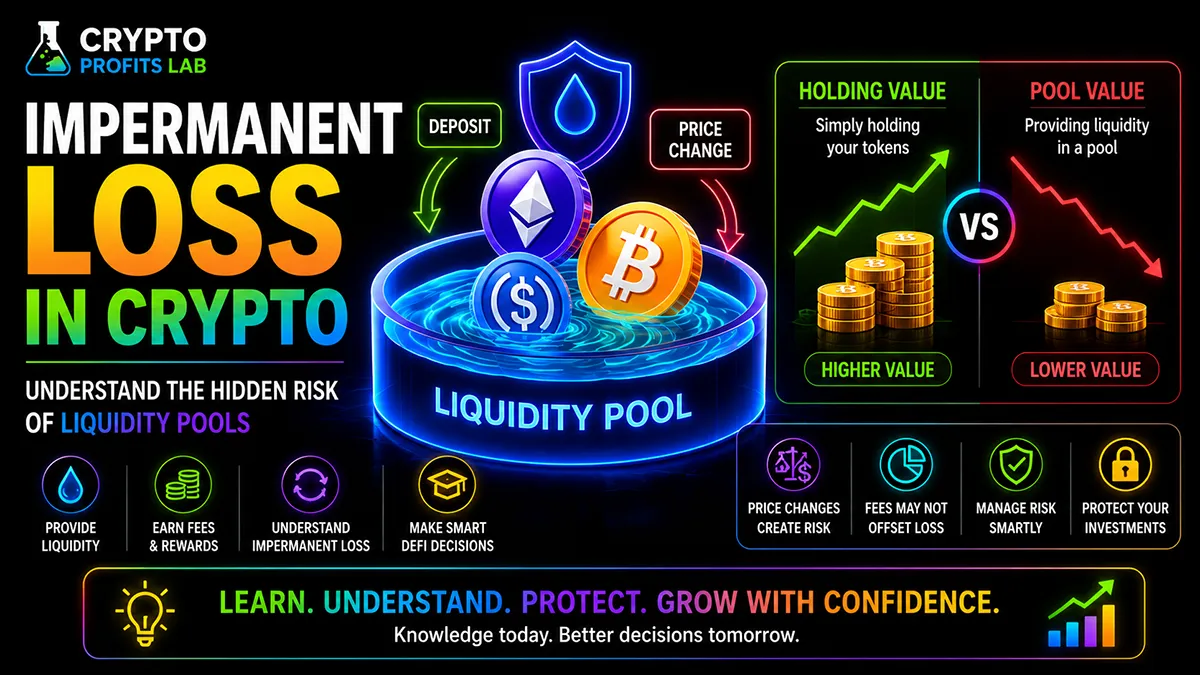
Impermanent Loss in Crypto is one of the most important risks beginners should understand before using DeFi liquidity pools or yield farming.
The term sounds complicated, but the basic idea is simple. Impermanent loss can occur when you provide crypto to a liquidity pool, and the tokens’ prices change relative to when you deposited them.
In plain English, you may end up with less value than you would have had if you simply held the tokens in your wallet.
This does not always mean you lose money in dollar terms. It means your liquidity pool position may underperform compared with simply holding the same assets.
That difference matters because many beginners see DeFi rewards, trading fees, or high APY numbers and assume the opportunity is safe. But rewards are only one part of the picture. Impermanent loss, fees, token prices, scams, and smart contract risk can all affect your final result.
This guide explains Impermanent Loss in Crypto in simple terms, how it happens, why it matters, and how beginners can reduce risk before using DeFi.
Quick Answer: What Is Impermanent Loss in Crypto?
Impermanent Loss in Crypto is the loss in value that can happen when you provide tokens to a liquidity pool and the price relationship between those tokens changes.
For example, if you deposit ETH and a stablecoin into a liquidity pool, and ETH rises sharply, your pool position may be worth less than if you had simply held the ETH and stablecoin separately.
It is called “impermanent” because the loss may shrink if prices move back toward where they were when you deposited. However, the loss can become real if you withdraw while the price difference still exists.
For beginners, the simple rule is this: liquidity pool rewards are not automatically profit. You must compare rewards against impermanent loss, fees, token risk, and platform risk.
Key Takeaways
- Impermanent Loss in Crypto is a major risk for liquidity providers.
- It happens when token prices change after you add crypto to a liquidity pool.
- The larger the price difference, the larger the possible impermanent loss.
- Trading fees and rewards may help offset losses, but they do not guarantee a profit.
- Stablecoin pools may reduce price movement risk, but they are not risk-free.
- Yield farming can expose beginners to impermanent loss.
- A high APY does not automatically mean a safe DeFi opportunity.
- Impermanent loss can become permanent when you withdraw from the pool.
- Beginners should understand liquidity pools before providing crypto.
- Safety, research, and small test amounts matter more than chasing high rewards.
Impermanent Loss in Crypto Beginner Facts Table
| Topic | Beginner-Friendly Explanation |
|---|---|
| Main idea | Your liquidity pool position may be worth less than simply holding the tokens |
| Where it happens | DeFi liquidity pools and automated market makers |
| Common with | Yield farming, DEX pools, liquidity rewards |
| Main cause | Token prices change after you deposit |
| Bigger risk when | One token moves much more than the other |
| Can rewards help? | Yes, but they may not fully offset the loss |
| Is it always permanent? | Not until you withdraw while the loss exists |
| Beginner difficulty | Medium to advanced |
| Main safety habit | Understand the pool before adding funds |
| Best first step | Learn DeFi, DEXs, liquidity, and gas fees |
Why Impermanent Loss in Crypto Matters
Impermanent Loss in Crypto matters because many beginners enter DeFi for rewards without fully understanding the trade-off.
A liquidity pool may advertise trading fees, rewards, or an attractive APY. That can make it look like an easy way to earn passive income. But the return shown on a platform may not include the full risk.
If token prices move against your position, your final value can be lower than expected.
This is especially important for beginners using:
- DeFi platforms
- Decentralized exchanges
- Liquidity pools
- Yield farming strategies
- Stablecoin reward pools
- Token pair rewards
- High APY opportunities
Before going further, it helps to understand What Is DeFi? and What Is a DEX?. Those two topics explain the environment in which impermanent loss usually occurs.
What Is a Liquidity Pool?
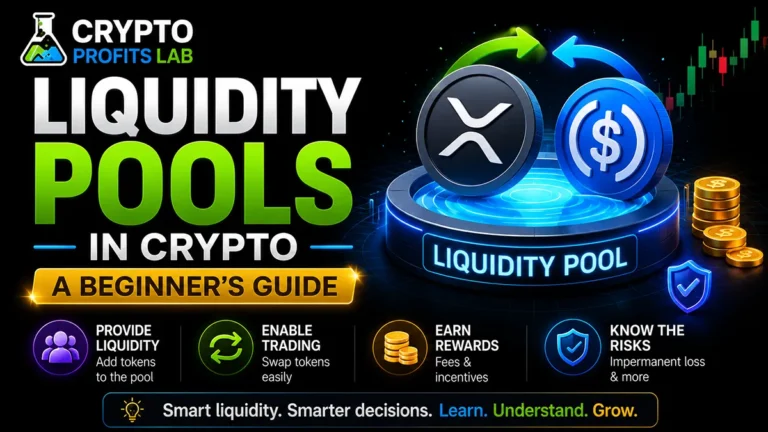
A liquidity pool is a collection of crypto tokens locked in a DeFi protocol, allowing users to trade them.
Instead of matching buyers and sellers like a traditional exchange, many decentralized exchanges use liquidity pools. Users called liquidity providers add crypto to the pool. Other users trade against that pool.
Liquidity providers may earn a share of trading fees or extra rewards.
For example, a liquidity pool may contain ETH and USDC. Traders can swap ETH for USDC or USDC for ETH. The pool adjusts token amounts based on trading activity.
This setup helps decentralized exchanges work, but it creates risk for the people providing liquidity.
To better understand this foundation, read Crypto Liquidity.
Impermanent Loss in Crypto usually happens because the pool constantly adjusts token balances as prices move.
Simple Example of Impermanent Loss
Imagine you have two choices.
Choice 1: Hold your tokens in your wallet.
Choice 2: Put the same tokens into a liquidity pool.
Let’s say you provide ETH and USDC to a pool. ETH later rises in price.
Because of how the pool works, your share of the pool may end up holding less ETH and more USDC than before. That can make your liquidity pool position worth less than simply holding the original ETH and USDC outside the pool.
You may still earn trading fees. But if the price movement is large enough, those fees may not fully cover the difference.
That difference is Impermanent Loss in Crypto.
The important beginner point is this: impermanent loss is measured against the value you could have had by simply holding.
Why Is It Called Impermanent?
The word “impermanent” can be confusing.
It does not mean the loss is harmless. It means the loss can change over time.
If token prices move back toward their original relationship, the impermanent loss may shrink. But if you withdraw your funds while the loss exists, the loss becomes real.
That is why some people say impermanent loss becomes permanent when you exit the pool.
Beginners should not let the word “impermanent” create false comfort. The risk is real. The value of your position can be lower than expected.
Impermanent Loss in Crypto is best understood as a moving risk that depends on token price changes and on when you withdraw.
How Impermanent Loss Happens Step by Step
Here is a simple step-by-step explanation.
Step 1: You add two tokens to a liquidity pool
Many pools require two assets.
For example, you may add ETH and USDC. Some pools use other pairs, such as ETH and another token, or two stablecoins.
Step 2: The pool keeps token values balanced
Liquidity pools use formulas to help set prices and keep the pool working.
As users trade, the pool changes how much of each token it holds.
Step 3: One token changes price
If one token rises or falls compared with the other, the pool adjusts.
This adjustment can leave you with a different mix of tokens than you started with.
Step 4: Your pool position may underperform holding
If you had simply held the two tokens outside the pool, your value may have been higher.
That difference is the impermanent loss.
Step 5: Fees may or may not offset the loss
Liquidity providers may earn trading fees or rewards.
Those rewards can help, but they do not guarantee profit.
For a direct DeFi platform explanation, Uniswap explains impermanent loss as a loss of value that can happen when prices in a liquidity pool change after liquidity is added.
Impermanent Loss vs Losing Money
Impermanent Loss in Crypto does not always mean your account is down in dollar value.
This is where beginners get confused.
You could still make money overall, but make less than you would have by simply holding.
For example:
| Scenario | What Happens |
|---|---|
| Holding tokens | Your tokens rise in value |
| Providing liquidity | Your pool position rises too, but less than holding |
| Result | You made money, but underperformed holding |
In another case, the token price may fall, and your liquidity pool position may lose money in dollar terms.
The key is comparison. Impermanent loss compares the pool result against the holding result.
That is why rewards alone do not tell the full story.
Impermanent Loss and Yield Farming
Yield farming is one of the most common places beginners run into this risk.
Yield farming means using DeFi strategies to earn rewards. This can include providing liquidity, staking liquidity pool tokens, or moving funds between protocols.
If you are new to this, read What Is Crypto Yield Farming?.
Yield farming platforms may show high reward rates. But if the strategy involves a liquidity pool, Impermanent Loss in Crypto may reduce or erase those rewards.
This is why a 30% APY does not automatically mean you will earn 30% profit.
The actual result depends on:
- Token price movement
- Trading fees
- Reward tokens
- Gas fees
- Pool design
- Time in the pool
- Withdrawal timing
- Platform safety
Beginners should understand all of these before joining a yield farm.
Impermanent Loss and Staking
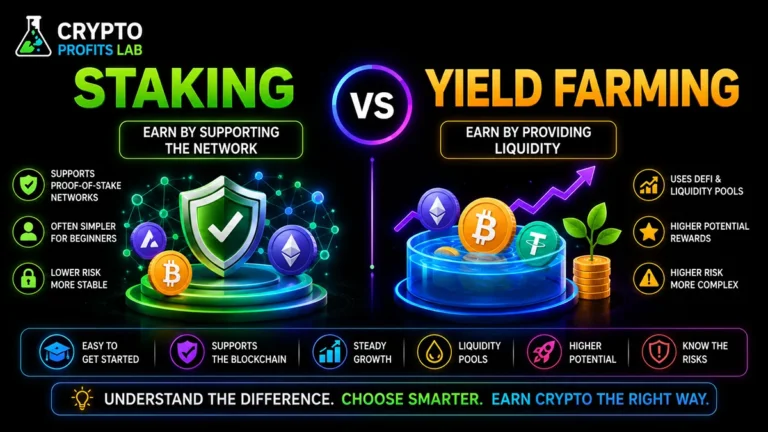
Staking and liquidity pools are different.
Staking usually means using crypto to help support a proof-of-stake blockchain. Liquidity pools usually help decentralized trading.
If you are comparing reward methods, read Staking vs Yield Farming.
Basic staking usually does not create impermanent loss because you are not pairing two assets in a liquidity pool. However, staking still has other risks, including token price changes, lockups, validator issues, and platform risk.
Impermanent Loss in Crypto is more closely connected to liquidity providing and yield farming than simple staking.
That is one reason staking may be easier for beginners to understand than yield farming.
Impermanent Loss and Stablecoin Pools
Stablecoin pools may reduce the risk of impermanent loss because stablecoins are designed to stay close to a target value, often $1.
For example, a pool with USDC and USDT may have less price movement than a pool with ETH and a small token.
But stablecoin pools are not risk-free.
Stablecoin risks include:
- Losing the peg
- Platform failure
- Smart contract bugs
- Regulatory changes
- Low liquidity
- DeFi protocol risk
Read What Are Stablecoins? before assuming stablecoin rewards are safe.
Impermanent Loss in Crypto may be lower in stablecoin pools, but other risks can still matter.
Impermanent Loss and Crypto Slippage
Crypto slippage and impermanent loss are different, but both are connected to DeFi trading.
Slippage occurs when the price you expect for a trade differs from the price you actually receive.
Impermanent loss happens when your liquidity pool position underperforms holding because token prices change.
If you use a DEX, both topics matter.
Read Crypto Slippage to understand trade execution risk.
A beginner using DeFi should understand liquidity, slippage, gas fees, and impermanent loss before adding funds to any pool.
Fees, Rewards, and the Real Return
Liquidity providers may earn trading fees.
Those fees are one reason people provide liquidity. If the pool has high trading volume, fees may help offset impermanent loss.
Some DeFi platforms also offer extra token rewards.
However, rewards can be misleading.
A pool may offer high rewards because the token is risky, the liquidity is low, or the platform is trying to attract users quickly.
To compare reward rates more clearly, read APR vs APY in Crypto.
Your real return may depend on:
- Trading fees earned
- Reward tokens earned
- Token price changes
- Impermanent loss
- Gas fees
- Claim fees
- Withdrawal fees
- Taxes
- Time in the pool
Impermanent Loss in Crypto should always be part of your return calculation.
Gas Fees Can Change the Math
Gas fees are blockchain transaction fees.
If you provide liquidity, claim rewards, remove liquidity, or move tokens, you may pay gas fees. These costs can reduce your final return.
For small accounts, gas fees can make DeFi strategies less practical.
For example, earning $8 in rewards does not help much if you pay $20 in gas fees.
Read What Are Crypto Gas Fees? before using liquidity pools on any network.
Beginners should factor in gas fees when considering Impermanent Loss in Crypto. Fees may make a risky strategy even less worthwhile.
Common Beginner Mistakes
Beginners often make the same mistakes with liquidity pools.
Mistake 1: Chasing the highest APY
High APY may come with high risk.
A pool offering huge rewards may involve volatile tokens, low liquidity, or unsustainable incentives.
Mistake 2: Ignoring token price movement
Impermanent loss is caused by price changes.
If one token moves sharply relative to the other, the risk can increase.
Mistake 3: Thinking fees always cover losses
Trading fees can help, but they do not guarantee profit.
A large price move can outweigh fees.
Mistake 4: Providing liquidity to unknown tokens
Small or unknown tokens can be risky.
They may have low liquidity, high volatility, or a risk of scams.
Mistake 5: Not understanding wallet approvals
DeFi often requires wallet approvals.
Approving a bad contract can put your funds at risk.
Mistake 6: Forgetting gas fees
Gas fees can reduce or erase returns, especially for smaller positions.
Mistake 7: Treating yield farming like a savings account
Liquidity pools are not bank accounts.
They involve market risk, protocol risk, and token risk.
Mistake 8: Not tracking taxes
DeFi rewards, swaps, and liquidity activity can create tax records.
Read Crypto Taxes for Beginners before assuming DeFi is simple.
Safety and Risk Section
Impermanent Loss in Crypto is only one risk. DeFi has several others.
Before providing liquidity, beginners should understand:
- Smart contract risk
- Scam websites
- Fake tokens
- Rug pulls
- Low liquidity
- High gas fees
- Wallet approval risk
- Token volatility
- Stablecoin depeg risk
- Tax complexity
Use these safety habits:
- Start with education before depositing funds.
- Use official links only.
- Never share your seed phrase.
- Do not connect your main wallet to unknown platforms.
- Start with small amounts if testing.
- Avoid pools with tokens you do not understand.
- Check fees before confirming transactions.
- Research the protocol.
- Be skeptical of extremely high rewards.
- Keep records for taxes.
- Understand how to remove liquidity before you add it.
For wallet protection, read Crypto Safety Tips and Crypto Scams to Avoid.
If you plan to hold larger amounts, learn about using a Hardware Wallet for long-term storage.
How to Reduce Impermanent Loss Risk
You cannot remove impermanent loss risk completely from liquidity pools, but you can reduce it.
Choose less volatile pairs
Pools with two stable assets may have less impermanent loss risk than pools with one volatile token and one small token.
Understand both tokens
Do not provide liquidity for a token you would not want to own.
If one token fails, rewards may not matter.
Avoid unknown high-yield pools
High rewards may be offered because the pool is risky.
Be careful with new tokens and social media hype.
Watch pool size and liquidity
Low-liquidity pools can be riskier.
They may have bigger price swings, higher slippage, or less reliable trading activity.
Consider fees and rewards
Fees and rewards can offset impermanent loss, but they should not be assumed.
Compare the full risk before depositing.
Start small
Beginners should not test DeFi strategies with money they cannot afford to lose.
Learn before using DeFi
Read Crypto Rewards for Beginners and Is Crypto Passive Income Safe? before treating DeFi rewards as passive income.
Is Impermanent Loss Always Bad?
Impermanent Loss in Crypto is not automatically bad, but it must be understood.
Some liquidity providers still earn positive returns if trading fees and rewards exceed losses. Others may lose money or underperform when holding.
The problem for beginners is not that impermanent loss exists. The problem is entering a pool without knowing it exists.
A liquidity pool can be useful for experienced users who understand the risks. But it can be dangerous for beginners who only see the reward percentage.
The best question is not “Can this pool earn rewards?”
The better question is “Can I explain how this pool could lose money?”
Beginner Checklist Before Providing Liquidity
Before adding crypto to a pool, ask:
- Do I understand Impermanent Loss in Crypto?
- Do I understand both tokens in the pool?
- Would I hold both tokens separately?
- Is one token extremely volatile?
- Is the pool liquid enough?
- Are rewards paid in a risky token?
- What fees apply?
- What gas fees will I pay?
- Can I remove liquidity easily?
- Is the platform reputable?
- Could scams or fake websites be involved?
- Are taxes involved?
- What happens if one token drops sharply?
- Am I using money I can afford to lose?
If you cannot answer these questions, wait and learn more.
There is no need to rush into DeFi.
Final Thoughts
Impermanent Loss in Crypto is one of the most important DeFi risks beginners should understand.
It can happen when you provide tokens to a liquidity pool and the prices of those tokens change. Your pool position may end up worth less than simply holding the original tokens.
Trading fees and rewards may help offset losses, but they do not guarantee a profit.
Beginners should be especially careful with yield farming, low-liquidity pools, volatile token pairs, high APY offers, and unknown DeFi platforms.
Crypto Profits Lab is built to make crypto easier for beginners, and this topic is a perfect example. The smartest move is not chasing the highest DeFi rewards. It is learning how the risk works before putting money into a pool.
If you understand impermanent loss, liquidity, gas fees, slippage, wallet safety, and scams, you will be in a much better position to make safer crypto decisions.
Impermanent Loss in Crypto FAQ
What is Impermanent Loss in Crypto?
Impermanent Loss in Crypto is the value difference that can happen when you provide tokens to a liquidity pool and token prices change. Your liquidity pool position may become worth less than if you had simply held the tokens separately. It is called impermanent because the loss can change, but it can become real when you withdraw.
Why does impermanent loss happen?
Impermanent loss happens because liquidity pools automatically adjust token balances as prices move. If one token rises or falls compared with the other, the pool may leave you with a different mix of tokens than you started with. That new mix can underperform simply holding the original tokens outside the pool.
Can impermanent loss become permanent?
Yes, impermanent loss can become permanent if you withdraw from the liquidity pool while the loss still exists. If token prices return closer to their original relationship, the loss may shrink. However, there is no guarantee that prices will return, and withdrawing locks in the result at that time.
Does impermanent loss mean I lost money?
Not always. You may still have more dollar value than you started with, but less than you would have had by simply holding the tokens. Impermanent loss is a comparison against holding. In some cases, you can still earn a profit overall, but in other cases, you can lose money.
Can trading fees offset impermanent loss?
Trading fees and rewards can help offset impermanent loss, but they do not guarantee profit. If the pool earns enough fees, a liquidity provider may still come out ahead. However, large token price moves, low trading volume, gas fees, and risky reward tokens can reduce or erase the benefit.
Is impermanent loss common in yield farming?
Yes, impermanent loss is common in yield farming when the strategy involves liquidity pools. Many yield farms pay rewards to users who provide token pairs. If the token prices change after deposit, impermanent loss can occur. Beginners should understand this risk before chasing high APY numbers.
Do stablecoin pools have impermanent loss?
Stablecoin pools may have a lower risk of impermanent loss because the tokens are designed to remain close to their nominal value. However, they are not risk-free. A stablecoin can lose its peg, a platform can fail, a smart contract can have bugs, and fees can still reduce returns.
How can beginners reduce the risk of impermanent loss?
Beginners can reduce the risk of impermanent loss by choosing less volatile token pairs, avoiding unknown tokens, checking liquidity, understanding both assets, considering fees, and starting small. It is also wise to learn the basics of DeFi before providing liquidity. Risk can be reduced, but it cannot be fully removed.
Is impermanent loss only on decentralized exchanges?
Impermanent loss is primarily associated with decentralized exchanges and DeFi liquidity pools. It usually happens when users provide tokens to automated market maker pools. A normal buy or sell on a centralized exchange does not create impermanent loss, although it can still involve trading fees, slippage, and price risk.
Should beginners provide liquidity?
Beginners should not provide liquidity until they understand impermanent loss, gas fees, wallet approvals, token risk, and DeFi safety. Liquidity pools can be useful, but they are more advanced than simply buying and holding crypto. A beginner should learn first, start small, and avoid pools they do not understand.