Crypto Take Profit: 7 Smart Ways to Lock In Gains

Crypto take profit is a simple risk-management idea: decide in advance where you may sell some or all of a crypto position if the price rises to a target. Instead of waiting for emotions to take over, you create an exit plan before the market moves.
A take-profit target does not predict the future or guarantee a profit. It simply gives you a planned price or set of prices where you intend to reduce or close a position.
This guide explains how crypto take profit works, how it differs from regular limit orders and stop-loss orders, how to choose realistic targets, and what can go wrong when markets move quickly.
Quick Answer
Crypto take profit means planning to sell a cryptocurrency position after price reaches a chosen target. Depending on the exchange, you may use a dedicated take-profit order, a sell limit order, or a bracket-style order that combines a profit target with a stop loss.
The goal is not to sell at the exact top. It is to create an exit plan before greed, fear, or fast price movement changes your decision.
Because order types vary across exchanges, always review how your platform handles triggers, market orders, limit orders, partial fills, and fees.
Key Takeaways
- A crypto take profit target is a planned exit price for a profitable position.
- Take-profit orders can work differently depending on the exchange.
- A take-profit target does not guarantee the exact price you will receive.
- Using a profit target together with a crypto stop loss can define both the potential upside and downside before a trade.
- Fees, spread, and slippage can reduce the amount you actually keep.
- Selling only part of a position can be an alternative to closing everything at one price.
- A good exit plan should be based on a reasoned target, not simply on hope that the price will keep rising.
Crypto Take Profit at a Glance
| Term | Beginner Meaning |
|---|---|
| Take-profit target | A price where you plan to sell for a gain |
| Take-profit order | An exchange order designed to activate when a profit target is reached |
| Trigger price | The price that causes the take-profit instruction to activate |
| Limit price | The minimum price you are willing to accept on a sell limit order |
| Stop loss | A planned exit designed to limit downside if price moves against you |
| Partial profit taking | Selling part of a position while keeping the rest |
| Risk/reward | Comparing the amount you could lose with the amount you hope to gain |
| Slippage | The difference between the expected execution price and the actual fill price |
What Is Crypto Take Profit?
Crypto take profit is the process of setting a price level where you plan to realize gains from a cryptocurrency position.
Imagine you buy a coin at $100. Before placing the trade, you decide that $120 would be a reasonable target based on your plan. If the price reaches $120, you may sell all or part of the position. Your profit is no longer only an unrealized gain on the screen; after the sale, it becomes a realized gain or loss for that portion of the position, before considering fees and taxes.
The important idea is planning.
Beginners often focus heavily on when to buy. They may spend hours studying a chart, reading news, or comparing coins. But the exit receives much less attention. Without an exit plan, a rising price can create a new question every few minutes: Should I sell now? Should I wait? What if it goes higher?
A crypto take profit plan gives you an answer before that pressure appears.
It also fits naturally with spot trading in crypto, where you buy an asset and later sell it rather than borrowing funds to increase your exposure.
Why Taking Profit Can Be Hard for Beginners
Selling a winning position can be surprisingly difficult. When price rises, a trader may keep moving the target higher because they fear missing a bigger rally. If price reverses, an unrealized gain can shrink quickly. The opposite can happen too: fear can cause someone to sell far earlier than planned.
A crypto take profit process separates planning from reaction. You decide on an exit while you are calm, then compare later decisions with that original plan. This can be especially useful during periods of crypto volatility, when prices may move sharply in both directions.
How a Crypto Take Profit Order Works
A dedicated take-profit order usually has a trigger price. When the market reaches that trigger, the exchange follows the instructions attached to the order.
The exact behavior depends on the platform.
For example, one exchange may trigger a market order, which tries to execute immediately at the best available prices. Another may allow a take-profit limit order, which is submitted after the trigger. Some platforms offer bracket-style orders that connect a profit target with a stop-loss level.
That distinction matters.
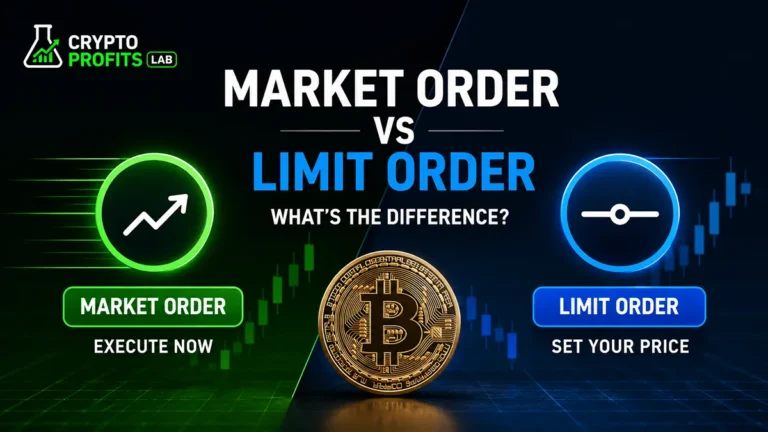
A market order prioritizes execution, not a specific price. A limit order prioritizes price, but it may not fill if the market moves away. If you are new to these differences, review market order vs limit order in crypto before using advanced exit orders.
Order behavior also changes over time as exchanges update their trading tools. For one platform-specific example, see Coinbase’s Advanced order types guide.
A crypto take profit trigger therefore should not be treated as a guarantee that you will receive the exact trigger price.
Take Profit vs. Stop Loss
Take profit and stop loss solve different parts of the same planning problem.
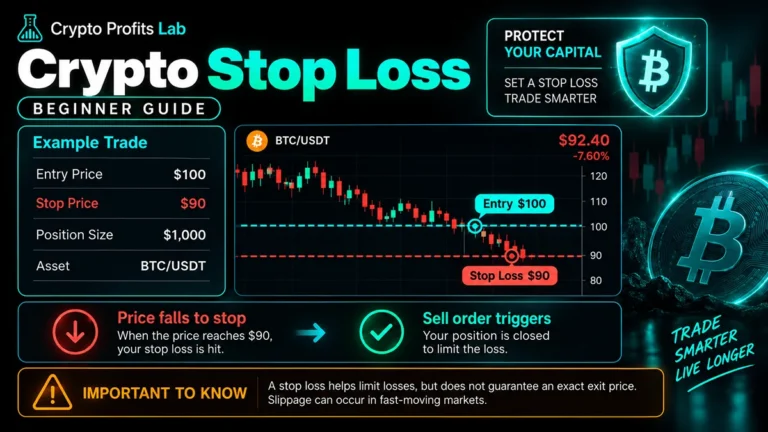
A take-profit target defines where you may exit if the trade moves in your favor. A stop loss defines where you may exit if the trade moves against you.
Suppose you buy at $100.
You might set a stop at $95 and a profit target at $110. In this simplified example, the planned downside is $5 per unit and the planned upside is $10 per unit. That is a risk/reward relationship of $5 risk to $10 reward, often written as 1:2.
The numbers are only examples. They are not a universal rule for where a beginner should place orders.
What matters is that both sides are considered before the trade. A crypto take profit target without a downside plan can still leave you exposed to a large loss if the market falls before reaching your target.
Take Profit vs. Limit Order
A sell limit order placed above the current market price can act as a simple profit target. A dedicated take-profit order often adds a trigger and may not become active until that trigger is reached.
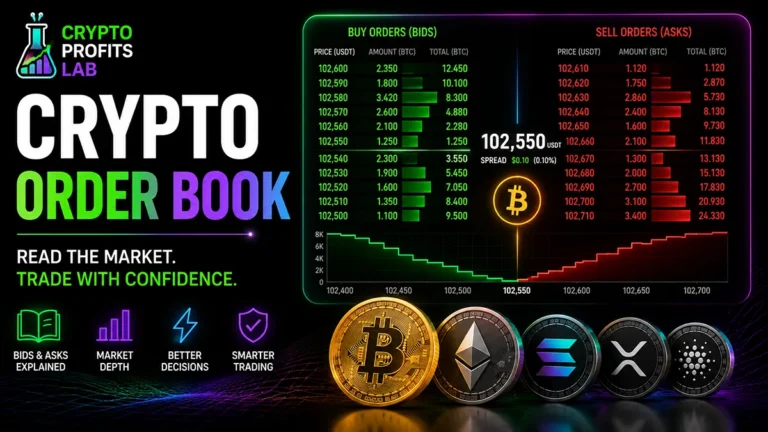
Depending on the exchange, the trigger may create a market order, limit order, or another instruction. Beginners should read the order ticket carefully rather than assuming that every “take profit” button behaves the same way. If these order types are new to you, review market order vs limit order in crypto and the crypto order book.
Step by Step: How to Build a Crypto Take Profit Plan
Step 1: Decide why you are entering
Before choosing an exit, define why you are buying.
Are you making a short-term spot trade? Are you gradually building a long-term position? Are you reacting to a technical setup? Your reason for entering affects what a sensible exit plan looks like.
A short-term trader may use specific price targets. A long-term investor may prefer staged selling over a much longer period.
Step 2: Choose an invalidation point
An invalidation point is a price or condition showing that your original trade idea may no longer make sense.
This is where stop-loss planning becomes useful. Your downside should be considered before you calculate the upside.
If you have not yet learned how stops work, read the crypto stop loss guide before combining stop and profit orders.
Step 3: Identify a realistic profit target
Next, choose a price that has a logical reason behind it.
Some traders look at previous areas where price had difficulty moving higher. Others use a predefined percentage, a chart level, or a risk/reward calculation. No method guarantees that the target will be reached.
The goal of crypto take-profit planning is to choose a target you can explain, not a number chosen solely because it would produce a large gain.
Step 4: Calculate the potential gain
Compare your entry price with your planned exit.
If you buy at $50 and your target is $55, the gross price gain is $5 per unit, or 10% before trading costs and taxes.
Then compare that potential gain with the amount you are prepared to lose if the trade fails.
Step 5: Check fees, spread, and slippage
The price chart does not show every trading cost.
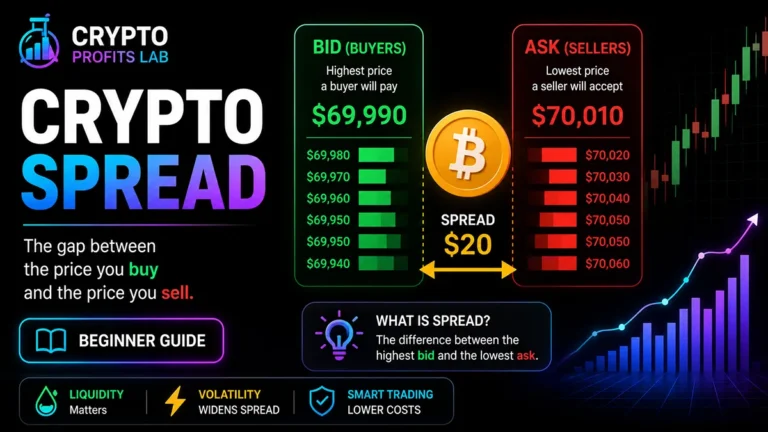
Your net result can be reduced by crypto trading fees, the crypto spread, and crypto slippage.
These effects can be small in a highly liquid market and more noticeable in a thin market or during rapid price movement.
Step 6: Choose full or partial profit taking
You do not always have to sell the entire position at one target.
You could decide in advance to sell a portion at the first target and keep the rest for a second target. This is often called scaling out.
Partial selling reduces exposure while allowing some of the position to remain open. The trade-off is that your final result becomes more complex to track.
Step 7: Review the order before submitting it
Check the asset, quantity, trigger price, order type, and whether the order will cancel another linked order if one side executes.
Also confirm whether your exchange uses last price, mark price, index price, or another reference for the trigger. This is especially important on derivatives platforms.
A crypto take profit order should be understood before it is submitted, not after the market begins moving.
7 Smart Ways to Use Crypto Take Profit
1. Set the target before entering
Writing down the target before you buy can reduce the temptation to keep moving it higher during a rally.
The point is not to make the original target untouchable. New information can justify changing a plan. The key is knowing why you changed it.
2. Use more than one target
Instead of treating profit taking as an all-or-nothing decision, divide the position into portions.
For example, you might plan three separate exits. If the first target is reached, you realize part of the gain while keeping some exposure.
This can reduce the pressure of trying to identify one perfect selling price.
3. Pair the target with a stop
A target describes the upside. A stop describes the downside.
Using both creates a more complete trading plan and makes the potential risk easier to compare with the potential reward.
4. Base targets on market structure
A random percentage may be easy to calculate, but it may have little connection to actual market behavior.
Some traders study previous highs, support and resistance areas, or zones where trading activity was concentrated. These levels do not guarantee a reversal, but they can provide a reasoned reference point.
5. Account for liquidity
A target is only useful if there is sufficient market activity to execute your order at a price reasonably close to the expected price.
Low liquidity can increase spread and slippage. A large order can also consume several price levels in the order book.
6. Avoid changing the plan because of FOMO
Crypto FOMO can set in even after you are already in a profitable trade.
The thought changes from “I hope this goes up” to “I cannot sell because it might go much higher.” That emotional shift can turn a planned trade into an open-ended bet.
A written crypto take profit plan gives you something objective to compare against that feeling.
7. Review the result after the trade
After the position closes, record the entry, target, stop, fees, and actual fill price.
Then ask whether you followed the plan. Do not judge the plan solely by whether the price continued to rise after you sold.
A good process can still lead to a frustrating outcome. A poor process can occasionally be followed by a lucky one.
Example of a Simple Crypto Take Profit Plan
Assume a beginner buys 10 units of a cryptocurrency at $20 each.
The position costs $200 before fees.
The trader decides on the following hypothetical plan:
- Entry: $20
- Stop-loss level: $18
- First profit target: $24
- Second profit target: $28
- Amount sold at first target: 5 units
- Amount sold at second target: 5 units
If the first target is reached, the trader sells half the position. If the second target is later reached, the remaining half is sold.
This example shows how partial exits can work, but it does not account for every real-world cost. Trading fees, spread, slippage, and taxes may change the final result.
It also demonstrates why crypto take profit planning is different from predicting the market top. The trader is not claiming that $28 is the highest possible price. The trader is simply following a predefined exit structure.
How Risk/Reward Fits In
Risk/reward compares planned downside with potential upside.
Suppose your entry is $100, your stop is $96, and your target is $108. The distance to the stop is $4, and the distance to the target is $8, a simplified 1:2 relationship.
A crypto take profit target can therefore be part of a risk/reward calculation before a trade begins. But the ratio does not tell you how likely the trade is to succeed. A distant target can look attractive on paper while being difficult to reach. Treat risk/reward as a planning tool, not a promise.
How Fees, Spread, and Slippage Affect Profit Targets
A trade can reach its target and still produce less profit than expected. Trading fees, spread, and slippage all affect the final result.
This matters most when the planned profit is small. Entry and exit costs can consume a meaningful part of a narrow target. A crypto take profit plan should therefore consider the net result, not only the chart price.
Take Profit and Leverage
Leverage makes take-profit planning more complicated.
With crypto leverage, borrowed exposure can magnify both gains and losses. A leveraged position can also face crypto liquidation if losses become large enough relative to the collateral supporting the trade.
A profit target does not protect you from liquidation on the way to that target.
Beginners who are still learning order types may find it easier to understand crypto take profit in ordinary spot trading before studying leveraged products.
Common Beginner Mistakes
Setting a target with no reason
Choosing a target only because it would create a satisfying profit does not explain why the market should reach that level.
Use a method you understand and can repeat.
Moving the target higher every time price rises
Sometimes a new target is justified. Constantly raising it because of excitement is different.
If you change the plan, write down why.
Ignoring the stop side of the trade
Focusing only on potential profit can hide the real downside.
Pairing a profit target with a clear loss plan makes the trade easier to evaluate before money is at risk.
Assuming a trigger guarantees the fill price
Fast markets can move through a price level quickly. A market-style exit may fill away from the trigger, while a limit-style exit may not fill completely.
Forgetting fees and taxes
A gross trading gain is not necessarily the amount you keep.
Along with trading costs, selling or exchanging crypto can have tax consequences depending on your jurisdiction. Our crypto taxes for beginners guide explains the basic concepts.
Using too many complicated orders at once
Beginners can create mistakes by stacking multiple conditional orders before they understand how each one behaves.
Start by learning one order type at a time.
Safety and Risk Considerations
Crypto trading involves substantial risk. A take-profit order can help organize an exit, but it cannot remove market risk.
Price can move sharply. Exchanges can experience outages. Orders can partially fill. Trigger conditions can vary by platform. Low-liquidity markets can produce large slippage. A linked stop may also behave differently than you expect during periods of extreme volatility.
Never assume that automation means certainty.
Before using crypto take profit tools with real money, consider practicing with very small amounts or a simulation if your platform offers one. Read the exchange’s order documentation, confirm the order details before submission, and avoid risking money you cannot afford to lose.
Account security matters too. Use strong, unique passwords, enable crypto 2FA, and verify that you are on the correct exchange website or app before entering credentials.
Frequently Asked Questions
What does crypto take profit mean?
Crypto take profit means planning to sell some or all of a cryptocurrency position after the price reaches a chosen target. The plan may be executed manually, via a sell limit order, or via a dedicated take-profit order if the exchange supports it. Its purpose is to define an exit before emotions become stronger during a price move. It does not guarantee that the target will be reached or that execution will occur at the exact target price.
How does a take-profit order work in crypto?
A take-profit order normally uses a trigger price. When that trigger is reached, the exchange activates the attached selling instruction. Depending on the platform, that instruction may become a market order, limit order, or part of a bracket order. Because exchanges implement these tools differently, beginners should read the order description on their own platform. Fast price changes, liquidity, and slippage can affect the actual execution result.
Is take profit the same as a limit order?
Not always. A sell limit order can be used as a simple profit target because it seeks to sell at the chosen limit price or better. A dedicated take-profit order may remain inactive until a separate trigger price is reached. After triggering, it may submit a market or limit order depending on the exchange. The practical result may look similar, but the mechanics and execution risks can differ.
Should beginners use take profit and stop loss together?
They can be used together to define both sides of a trade before entry. The take-profit target shows where gains may be realized, while the stop-loss identifies where the trader plans to exit if the price moves against the position. Using both can make potential risk and reward easier to compare. However, neither order guarantees the expected fill price, especially during rapid market movements or periods of low liquidity.
Can a take-profit order fail to execute?
Yes. The exact risk depends on the order type. A limit-based take-profit order may remain unfilled if the market touches the trigger or limit and then moves away before enough buyers are available. A market-based exit usually prioritizes execution, but the fill price may differ from the trigger price due to slippage. Exchange outages, trading halts, or platform-specific rules can also affect execution.
What is partial profit taking in crypto?
Partial profit taking means selling only part of a position when a target is reached. For example, a trader could sell one-third at a first target, another third at a second target, and keep the remainder open. This reduces exposure gradually rather than making an all-or-nothing decision. The trade-off is added complexity, more transactions, and potentially more fees to track.
How do I choose a take-profit price?
There is no single correct take-profit price for every trade. Traders may use previous price highs, support and resistance zones, a percentage target, or a risk/reward framework. A useful target should have a clear rationale and fit the purpose of the trade. Beginners should also account for fees, spread, slippage, volatility, and the possibility that the target may never be reached.
Does taking profit on crypto create a tax event?
In many jurisdictions, selling or exchanging cryptocurrency can create a taxable event, but tax rules depend on where you live and the type of transaction. Realized gains may need to be reported, and losses may also be subject to tax treatment. Keep accurate records of purchases, sales, fees, and transfers. For personal tax guidance, use official tax resources for your jurisdiction or consult a qualified tax professional.
Final Thoughts
Crypto take profit is not about predicting the perfect top. It is about deciding in advance what you will do if a trade moves in your favor.
For a beginner, that shift can be valuable. Instead of relying on excitement, fear, or a last-minute guess, you can define a target, compare it with your downside, account for trading costs, and choose whether to exit all at once or in stages.
The most important part is understanding the order you are using. Different exchanges can handle triggers and execution differently, and no automated order removes risk.
Crypto Profits Lab focuses on making concepts like crypto take profit easier to understand without unnecessary jargon. Learn the mechanics first, keep your plan simple, and treat every trade as a decision that includes both potential reward and potential loss.