What Is a Crypto Spread? Beginner Guide to Bid and Ask Prices
When beginners buy cryptocurrency, they often focus on one number: the price.
But an exchange may actually show slightly different prices for buyers and sellers. The small gap between those prices can affect how much you pay when buying crypto and how much you receive when selling it.
That gap is called the crypto spread.
Understanding it can help you read an exchange more confidently, compare trading costs, recognize liquid markets, and avoid wondering why your purchase price was slightly higher than the price you expected.
The concept sounds technical, but the basic idea is simple.
Quick Answer: What Is a Crypto Spread?
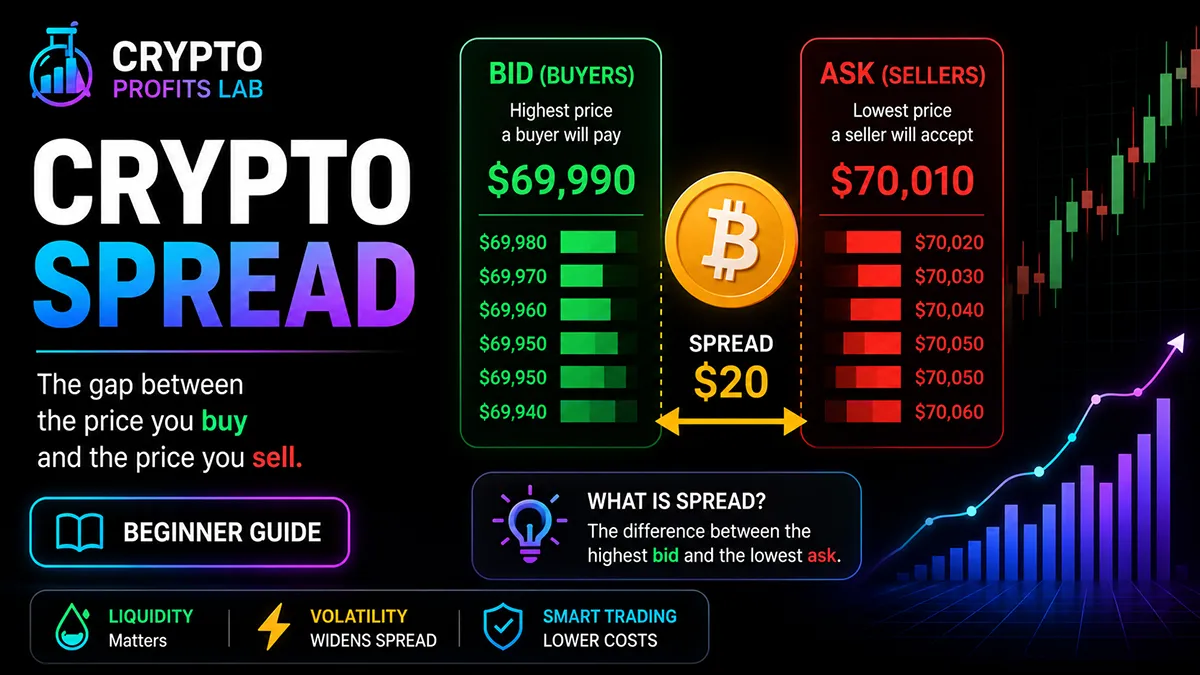
A crypto spread is the difference between the highest price a buyer is willing to pay for a cryptocurrency and the lowest price a seller is willing to accept.
These prices are commonly called the bid and ask.
For example:
- Highest bid: $99.90
- Lowest ask: $100.10
- Spread: $0.20
The smaller the gap, the tighter the spread.
The larger the gap, the wider the spread.
A narrow crypto spread often appears in active markets with many buyers and sellers. A wider spread can appear when trading activity is low, liquidity is limited, or prices are moving quickly.
The spread matters because it can become part of the real cost of entering or exiting a crypto position.
Key Takeaways
- A crypto spread is the gap between buying and selling prices in a market.
- The bid is the highest price a buyer is currently willing to pay.
- The ask is the lowest price a seller is currently willing to accept.
- A small gap is called a tight or narrow spread.
- A large gap is called a wide spread.
- High-liquidity markets often have smaller spreads.
- Low liquidity and high volatility can make spreads wider.
- Spread is different from exchange fees and slippage.
- Market orders can be affected by the spread immediately.
- Beginners should check the spread before placing larger trades.
Crypto Spread Beginner Facts
| Topic | Beginner Explanation |
|---|---|
| Spread | Difference between the highest bid and lowest ask |
| Bid | Highest current price a buyer will pay |
| Ask | Lowest current price a seller will accept |
| Tight spread | Small difference between bid and ask |
| Wide spread | Large difference between bid and ask |
| Common cause of tight spreads | Strong liquidity and active trading |
| Common cause of wide spreads | Low liquidity or fast-moving markets |
| Same as trading fee? | No |
| Same as slippage? | No |
| Where to see it | Order books and advanced trading screens |
Why Does a Crypto Spread Exist?
Buyers and sellers usually want different prices.
Buyers naturally want to pay as little as possible.
Sellers naturally want to receive as much as possible.
Imagine a buyer is willing to pay no more than $10.00 for a token, while the cheapest seller wants $10.05.
There is a five-cent difference between them.
That difference is the spread.
For a trade to happen immediately, someone generally needs to accept the price available on the other side of the market.
This process takes place through an exchange’s order system.
If you are unfamiliar with how these markets are organized, our guide to a crypto exchange explains how exchanges connect cryptocurrency buyers and sellers.
Bid Price Explained
The bid is the highest price someone is currently willing to pay to buy an asset.
Imagine an order book contains these buy orders:
- $99.70
- $99.80
- $99.90
The highest bid is $99.90.
That buyer is currently offering more than the other buyers, so the $99.90 bid sits closest to the selling side of the market.
If a seller wants to sell immediately using a market order, that seller may begin matching against available bids.
This is one half of the crypto spread calculation.
Ask Price Explained
The ask is the lowest price at which someone is currently willing to sell.
Suppose the sell side contains these prices:
- $100.10
- $100.20
- $100.30
The lowest ask is $100.10.
That seller is offering the cheapest currently available selling price.
If a buyer wants to purchase immediately, the buyer may begin matching against the available asks.
The difference between the $100.10 ask and the $99.90 bid creates a $0.20 spread.
How to Calculate a Crypto Spread
The basic formula is:
Spread = Lowest Ask − Highest Bid
Using our previous example:
Lowest ask = $100.10
Highest bid = $99.90
$100.10 − $99.90 = $0.20
The crypto spread is therefore $0.20.
You can also express the spread as a percentage.
For example, a $0.20 difference on a roughly $100 asset is approximately 0.20%.
Percentages make spreads easier to compare between cryptocurrencies with very different prices.
A $10 spread sounds large by itself, but $10 on a $100,000 asset is very different from a $10 spread on an asset worth only $50.
Tight Spread vs Wide Spread
You will often hear traders describe spreads as tight or wide.
Tight Spread
A tight spread means the bid and ask prices are close together.
Example:
- Bid: $1,999.90
- Ask: $2,000.10
The gap is only $0.20.
Tight spreads commonly occur in markets with strong trading activity and many competing orders.
Wide Spread
A wide spread means buyers and sellers are farther apart.
Example:
- Bid: $1.80
- Ask: $2.10
The difference is $0.30.
On an asset trading around $2, that is a significant gap.
A wide crypto spread may signal that the market is thin, less active, volatile, or temporarily unbalanced.
It does not automatically mean something is wrong with the cryptocurrency, but beginners should pay closer attention.
Why Liquidity Matters
Liquidity describes how easily an asset can be bought or sold without causing a major change in its price.
A highly liquid market has many buyers and sellers placing orders near the current market price.
This competition can push bids and asks closer together.
As a result, the crypto spread may become smaller.
In a low-liquidity market, there may be large gaps between orders.
For example, the highest buyer might offer $9.50 while the cheapest seller wants $10.25.
That creates a much wider gap.
Our beginner guide to crypto liquidity explains this relationship in more detail.
Liquidity is one of the most important reasons spreads can differ dramatically from one cryptocurrency to another.
How Trading Volume Affects Spreads
Trading volume measures how much of an asset changes hands during a certain period.
High volume and high liquidity are not exactly the same thing, but they are often related.
A heavily traded market may attract more participants.
More participants can create more buy and sell orders.
Those competing orders can help tighten the crypto spread.
Low-volume markets may have fewer active participants, which can leave larger gaps between prices.
Volume should never be used by itself to decide whether an investment is good or safe.
However, it is useful when evaluating market activity.
You can learn more in our guide to crypto trading volume.
How a Crypto Spread Works Step by Step
A simple trade example makes the concept easier to understand.
Imagine you are looking at a BTC/USD market.
Step 1: Open the Trading Market
You select BTC/USD on your exchange.
BTC/USD is a crypto trading pair showing Bitcoin priced against U.S. dollars.
The exchange displays current buy and sell orders.
Step 2: Find the Best Bid and Ask
Suppose you see:
- Best bid: $69,990
- Best ask: $70,010
The difference is $20.
The crypto spread is therefore $20.
If you place an order that executes immediately, the side of the market you interact with affects the price you receive.
Step 3: Understand What Happens When You Buy
If you place an immediate market buy, you generally begin purchasing from the sell orders.
The cheapest available seller in this example is asking $70,010.
So even though you may see a general Bitcoin price around $70,000, your immediate purchase could begin at the ask price.
If you immediately turned around and sold, the best buyer might only be offering $69,990.
That price difference exists even before considering separate trading fees.
Step 4: Understand the Difference Between Spread and Slippage
Spread and slippage are related trading concepts, but they are not the same thing.
The spread is the gap between available buying and selling prices.
Slippage happens when your trade executes at a different price than you expected, often because prices move or because your order consumes multiple levels of liquidity.
Coinbase’s explanation of spread and slippage provides additional details on how these concepts can affect cryptocurrency transactions.
For a beginner-focused explanation, you can also read our guide to crypto slippage.
Step 5: Review the Total Trade Cost
Before confirming a transaction, look beyond the headline price.
Your effective cost can be influenced by:
- The crypto spread
- Exchange trading fees
- Slippage
- Order size
- Market liquidity
- Price volatility
This gives you a more complete picture of what the trade may actually cost.
Crypto Spread vs Trading Fees
Spread and trading fees are different.
A trading fee is a charge set by an exchange or trading platform.
For example, an exchange might charge a percentage of the transaction amount.
A spread is a difference between prices.
You may encounter both during the same trade.
Imagine an asset has:
- Bid: $49.90
- Ask: $50.10
The spread is $0.20.
If the exchange also charges a trading fee, that fee is an additional cost.
This is why beginners should not evaluate a platform based only on an advertised trading fee.
The total transaction experience may also involve spread, slippage, withdrawal costs, or network fees.
Our guide to crypto trading fees for beginners explains the major types of trading costs.
Crypto Spread vs Slippage
These two terms are commonly confused.
Here is a simple comparison.
| Feature | Spread | Slippage |
|---|---|---|
| What it is | Gap between bid and ask | Difference between expected and actual execution price |
| Visible before trade? | Often visible in an order book | Usually known after or during execution |
| Main causes | Liquidity, market activity, volatility | Price movement, order size, liquidity |
| Can affect market orders? | Yes | Yes |
| Same as exchange fee? | No | No |
A crypto spread can exist even when no trade is taking place.
Slippage requires an order to be executed at a price different from what was expected.
Why Volatility Can Widen Spreads
Crypto prices can move quickly.
During highly volatile periods, buyers and sellers may become less certain about the price at which they are willing to trade.
A buyer may lower the amount they are willing to pay.
A seller may raise the amount they are willing to accept.
That can widen the gap between them.
Market participants providing liquidity may also adjust or remove orders during sudden price moves.
The result can be a larger crypto spread at exactly the time when someone is rushing to buy or sell.
Our guide to crypto volatility explains why cryptocurrency prices can move so sharply.
This is another reason beginners should avoid making rushed decisions during fast-moving markets.
Why Order Books Matter
An order book is a live list of buy and sell orders for a trading market.
The highest bid and lowest ask usually appear near the center of the book.
The gap between those two prices is the spread.
You may also see many additional price levels above and below them.
Those levels become important if your order is large enough to consume the best available price and continue into additional orders.
Learning to read a basic crypto order book makes spreads much easier to understand visually.
You do not need to become an active trader.
Even long-term investors can benefit from understanding what the exchange screen is showing before pressing Buy or Sell.
How Market Orders Are Affected
A market order tells the exchange to execute your trade against available orders rather than waiting for one exact price.
That makes execution convenient, but your trade interacts directly with the existing bid or ask side.
For a buyer, this usually means taking available sell orders.
For a seller, it generally means taking available buy orders.
Because of the crypto spread, the best immediate buying price and best immediate selling price are not necessarily identical.
Larger market orders can also move through several order-book levels, introducing additional slippage.
If you are unsure which order type to use, see our beginner comparison of market order vs limit order in crypto.
Can Limit Orders Reduce Spread Costs?
A limit order lets you specify the price at which you are willing to buy or sell.
That means you do not necessarily have to accept the current ask when buying or current bid when selling.
For example, suppose:
- Bid: $99
- Ask: $101
Instead of immediately buying at $101, you might place a limit buy at $99.50.
However, there is no guarantee your order will execute.
The market might rise without ever reaching your price.
Limit orders provide more price control, but they introduce the possibility that the trade will remain unfilled.
They do not magically eliminate the crypto spread.
Why Different Exchanges May Show Different Spreads
Cryptocurrency markets are fragmented across many trading platforms.
Each exchange can have its own:
- Buyers
- Sellers
- Liquidity
- Order book
- Trading volume
- Fees
- Available pairs
Because the participants are different, the crypto spread for the same cryptocurrency can differ between exchanges.
One platform might have a very liquid BTC/USD market while another has less activity.
The quoted prices may therefore differ slightly.
Large price differences between exchanges can sometimes attract traders attempting crypto arbitrage.
However, arbitrage involves fees, transfer delays, execution risk, and other complications. It should not be viewed as guaranteed profit.
Does Every Cryptocurrency Have the Same Spread?
No.
Spreads can vary widely.
Large, actively traded cryptocurrencies may often have tighter spreads because many buyers and sellers are competing in the market.
Smaller or less popular tokens may have fewer orders.
That can produce a wider crypto spread.
The same cryptocurrency can also have different spreads depending on:
- Exchange
- Trading pair
- Time of day
- Market conditions
- Volatility
- News events
- Order-book depth
Never assume that a familiar coin automatically has a tight spread on every market.
Check the actual pair you intend to trade.
How Beginners Can Check the Spread
Many basic “Buy Crypto” screens simplify the transaction and may not display a traditional order book.
Advanced trading screens often provide more information.
To check a crypto spread manually:
- Open the trading pair.
- Find the order book.
- Locate the highest bid.
- Locate the lowest ask.
- Subtract the bid from the ask.
- Compare the difference with the asset’s approximate price.
- Review any exchange fees separately.
You can also compare the final purchase quote with the market information shown by the platform.
The goal is not to calculate every trade to several decimal places.
The goal is to understand why the buying and selling prices may differ.
Common Beginner Mistakes
Mistake 1: Assuming There Is Only One Crypto Price
Beginners may expect one universal price.
In reality, exchanges have buyers and sellers placing different orders.
The last traded price, bid, ask, and quoted purchase price can all be slightly different.
Mistake 2: Confusing Spread With a Fee
A crypto spread is not automatically the same thing as an exchange commission.
Always review the platform’s fee structure separately.
Mistake 3: Ignoring Liquidity
A wide spread can be especially important in low-liquidity markets.
Do not assume a token is easy to sell simply because it has a visible market price.
Mistake 4: Placing Large Market Orders Without Looking at the Order Book
A large order may consume several available price levels.
That can increase the difference between the expected price and the final average price.
Mistake 5: Chasing Rapid Price Moves
Fast-moving markets can produce wider spreads and greater slippage.
Fear of missing out can make beginners ignore trading costs.
Mistake 6: Assuming All Exchanges Are Identical
The same pair can have different liquidity and pricing on different platforms.
Compare the exact market you plan to use.
Mistake 7: Focusing Only on Advertised Fees
A low trading fee does not necessarily mean the total transaction will be inexpensive.
Spread, slippage, withdrawal fees, and other costs may also matter.
Safety and Risk Tips
Understanding spread will not remove crypto risk, but it can help you avoid preventable trading mistakes.
Slow Down Before Confirming
Review the amount, asset, trading pair, estimated price, and fees before submitting an order.
Be Careful in Thin Markets
A token with very low liquidity may be easy to buy but difficult to sell at the price you expect.
A wide crypto spread is one warning sign worth investigating.
Avoid Emotional Trading
Sudden price moves can make people feel pressured to act immediately.
Crypto markets can move extremely quickly, and rushed market orders can produce unexpected results.
Start Small When Learning
If you are unfamiliar with a new exchange or order type, consider learning with a small amount first.
This allows you to see how orders, spreads, fees, and balances work without committing a large amount.
Use Reputable Platforms
Security matters just as much as pricing.
Protect exchange accounts with strong unique passwords and crypto 2FA.
Never Treat a Tight Spread as Proof an Asset Is Safe
A liquid market can still contain a risky cryptocurrency.
Spread measures market conditions.
It does not measure whether a project is legitimate, financially sound, or appropriate for your portfolio.
Is a Small Crypto Spread Always Better?
For trading efficiency, a smaller spread is generally preferable because the gap between buyers and sellers is smaller.
However, spread should never be your only consideration.
You should also evaluate:
- Exchange security
- Asset risk
- Trading fees
- Liquidity
- Volume
- Slippage
- Volatility
- Your investment goals
A tight market for a highly speculative token does not make the token a good investment.
Likewise, a temporarily wider spread does not automatically mean a legitimate asset is bad.
The crypto spread is one piece of market information.
A Simple Example for Beginners
Suppose a cryptocurrency has these prices:
Bid: $24.95
Ask: $25.05
The difference is $0.10.
If you buy immediately, you may purchase near $25.05.
If you immediately sell under the same conditions, the best buyer may only offer $24.95.
Your immediate difference is $0.10 per coin before separate trading fees or additional price movement.
Now imagine another token:
Bid: $20
Ask: $25
That is a $5 difference.
The second market has a dramatically wider crypto spread.
A beginner should investigate why the gap is so large before trading.
Possible reasons could include weak liquidity, low activity, extreme volatility, or an unusually thin order book.
Final Thoughts
A crypto spread is simply the gap between the highest price buyers are currently willing to pay and the lowest price sellers are willing to accept.
Understanding that one idea makes several other exchange concepts easier to understand.
You can see why the bid and ask are different.
You can understand why immediate buying and selling prices may not match.
You can see how liquidity, volume, volatility, order books, and order types interact.
Most importantly, you can begin thinking about the true cost of a trade instead of looking only at the large price displayed on the screen.
Beginners do not need advanced trading strategies to benefit from this knowledge.
Before placing an order, check what you are buying, understand the trading pair, review the bid and ask, consider liquidity, and look at the total cost.
Crypto Profits Lab is designed to make concepts like crypto spread easier to understand without unnecessary jargon, hype, or complicated explanations.
Build the basics first.
Then make informed decisions at your own pace.
Crypto Spread Frequently Asked Questions
What is a crypto spread in simple terms?
A crypto spread is the difference between the highest price a buyer is willing to pay and the lowest price a seller is willing to accept for a cryptocurrency. These prices are called the bid and ask. If the highest bid is $99 and the lowest ask is $101, the spread is $2. Smaller spreads generally indicate that buyers and sellers are closer together.
Is crypto spread the same as a trading fee?
No. A crypto spread and a trading fee are separate concepts. The spread is the difference between buying and selling prices in the market. A trading fee is a charge imposed by an exchange or platform for processing a transaction. A single trade can be affected by both, along with possible slippage, withdrawal fees, or blockchain network fees depending on the transaction.
Why is the crypto spread sometimes so large?
A crypto spread can become larger when liquidity is low, trading activity is limited, or prices are moving rapidly. With fewer buyers and sellers competing near the current price, bigger gaps can appear between bids and asks. Smaller cryptocurrencies and thin trading pairs may therefore experience wider spreads than highly active markets. Market uncertainty and sudden volatility can also cause spreads to widen temporarily.
What is the difference between spread and slippage in crypto?
Spread is the existing difference between the best buying and selling prices in a market. Slippage is the difference between the price you expected and the price at which your order actually executes. A trade may experience both. Slippage is more likely when prices move quickly, liquidity is limited, or an order is large compared with the available orders near the current market price.
Does high liquidity create a smaller crypto spread?
High liquidity often helps create smaller spreads because more buyers and sellers are competing near the current market price. Their orders can push the highest bid and lowest ask closer together. However, spreads can still change during periods of unusual volatility or market stress. Liquidity is an important factor, but it is not the only factor that determines how wide or narrow a spread will be.
Can I avoid the crypto spread completely?
You generally cannot make the market’s bid-ask gap disappear, but your order choice can affect how you interact with it. A limit order allows you to set the price you are willing to accept instead of automatically taking the current market price. However, the order may never execute. Beginners should focus on liquid markets, understand order types, and review total costs rather than expecting to eliminate spreads entirely.
How can I see the spread on a crypto exchange?
Open the exchange’s advanced trading screen and look for the order book. Find the highest current bid and the lowest current ask. Subtract the bid from the ask to calculate the crypto spread. Some simplified buy screens may not display a traditional order book, so you may need to switch to an advanced or spot trading interface to see the underlying buy and sell prices.
Is a tight crypto spread a sign that a coin is safe?
No. A tight crypto spread can indicate an active, liquid market, but it does not prove that the cryptocurrency itself is safe or a good investment. A token can trade efficiently while still carrying serious financial, technical, regulatory, or project-related risks. Beginners should evaluate the asset separately and consider liquidity, security, token fundamentals, volatility, and personal risk tolerance before investing.