What Is a Crypto Trading Pair? Beginner Guide
If you open a cryptocurrency exchange for the first time, you may see symbols such as BTC/USD, ETH/USDT, or XRP/USD. Those symbols can look confusing, but they are simply showing which two assets can be traded with each other.
A crypto trading pair tells you what asset you are buying or selling and what asset is being used to measure its price. Understanding this simple idea makes exchange screens, price charts, order books, and buy or sell forms much easier to understand.
This guide explains how trading pairs work, what the two sides mean, how prices are displayed, and what beginners should check before placing a trade.
Quick Answer: What Is a Crypto Trading Pair?
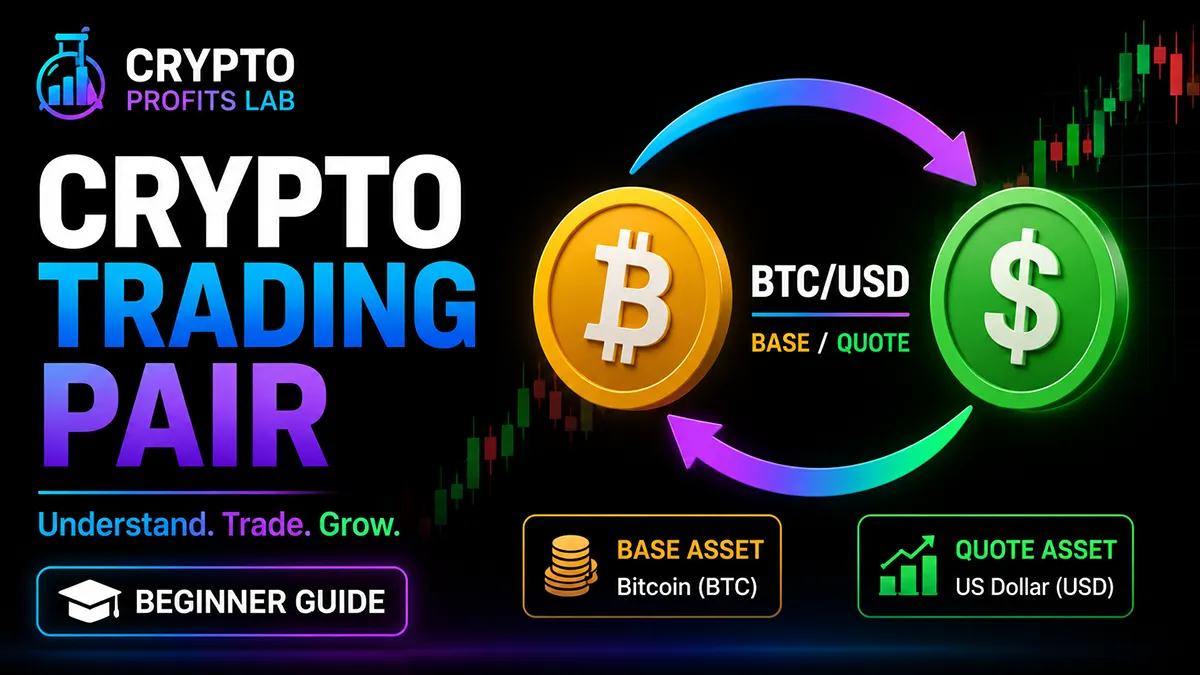
A crypto trading pair is a combination of two assets that can be exchanged for one another on a cryptocurrency exchange. For example, BTC/USD is a pair between Bitcoin and the U.S. dollar.
In a pair, the first asset is generally called the base asset, while the second is called the quote asset. The quoted price tells you how much of the second asset is needed to buy one unit of the first asset.
For example, if BTC/USD is shown at $70,000, that means one Bitcoin is priced at $70,000 in that market.
You do not need to become an advanced trader to understand pairs. You only need to know which asset is on each side, what the price means, and whether the market has enough trading activity for the order you want to place.
Key Takeaways
- A crypto trading pair shows two assets that can be traded directly with each other.
- The first asset is usually the base asset, and the second is the quote asset.
- A price such as ETH/USD shows the value of one ETH measured in U.S. dollars.
- Not every cryptocurrency can be traded directly against every other cryptocurrency.
- Different exchanges may support different pairs.
- Higher liquidity and trading volume can make it easier to enter or exit a position near the displayed market price.
- Beginners should confirm the pair carefully before placing an order.
Crypto Trading Pair Beginner Facts
| Topic | Beginner Explanation |
|---|---|
| Pair example | BTC/USD |
| First asset | Base asset |
| Second asset | Quote asset |
| What the price shows | How much quote asset is needed for one unit of the base asset |
| Common quote assets | USD, USDT, USDC, BTC, ETH |
| Where pairs appear | Exchanges, charts, order books, and trading screens |
| Can every two coins form a pair? | No. The exchange must support that market |
| Main beginner risk | Trading the wrong pair or misunderstanding the quoted price |
| Helpful market factors | Liquidity, volume, spread, fees, and order type |
Why Do Crypto Exchanges Use Trading Pairs?
A cryptocurrency exchange needs a way to organize markets. Instead of showing one universal price for every digital asset, an exchange creates markets between specific assets.
A crypto trading pair creates one of those markets.
Think about a currency exchange booth at an airport. You might exchange U.S. dollars for euros. The booth needs an exchange rate between USD and EUR. Crypto markets work in a similar way, although cryptocurrency prices can move much faster.
A pair tells the exchange which asset a buyer wants and which asset the buyer is willing to give up in return.
If you are still learning how an exchange works, start with our beginner guide to a crypto exchange. It explains the basic role exchanges play when people buy, sell, and trade digital assets.
The Two Sides of a Crypto Trading Pair
Every crypto trading pair has two sides.
Consider this example:
BTC/USD
BTC is the first asset.
USD is the second asset.
The first asset is commonly called the base asset. The second asset is commonly called the quote asset.
The price tells you how much of the quote asset is needed to buy one unit of the base asset.
If BTC/USD is trading at $70,000, one BTC is worth $70,000 in that market.
Now consider:
ETH/BTC
Here, ETH is the base asset and BTC is the quote asset.
If ETH/BTC is priced at 0.04, it means one ETH is worth 0.04 BTC.
This is why understanding the order of the symbols matters. ETH/BTC and BTC/ETH describe the relationship from opposite directions and would display very different numbers.
Base Asset Explained Simply
The base asset is the first asset in the pair.
In XRP/USD, XRP is the base asset.
In ETH/USDT, ETH is the base asset.
In BTC/USDC, BTC is the base asset.
When you look at the price, you are usually asking:
“How much of the quote asset does one unit of the base asset cost?”
For beginners, this is the easiest way to read a crypto trading pair without getting lost in technical terminology.
Quote Asset Explained Simply
The quote asset is the second asset in the pair.
In XRP/USD, USD is the quote asset.
In ETH/USDT, USDT is the quote asset.
In BTC/USDC, USDC is the quote asset.
The quote asset acts like the measuring stick for the price.
For example, if XRP/USD shows 2.50, one XRP is priced at $2.50. If XRP/BTC shows 0.000025, one XRP is being measured in Bitcoin instead.
The underlying asset has not changed. Only the asset being used to express its price has changed.
Fiat-to-Crypto and Crypto-to-Crypto Pairs
Not all trading pairs are structured the same way.
Fiat-to-Crypto Pairs
A fiat-to-crypto pair combines a cryptocurrency with government-issued money such as the U.S. dollar.
Examples include:
- BTC/USD
- ETH/USD
- XRP/USD
These are often easier for beginners because the price is shown in a familiar currency.
If BTC/USD is $70,000, you immediately understand that Bitcoin is being valued in dollars.
Crypto-to-Crypto Pairs
A crypto-to-crypto pair combines two digital assets.
Examples include:
- ETH/BTC
- SOL/BTC
- XRP/USDT
Stablecoins such as USDT and USDC are digital assets designed to track the value of another asset, usually the U.S. dollar. You can learn more in our guide to stablecoins.
A crypto trading pair that uses a stablecoin may feel similar to a U.S. dollar pair, but the stablecoin is still a crypto asset rather than money held in a traditional bank account.
How a Crypto Trading Pair Works Step by Step
Understanding the process becomes easier when you follow one simple example.
Imagine you want to buy Ethereum using U.S. dollars.
Step 1: Choose an Exchange
First, you need a platform that supports the asset you want to trade.
Different exchanges offer different markets. One exchange may offer ETH/USD, while another may emphasize ETH/USDT or another quote asset.
If you are new to exchange types, our guide to centralized vs decentralized exchanges explains the main differences.
Step 2: Select the Pair
You choose ETH/USD.
That crypto trading pair tells the platform you want to trade Ethereum against U.S. dollars.
Coinbase explains in its spot trading overview that traders select a cryptocurrency pair, enter the amount they want to trade, and place an order that can match through the order book.
Step 3: Read the Current Price
Suppose ETH/USD is shown at $4,000.
That means one ETH is currently valued at about $4,000 in that market.
You do not have to buy a whole ETH. Most exchanges allow fractional purchases, so you may be able to buy a much smaller amount.
Step 4: Choose an Order Type
You may see choices such as market order or limit order.
A market order aims to execute at the best available prices immediately. A limit order lets you choose a specific price or better.
Before using these controls, read our guide to market order vs limit order in crypto.
Step 5: Your Order Enters the Market
Orders are matched with other buyers and sellers.
The exchange’s crypto order book displays available buy and sell orders at different prices.
If your order can match an available order, the trade may execute.
Step 6: The Balances Change
If you buy ETH using USD, your USD balance decreases and your ETH balance increases.
If you later sell ETH back into the same market, the process works in reverse.
The pair stays the same. Your action changes from buying the base asset to selling it.
Trading Pair vs Cryptocurrency Price
Beginners sometimes think a coin has one fixed price.
In reality, the price you see is always being measured against something.
When a website says Bitcoin is worth a certain number of dollars, it is effectively presenting a Bitcoin-to-dollar price.
A crypto trading pair makes that relationship explicit.
This matters because the same coin can rise against one asset while falling against another.
For example, a cryptocurrency could increase in value against the U.S. dollar but decrease in value against Bitcoin if Bitcoin rises even faster.
The pair you choose determines what you are comparing.
Why Liquidity Matters
Liquidity describes how easily an asset can be bought or sold without causing a large price change.
A crypto trading pair with strong liquidity usually has many active buyers and sellers.
That can make it easier for an order to execute near the price you expected.
A thin market may have fewer orders available. If you try to buy or sell a large amount, your trade may move through several price levels.
Our beginner guide to crypto liquidity explains why this matters.
Liquidity does not remove risk, but it is an important market condition to check.
Why Trading Volume Matters
Trading volume measures how much of an asset or market has been traded during a period of time.
A pair with active volume often has more ongoing participation, although high volume by itself does not guarantee that a market is safe or fairly priced.
When comparing markets, beginners should look at both liquidity and volume rather than assuming every listed pair behaves the same way.
A crypto trading pair with low activity may have wider price gaps, fewer available orders, or greater slippage.
To understand this measurement in more detail, see our guide to crypto trading volume.
What Is the Spread in a Trading Pair?
The spread is the difference between the highest price a buyer is currently willing to pay and the lowest price a seller is currently willing to accept.
These are often called the best bid and best ask.
For example:
- Best bid: $99.90
- Best ask: $100.10
- Spread: $0.20
A smaller spread generally means buyers and sellers are closer together.
A wider spread can make trading more expensive because you may have to cross a larger price gap to execute immediately.
The spread is one of the details visible in or derived from an order book.
How Slippage Can Affect a Trade
Slippage happens when your actual execution price is different from the price you expected.
This can happen when prices move quickly or when there are not enough orders available at the price shown.
A crypto trading pair with low liquidity may be more vulnerable to noticeable slippage, especially for larger market orders.
If you want a deeper explanation, see our guide to crypto slippage.
For beginners, the practical lesson is simple: the price displayed before you click buy or sell is not always the exact price you will receive.
Do Trading Pairs Have Different Fees?
Trading fees are usually set by the exchange, but the total cost of a trade can still differ from one market to another.
Possible costs include:
- Exchange trading fees
- The bid-ask spread
- Slippage
- Deposit or withdrawal fees
- Blockchain network fees when moving crypto afterward
Some exchanges may also use different fee schedules or rules for certain products.
Read our guide to crypto trading fees for beginners before assuming the displayed market price is your complete cost.
A crypto trading pair can look attractive while still producing a poor trade if the market is thin or the total fees are high.
How Beginners Can Choose a Trading Pair
You do not need to search for the most complicated market.
In many cases, the simplest pair is the one that directly matches the asset you already hold and the asset you want to obtain.
If you have U.S. dollars and want Bitcoin, BTC/USD may be straightforward when available.
If you already hold USDC and want Ethereum, ETH/USDC may be more direct than converting through several other assets.
Before choosing a crypto trading pair, ask:
- Do I understand both assets?
- Does this pair trade directly on my exchange?
- Is the market reasonably liquid?
- Is there enough trading volume?
- Is the spread reasonable?
- What fees will I pay?
- Am I using the correct order type?
- Have I checked the pair symbols carefully?
The goal is not to find a “winning” pair. The goal is to understand exactly what transaction you are making.
Common Beginner Mistakes
Mistake 1: Reading the Pair Backward
One of the easiest mistakes is confusing the base and quote assets.
If you see ETH/BTC, the price is Ethereum measured in Bitcoin, not Bitcoin measured in Ethereum.
Always read the pair from left to right before placing an order.
Mistake 2: Assuming Every Exchange Has the Same Pairs
A coin may be available on two exchanges but paired with different assets.
One platform may offer a USD market while another offers a USDT market.
Check the exact market rather than assuming the same crypto trading pair exists everywhere.
Mistake 3: Ignoring Liquidity
A market can exist without being very active.
Low liquidity can lead to wider spreads and greater slippage.
This becomes more important as trade size increases.
Mistake 4: Confusing Stablecoins With Bank Dollars
USDT or USDC may trade near one U.S. dollar, but they are crypto assets with their own structures and risks.
Do not assume a stablecoin pair is identical to a USD pair.
Mistake 5: Using Market Orders Without Understanding Execution
A market order prioritizes immediate execution, not a guaranteed exact price.
In fast or thin markets, the final average execution price may be different from the last price you saw.
Mistake 6: Ignoring Fees
A profitable-looking conversion can become less attractive after fees, spread, and slippage are included.
Always think about total cost.
Mistake 7: Trading an Asset You Do Not Understand
Knowing how to read a crypto trading pair does not mean the underlying token is safe, useful, or appropriate for you.
Research the project separately before buying it.
Safety and Risk Tips for Beginners
Trading pairs are simple to read once you understand the format, but crypto markets still involve risk.
Double-Check the Symbols
Crypto tickers can look similar.
Before placing a trade, confirm the full asset name, ticker, network, and pair.
Start With Small Amounts
A smaller first trade can help you learn how an exchange handles orders, fees, and balances.
You can learn the process without putting a large amount at risk.
Avoid Chasing Fast Price Moves
A rapidly moving market can create poor execution, emotional decisions, and unexpected slippage.
If you feel rushed, step away and review the trade.
Protect Your Exchange Account
Use a strong unique password and two-factor authentication.
If you later move funds to your own wallet, confirm the address and blockchain network carefully. Our guide to a crypto wallet explains the basics.
Be Careful With Unknown Tokens
A listed market does not automatically mean a token is safe.
Research the project, token structure, liquidity, and risks before buying.
Never Treat a Pair as a Recommendation
A crypto trading pair only tells you what two assets can be exchanged.
It does not tell you whether either asset will rise in value.
Can You Trade Between Coins Without a Direct Pair?
Sometimes two assets do not have a direct market.
Imagine you hold Asset A and want Asset C, but the exchange only offers:
A/USDT
and
C/USDT
You may need to make two trades:
- Convert Asset A to USDT.
- Use USDT to buy Asset C.
This creates extra steps and may create additional fees, spread costs, or taxable events depending on your jurisdiction.
A direct pair can simplify the conversion, but direct pairs are not always available.
Final Thoughts
A crypto trading pair is simply a market between two assets.
The first asset is generally the base asset. The second is the quote asset. The displayed price shows how much of the quote asset is needed to buy one unit of the base asset.
That simple framework helps make sense of pairs such as BTC/USD, ETH/USDT, and XRP/BTC.
For beginners, the most important habit is to slow down and confirm what each side of the pair represents before placing an order. Then check liquidity, volume, spread, fees, and your chosen order type.
You do not need complicated trading strategies to use an exchange responsibly. Understanding the basic mechanics first can help you make clearer, more informed decisions and avoid preventable mistakes.
Crypto Profits Lab focuses on explaining concepts like this in plain English so beginners can build knowledge one step at a time without unnecessary hype.
Crypto Trading Pair Frequently Asked Questions
What does a crypto trading pair mean?
A crypto trading pair shows two assets that can be exchanged directly in a specific market. In BTC/USD, Bitcoin is the first asset and U.S. dollars are the second. The displayed price shows how much USD is needed for one BTC. The pair helps the exchange organize buyers and sellers who want to trade those two assets with each other.
What is the base asset in a crypto pair?
The base asset is usually the first asset shown in the pair. In ETH/USD, ETH is the base asset. The market price tells you how much of the second, or quote, asset is needed to buy one unit of the base asset. Identifying the base asset is one of the easiest ways to understand what an exchange price is showing.
What is the quote asset in a crypto pair?
The quote asset is usually the second asset in the pair and is used to express the price of the first asset. In XRP/USD, USD is the quote asset. If the pair price is 2.50, one XRP is valued at $2.50. Quote assets can include fiat currencies, stablecoins, Bitcoin, Ethereum, and other supported assets.
Is BTC/USD the same as BTC/USDT?
No. BTC/USD and BTC/USDT are separate markets. BTC/USD trades Bitcoin against U.S. dollars, while BTC/USDT trades Bitcoin against Tether. Their prices may be close, but each market can have different liquidity, volume, spreads, order books, and risks. Beginners should check which asset they are actually spending or receiving before placing a trade.
Why are some crypto trading pairs unavailable?
Exchanges decide which markets they support based on factors such as demand, liquidity, operations, regulation, and platform policies. A cryptocurrency can be listed on an exchange without being paired against every other asset. If no direct market exists between two assets, you may need to convert through a third asset such as USD, USDT, USDC, BTC, or ETH.
Are high-volume crypto trading pairs safer?
Higher volume can make a market more active, but it does not make the cryptocurrency itself safe. Active markets may offer deeper liquidity and easier execution, yet the asset can still be volatile, speculative, or risky. Beginners should evaluate the project, market conditions, exchange security, fees, and personal risk tolerance rather than treating volume as a guarantee of safety.
Can a crypto trading pair affect the price I pay?
Yes. Different pairs can have different order books, liquidity, spreads, and trading activity. Those differences can affect the price at which your order actually executes. This is especially noticeable in thin or fast-moving markets. Beginners should compare the quoted market, review the spread, and understand possible slippage before placing a large order.
What is the easiest crypto trading pair for a beginner?
There is no single best pair for everyone. A straightforward choice is often a liquid pair that directly connects the asset you already hold with the asset you want to buy. For someone funding an exchange with U.S. dollars, a supported crypto/USD pair may be easier to understand than a crypto-to-crypto pair. Fees, liquidity, availability, and local rules still matter.