
Crypto Trading Volume: What It Means for Beginners
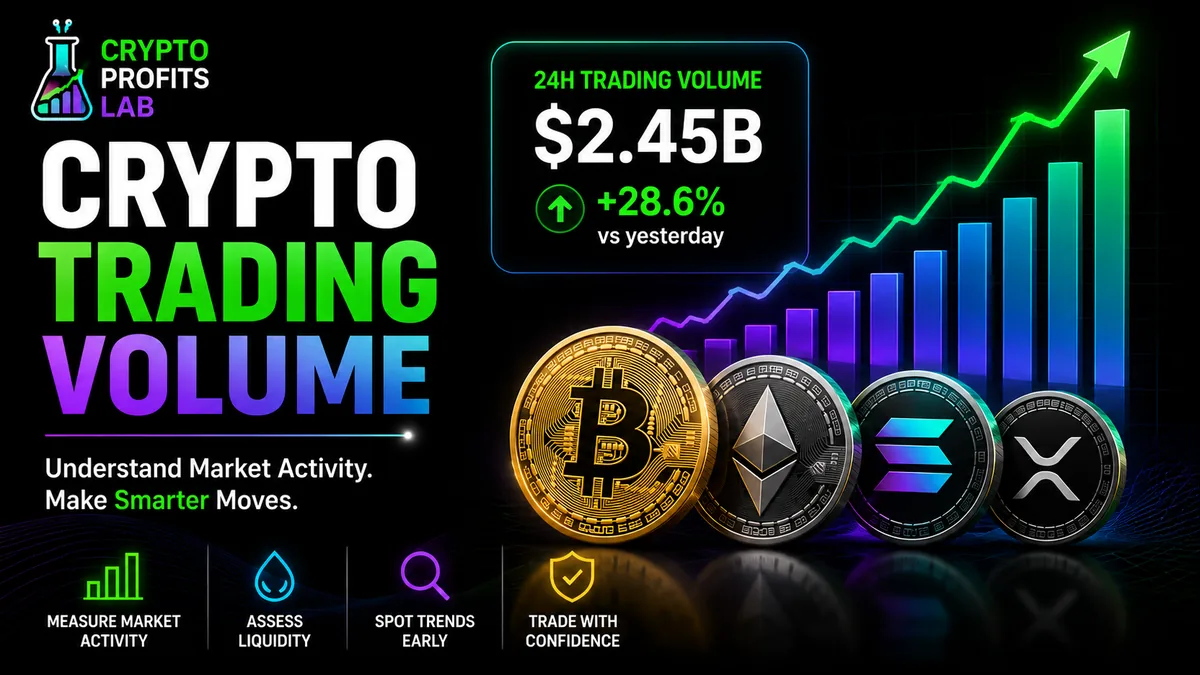
When you look at a cryptocurrency price page, you will usually see more than just the current price. One of the most common numbers shown beside market cap and price change is trading volume.
For beginners, trading volume can look like just another statistic. In reality, it can tell you something important about how active a market is.
A coin with heavy trading activity may have many buyers and sellers participating. A coin with very little activity may be harder to trade without affecting the price. Volume can also help you understand whether a price move is happening with strong participation or in a quieter market.
That does not mean volume predicts what a cryptocurrency will do next. High volume is not automatically bullish, and low volume is not automatically bearish.
The goal of this guide is to make crypto trading volume easy to understand so you can use it as one piece of market information rather than a magic signal.
Quick Answer
Crypto trading volume measures how much of a cryptocurrency has been bought and sold during a specific period.
You will often see 24-hour volume on crypto price pages. It may be shown as the number of coins traded or as the dollar value of those trades.
Higher volume usually means more market activity. Lower volume usually means less activity.
Volume can help beginners compare how actively different cryptocurrencies are traded, understand liquidity, and add context to price movements. However, it should always be used with other information such as price trends, market cap, liquidity, and the project itself.
Key Takeaways
- Trading volume measures how much trading happens during a set period.
- The most common figure beginners see is 24-hour trading volume.
- Higher volume usually means more market activity, but it does not guarantee rising prices.
- Low volume can make a market less liquid and potentially increase slippage.
- Volume can be shown in coins, tokens, dollars, or another quote currency.
- A sudden increase in volume can signal that market interest has changed.
- Volume is more useful when compared with the asset’s normal activity and current price movement.
- Different exchanges can report different volumes for the same cryptocurrency.
- Volume should not be used by itself as a buy or sell signal.
Beginner Facts About Crypto Trading Volume
| Beginner Question | Simple Answer |
|---|---|
| What does trading volume measure? | How much of an asset was traded during a period |
| What period is commonly shown? | 24 hours |
| Can volume be shown in dollars? | Yes |
| Does high volume mean price will rise? | No |
| Does low volume mean a coin is bad? | Not necessarily |
| Is volume connected to liquidity? | Often, yes |
| Can volume change quickly? | Yes |
| Does every exchange show the same volume? | No |
| Can volume help confirm a price move? | It can add context |
| Should beginners use volume alone? | No |
What Is Crypto Trading Volume?
Crypto trading volume is the amount of cryptocurrency traded during a certain period.
For example, if 10,000 coins change hands during one day, the volume could be reported as 10,000 coins. If each coin traded around $5, the same activity could also be shown as roughly $50,000 in dollar-denominated volume.
Many websites and exchanges display 24-hour volume because it gives users a quick picture of recent market activity.
The CoinMarketCap explanation of trading volume describes trading volume as a measure of how much money moves through a cryptocurrency market over a given period.
The basic idea is simple: price tells you what people are paying, while volume tells you how much trading is taking place.
That distinction matters because two cryptocurrencies can have similar prices but very different levels of activity.
Trading Volume Is Not the Same as Market Cap
Beginners often confuse trading volume with market capitalization.
They measure different things.
Market cap in crypto estimates the total market value of a cryptocurrency’s circulating supply. A simple version of the formula is:
Market cap = current price × circulating supply
Volume measures trading activity instead.
Imagine a coin has a market cap of $1 billion and $100 million in 24-hour volume. Another coin may also have a $1 billion market cap but only $5 million in daily volume.
The two assets may be similar in total market value while having very different levels of trading activity.
This is why volume adds information that market cap alone cannot provide.
What Does 24-Hour Trading Volume Mean?
When you see “24h volume,” it usually means the amount traded during the most recent 24-hour period.
This is often a rolling period rather than a calendar day beginning at midnight.
Suppose a cryptocurrency page shows:
- Price: $2.00
- Market cap: $500 million
- 24h volume: $40 million
That $40 million figure means the reported value of trades over the previous 24 hours was about $40 million according to that data source.
It does not mean $40 million of new money entered the cryptocurrency.
Every completed trade has a buyer and a seller. Volume measures trading activity, not simply cash flowing into an asset.
That difference is important because phrases such as “money flowing into crypto” are often used loosely. Crypto trading volume tells you how much trading occurred, not the exact amount of new capital entering or leaving the market.
How Is Crypto Trading Volume Calculated?
At a basic level, volume is created whenever trades are completed.
If one Bitcoin is bought and sold on an exchange, that completed transaction contributes to the exchange’s reported trading volume for the relevant market.
Data providers may then collect volume from many markets and exchanges.
There are two common ways beginners may see volume displayed.
Volume in Units of Crypto
A chart may show that 50,000 XRP, 2,000 ETH, or 100 BTC traded during a period.
This tells you the number of asset units exchanged.
Volume in Dollar Value
A price website may instead show $5 million, $100 million, or several billion dollars of 24-hour trading volume.
Dollar-denominated volume makes it easier to compare assets with very different prices.
The exact methodology can vary between platforms, so two websites may not always display identical numbers.
Why Crypto Trading Volume Matters
Volume matters because activity can provide useful context.
It Shows Market Participation
Higher volume means more of the asset is being traded during the measured period.
That does not tell you whether buyers or sellers will win next. It simply tells you that more trading activity is occurring.
A sudden volume increase may happen because of major news, a price breakout, a sharp selloff, an exchange listing, market speculation, or broader changes in crypto sentiment.
It Can Help You Understand Liquidity
Crypto liquidity refers to how easily an asset can generally be bought or sold without causing a large price change.
Trading volume and liquidity are related, but they are not exactly the same thing.
A heavily traded market often has more active buyers and sellers, which can support stronger liquidity. However, you should also look at the crypto order book, bid-ask spread, and market depth when evaluating trade execution.
Volume is therefore useful as one clue about activity rather than a complete measurement of liquidity.
It Adds Context to Price Changes
A 10% price move with unusually heavy volume can tell a different story from a 10% move in a very quiet market.
Many market participants watch volume because it shows how much activity is taking place behind a move.
Still, volume does not prove that the price will continue in the same direction.
High Volume vs. Low Volume
Neither high nor low volume is automatically good or bad.
What High Crypto Trading Volume Can Mean
High volume usually means an asset is being traded actively.
High volume can happen during bullish or bearish conditions.
A market crash can generate enormous volume because many investors are selling while other participants are buying those assets.
What Low Crypto Trading Volume Can Mean
Low volume means less trading activity.
That may happen because:
- Investor interest is low
- The market is temporarily quiet
- The asset is small or new
- The trading pair is unpopular
- Traders are waiting for more information
- The asset is listed on few exchanges
Low volume does not prove that a project is weak. However, very low trading activity can create practical problems when trying to buy or sell, especially in large amounts.
Step-by-Step: How Beginners Can Read Trading Volume
You do not need advanced technical analysis to use volume. A simple process is enough.
Step 1: Check the Time Period
First, identify what the number represents.
Is it 24-hour volume? One-hour volume? Daily chart volume?
Do not compare two figures unless they cover the same period.
Step 2: Look at the Price
Volume makes more sense when paired with price.
Ask:
- Is price rising?
- Is price falling?
- Is price moving sideways?
- Was there a sudden large move?
Then look at whether volume changed at the same time.
If you are still learning chart basics, see our crypto charts for beginners guide.
Step 3: Compare Volume With Its Normal Level
A volume number by itself has limited meaning.
For a major asset, $100 million might be unusually low. For a small token, $100 million might be extraordinarily high.
Compare current volume with the asset’s recent history.
Is today’s activity normal, unusually high, or unusually low?
Relative changes can be more informative than the raw number.
Step 4: Check Liquidity and the Order Book
If you are considering a trade, do not stop at volume.
Look at the spread between buyers and sellers and how much is available near the current price.
A high reported volume does not guarantee that your exact trading pair has deep liquidity at that moment.
Step 5: Compare the Market Cap
Volume relative to market cap can provide another way to think about activity.
For example, a small cryptocurrency with very large daily volume relative to its market cap may be experiencing unusually intense trading.
That does not automatically make the asset attractive. It is simply a reason to investigate what is causing the activity.
Step 6: Look for a Reason
If volume suddenly explodes, ask why.
Check whether there was:
- Project news
- A listing or delisting
- A large market move
- A security incident
- A token unlock
- A broader Bitcoin move
- A sudden change in market sentiment
The purpose is not to react immediately. It is to understand the context.
Step 7: Combine Volume With Your Plan
Trading volume should never replace your investment plan.
If you use a long-term strategy such as dollar-cost averaging, one day of unusually high or low volume may not justify changing your approach.
Volume is information. Your strategy determines what you do with that information.
Trading Volume and Price: 3 Simple Examples
Example 1: Price Rising and Volume Rising
Suppose a cryptocurrency rises from $10 to $12 while volume increases sharply.
This tells you that the price move is happening during increased trading activity.
It does not guarantee that $12 will hold or that the coin will continue higher. It simply means the move attracted more participation than before.
Example 2: Price Rising and Volume Falling
Now imagine the price continues climbing while trading activity gradually decreases.
That may tell you fewer trades are occurring as the price rises.
Some traders view declining volume during a move as a reason to be more cautious, but beginners should avoid treating that pattern as a guaranteed reversal signal.
Example 3: Price Falling and Volume Rising
A sharp price decline can produce very high crypto trading volume.
This can happen when fear, liquidations, or breaking news causes many people to trade at once.
High volume in this situation is not bullish simply because the number is large.
These examples show why price direction and volume should be viewed together rather than separately.
Trading Volume and the Crypto Order Book
The crypto order book explains the open bids and asks waiting to trade.
Volume is different because it measures completed trading activity.
Think of it this way:
- Order book = orders currently waiting
- Trading volume = trades that have actually occurred
Both can help you understand market activity.
An order book may show whether there is substantial liquidity close to the current price. Crypto trading volume can show how much trading has occurred over a period.
Used together, they provide more context than either number alone.
Does High Trading Volume Mean a Cryptocurrency Is Safe?
No.
A cryptocurrency can have high trading volume and still be extremely risky.
Heavy trading may come from speculation, hype, panic, leverage, market manipulation, or short-term interest.
Volume does not tell you whether a project’s technology works, whether its token is fairly valued, or whether its price will rise.
If you are evaluating a token, our guide to tokenomics explains how supply, distribution, incentives, and other token design features can matter.
Can Trading Volume Be Fake or Misleading?
Volume data should be treated carefully.
Not every exchange calculates, reports, or verifies activity in exactly the same way. Some markets can also contain artificial or manipulative activity.
One example is wash trading, where trading activity is created in a way that can make a market look more active than genuine independent buying and selling would suggest.
For beginners, the practical lesson is simple: do not judge a cryptocurrency only by an impressive volume number.
Use reputable exchanges and data providers, compare information across more than one source, and examine liquidity, spread, market cap, project fundamentals, and price history.
If a little-known token suddenly shows enormous crypto trading volume without a clear reason, treat that as something to research rather than proof of quality.
7 Smart Ways to Use Crypto Trading Volume
1. Compare Activity Over Time
Instead of asking whether today’s volume is “high,” compare it with the asset’s own recent history.
This gives the number useful context.
2. Check Volume During Large Price Moves
When price rises or falls sharply, check whether market activity also increased.
Volume can help show whether the move happened in a busy or quiet market.
3. Use It With Liquidity
Volume can suggest activity, but liquidity tells you more about how easily you may be able to execute a trade.
Use both.
4. Compare Similar Assets Carefully
If two cryptocurrencies serve similar purposes, their volume can help show how actively each market is currently traded.
Do not use that comparison as your only measure of quality.
5. Watch for Sudden Changes
A large volume spike can tell you that something has changed.
Research the reason before reacting.
6. Use Volume to Slow Down, Not Speed Up
Fast-rising crypto trading volume can create excitement and crypto FOMO.
Instead of chasing the move, pause and understand why activity increased.
7. Combine Volume With Broader Sentiment
The crypto fear and greed index can give you another view of market emotion.
If sentiment and trading activity both become extreme, that may be a useful reminder that the market is unusually active or emotional. It is still not a guaranteed signal.
Common Beginner Mistakes
Mistake 1: Assuming High Volume Means the Price Will Rise
Volume measures activity, not direction.
High crypto trading volume can appear during a strong rally or a severe selloff.
Mistake 2: Comparing Raw Volume Without Context
$10 million in daily volume can mean very different things for a tiny token and a large cryptocurrency.
Compare current activity with the asset’s usual volume, market cap, and liquidity.
Mistake 3: Confusing Volume With Money Entering the Market
Trading volume represents completed trades.
It is not a direct measure of how much new money entered an asset.
Mistake 4: Ignoring the Trading Pair
BTC/USD volume on one exchange may differ greatly from BTC/USDT volume on another.
Always check what market the volume number represents.
Mistake 5: Using Volume Alone
Volume cannot tell you whether a project is safe, undervalued, legitimate, or likely to rise.
Use it as one data point.
Mistake 6: Chasing a Volume Spike
A sudden surge can attract attention, but the reason might be negative news, panic selling, manipulation, or temporary speculation.
Research first.
Safety and Risk for Beginners
Crypto markets can move quickly, and heavy trading activity can make those moves feel urgent.
That is exactly when beginners should be careful.
Do not buy a cryptocurrency only because its crypto trading volume suddenly increased. Do not assume an active market is a safe market. Do not borrow money or increase your position simply because a token is trending.
If you decide to trade, understand the difference between market and limit orders before submitting an order. Market orders prioritize execution, while limit orders give you more control over the price you are willing to accept.
Also remember that trading has costs. Review crypto trading fees for beginners so you understand how fees can affect frequent buying and selling.
Most importantly, treat volume as information rather than pressure.
A market can be highly active without offering a good opportunity for you.
Crypto Trading Volume Frequently Asked Questions
What is crypto trading volume in simple terms?
Crypto trading volume is the amount of a cryptocurrency that is bought and sold during a specific period, often 24 hours. It may be displayed as the number of coins or tokens traded or as the dollar value of those trades. Volume helps beginners understand how active a market is, but it does not predict whether the cryptocurrency’s price will rise or fall.
Is high crypto trading volume good?
High crypto trading volume means there is a lot of trading activity, but it is not automatically good or bad. Heavy volume can occur during rising prices, falling prices, major news, or strong speculation. It can sometimes support better liquidity, but beginners should also check spreads, order-book depth, market cap, and the reason activity has increased before drawing conclusions.
What does low trading volume mean in crypto?
Low trading volume means relatively little of the cryptocurrency is being traded during the measured period. The market may be quiet, the asset may have limited interest, or the trading pair may be less popular. Low volume can sometimes be associated with weaker liquidity, which may make larger trades harder to execute near the displayed price. It does not automatically mean the project is bad.
Does high trading volume mean a crypto price will go up?
No. High volume shows increased trading activity, not future price direction. A cryptocurrency can experience high volume while the price rises sharply or falls sharply. For example, panic selling during a market decline can generate heavy trading activity. Beginners should compare volume with price movement and other market information instead of treating volume as a bullish signal.
What is 24-hour trading volume?
24-hour trading volume is the amount of trading activity recorded over the most recent 24 hours. Depending on the platform, it may be displayed in cryptocurrency units or as a value such as U.S. dollars. It is commonly used on exchange and price-tracking pages because it gives users a quick picture of recent market activity. The exact figure can differ between data providers.
Is trading volume the same as liquidity?
No. Trading volume measures how much trading occurred over a period, while liquidity describes how easily an asset can generally be bought or sold without causing a large price change. The two are related because active markets often have stronger liquidity, but they are not identical. Order-book depth, bid-ask spread, and order size also matter when evaluating liquidity.
Why does crypto trading volume suddenly increase?
Crypto trading volume can jump for many reasons, including major news, price breakouts, sharp selloffs, exchange listings, token unlocks, market-wide volatility, or increased speculation. A volume spike tells you activity has changed, but not whether the cause is positive or negative. Beginners should investigate what happened before deciding whether the increase is meaningful for their own strategy.
Can crypto trading volume be manipulated?
Yes, reported volume can sometimes be misleading or affected by artificial trading activity. Practices such as wash trading can make a market appear more active than it really is. Data quality can also vary between exchanges and providers. Beginners should use reputable sources, compare multiple data points, and avoid assuming that unusually high reported volume proves a cryptocurrency is trustworthy or liquid.
Final Thoughts
Crypto trading volume is one of the simplest market statistics to understand once you know what it measures.
Price tells you where an asset is trading. Volume tells you how much trading activity is happening.
That can help you understand whether a market is busy or quiet, add context to price changes, compare activity over time, and notice when interest suddenly changes.
The biggest mistake is asking volume to do more than it can.
Crypto trading volume cannot tell you whether a cryptocurrency is safe, whether the project is strong, or where the price will go next. It is one piece of information that becomes more useful when combined with market cap, liquidity, price charts, order-book depth, and careful research.
That is the Crypto Profits Lab approach: learn the concept in plain English, understand what it can and cannot tell you, and make more informed decisions without hype.