What Is Liquid Staking? A Beginner’s Guide
Staking can help cryptocurrency networks process transactions and stay secure. In return, participants may receive crypto rewards. The traditional approach may require locking up assets, running technical equipment, or waiting until funds become available again.
Liquid staking offers a different approach. It lets a user stake eligible cryptocurrency through a third-party protocol or provider and receive a separate token that represents the staked position. That representative token may remain transferable and may sometimes be used elsewhere in decentralized finance.
This flexibility can be useful, but it adds extra layers of risk. Beginners need to understand both the staking position and the token received in return before committing funds.
Quick Answer
Liquid staking is a method of staking cryptocurrency that provides a liquid staking token (LST). The LST represents the crypto you deposited and may also reflect the rewards earned over time.
Instead of waiting for the original asset to be unstaked before accessing value, you may be able to transfer, trade, or use the LST in compatible decentralized applications. However, the original crypto is still staked through a protocol or provider.
The main benefits are easier access, smaller entry amounts on some platforms, and the ability to use the representative token. The main risks include smart-contract bugs, provider failure, slashing, fees, liquidity problems, scams, and the LST trading below the value of the underlying asset.
Key Takeaways
- Liquid staking lets users stake eligible crypto and receive a representative token.
- The representative asset is commonly referred to as an LST.
- An LST may be transferable, tradable, or usable in decentralized finance.
- Staking rewards are not guaranteed and can change over time.
- The market price of an LST may deviate from the value of its underlying crypto.
- Third-party protocols add smart-contract, operator, governance, and platform risk.
- Using an LST in another application adds a second layer of risk.
- Fees can reduce the reward shown in an advertised annual percentage rate.
- Beginners should verify the official website and contract address before making a deposit.
- Starting with a small amount is safer than committing a large balance immediately.
Beginner Facts
| Question | Beginner-Friendly Answer |
|---|---|
| What do I receive after staking? | You normally receive an LST that represents your deposited asset and claim on the staking position. |
| Is the original crypto still mine? | You retain an economic claim, but the asset is controlled by the staking system until it is withdrawn or redeemed. |
| Can I sell the LST? | Often yes, if a market and enough liquidity are available. Its market price may differ from the underlying asset. |
| Do I still earn staking rewards? | Usually, but the way rewards appear depends on the token and provider. |
| Is there a minimum deposit? | It varies. Pooled services may accept much less than solo validator requirements. |
| Is it risk-free passive income? | No. Rewards come with market, technical, platform, liquidity, and security risks. |
| Can I lose money? | Yes. The crypto price can fall, the LST can lose value, or the protocol can experience losses. |
| Do I need technical equipment? | Usually not when using a pooled provider, but you must still understand the service and wallet steps. |
What Is Traditional Crypto Staking?
Before learning about this method, it helps to understand ordinary crypto staking.
Proof-of-stake blockchains use staked cryptocurrency to help confirm transactions and secure the network. A participant may run a validator directly or use a service that combines deposits from many users.
A crypto validator follows network rules, proposes or confirms blocks, and may receive rewards. Misbehavior, serious mistakes, or long periods offline can sometimes lead to penalties.
On Ethereum, a solo validator requires 32 ETH. Other networks have different rules. Pooled staking services enable people with smaller balances to participate without having to run a validator.
Traditional staking can involve a delay before assets become transferable again. The time and process depend on the network and method used. During that period, the user may not be able to sell or use the staked asset.
How Does Liquid Staking Work?
This approach separates the staking position from the token a user can hold and move.
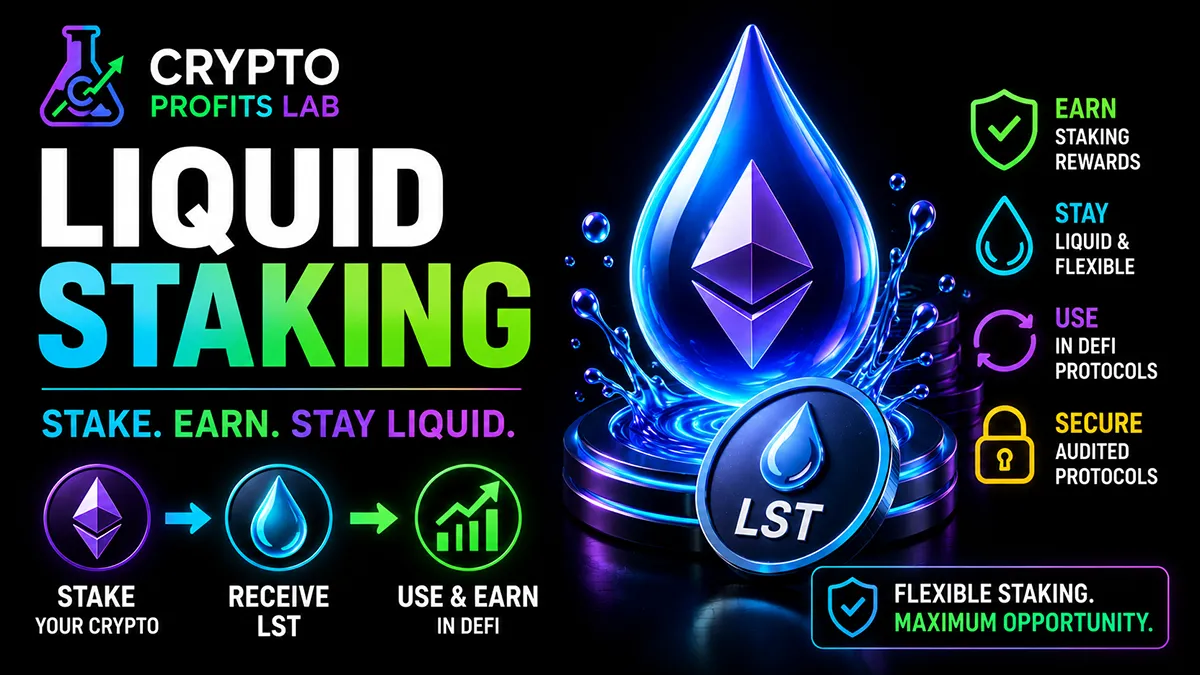
A simplified process looks like this:
- A user deposits an eligible proof-of-stake asset into a protocol or provider.
- The service pools the deposit with assets from other users.
- Validators stake the pooled assets and help secure the blockchain.
- The user receives an LST representing a claim on the deposited crypto.
- Staking rewards are reflected through the LST according to the provider’s design.
- The user may hold, transfer, trade, or use the LST where supported.
- The LST can later be redeemed or exchanged for the underlying asset, subject to the provider’s rules and available liquidity.
Ethereum.org explains that pooled staking services may issue an ERC-20 staking token that users can trade on the open market, effectively allowing them to sell their staking position without directly withdrawing the underlying ETH. Its pooled staking guidance also makes clear that these third-party solutions carry their own risks.
The exact process varies by blockchain and provider. Some services are decentralized protocols controlled through smart contracts. Others are operated by centralized companies that hold or manage assets on behalf of customers.
What Is a Liquid Staking Token?
A liquid staking token is a crypto asset that represents a staked position. It may show a claim on the original deposit, accumulated rewards, or both.
An LST is not simply a duplicate coin. It is a separate token with its own smart contract, market price, liquidity, and risks.
Providers generally use one of two reward designs.
Rebasing Tokens
The number of tokens in the wallet may increase as rewards are added.
For example, a balance could gradually grow from 10 tokens to slightly more than 10.
Reward-Bearing or Exchange-Rate Tokens
The number of tokens may stay the same while each token becomes redeemable for more of the underlying asset.
A user may still hold 10 LSTs, but each one represents a growing amount of the staked crypto.
Beginners should learn which model is being used. Wallet balances, portfolio trackers, and tax records may display the two types differently.
Many Ethereum LSTs use the ERC-20 token standard, which makes them compatible with wallets and applications built for ERC-20 assets. Compatibility does not guarantee that every application is safe.
Why Do People Use Liquid Staking?
The main attraction is flexibility.
Access to Staking With Smaller Amounts
Solo staking may require a large minimum balance or technical equipment. A pooled service can combine smaller deposits from many users.
A Transferable Representation of the Position
The LST may be moved between compatible wallets, traded through a market, or transferred to another user.
Potential Use in DeFi
Some LSTs can be supplied to lending markets, used in liquidity pools, or deposited in other decentralized applications.
This can make staked capital more useful, but it also increases risk. One asset may be exposed to multiple smart contracts simultaneously.
Easier Market-Based Exit
A holder may be able to swap an LST for another asset instead of waiting for the underlying staking withdrawal process.
This depends on market liquidity and may involve an unfavorable price.
Automatic Reward Tracking
Some services handle validator operations and automatically distribute or reflect rewards. That convenience is one reason the approach is often described as a passive-income method.
“Passive” does not mean maintenance-free. Users still need to monitor the provider, token value, approvals, fees, and security of the applications they use.
Liquid Staking vs. Regular Staking
| Feature | Regular Staking | LST Method |
|---|---|---|
| Representative token | Usually no | Usually yes |
| Ability to transfer the position | Often limited | LST may be transferable |
| Technical work | May require validator setup | Usually handled by a provider |
| Minimum amount | Depends on network and method | Pooled options may have lower minimums |
| Third-party risk | Can be low for solo staking | Usually higher because a provider or protocol is involved |
| DeFi use | Staked asset is generally unavailable | LST may be used in compatible applications |
| Exit method | Network withdrawal process | Redemption or market sale may be available |
| Main added risk | Validator performance and market risk | Smart contracts, LST price, provider, liquidity, and integrations |
Neither method is automatically better. Solo staking offers greater control but requires more money, equipment, and responsibility. A pooled traditional service may be simpler but may not issue a transferable token.
The approach can improve flexibility, but each extra layer introduces another way for things to go wrong.
Liquid Staking vs. Yield Farming
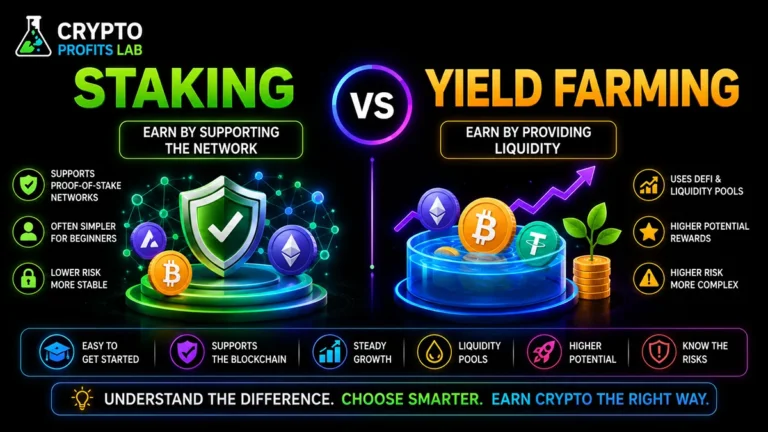
Liquid staking earns rewards from helping secure a proof-of-stake blockchain. Crypto yield farming usually involves moving assets among decentralized protocols to earn trading fees, incentives, interest-like rewards, or governance tokens.
An LST can be used in yield farming, but that creates a combined strategy. The user is then exposed to the staking protocol and the second DeFi application.
The comparison in staking vs. yield farming can help beginners understand why higher advertised returns often come with greater complexity and risk.
How Rewards Are Calculated
Reward rates depend on the blockchain, validator performance, total amount staked, provider fees, and other network conditions.
A displayed rate is normally an estimate rather than a promise. It may be shown as APR or APY:
- APR estimates a simple annual rate, not a compounded rate.
- APY estimates an annual return that incorporates compounding.
The APR vs. APY in crypto guide explains the difference in plain English.
Always examine the net reward after:
- Provider fees
- Validator or operator fees
- Blockchain transaction fees
- Swap fees
- Slippage
- Withdrawal or redemption costs
- Possible taxes
A higher headline rate does not always produce a better result.
Step-by-Step: How Liquid Staking Usually Works for Beginners
The following process is educational rather than a recommendation for a specific provider.
Step 1: Learn the Base Network
Understand the asset, blockchain, staking rules, withdrawal process, and normal reward source.
Read about proof of stake before adding a third-party protocol.
Step 2: Choose Between Centralized and Decentralized Access
A centralized platform may handle the wallet and interface but adds custody and company risk.
A decentralized protocol may let you interact from your own wallet but adds smart-contract and transaction-signing responsibility.
Step 3: Compare Providers
Review fees, audits, operator structure, withdrawal rules, governance, liquidity, supported wallets, and how rewards appear.
Do not choose a service only because it shows the highest rate.
Step 4: Verify the Official Website and Contract
Use a trusted official source. Check every character in the web address and token contract.
A fake site may imitate a well-known protocol and request a dangerous signature or crypto token approval.
Step 5: Estimate the Full Cost
Account for network fees, provider fees, swap costs, and the cost of eventually exiting.
On Ethereum, crypto gas fees can make very small deposits uneconomical.
Step 6: Start With a Small Amount
A small initial deposit lets you learn how the interface, LST, reward method, and withdrawal process work.
It does not eliminate risk, but it limits the extent to which you are exposed while you learn.
Step 7: Confirm the LST in Your Wallet
Verify the token contract before adding it to your wallet display. Scam tokens can copy legitimate names and symbols.
Step 8: Monitor the Position
Track the LST’s market price, redemption value, provider announcements, validator performance, liquidity, and contract changes.
Step 9: Keep the Strategy Simple
Holding the LST may already provide the intended staking exposure.
Depositing it into another DeFi protocol can add liquidation, smart-contract, liquidity-pool, or token-approval risk.
Step 10: Understand the Exit Before Depositing More
Learn whether you must request redemption, wait for a network withdrawal, or swap the LST on the open market.
Check fees and possible crypto slippage before assuming the displayed balance can be converted at full value.
7 Proven Ways to Use Liquid Staking More Safely
1. Choose Simplicity Over the Highest Yield
A plain staking position is easier to understand than a chain of lending, borrowing, farming, and restaking transactions.
Additional yield normally comes from additional risk or incentives.
2. Check Who Controls the System
Learn whether administrators can pause withdrawals, upgrade contracts, change fees, select validators, or control important keys.
A service with concentrated control may depend heavily on a small team or a limited number of decision-makers.
3. Review Audits Without Treating Them as Guarantees
A reputable audit can identify known problems, but it cannot prove that a smart contract will never fail.
Check whether the serious findings have been fixed and whether the current contract version matches the audited version.
4. Watch the LST’s Market Value
Compare the token’s market price with its underlying redemption value.
A discount may reflect low liquidity, market fear, withdrawal delays, or doubts about the provider.
5. Limit DeFi Layers
Using an LST as collateral or in a liquidity pool may increase returns, but it also increases the number of systems that must work correctly.
A simple position is generally easier for a beginner to monitor and understand.
6. Protect the Wallet
Use verified bookmarks, review transaction details, limit token approvals, and consider a hardware wallet for balances above a certain threshold.
Never provide a seed phrase or private key to a staking website, support representative, or reward-claim page.
7. Maintain an Exit Plan
Know how long redemption may take, which market could provide an alternative exit, and how much value could be lost to fees or a discount.
These habits cannot make the method risk-free, but they can reduce avoidable mistakes.
Major Liquid Staking Risks
Smart-Contract Risk
A bug or exploit may cause losses, block withdrawals, or let an attacker control assets.
Even an audited contract can contain an undiscovered problem.
Provider and Operator Risk
Validators may perform poorly, go offline, or violate network rules.
A centralized provider may also experience insolvency, fraud, account freezes, security breaches, or operational failure.
Slashing Risk
Some proof-of-stake networks can penalize validators for serious mistakes or dishonest behavior.
Users may share part of that loss, depending on the provider and protocol rules.
LST Price Risk
The market price of an LST can fall below the value of the underlying crypto.
This is sometimes called depegging, although an LST is not always designed to maintain a perfect fixed price at every moment.
Liquidity Risk
A holder may not find enough buyers near the expected price.
A large or urgent sale may produce significant slippage, especially during a market panic.
Governance and Centralization Risk
A small group may control contract upgrades, validator selection, voting power, or emergency decisions.
Large staking providers may also concentrate influence over the underlying blockchain network.
Composability Risk
Using the LST in another protocol connects multiple systems.
A failure in the staking protocol, the lending platform, the price oracle, the bridge, or the liquidity pool may affect the same position.
Market Risk
Staking rewards do not protect against a falling cryptocurrency price.
An asset can earn more units while losing value in U.S. dollars.
Regulatory and Tax Uncertainty
Rules differ by location and may change.
Rewards, token swaps, and redemptions may have reporting or tax consequences. Keep complete records and use qualified professional guidance when needed.
Common Beginner Mistakes
Believing the LST Is the Same as the Original Asset
The LST is a separate token representing a claim. It can have different market behavior and contract risk.
Chasing the Highest Advertised Rate
A high reward may depend on temporary incentives, extra leverage, weak liquidity, or greater platform risk.
The highest rate is not automatically the best opportunity.
Ignoring Fees
Small deposits can earn less than the cost of entering and exiting.
Calculate the likely net reward rather than focusing solely on the advertised percentage.
Using an Unverified Website
Search ads, social posts, and direct messages can lead to convincing copies of real protocols.
Review the crypto phishing scam guide before connecting a wallet.
Stacking Too Many Strategies
Staking an asset, borrowing against its LST, and farming with the borrowed funds may create risks that are difficult for a beginner to track.
Assuming “Liquid” Means Guaranteed Cash Access
Liquidity depends on buyers, pools, network conditions, and redemption rules.
A token can be technically tradable but costly to sell.
Investing Money Needed Soon
Withdrawal delays, price declines, or protocol problems can make the position unavailable when cash is needed.
Is Liquid Staking Really Passive Income?
Liquid staking can generate crypto rewards with less daily work than active trading or running a validator. In that limited sense, it may fit within a passive-income strategy.
However, the income is not guaranteed, fixed, or protected like interest in an insured bank account.
The user remains exposed to the underlying crypto price and the risks of the provider, token, wallet, and any DeFi applications used.
Before participating, review whether passive crypto income is safe and decide whether the potential reward justifies the associated risk.
Safety Checklist
Before depositing, confirm that you can answer these questions:
- What asset am I staking?
- Who operates the validators?
- Who controls or upgrades the protocol?
- What token will I receive?
- How are rewards reflected?
- What fees will I pay?
- Can the LST trade below its redemption value?
- How do I redeem or sell it?
- Is there enough liquidity for my expected exit?
- What happens after slashing or a contract exploit?
- Am I using the official website and contract?
- Can I afford to lose the entire amount?
When several answers are unclear, pause rather than guess.
Final Thoughts
Liquid staking can make staking more accessible and flexible. It may let beginners use smaller amounts, receive a transferable token, and avoid operating validator hardware.
That convenience is not free. The user exchanges some network-level simplicity for added smart-contract, provider, LST, liquidity, and security risks.
Start by understanding ordinary staking. Compare providers carefully, verify every website and contract, calculate net rewards after fees, and avoid adding unnecessary DeFi layers.
Crypto Profits Lab focuses on cleaner, simpler, and more trustworthy beginner education. A good passive-income decision is not the one with the largest advertised return. It is the one whose rewards, costs, risks, and exit process you can clearly explain before making a deposit.
Liquid Staking Frequently Asked Questions
Is liquid staking safe for beginners?
Liquid staking can be accessible to beginners, but it is not risk-free. A user depends on the underlying blockchain, validators, provider, smart contracts, LST design, and available liquidity. Beginners should start small, use verified official websites, understand the exit process, and avoid immediately depositing the LST into additional DeFi applications.
What is the difference between staking and liquid staking?
Regular staking locks or commits cryptocurrency to help secure a proof-of-stake network and may not provide a transferable asset in return. Liquid staking normally issues an LST that represents the staked position. The LST adds flexibility because it may be transferred or traded, but it also introduces separate token, provider, smart-contract, and liquidity risks.
Do LSTs earn rewards automatically?
Usually, but the method depends on the token. A rebasing LST may increase the number of tokens in the wallet. A reward-bearing LST may keep the same token balance while each token represents more of the underlying asset. Provider fees, validator performance, and network conditions can affect the actual reward.
Can a liquid staking token lose value?
Yes. The underlying cryptocurrency can decline in price, and the LST can also trade below its redemption value due to low liquidity, market fear, provider concerns, or withdrawal delays. Staking rewards may not be large enough to offset either decline. The displayed reward rate should never be treated as a guaranteed profit.
Can I sell a liquid staking token at any time?
An LST may be tradable at any time when an active market has enough liquidity, but that does not guarantee a favorable price. Selling may involve network fees, swap fees, and slippage. Direct redemption can follow a different process and may require a waiting period. Check both exit methods before depositing.
How much cryptocurrency do I need for liquid staking?
The minimum depends on the blockchain and provider. Pooled services often accept less than the amount required to run a solo validator. However, a very small deposit may not be worthwhile when blockchain fees are high. Compare the expected net reward with the full cost of entering and exiting.
Is liquid staking better than using a centralized exchange?
Neither option is automatically better. A centralized exchange may offer a simpler interface but adds custody, account, and company risk. A decentralized protocol may let you use your own wallet but requires careful contract verification and transaction approval. Compare control, fees, withdrawal terms, security, transparency, and your experience level.
Can I use a liquid staking token in DeFi?
Many LSTs can be supplied to lending platforms, liquidity pools, or other DeFi applications. Doing so may create additional rewards, but it adds another layer of smart-contract, liquidation, liquidity, token-approval, and platform risk. Beginners should understand the basic staking position before combining it with a second protocol.