Crypto Trailing Stop: A Beginner’s Guide to Protecting Gains

A crypto trailing stop is an order that follows the market when price moves in your favor and can trigger an exit if price reverses by a set amount or percentage. Instead of placing one fixed stop price and leaving it there, the stop can move upward with a rising market for a long position.
That sounds simple, but beginners need to understand an important detail: a trailing stop does not guarantee profit, and it does not guarantee an exact selling price. It is a risk-management tool that reacts to price movement according to rules you choose.
This guide explains crypto trailing stop orders in plain English, including how they work, how they compare with regular stop-loss and take-profit orders, how to choose a trailing distance, and what risks to watch for in volatile crypto markets.
Quick Answer
A crypto trailing stop is a moving exit order. For a long position, the trailing level follows price upward as the market makes new highs. If price later falls by the trailing amount you selected, the order can trigger.
For example, if a coin rises from $100 to $120 and you use a 5% trailing distance, the stop can follow the price higher. If $120 becomes the highest price reached after activation, a 5% decline from that peak would place the trigger around $114.
The exact mechanics vary by exchange. Some platforms trigger a market order, while others offer trailing stop-limit versions. Always read the order description before using one.
Key Takeaways
- A crypto trailing stop moves with favorable price action instead of staying at one fixed price.
- For a long position, the trailing level can rise as the market rises, but it normally does not move back down when price falls.
- A tighter trail may trigger more quickly during normal volatility.
- A wider trail gives the trade more room but can surrender more unrealized profit before triggering.
- A trailing stop is different from a fixed crypto stop loss and a fixed crypto take profit.
- Market orders can experience slippage, while limit-based exits may fail to fill.
- No trailing distance guarantees the best exit or protects against every market condition.
Crypto Trailing Stop Beginner Facts
| Term | Beginner Meaning |
|---|---|
| Trailing stop | A stop that follows favorable price movement |
| Trailing percentage | The percentage price can reverse before the order triggers |
| Trailing amount | A fixed dollar or quote-currency distance used instead of a percentage |
| Peak price | The highest tracked price after the trailing order begins following a long position |
| Trigger price | The level that activates the exit instruction |
| Market order | An order designed to execute quickly at available prices |
| Limit order | An order that only fills at the limit price or better |
| Slippage | The difference between the expected price and the actual execution price |
What Is a Crypto Trailing Stop?
A crypto trailing stop is a variation of a stop order that adjusts as the market moves in your favor.
With a traditional fixed stop loss, you choose one stop price. If you buy at $100 and place a stop at $90, that stop usually remains at $90 unless you manually change it.
A trailing stop works differently. Instead of staying fixed, it follows the market by a chosen distance. If the price climbs, the trailing level can climb with it. If the market later reverses enough to reach that trailing distance, the order can activate.
The idea is to give a winning trade room to continue while creating an automatic exit if momentum reverses.
This can be especially useful in spot trading in crypto, where a trader may want to stay in a rising position without manually moving a stop every time the market makes a new high.
How a Crypto Trailing Stop Works
Imagine you buy a cryptocurrency at $100 and later place a crypto trailing stop with a 10% trailing distance.
If the market rises to $110, the trailing reference moves higher. If the market then rises to $120, the trailing reference rises again. With $120 as the highest tracked price, a 10% reversal would place the trigger around $108.
If price keeps rising to $130 before a large enough decline occurs, the trailing reference would move higher again. A 10% decline from $130 would be around $117.
For a sell trailing stop on a long position, the trailing level generally rises with new highs but does not move back down when price falls. It waits for the selected reversal amount to be reached.
Exchanges implement these orders differently. Kraken provides a public explanation in its Trailing Stop Orders guide, including trailing offsets and trigger behavior. Kraken Trailing Stop Orders guide
Crypto Trailing Stop vs. Regular Stop Loss
A fixed stop loss and a trailing stop both attempt to create a planned exit, but they behave differently after price moves in your favor.
Suppose you buy at $100 and place a fixed stop at $90. If the price later rises to $140, the stop may still remain at $90 unless you manually change it.
With a crypto trailing stop, the stop distance can move upward as the price rises. That means the exit level may eventually move above your original entry price.
A trailing stop is not automatically better. A fixed stop may fit a trade that depends on a specific support or invalidation level.
- Fixed stop: stays at a chosen level.
- Trailing stop: follows favorable market movement.
If fixed stops are new to you, start with our crypto stop loss guide.
Crypto Trailing Stop vs. Take Profit
A take-profit order usually targets a specific price above your entry. Once that target is reached, the order attempts to close some or all of the position.
A trailing stop does not require one fixed upside target. It allows the trade to keep running as long as price continues moving favorably without reversing by the chosen trailing distance.
For example, a trader may buy at $100 and set a take-profit target at $120. If price reaches $120, the planned exit occurs.
With a crypto trailing stop, the trader might instead allow the position to continue beyond $120. If price reaches $135 before reversing enough to trigger the trail, the exit may occur at a higher level than the original $120 target.
The trade-off is uncertainty. Price could reverse earlier and trigger below the level you hoped to reach. Learn the fixed-target approach in our crypto take profit guide.
Crypto Trailing Stop vs. Stop-Limit Order
A stop-limit order uses two prices: a stop price that activates the order and a limit price that controls the worst price the trader is willing to accept.
A trailing stop can also have a limit-based version on some platforms. In that case, the trigger itself moves with favorable price action, but once triggered, the exchange places a limit order rather than a market order.
Market-style and limit-style exits have different risks. A market order prioritizes execution, while a limit order prioritizes price and may remain unfilled in a fast market.
Review market order vs limit order in crypto before using conditional orders.
Percentage Trail vs. Fixed-Amount Trail
Many exchanges let traders define a trailing stop in one of two basic ways.
Percentage Trail
A percentage trail uses a percentage of price.
If the trailing distance is 5% and the highest tracked price is $200, the trigger would be roughly 5% below that peak, or around $190.
Percentage-based trails scale naturally with price. That can make them easier to compare across assets with very different prices.
Fixed-Amount Trail
A fixed-amount trail uses a set currency distance.
If a coin is trading at $200 and you set a $10 trailing amount, the trigger follows $10 below the highest tracked price.
A fixed amount can be simple to understand, but the same dollar distance can mean very different things for a $20 coin and a $20,000 asset.
Neither method is automatically better. The distance should match the trade and its volatility.
Step by Step: How to Plan a Crypto Trailing Stop
The exact buttons vary by exchange, but the planning process is broadly similar.
Step 1: Understand Why You Entered the Trade
Before setting an exit, know what the trade is trying to accomplish.
Are you trading a short-term breakout? Following a trend? Holding a spot position that has already moved into profit?
The answer matters because the trailing distance should fit the trade, not be chosen randomly.
Step 2: Look at Normal Price Movement
Crypto can move sharply even when the broader trend remains unchanged. A very tight crypto trailing stop may trigger simply because the asset experiences ordinary intraday volatility.
Review recent price swings and learn the basics of crypto volatility before choosing a distance.
Step 3: Choose Percentage or Fixed Amount
Decide whether a percentage or fixed-distance trail is easier to understand for the asset you are trading.
A percentage can adapt to the price level. A fixed amount can make sense when you are thinking in a specific dollar range.
Step 4: Decide Whether the Order Activates Immediately
Some platforms begin trailing as soon as the order is placed. Others may allow an activation price.
An activation price tells the exchange not to begin tracking the trail until the market reaches a particular level.
Read the exchange order ticket carefully. Never assume every platform uses the same terminology.
Step 5: Check What Happens After the Trigger
Find out whether your trailing order creates a market order, a limit order, or another type of instruction.
This is one of the most important details because it affects execution risk.
Step 6: Review Quantity and Position Size
Confirm how much crypto the order will sell if triggered.
A trailing stop on 25% of a position is very different from one that closes 100%.
Step 7: Double-Check Before Submitting
Review the asset, trading pair, quantity, trailing distance, activation price if used, and resulting order type.
Then monitor the order until you understand how your exchange displays the moving trigger.
7 Smart Ways to Use a Crypto Trailing Stop
1. Give Volatile Assets Enough Room
A common beginner mistake is choosing an extremely tight trail because it feels safer.
But if an asset regularly moves 3% or 4% during ordinary trading, a 1% trail may trigger quickly even while the larger trend remains intact.
The goal is to choose a distance that matches the trade plan.
2. Do Not Choose the Trail Only From Your Desired Profit
Do not base the trail only on how much profit you want to keep. Study recent volatility and important price areas.
Our crypto charts for beginners guide can help with basic chart reading.
3. Understand the Trading Pair
A trailing order operates on a specific crypto trading pair.
BTC/USD, BTC/USDT, and BTC/EUR are separate markets with different liquidity and spreads. Make sure the order is attached to the intended pair.
4. Check Liquidity Before Relying on Automation
Low liquidity can make execution less predictable.
Thin markets can increase crypto slippage. Reviewing the crypto order book can help you understand available buy and sell orders.
5. Account for Trading Fees
A profitable-looking exit can produce less net profit after fees.
Review crypto trading fees for beginners before deciding whether a small trailing strategy is worthwhile.
6. Avoid Moving the Trail Because of Emotion
A trailing stop is meant to create structure. Constantly widening it because you do not want to be stopped out can defeat that purpose.
This can happen when crypto FOMO takes over. If you change the trail, have a clear reason tied to the trade plan.
7. Review the Trade Afterward
After the order triggers, compare the result with your original plan.
Did the trail match normal volatility? Did slippage matter? Was the order too tight or too wide? Did you understand the trigger?
Judge the process, not only whether price went higher afterward.
Example: A 5% Crypto Trailing Stop
Suppose a trader buys a coin at $100.
Later, the price rises to $120. The trader places a crypto trailing stop with a 5% trailing distance.
If the order begins tracking immediately at $120, the initial trailing trigger would be roughly $114.
Now imagine the price rises further:
- Price reaches $125: approximate trailing trigger becomes $118.75.
- Price reaches $130: approximate trailing trigger becomes $123.50.
- Price reaches $140: approximate trailing trigger becomes $133.
If $140 remains the peak and the market then drops 5%, the order can trigger around $133.
This example is simplified. Reference prices, rounding, liquidity, spreads, and order types can change real execution.
Why Volatility Matters
Volatility is one of the biggest challenges when choosing a trailing distance.
A trail that is too narrow may react to normal market noise. A trail that is too wide may allow a large portion of unrealized gains to disappear before the exit activates.
There is no universal percentage. Bitcoin, a small-cap token, and a thinly traded asset can behave very differently, and volatility can change quickly. A percentage copied from someone else’s strategy may not fit your trade.
Fees, Spread, and Slippage
A trailing order does not remove trading costs.
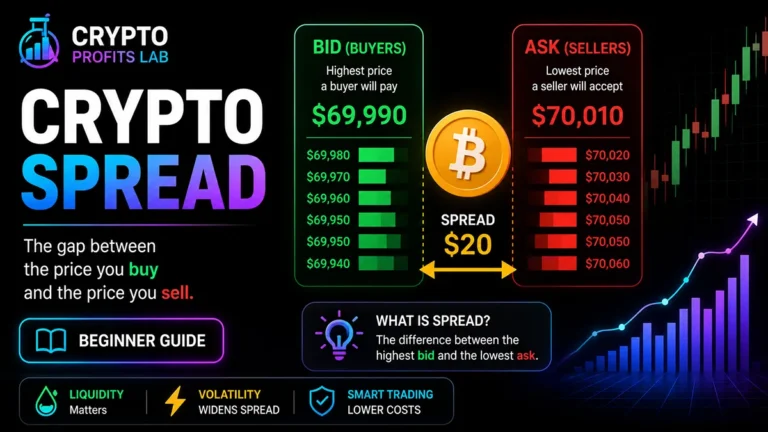
The crypto spread is the difference between the best available buy and sell prices. Fees are charged according to the exchange’s pricing rules. Slippage can occur when your order fills at prices different from the expected level.
These effects matter most when the trail is small or the market moves quickly. A market order triggered during a sudden drop may execute across several bids, producing an average price below the trigger.
A trailing order is an instruction to the exchange, not a guarantee of a precise result.
Common Beginner Mistakes
Setting the Trail Too Tight
A tight trail can feel protective, but normal volatility may activate it quickly.
That can cause exits during ordinary price fluctuations.
Setting the Trail Too Wide
A wide trail can allow a large unrealized gain to shrink before the trigger occurs.
Assuming the Trigger Price Equals the Fill Price
Trigger price and execution price are not always the same.
Market orders can experience slippage. Limit orders can remain unfilled.
Forgetting About Activation Rules
Some exchanges allow an activation price, while others begin trailing immediately.
Misunderstanding when the order starts tracking can produce an unexpected result.
Using the Wrong Side of the Order
A trailing sell and trailing buy are not the same.
For a long spot position, you would normally study a trailing sell order. Always confirm the order side before submitting.
Ignoring Fees and Liquidity
Trading costs and thin order books can reduce the result.
Believing the Order Guarantees Profit
A crypto trailing stop can trigger below your original entry if the trade never moves far enough in your favor or if the order is activated before a meaningful gain develops.
Automation does not remove market risk.
Safety and Risk Considerations
Trailing stops can be useful, but they have limitations.
Crypto markets trade around the clock and can move quickly. A market exit may fill far from the trigger, while a limit-based exit may remain unfilled. Exchange outages can also affect access to trading tools.
Beginners may want to test unfamiliar order types with very small amounts first.
Also protect the account itself. Use a unique password and enable crypto 2FA. A well-designed trading order cannot protect funds if the account is compromised.
Never risk money you cannot afford to lose, and remember that educational information about order types is not a promise of investment results.
When a Trailing Stop May Not Fit the Plan
A trailing order is not necessary for every position.
A long-term investor may prefer a different exit approach. A trader using a precise invalidation level may prefer a fixed stop, while someone with a clear price target may prefer a fixed take-profit order.
The important question is whether the order matches the reason for the trade.
Frequently Asked Questions
What Is a Crypto Trailing Stop?
A crypto trailing stop is an order that follows favorable price movement by a set percentage or fixed amount. For a long position, the trailing level can move upward as price makes new highs. If price later falls by the selected trailing distance, the order can trigger an exit. The exact execution method depends on the exchange and may involve a market or limit order.
How Is a Trailing Stop Different From a Regular Stop Loss?
A regular stop loss normally stays at the price you choose unless you manually change it. A trailing stop automatically adjusts when price moves in your favor. For a long position, the trailing level can rise with new highs but normally does not move lower when price falls. This can help protect part of an unrealized gain, but it can also trigger during normal volatility.
What Percentage Should I Use for a Crypto Trailing Stop?
There is no single percentage that is appropriate for every cryptocurrency or trade. A suitable trailing distance depends on normal volatility, the time frame, liquidity, and the purpose of the position. A very tight percentage may trigger during routine price movement, while a wide percentage can allow more profit to disappear before exit. Beginners should avoid copying a percentage without understanding why it fits the asset.
Can a Crypto Trailing Stop Guarantee a Profit?
No. A trailing stop does not guarantee a profit or a specific execution price. The market may reverse before the position develops a gain, and a triggered market order can experience slippage. A limit-based version may fail to fill if price moves too quickly. A trailing stop is a risk-management tool, not a guarantee that a trade will be profitable.
Does a Trailing Stop Move Back Down After Price Falls?
For a typical sell trailing stop on a long position, the trailing reference rises when the market reaches new highs but does not move back down when price declines. Once price reverses by the chosen trailing distance, the exit condition can be triggered. Exact platform rules differ, so always check how your exchange calculates the reference price and trailing offset.
Is a Trailing Stop Better Than Take Profit?
Neither order is automatically better. A take-profit order uses a fixed upside target, while a trailing stop can continue following price if the market keeps rising. A take-profit order provides a clearer planned target. A trailing stop offers more flexibility but creates uncertainty about the final exit level. The better choice depends on the trade plan and the type of risk you are trying to manage.
Can a Trailing Stop Fail to Sell My Crypto?
Yes, especially if the trailing order creates a limit order after triggering. If price falls through the limit too quickly, there may be no buyer at your required price and the order can remain unfilled. A market-style trailing exit is more likely to execute, but the actual fill price can be worse than expected. Always understand the order type created after the trigger.
Can I Use a Trailing Stop in Spot Crypto Trading?
Some exchanges support trailing stop orders for spot markets, while others may offer them only on certain trading interfaces or products. Availability and terminology vary by platform. If the feature is available, a spot trader may use a trailing sell order to create a moving exit for crypto already owned. Confirm the trading pair, quantity, activation rule, and resulting order type before submitting.
Final Thoughts
A crypto trailing stop can make exit planning more flexible because the stop can follow price when a trade moves in your favor.
For beginners, the most important lesson is not finding a perfect percentage. It is understanding what the order actually does.
Know when the trailing process begins. Know what price the exchange tracks. Know whether the trigger creates a market or limit order. Consider volatility, liquidity, fees, spread, and slippage before relying on the order.
A crypto trailing stop can help add structure to a trading plan, but it cannot predict the market or remove risk.
Crypto Profits Lab focuses on making tools like this easier to understand without unnecessary jargon. Learn the mechanics first, keep the plan simple, and only use an order when you understand how it behaves before, during, and after the trigger.