
What Is Crypto Volatility? A Beginner’s Guide
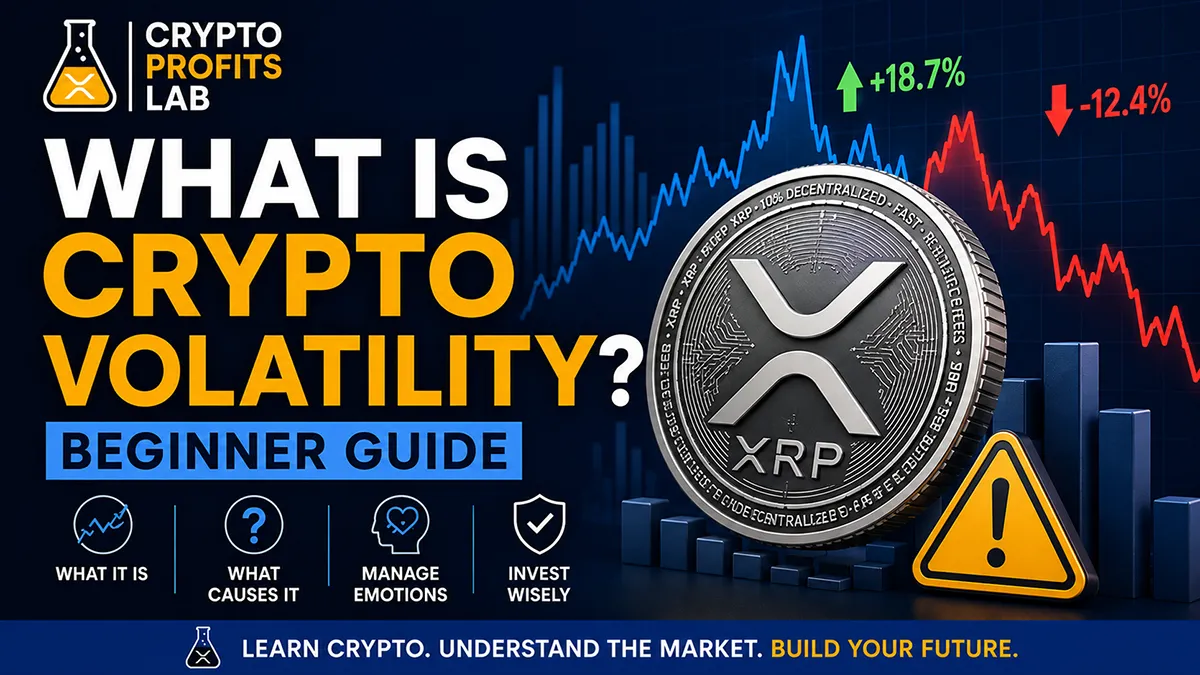
Crypto volatility is one of the first things beginners notice when they start following Bitcoin, Ethereum, XRP, or any other cryptocurrency. Prices can rise quickly, fall sharply, and change direction faster than many traditional investments.
For new investors, this can feel exciting and stressful at the same time. A coin may be up 20% one week and down 30% the next. A social media post, regulation headline, exchange issue, or market cycle can move prices quickly. That is why understanding crypto volatility is so important before buying or trading digital assets.
Volatility is not always bad. Price movement can create opportunity. But it also creates risk, especially for beginners who make emotional decisions. If you do not understand volatility, it is easy to buy during hype, panic during downturns, or invest more than you can afford to lose.
In this guide, we’ll explain what crypto volatility means, why crypto prices move so much, what causes big price swings, how beginners can manage risk, and what mistakes to avoid.
What Is Crypto Volatility?
Crypto volatility means the price of a cryptocurrency can change significantly over a short period of time. A volatile asset may move up or down quickly, sometimes within minutes, hours, or days.
In simple terms, crypto volatility describes how unstable or unpredictable crypto prices can be.
For example, if Bitcoin moves from $60,000 to $66,000 and then back to $58,000 in a short time, that is volatility. If a smaller altcoin doubles and then loses half its value in a week, that is also volatility.
Volatility happens in many markets, but crypto is known for larger and faster swings than many traditional assets. This is because crypto markets are still developing, trade 24/7, and are heavily influenced by sentiment, liquidity, news, and speculation.
If you are new to digital assets, start with what cryptocurrency is before studying volatility. Understanding the basics makes price movement easier to interpret.
Why Crypto Volatility Matters
Crypto volatility matters because it affects almost every decision a beginner makes. It affects when people buy, when they sell, how much risk they take, and how they react emotionally to market moves.
Volatility can affect:
- Portfolio value
- Investor confidence
- Trading decisions
- Long-term holding plans
- Stop-loss decisions
- Profit-taking decisions
- Risk tolerance
- Passive income strategies
- Wallet and exchange behavior
A beginner may think they are comfortable with risk until a coin drops 25% in a few days. That is when emotions can take over.
Understanding crypto volatility helps you prepare before the market moves against you. It reminds you that price swings are normal in crypto and that a plan matters more than panic.
Volatility also helps explain why beginners should avoid investing money they need for bills, emergencies, or short-term goals.
Why Is Crypto More Volatile Than Traditional Markets?
Crypto is often more volatile than traditional markets because the asset class is younger, smaller, and more speculative. Stocks, bonds, and major currencies have longer histories, deeper liquidity, and more established investor behavior.
Crypto is different.
Many crypto assets are still early-stage projects. Some have limited real-world adoption. Others depend heavily on future expectations. This makes prices more sensitive to news, hype, fear, regulation, exchange listings, and social media attention.
Crypto can also move faster because the market never closes. Traditional stock markets have trading hours. Crypto trades 24 hours a day, seven days a week. That means a major move can happen overnight, on weekends, or during holidays.
Other reasons crypto volatility can be high include:
- Smaller market size compared with traditional finance
- Heavy retail speculation
- Lower liquidity in smaller coins
- Rapid news cycles
- High leverage in trading markets
- Token unlocks and supply changes
- Whale activity
- Social media hype
- Regulatory uncertainty
This does not mean crypto is bad. It means beginners need to respect the risk.
What Causes Crypto Volatility?
Crypto volatility can be caused by many different factors. Sometimes prices move because of real developments. Other times they move because of emotion, speculation, or sudden changes in liquidity.
Common causes include:
- Bitcoin price movement
- Regulation news
- Exchange listings or delistings
- Hacks or security incidents
- Social media hype
- Influencer attention
- Major partnerships
- Token unlocks
- Whale buying or selling
- Macroeconomic news
- Interest rate expectations
- Liquidations from leveraged traders
- Bull and bear market cycles
Crypto prices can also move when investors become overly excited or fearful. This is why emotion plays such a big role in the market.
For an outside beginner reference, Investor.gov explains volatility as how much and how quickly an investment’s value changes: Investor.gov volatility glossary.
Bitcoin and Crypto Volatility
Bitcoin often has a major influence on crypto volatility. Because Bitcoin is the largest and most recognized cryptocurrency, its price movement can affect the entire market.
When Bitcoin rises strongly, confidence may spread into Ethereum, XRP, Solana, and smaller altcoins. When Bitcoin falls sharply, the rest of the market may fall even harder.
This happens because many investors treat Bitcoin as the main crypto benchmark. If Bitcoin looks strong, risk appetite may increase. If Bitcoin looks weak, investors may become more defensive.
Beginners should pay attention to Bitcoin even if they are interested in altcoins. Bitcoin often sets the tone for the broader market.
However, Bitcoin is still volatile. It may be more established than many altcoins, but it can still experience major price swings.
Ethereum and Altcoin Volatility
Ethereum and altcoins can be even more volatile than Bitcoin. Ethereum has a large ecosystem, but it still moves sharply during market cycles. Smaller altcoins can move even more aggressively.
Altcoin volatility can be higher because many smaller projects have:
- Lower liquidity
- Smaller communities
- Less adoption
- More speculation
- Higher token supply risk
- Fewer exchange listings
- More concentrated ownership
- Less proven technology
A coin like XRP may move based on payment-related news, regulation, market sentiment, and broader crypto cycles. A DeFi token may move based on protocol activity, security risks, or token rewards. A Layer 2 token like Optimism or Arbitrum may move based on Ethereum scaling trends.
The key lesson is simple: not all crypto volatility is the same. Each coin has its own risk profile.
Crypto Volatility and Market Cap
Market cap can help beginners understand why some coins are more volatile than others. Smaller market cap assets often move more dramatically because it takes less money to push the price up or down.
A large-cap coin like Bitcoin may still be volatile, but it usually has deeper liquidity than a small altcoin. A small-cap token may rise quickly during hype, but it may also collapse quickly when sellers appear.
This is why beginners should learn crypto market cap before comparing coins.
Market cap helps answer questions like:
- How large is this project?
- How much money may be needed to move the price?
- Is the price prediction realistic?
- Is this coin small and speculative?
- Does the token supply make sense?
Low price does not mean low risk. A coin with a tiny price and huge supply can still have a large market cap, and a small market cap coin can still be extremely risky.
Crypto Volatility and Bull vs Bear Markets
Crypto volatility is closely tied to market cycles. During bull markets, prices may rise quickly as investor confidence grows. During bear markets, prices may fall sharply as fear increases.
A bull market can make beginners feel like every coin is a good investment. A bear market can make beginners feel like crypto is finished. Both emotions can be dangerous.
In a bull market, volatility can show up as fast rallies, sudden pullbacks, and extreme hype. In a bear market, volatility can show up as sharp crashes, relief rallies, and panic selling.
Understanding bull vs bear market crypto helps beginners see that crypto moves in cycles. A rising market does not rise forever, and a falling market does not fall in a straight line forever.
The goal is not to predict every move perfectly. The goal is to avoid emotional decisions.
Crypto Volatility and Liquidity
Liquidity means how easily an asset can be bought or sold without moving the price too much. Liquidity has a major effect on crypto volatility.
High-liquidity markets usually have more buyers and sellers. This can make price movement smoother. Low-liquidity markets can move sharply because even a modest buy or sell order can affect price.
Low-liquidity tokens can be dangerous for beginners. A chart may look exciting when the price rises, but selling later may be difficult if there are not enough buyers.
Signs of weak liquidity may include:
- Low trading volume
- Wide spreads
- Sudden price spikes
- Limited exchange listings
- Large moves from small trades
- Difficulty selling without slippage
If you use exchanges, learn the difference between centralized and decentralized exchanges. Liquidity, fees, slippage, and custody work differently depending on the platform.
Crypto Volatility and Gas Fees
Crypto volatility can also affect network activity. When markets move quickly, more people may send transactions, trade tokens, bridge assets, or use DeFi apps. This can increase blockchain congestion and transaction costs.
On Ethereum, these transaction costs are known as gas fees. During busy periods, gas fees can rise quickly.
This matters because a beginner may try to sell, swap, or move assets during high volatility and then discover that fees are much higher than expected.
Before using Ethereum or DeFi apps, read our guide on crypto gas fees. Fees can affect small investors especially hard because a $20 transaction fee is much more painful on a $50 transaction than on a $5,000 transaction.
Volatility does not only affect coin prices. It can affect the entire user experience.
Crypto Volatility and Wallet Safety
Wallet safety matters even more during volatile markets. When prices move quickly, beginners may rush. Rushing leads to mistakes.
Common wallet mistakes during volatile periods include:
- Sending funds to the wrong address
- Using the wrong network
- Clicking fake links
- Forgetting destination tags or memos
- Approving unsafe wallet permissions
- Ignoring test transactions
- Using fake support accounts
- Sharing a seed phrase
A crypto wallet gives you control over your assets, but that control comes with responsibility.
If you hold crypto in a personal wallet, protect your crypto seed phrase and understand hot wallet vs cold wallet. For larger balances, many users prefer a hardware wallet or another cold storage crypto method.
Security should not disappear just because the market is moving fast.
Crypto Volatility and Exchanges
Exchanges often become more active during volatile markets. More users buy, sell, deposit, and withdraw funds. This can create delays, higher fees, and emotional trading decisions.
If you are using a centralized exchange, protect your account with crypto 2FA. Use strong passwords, avoid phishing emails, and make sure you are on the real exchange website.
If you are new, read how to buy crypto for beginners and the best crypto exchange for beginners before placing trades.
Exchange safety tips include:
- Verify the website URL.
- Enable two-factor authentication.
- Avoid clicking email links.
- Use small test withdrawals.
- Understand withdrawal fees.
- Do not leave large balances without a plan.
- Keep records of transactions.
Volatility can make people act quickly. Good security habits force you to slow down.
Crypto Volatility and Passive Income
Crypto passive income strategies may look attractive during volatile markets, but they still carry risk. Staking, lending, and yield farming do not remove price volatility.
For example, you may earn staking rewards while the token price falls. You may earn lending interest while platform risk increases. You may earn yield farming rewards while impermanent loss or smart contract risk reduces your overall return.
Common passive income topics include:
Beginners should be careful with high-yield offers during volatile markets. High returns often come with high risk.
Crypto volatility can quickly erase rewards if the underlying asset falls sharply.
Crypto Volatility and DeFi Risk
DeFi can become riskier when the market is volatile. Token prices can move quickly, liquidity can change, and smart contract activity can increase. This can create problems for borrowers, liquidity providers, and yield farmers.
DeFi risks during volatile markets include:
- Liquidations
- Impermanent loss
- Smart contract bugs
- Liquidity shortages
- Bad token approvals
- Oracle issues
- Bridge delays
- High gas fees
- Scam tokens
If you use DeFi apps like Aave or Uniswap, make sure you understand the risks before connecting a wallet.
You should also understand what a crypto bridge is before moving assets between networks. Bridges can be useful, but they add another layer of risk.
How Beginners Can Manage Crypto Volatility
Beginners cannot eliminate crypto volatility, but they can manage their response to it.
Useful habits include:
- Invest only what you can afford to lose.
- Start with small positions.
- Avoid leverage.
- Understand the coin before buying.
- Use a trusted exchange.
- Keep wallet security strong.
- Learn market cap before believing price predictions.
- Avoid chasing pumps.
- Create a plan before buying.
- Take breaks from price charts when needed.
A beginner does not need to react to every price move. Sometimes the best decision is to do nothing until emotions cool down.
The more you understand crypto volatility, the less likely you are to panic during normal market swings.
Dollar-Cost Averaging and Crypto Volatility
Dollar-cost averaging, often called DCA, is a strategy where someone invests a fixed amount on a regular schedule instead of trying to perfectly time the market.
For example, a person might buy a small amount of Bitcoin every week or every month.
DCA does not guarantee profits. It does not protect you from losses. But it may help reduce emotional decision-making because you are not trying to guess the exact top or bottom.
Our guide on dollar-cost averaging crypto explains how this strategy works.
DCA may be useful for beginners who want a more disciplined approach, but it should still be paired with research, risk management, and realistic expectations.
Long-Term Thinking and Crypto Volatility
Long-term thinking can help beginners handle crypto volatility more calmly. If you are investing for the long term, every daily price move may not require action.
However, long-term thinking does not mean blindly holding every coin forever. Some projects fail. Some tokens lose relevance. Some narratives disappear.
A stronger long-term approach includes:
- Studying the project
- Understanding token supply
- Reviewing market cap
- Tracking real adoption
- Watching security risks
- Protecting your wallet
- Avoiding emotional decisions
- Reassessing when facts change
Long-term investors still need risk management. Patience is useful, but ignoring reality is not.
Common Beginner Mistakes During Crypto Volatility
Beginners often make the same mistakes when prices move quickly.
Common mistakes include:
- Buying because of fear of missing out
- Panic selling during normal corrections
- Investing too much at once
- Ignoring market cap
- Chasing low-priced coins
- Trading without a plan
- Using leverage too early
- Forgetting wallet security
- Falling for fake giveaways
- Moving funds too quickly
- Believing every price prediction
- Ignoring scams
The biggest mistake is letting emotion replace research.
When crypto volatility increases, slow down. Review your plan, check your risk, and avoid making decisions only because the market feels urgent.
Is Crypto Volatility Good or Bad?
Crypto volatility is neither completely good nor completely bad. It depends on how it affects your goals, decisions, and risk tolerance.
Volatility can be good because it creates opportunity. Traders may profit from price movement. Long-term investors may find better entry points during downturns.
Volatility can be bad because it creates stress, losses, and emotional mistakes. A coin can fall sharply before a beginner understands what happened.
The key is not to fear volatility or blindly chase it. The key is to respect it.
Crypto volatility is part of the market. Beginners who understand it are better prepared than beginners who assume prices only move up.
When Should Beginners Avoid Trading?
Beginners should avoid trading when emotions are high or when they do not understand the asset.
Avoid trading when:
- You are panicking.
- You are chasing a pump.
- You do not understand the coin.
- You are using borrowed money.
- You are trying to recover losses quickly.
- You are relying only on social media.
- You have not checked market cap.
- You cannot afford the loss.
- You are tired, rushed, or distracted.
Not every market move needs a response. Sometimes the smartest beginner decision is to pause.
How to Study Crypto Volatility Before Investing
A beginner-friendly research process can help you understand volatility before buying.
Start by asking:
- What does this project do?
- What is the market cap?
- How volatile has the coin been?
- What caused recent price moves?
- Is the coin liquid?
- Is the token supply changing?
- Is the project driven by hype or real use?
- What risks could cause the price to fall?
- Where will I store it safely?
- What is my plan if it drops?
You can use this process for Bitcoin, Ethereum, XRP, Solana, DeFi tokens, Layer 2 tokens, and smaller altcoins.
Volatility becomes less confusing when you study the reasons behind price movement.
Final Thoughts: Crypto Volatility
Crypto volatility is one of the most important concepts every beginner should understand. It describes how much and how quickly crypto prices can move. In cryptocurrency, those moves can be much larger and faster than many traditional investments.
Volatility can create opportunity, but it can also create serious risk. Beginners who ignore volatility often buy during hype, sell during fear, or invest more than they can afford to lose.
The best approach is to learn before acting. Understand market cap, bull and bear markets, wallet safety, exchange security, gas fees, scams, and passive income risks before making major decisions.
Crypto volatility is not something beginners can control. But they can control their preparation, position size, security habits, and emotional reactions.
If you understand crypto volatility, you will be better prepared to handle market swings and make smarter decisions as you continue your crypto education.
Crypto Volatility FAQ
What does crypto volatility mean?
Crypto volatility means cryptocurrency prices can move sharply up or down over short periods of time. A volatile crypto asset may rise quickly during hype and fall quickly during fear. Beginners should understand volatility before investing because it affects risk, emotions, timing, and portfolio value.
Why is crypto volatility so high?
Crypto volatility is high because the market is still young, trades 24/7, and is heavily influenced by liquidity, speculation, news, regulation, social media, and investor psychology. Smaller crypto assets can be even more volatile because they often have lower trading volume and fewer buyers or sellers.
Is crypto volatility always bad?
Crypto volatility is not always bad, but it is always risky. Price movement can create opportunities for traders and long-term investors, but it can also cause large losses. Beginners should avoid treating volatility as guaranteed profit and should focus on risk management first.
How can beginners handle crypto volatility?
Beginners can handle crypto volatility by investing only what they can afford to lose, avoiding leverage, starting with small positions, studying market cap, using trusted exchanges, protecting wallets, and creating a plan before buying. Emotional buying and panic selling are two of the biggest mistakes.
Does Bitcoin have less volatility than altcoins?
Bitcoin is usually less volatile than many smaller altcoins because it has deeper liquidity, stronger recognition, and a larger market cap. However, Bitcoin is still a volatile asset and can experience major price swings. Smaller altcoins often move faster in both directions.
Can dollar-cost averaging reduce crypto volatility risk?
Dollar-cost averaging can reduce the pressure of timing the market by spreading purchases across regular intervals. It does not eliminate crypto volatility or guarantee profits, but it may help beginners avoid emotional all-in decisions. DCA should still be paired with research and risk management.
How does crypto volatility affect long-term investors?
Crypto volatility can test the patience and discipline of long-term investors. Large price swings may create stress, but they can also be part of normal market cycles. Long-term investors should still review fundamentals, market cap, token supply, security risks, and whether the original investment thesis remains valid.
What is the biggest mistake beginners make during crypto volatility?
The biggest mistake beginners make during crypto volatility is reacting emotionally instead of following a plan. Many beginners buy after prices rise sharply and sell after prices fall sharply. Slowing down, researching, and managing risk can help prevent costly decisions.
Should beginners trade during high crypto volatility?
Most beginners should be careful trading during high crypto volatility because prices can move quickly and mistakes become more expensive. High volatility can increase slippage, fees, emotional decisions, and scam exposure. Beginners should focus on education and small, controlled decisions rather than rushed trades.