Bitcoin vs Ethereum: A Beginner’s Guide to the Key Differences
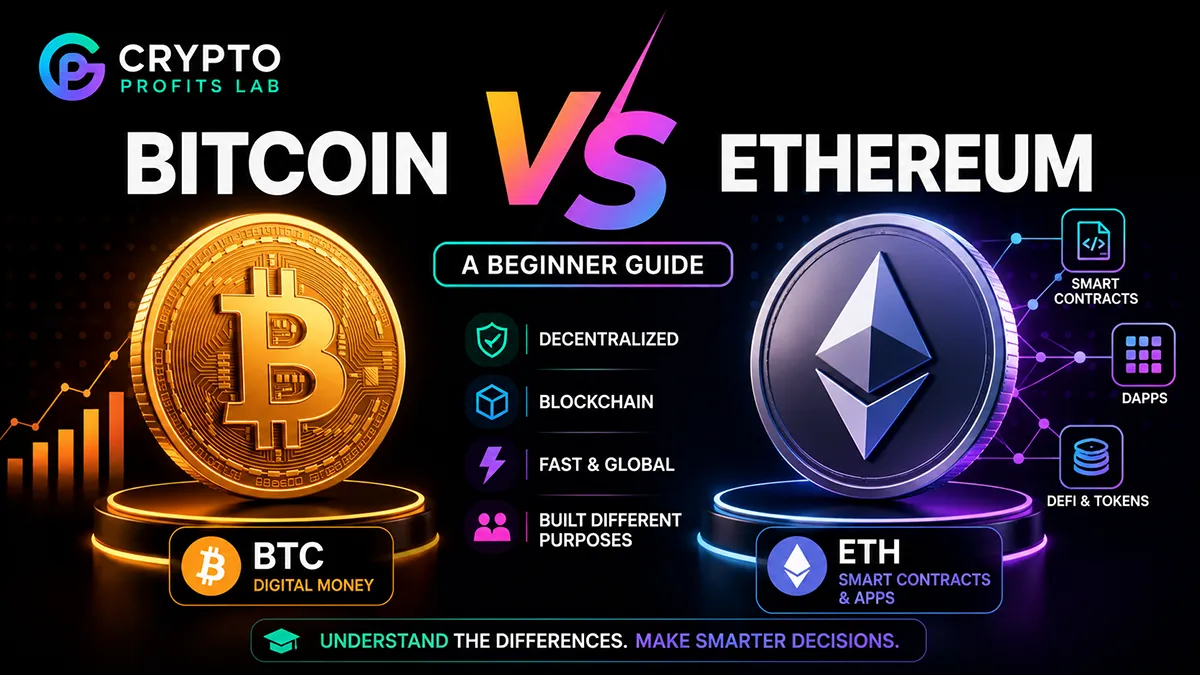
Bitcoin vs Ethereum is one of the first comparisons new crypto investors search for. Both are major cryptocurrencies, both use blockchain technology, and both can move sharply in price. But they were not created for the same purpose.
A beginner may hear Bitcoin referred to as digital money and Ethereum as a platform for apps. That is a simple starting point, but there is more to understand.
Bitcoin was designed to be a decentralized form of money that does not depend on a bank or government payment network. Ethereum was designed to be a programmable blockchain that can run smart contracts, tokens, decentralized apps, and many parts of the crypto ecosystem.
This guide explains Bitcoin vs Ethereum in plain English so you can understand what makes each one different, why both matter, and what beginners should know before investing.
Quick Answer: Bitcoin vs Ethereum
Bitcoin vs Ethereum is really a comparison between two different ideas.
Bitcoin is mainly used as decentralized digital money and a long-term store of value by many investors. It has a fixed maximum supply of 21 million coins, which is one reason people often compare it to digital gold.
Ethereum is a programmable blockchain. Its native cryptocurrency is ether, often called ETH. Ethereum is used to run smart contracts, decentralized finance apps, NFTs, tokens, games, and other blockchain-based tools.
The simple version is this:
Bitcoin is mostly about digital money.
Ethereum is mostly about programmable blockchain applications.
Both can be bought, sold, held, and traded. But their goals, features, and risks are different. Understanding Bitcoin vs Ethereum helps beginners avoid treating every cryptocurrency as if it does the same thing.
Key Takeaways
- Bitcoin and Ethereum are both major crypto networks, but they serve different purposes.
- Bitcoin is often viewed as decentralized digital money or digital gold.
- Ethereum is a programmable blockchain used for smart contracts and decentralized apps.
- BTC is the native coin of Bitcoin, while ETH is the native coin of Ethereum.
- Bitcoin has a fixed maximum supply, while Ethereum’s supply system works differently.
- Ethereum uses gas fees to pay for activity on its network.
- Both assets can be volatile and risky for beginners.
- Learning Bitcoin vs Ethereum is a smart step before comparing smaller altcoins.
Bitcoin vs Ethereum beginner facts table
| Feature | Bitcoin | Ethereum |
|---|---|---|
| Native coin | BTC | ETH |
| Main purpose | Decentralized digital money | Programmable blockchain platform |
| Common nickname | Digital gold | World computer, app platform |
| Supply style | Fixed maximum supply | More flexible supply model |
| Main use | Store value, transfers | Smart contracts, apps, tokens |
| Fees | Bitcoin transaction fees | Ethereum gas fees |
| Best beginner idea | Simple monetary network | Flexible application network |
| Main risk | Price volatility | Price volatility, app and smart contract risk |
What is Bitcoin?
Bitcoin is the first major cryptocurrency. It lets people send value over the internet without needing a bank in the middle.
To understand Bitcoin vs Ethereum, start with Bitcoin’s purpose. Bitcoin is designed to be simple, scarce, and decentralized. Scarce means there will only ever be a limited number of bitcoins. Decentralized means the network is not run by one company.
Bitcoin transactions are recorded on a blockchain. A blockchain is a public digital record that many computers help maintain. You can learn more about blockchain technology.
Bitcoin is often used by investors as a long-term asset. Some people buy it because they believe it may hold value over time. Others use it because it can be transferred globally without a traditional bank.
Beginners can read the full foundation article here: what is Bitcoin.
What is Ethereum?
Ethereum is a blockchain network, but it does more than send and receive money. Ethereum allows developers to build programs that run on the blockchain.
These programs are called smart contracts. A smart contract is code that can automatically follow rules when certain conditions are met. For example, a decentralized exchange can use smart contracts to let people trade crypto without a traditional middleman.
Ethereum’s native cryptocurrency is ETH. ETH is used to pay network fees and interact with apps on Ethereum.
This is one of the biggest Bitcoin vs Ethereum differences. Bitcoin is designed to be a focused money network. Ethereum is designed to be a flexible platform.
Beginners can learn more in what is Ethereum and smart contracts.
Why Bitcoin and Ethereum are both important
Bitcoin and Ethereum are important because they introduced two major concepts in crypto.
Bitcoin showed that digital money could exist without a central bank or payment company controlling the network. It proved that a decentralized blockchain could move value globally.
Ethereum expanded the idea by showing that blockchains could do more than record payments. Ethereum made it possible to build tokens, apps, lending platforms, NFT marketplaces, and decentralized exchanges.
This is why Bitcoin vs Ethereum is not just a price comparison. It is a comparison of two different types of crypto networks.
Bitcoin is more focused.
Ethereum is more flexible.
Both ideas influenced many later crypto projects, including crypto tokens, DeFi, and newer blockchain platforms.
Step-by-step: How to compare Bitcoin vs Ethereum
Here is a simple beginner framework.
Step 1: Compare the purpose
Ask what each network is trying to do.
Bitcoin focuses on money, scarcity, and decentralization. Ethereum focuses on programmable apps and smart contracts.
This first step helps beginners avoid confusion. If someone asks which one is “better,” the better question is usually: better for what?
Step 2: Compare the native coins
Bitcoin uses BTC. Ethereum uses ETH.
BTC is mainly used as the currency of the Bitcoin network. ETH is used to pay for activity on Ethereum, including transactions and smart contract actions.
Both can be investments, but they have different roles.
Step 3: Compare supply
Bitcoin has a fixed maximum supply of 21 million coins. This fixed supply is one reason many investors view it as scarce.
Ethereum does not work the same way. ETH supply is affected by network rules, staking, transaction fee burning, and other design choices.
For complete beginners, the simple point is this: Bitcoin’s supply story is easier to understand, while Ethereum’s supply system is more complex.
Step 4: Compare network activity
Bitcoin activity is mostly about sending, receiving, and holding BTC.
Ethereum activity can include transfers, token swaps, lending, borrowing, NFT activity, stablecoin movement, and smart contract use.
That flexibility is powerful, but it can also make Ethereum harder for beginners to understand at first.
Step 5: Compare fees
Bitcoin transaction fees are paid when users send BTC.
Ethereum fees are called gas fees. Gas is the cost of using the Ethereum network. If the network is busy, gas fees can rise.
Beginners should read crypto gas fees before using Ethereum apps.
Step 6: Compare risks
Bitcoin and Ethereum both have price risk. They can rise fast and fall fast.
Ethereum also has app-level risk because beginners may interact with smart contracts, tokens, bridges, or DeFi platforms. Those tools can add extra layers of risk.
This is why learning Bitcoin vs Ethereum before using advanced apps is a smart move.
Bitcoin vs Ethereum as investments
Many beginners compare Bitcoin vs Ethereum because they are deciding what to buy first.
That is understandable, but investing should not start with hype. It should start with understanding.
Bitcoin may appeal to someone who wants a simpler crypto thesis: scarce digital money with a long market history.
Ethereum may appeal to someone who believes blockchain apps, smart contracts, tokens, and DeFi will continue to grow.
Neither is guaranteed to go up. Both can lose value. Both can be affected by regulation, market cycles, security events, interest rates, and investor sentiment.
If you are brand new, read crypto volatility and bull vs bear market crypto before putting in money.
A beginner-friendly approach is to learn first, start small, and never invest money needed for bills, debt, or emergency savings.
Bitcoin vs Ethereum for everyday users
Bitcoin is easier to understand for many everyday users because its main idea is simple: send, receive, and hold digital money.
Ethereum can do more, but that also means more choices. A beginner using Ethereum may see wallets, tokens, gas fees, smart contracts, decentralized exchanges, stablecoins, and bridges.
More features can be useful, but more features can also create more mistakes.
For example, a beginner may buy an Ethereum token without understanding its risks. Or they may pay high gas fees during busy network periods. Or they may connect a wallet to an unsafe website.
This does not mean Ethereum is bad. It means beginners should move slowly.
If you are learning wallet basics, start with crypto wallet and crypto wallet address.
How Bitcoin and Ethereum use blockchain technology
Both networks use blockchain technology, but in different ways.
Bitcoin’s blockchain records BTC transactions and protects the money system. Its design is intentionally focused. That focus helps Bitcoin stay simple compared with many other crypto networks.
Ethereum’s blockchain records transactions, too, but it also stores and runs smart contract activity. That is what allows Ethereum apps to exist.
The Ethereum smart contracts documentation describes smart contracts as blockchain-based accounts controlled by code rather than by a regular user. That is the technical idea behind many Ethereum apps.
In beginner terms, Bitcoin records value transfers. Ethereum can record value transfers and run programmable rules.
That is one of the clearest differences between Bitcoin vs Ethereum.
Proof of work vs proof of stake
Bitcoin uses proof of work. This means miners use computing power to help secure the network and process transactions.
Ethereum now uses proof of stake. This means validators help secure the network by staking ETH. Staking means locking up crypto to support network operations and earn possible rewards.
You can learn more in what is proof of stake and crypto staking.
For beginners, the main difference is simple:
Bitcoin relies on mining.
Ethereum relies on staking.
This affects how each network is secured, how new coins are issued, and how people participate in the network.
Which is easier for beginners to understand?
Bitcoin is usually easier to understand first.
Its main idea is simple: decentralized digital money with limited supply.
Ethereum takes longer because it has more moving parts. To understand Ethereum well, beginners need to learn about ETH, gas fees, smart contracts, tokens, DeFi, NFTs, and wallet approvals.
That does not mean beginners should ignore Ethereum. It only means Ethereum may require more step-by-step learning.
A good beginner path is:
- Learn what Bitcoin is.
- Learn what Ethereum is.
- Learn how wallets work.
- Learn what gas fees are.
- Learn about smart contracts.
- Learn about DeFi only after understanding the basics.
This path helps beginners build confidence without getting overwhelmed.
Common beginner mistakes
Mistake 1: Thinking all crypto is the same
Bitcoin vs Ethereum shows why this is not true. Bitcoin and Ethereum are both crypto assets, but they are built for different goals.
Beginners should not assume every coin, token, or blockchain has the same purpose.
Mistake 2: Buying only because of price
A lower price per coin does not mean better value. ETH and BTC have different supplies, uses, and market sizes.
Beginners should learn market cap crypto before comparing prices.
Mistake 3: Ignoring fees
Ethereum gas fees can surprise beginners. Bitcoin also has transaction fees, but Ethereum app activity can involve more frequent fees.
Always understand the cost before making a transaction.
Mistake 4: Using advanced apps too early
Ethereum has many apps, but beginners should not rush into DeFi, bridges, or unknown tokens without learning the risks.
Start with education before experimenting.
Mistake 5: Leaving crypto unsecured
Whether you choose BTC, ETH, or both, security matters. Use strong passwords, two-factor authentication, safe wallets, and careful habits.
Start with crypto safety tips and crypto scams to avoid.
Safety and risk section
Bitcoin and Ethereum are well-known, but they are still risky.
Prices can fall quickly. A beginner may buy during excitement and panic during a market drop. That emotional cycle is one of the biggest dangers in crypto.
There are also custody risks. Custody means who controls the crypto. If you keep coins on an exchange, the exchange holds them for you. If you move coins to your own wallet, you are responsible for protecting your private keys and recovery phrase.
Ethereum adds another layer of risk because users may interact with smart contracts. A poorly built or malicious contract can cause losses. Fake tokens, phishing links, and unsafe wallet approvals are common beginner traps.
Use this safety checklist:
- Learn before investing.
- Start with small amounts.
- Avoid unknown links and fake giveaways.
- Use two-factor authentication.
- Double-check wallet addresses.
- Do not share your seed phrase.
- Avoid rushing into DeFi platforms.
- Keep emergency savings separate from crypto.
- Understand that no crypto return is guaranteed.
Bitcoin vs Ethereum is worth learning, but it should not push beginners into rushed decisions.
Should beginners buy Bitcoin, Ethereum, or both?
There is no single right answer for everyone.
Some beginners start with Bitcoin because it is simpler to understand. Others start with Ethereum because they are interested in apps, DeFi, NFTs, or smart contracts. Some hold both because they believe each network plays a different role.
Before deciding, ask yourself:
- Do I understand what I am buying?
- Am I comfortable with price swings?
- Do I know how I will store it?
- Am I buying for a reason or because of hype?
- Can I afford to lose money if the market drops?
If you cannot answer those questions, keep learning first.
Crypto Profits Lab is designed to make that learning process cleaner and easier. The goal is not to tell beginners what to buy. The goal is to explain crypto clearly so readers can make smarter decisions.
Final thoughts
Bitcoin vs Ethereum is one of the most useful crypto comparisons for beginners because it explains two different sides of the crypto world.
Bitcoin represents the idea of decentralized digital money. It is focused, scarce, and widely recognized as the original cryptocurrency.
Ethereum represents the idea of programmable blockchain technology. It powers smart contracts, tokens, DeFi apps, NFTs, and many other crypto tools.
Both are important. Both are risky. Both require education before investing.
For beginners, the best first step is not choosing a winner. The best first step is understanding the difference.
Once you understand Bitcoin vs Ethereum, the rest of crypto becomes easier to organize. You can better understand altcoins, tokens, wallets, exchanges, staking, gas fees, and DeFi with a stronger foundation.
Start simple. Learn the basics. Avoid hype. Protect your crypto. Make decisions slowly.
That is the Crypto Profits Lab approach: clear crypto education for beginners who want simple explanations without confusion.
FAQs About Bitcoin vs Ethereum
What is the main difference between Bitcoin and Ethereum?
The main difference is purpose. Bitcoin is primarily designed to be a decentralized digital currency and a store of value. Ethereum is a programmable blockchain that can run smart contracts and decentralized apps. Both use blockchain technology, but Ethereum supports more complex applications while Bitcoin stays more focused on money and value transfer.
Is Bitcoin better than Ethereum for beginners?
Bitcoin may be easier for beginners to understand because its purpose is simpler. It is mainly digital money with a fixed maximum supply. Ethereum can be more complicated because it includes smart contracts, gas fees, tokens, and decentralized apps. Neither is automatically better. The better starting point depends on what the beginner wants to learn.
Is Ethereum riskier than Bitcoin?
Ethereum can have extra risks because users may interact with smart contracts, tokens, and decentralized apps. Bitcoin also carries significant price risk, but its core use case is simpler. Both can lose value quickly. Beginners should understand volatility, custody, scams, and wallet safety before investing in either asset.
Can Bitcoin and Ethereum both be good investments?
They can both be part of a crypto portfolio, but neither is guaranteed to perform well. Bitcoin and Ethereum have different goals and different risk profiles. Beginners should avoid buying only because of hype. A careful investor should understand each asset, choose a position size responsibly, and never invest money needed for short-term expenses.
Does Ethereum have a fixed supply like Bitcoin?
No. Bitcoin has a fixed maximum supply of 21 million coins. Ethereum’s supply system is different and more complex. ETH supply can be affected by staking rewards, network activity, and fee-burning rules. Beginners should understand that Bitcoin has a simpler scarcity story, while Ethereum’s economics are more flexible.
Why does Ethereum have gas fees?
Ethereum uses gas fees to pay for transactions and smart contract activity on the network. Gas helps compensate validators and prevents unlimited free use of the blockchain. Fees can rise when the network is busy. Beginners should check estimated gas fees before using Ethereum apps or sending transactions.
Should I learn Bitcoin before Ethereum?
For most beginners, learning Bitcoin first is helpful because it introduces blockchain, wallets, scarcity, and decentralization in a simpler way. After that, Ethereum is easier to understand because you can build on those basics and then learn smart contracts, gas fees, tokens, and decentralized apps.
Can I store Bitcoin and Ethereum in the same wallet?
Many crypto wallets support both Bitcoin and Ethereum, but not all wallets work the same way. Beginners should confirm that a wallet supports the asset they want to store before sending funds. Always double-check wallet addresses, use trusted wallet software, and protect your recovery phrase carefully.