What Is Blockchain Finality? A Beginner’s Guide
When you send cryptocurrency, the transaction may appear in your wallet within seconds. However, seeing a transaction on the screen does not always mean it is permanent. The network may still need time to confirm the transaction and make it extremely difficult—or practically impossible—to reverse.
That point is known as blockchain finality.
Understanding blockchain finality helps beginners know when a payment is truly settled, why exchanges sometimes require several confirmations, and how different networks protect their transaction history. It also explains why a transaction can be visible before a recipient is ready to treat it as complete.
This guide breaks the process into simple steps. You will learn what finality means, how proof-of-work and proof-of-stake networks approach it, why temporary forks can happen, and how to check a transaction safely.
Quick Answer
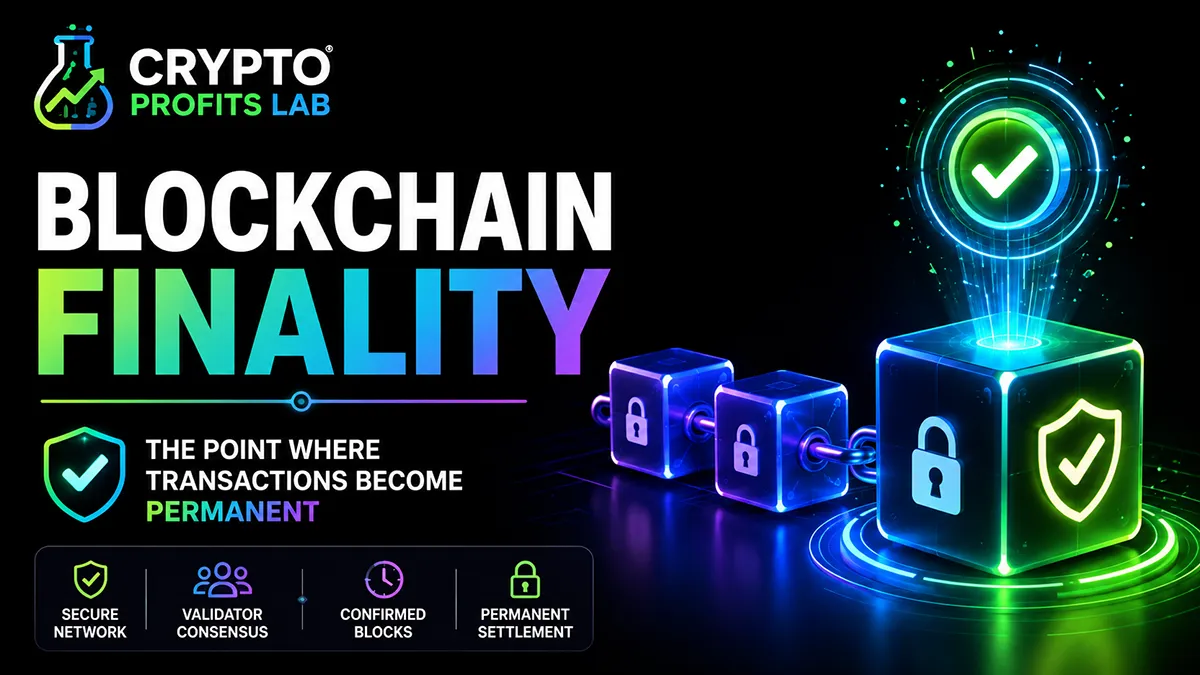
Blockchain finality is the point at which a transaction or block is considered permanent and should no longer be reversed by the network.
Some blockchains reach finality gradually. Each additional block makes an older transaction harder to undo. Other networks use validator votes or protocol checkpoints to mark blocks as finalized after specific conditions are met.
Finality does not always happen the moment you press Send. A transaction usually moves through several stages: broadcast, pending, included in a block, confirmed, and finally settled according to that blockchain’s rules.
Key Takeaways
- Blockchain finality describes when a block or transaction becomes effectively permanent.
- A transaction can appear in a wallet before it has reached final settlement.
- Proof-of-work networks often rely on increasing confirmation depth.
- Proof-of-stake networks may use validator votes and checkpoints.
- Finality rules differ between blockchains, exchanges, wallets, and payment services.
- More confirmations usually mean lower reversal risk, but the exact number needed depends on the network and transaction value.
- Beginners should verify the network, address, memo or tag, transaction status, and required confirmations before assuming a transfer is complete.
Blockchain Finality Beginner Facts
| Question | Beginner-Friendly Answer |
|---|---|
| What becomes final? | Usually a block and the valid transactions included inside it. |
| Is a pending transaction final? | No. It has not yet been permanently added to the accepted blockchain history. |
| Is one confirmation always enough? | No. The answer depends on the blockchain, the recipient, and the value being transferred. |
| Can a confirmed transaction change? | It may be possible during a temporary chain reorganization, especially when confirmation depth is low. |
| Who decides finality? | The blockchain protocol, participating nodes, miners or validators, and the receiving service’s risk policy all play a role. |
| Does finality mean a refund is impossible? | The blockchain transfer may be irreversible, but the recipient can still voluntarily send a new refund transaction. |
| Can finality take different amounts of time? | Yes. Networks use different block times, consensus rules, checkpoints, and security assumptions. |
What Does Finality Mean in Crypto?
A blockchain is a shared record maintained by many computers. Those computers must agree on which transactions are valid and which version of the transaction history should be accepted.
If you are new to the subject, start with blockchain technology and the guide explaining a crypto network. These guides explain how blocks, nodes, and network rules work together.
Blockchain finality answers a practical question:
“When can everyone safely treat this transaction as part of the permanent record?”
Before that point, a transaction may be pending, recently confirmed, or included in a block that could still be replaced during a rare network reorganization. After finality, reversing the accepted history should require an extraordinary event, a major protocol failure, or an economically unrealistic attack.
Finality is therefore about confidence in settlement. It is not simply about how quickly a wallet displays a transaction.
Why Blockchain Finality Matters
Blockchain finality matters because cryptocurrency transfers generally do not include a built-in chargeback process.
With a credit card, a payment may be disputed through a bank or payment network. With crypto, the blockchain normally follows its protocol rules without deciding whether a sender made a personal mistake.
Once a transaction reaches final settlement:
- The recipient can have greater confidence that the funds will remain received.
- An exchange may allow deposited crypto to be traded or withdrawn.
- A merchant may release a product or service.
- A lending or decentralized finance application may recognize a completed action.
- Wallet balances and blockchain applications can rely on the updated state.
This is why a large exchange may wait longer than a personal wallet before crediting a deposit. The exchange is managing risk for many customers and may require a deeper level of confirmation.
The concept also helps explain why “fast” and “final” are not always the same thing. A network may show a transaction quickly while still needing more time to provide stronger settlement confidence.
How a Crypto Transaction Reaches Finality Step by Step
The exact process varies by blockchain, but the following stages provide a useful beginner model.
Step 1: You Create and Sign the Transaction
You enter the recipient’s wallet address, choose an amount, review the network fee, and approve the transfer.
Your wallet uses your private key to create a digital signature. The signature proves that the transaction was authorized by the person controlling the wallet. Your private key should never be shared or entered into an unfamiliar website.
For a broader explanation, read what a crypto transaction is before sending funds.
Step 2: The Wallet Broadcasts the Transaction
Your wallet sends the signed transaction to the blockchain network.
At this stage, the transaction may appear as pending. Network participants can see it, but it has not yet been permanently added to the accepted chain.
On some networks, pending transactions wait in a crypto mempool. A mempool is a temporary waiting area for valid transactions that have not yet been included in a block.
Step 3: The Network Checks the Transaction
Nodes check whether the transaction follows the network’s rules.
They may verify that:
- The digital signature is valid.
- The sender has enough available funds.
- The same funds have not already been spent.
- The transaction uses the correct format.
- The fee and other required details are acceptable.
Invalid transactions are rejected. Valid transactions can move forward for possible inclusion in a block.
Step 4: A Miner or Validator Adds It to a Block
Depending on the consensus system, a miner or validator helps create the next block.
A crypto block is a group of transaction data linked to earlier blocks. Once the transaction is included, it normally receives its first confirmation.
The network’s crypto consensus mechanism determines how participants agree that this block should become part of the accepted chain.
Step 5: Additional Blocks or Votes Increase Confidence
A newly added block may not instantly have the strongest possible settlement guarantee.
On a proof-of-work network, later blocks may be built on top of it. Each additional block makes rewriting the earlier history more difficult.
On a proof-of-stake network, validators may vote, attest, or approve checkpoints according to the protocol’s rules.
This is where blockchain finality begins to differ significantly from one network to another.
Step 6: The Transaction Meets the Finality Standard
The transaction reaches the level of settlement recognized by the blockchain or receiving service.
A wallet may label the transaction confirmed. An exchange may wait for a certain number of confirmations. A proof-of-stake explorer may show a block as finalized.
The important point is that the service receiving the funds may use a stricter standard than the sender’s wallet. Always check the receiving platform’s deposit requirements.
Confirmations vs. Blockchain Finality
Confirmations and blockchain finality are related, but they are not identical.
A confirmation usually means a transaction has been included in a block. Additional confirmations accumulate as more blocks are added after it.
Finality refers to the level of confidence that the accepted transaction history will not be reversed.
On some networks, confirmation depth is the main way users judge finality. On others, a protocol can explicitly mark a checkpoint or block as finalized after enough validators vote for it.
You can learn more in the beginner guide to crypto confirmations.
A simple comparison looks like this:
| Term | What It Usually Means |
|---|---|
| Pending | Broadcast to the network but not yet included in an accepted block |
| First confirmation | Included in a block |
| Multiple confirmations | More blocks have been added after the transaction |
| Finalized | The network’s finality condition has been reached |
| Credited by an exchange | The receiving platform’s separate deposit policy has been satisfied |
A wallet’s status label may simplify these stages. When the transfer matters, use a blockchain explorer and the recipient’s official deposit instructions instead of relying on one label alone.
Probabilistic Finality
Probabilistic finality means a transaction becomes increasingly difficult and unlikely to reverse as more blocks are added after it.
This approach is commonly associated with proof-of-work blockchains. There may not be one exact moment when reversal becomes mathematically impossible. Instead, confidence rises with confirmation depth.
Imagine stacking heavy boxes on top of a document. Removing the document becomes harder each time another box is added. In a similar way, replacing an older block becomes increasingly difficult as honest miners continue building on the accepted chain.
Bitcoin is the best-known example of this general approach. The appropriate number of confirmations depends on the payment size, the recipient’s risk tolerance, and current network conditions.
Probabilistic does not mean unreliable. It means the security guarantee grows over time instead of switching from “not final” to “final” at one sharply defined point.
Proof-of-Work Finality
In proof of work, miners use computing power to compete for the right to add blocks.
Sometimes, two valid blocks can be produced at nearly the same time. Different parts of the network may temporarily see different chain tips. The protocol eventually selects the chain with the most accumulated work, and the other branch is no longer treated as the main history.
This change is called a chain reorganization, often shortened to reorg.
A transaction in the replaced branch may return to the mempool, appear in a later block, or become invalid if conflicting funds were spent elsewhere. This is one reason recipients wait for more than one confirmation before treating a valuable payment as settled.
Blockchain finality on a proof-of-work chain is therefore closely connected to:
- The amount of computing power securing the network
- The number of confirmations
- The value of the transaction
- The risk of a competing chain
- The recipient’s settlement policy
A high-value transfer may require more waiting than a small everyday payment.
Proof-of-Stake Finality
In proof of stake, validators lock cryptocurrency as stake and participate in block creation and approval.
Instead of depending mainly on accumulated computing work, many proof-of-stake systems use validator votes, attestations, or checkpoints. When enough stake supports the required checkpoints, the protocol can treat earlier blocks as finalized.
A crypto validator has an incentive to follow the rules because dishonest or conflicting behavior may lead to penalties. Some networks use crypto slashing to remove part of a validator’s stake after certain serious violations.
Ethereum is a useful example. According to Ethereum’s proof-of-stake documentation, validators vote on checkpoint blocks, and a supermajority of staked ETH is required for finalization. Reversing a finalized block would require a severe consensus failure and major economic loss.
Blockchain finality in proof-of-stake is often described as economic finality because the protocol makes dishonest reversal extremely costly.
However, not every proof-of-stake blockchain uses the same design. Never assume that Ethereum’s timing, voting thresholds, or terminology apply to every network.
What Is a Blockchain Reorganization?
A blockchain reorganization happens when the network replaces a short section of its recent history with another valid chain.
Temporary reorganizations can occur without an attack. For example, network delays may cause participants to receive competing blocks in a different order. The consensus rules help nodes decide which chain to follow.
A reorg can affect recently confirmed transactions. Older transactions with greater confirmation depth are normally much less likely to be removed.
A reorganization is related to, but different from, a permanent crypto fork. A temporary reorg resolves back to one accepted chain. A lasting fork may create separate networks with different rules or communities.
Blockchain finality reduces uncertainty by defining when a recent block should no longer be replaced under normal conditions.
Can a Final Crypto Transaction Ever Be Reversed?
A finalized blockchain transaction is not reversed in the same way as a bank chargeback.
However, several situations can create confusion:
- The recipient can voluntarily send a separate refund.
- A centralized exchange can adjust its internal account records.
- A token issuer may have smart-contract controls that freeze or move certain assets.
- A blockchain can experience an emergency, software defect, governance decision, or consensus failure.
- A transaction shown by a wallet may not have actually reached the network’s finality threshold.
These possibilities do not mean ordinary finalized transactions are easily reversible. They show why users must separate blockchain settlement from the policies of wallets, exchanges, token issuers, and applications.
Blockchain finality is strongest when the underlying network is secure, decentralized enough for its design, widely monitored, and operating normally.
How to Check Whether a Transaction Is Final
Use these steps when verifying a transfer.
1. Copy the Transaction Hash
A transaction hash is a unique identifier for a blockchain transaction. Your wallet or exchange withdrawal page should display it after the transfer is broadcast.
The guide to a crypto transaction hash explains where to find it and how to use it.
2. Open the Correct Blockchain Explorer
Use an explorer made for the network you selected.
A transaction sent on Ethereum must be checked on an Ethereum-compatible explorer. XRP, Bitcoin, Solana, and other networks have their own explorers.
Never enter your seed phrase or private key into an explorer. You only need public information such as the transaction hash or wallet address.
Learn how explorers work in the blockchain explorer guide.
3. Review the Status
Look for terms such as:
- Pending
- Confirmed
- Successful
- Failed
- Validated
- Finalized
The exact wording varies. “Successful” may mean the transaction executed correctly, while “finalized” may refer to a stronger consensus status.
4. Check the Confirmation Count or Finality Indicator
For networks that emphasize confirmation depth, review how many confirmations have accumulated.
For networks with explicit finality, look for a finalized status or finalized checkpoint. The explorer may display both block confirmation information and a separate finality indicator.
5. Confirm the Recipient’s Requirements
An exchange can receive a valid transaction but wait before adding the funds to your account.
Check:
- The minimum deposit amount
- Required confirmations
- Correct network
- Correct asset
- Required destination tag or memo
- Whether deposits are temporarily paused
Blockchain finality and exchange crediting are separate steps.
Common Beginner Mistakes
Assuming “Sent” Means Final
A wallet may show Sent as soon as it broadcasts the transaction. That status does not necessarily mean the transaction is confirmed or finalized.
Open the transaction details and check the network status.
Confusing Speed With Security
A network can display a transaction quickly without providing immediate final settlement.
Fast wallet updates are helpful, but blockchain finality depends on the protocol’s consensus process.
Using the Wrong Network
Sending an asset through an unsupported network can prevent the receiving platform from crediting it, even when the blockchain transaction itself is final.
Always match the deposit network exactly.
Ignoring a Memo or Destination Tag
Some exchanges use one shared deposit address for many customers and rely on a memo or tag to identify the correct account.
A missing memo can require support assistance. Read the crypto memo tag guide before sending XRP, XLM, or another asset when a platform requests one.
Trusting a Screenshot
A screenshot can be altered and does not prove that a transaction is final.
Verify the transaction hash on the correct explorer.
Sending the Full Amount First
For a new wallet, address, network, or exchange, send a small test transaction first.
Wait until it is received and satisfies the recipient’s requirements before sending the remaining amount.
Assuming Every Blockchain Uses the Same Rules
Block times, confirmation recommendations, validator systems, and finality standards differ.
Use documentation for the specific network and receiving service.
Blockchain Finality Safety and Risk Tips
Finality protects the blockchain’s accepted history, but it does not protect you from every user mistake or scam.
Follow these safety habits:
- Verify the first and last several characters of the destination address.
- Confirm the asset and network before approving the transaction.
- Include a memo or destination tag when the recipient requires one.
- Start with a small test transfer.
- Use the official blockchain explorer.
- Never share your seed phrase or private key.
- Be suspicious of anyone asking you to “validate,” “synchronize,” or “unlock” a wallet by entering recovery words.
- Wait for the recipient’s required confirmation level before assuming the transfer is complete.
- Save the transaction hash when moving a meaningful amount.
- Read the beginner crypto safety tips before using a new platform.
A scammer may use urgency to push you into sending before checking the details. Blockchain finality makes secure settlement possible, but it also means a mistaken payment may be very difficult to recover.
Final Thoughts
Blockchain finality is the process that turns a recent crypto transaction into dependable settlement.
Proof-of-work networks often build confidence through additional blocks and confirmations. Proof-of-stake networks may use validator votes, economic penalties, and checkpoints. Other systems may provide an explicit final state through different consensus rules.
You do not need to understand every mathematical detail to use crypto more safely. Remember the practical steps: check the network, verify the address, include any required memo, send a test amount, save the transaction hash, and wait for the recipient’s required finality level.
Crypto Profits Lab focuses on explaining topics like blockchain finality in a cleaner, simpler way so beginners can understand what is happening before placing funds at risk.
Blockchain Finality Frequently Asked Questions
What is blockchain finality in simple terms?
Blockchain finality is the point when a crypto transaction is considered permanently recorded in the accepted blockchain history. Before finality, a recent block may still face a small chance of being replaced during a network reorganization. Different blockchains reach this point in different ways, including added confirmations, validator voting, checkpoints, or other consensus rules.
How long does blockchain finality take?
The time needed for blockchain finality depends on the network. Some systems provide a strong finality signal within seconds, while others build confidence over several minutes or longer through additional confirmations. The receiving wallet, exchange, or merchant may also require extra waiting. Always check the specific blockchain and recipient rather than assuming one timing rule applies everywhere.
Is a confirmed transaction the same as a finalized transaction?
Not always. A confirmed transaction has usually been included in a block. A finalized transaction has reached the network’s stronger settlement condition and should no longer be replaced during normal operation. On some blockchains, several confirmations are used as a practical measure of finality. On others, validators explicitly vote to finalize checkpoints or blocks.
Why do crypto exchanges require multiple confirmations?
Exchanges require confirmations to reduce the risk that a recent deposit could disappear during a short blockchain reorganization or conflict with another transaction. The number required can depend on the asset, network security, deposit value, and the exchange’s internal risk policy. A transaction can be valid on the blockchain before the exchange credits it to your account.
Can blockchain finality prevent crypto scams?
Blockchain finality secures transaction history, but it does not determine whether a recipient is honest. A scam payment can become final just like a legitimate payment. Users must verify addresses, websites, wallet connections, token approvals, and transaction details before signing. Once a scam transfer is finalized, the blockchain generally cannot provide a chargeback.
What is probabilistic finality?
Probabilistic finality means a transaction becomes less likely to be reversed as more blocks are added after it. Proof-of-work networks commonly use this model. There may not be one exact moment when reversal becomes impossible, but the probability can become extremely small as confirmation depth grows and honest miners continue extending the accepted chain.
What is economic finality?
Economic finality means reversing a finalized block would require participants to sacrifice or lose a very large amount of staked value. Proof-of-stake networks can use validator votes and penalties to create this protection. The exact rules vary, but the basic idea is to make dishonest behavior financially destructive enough that finalized history is highly dependable.
How can I tell whether my crypto transaction is final?
Copy the transaction hash and open the official explorer for the correct blockchain. Review the transaction result, block number, confirmations, and any finalized status shown. Then check the receiving exchange or wallet’s requirements. Never enter a seed phrase or private key into a blockchain explorer; public transaction information is enough to verify the transfer.