Spot Trading in Crypto: A Beginner’s Guide
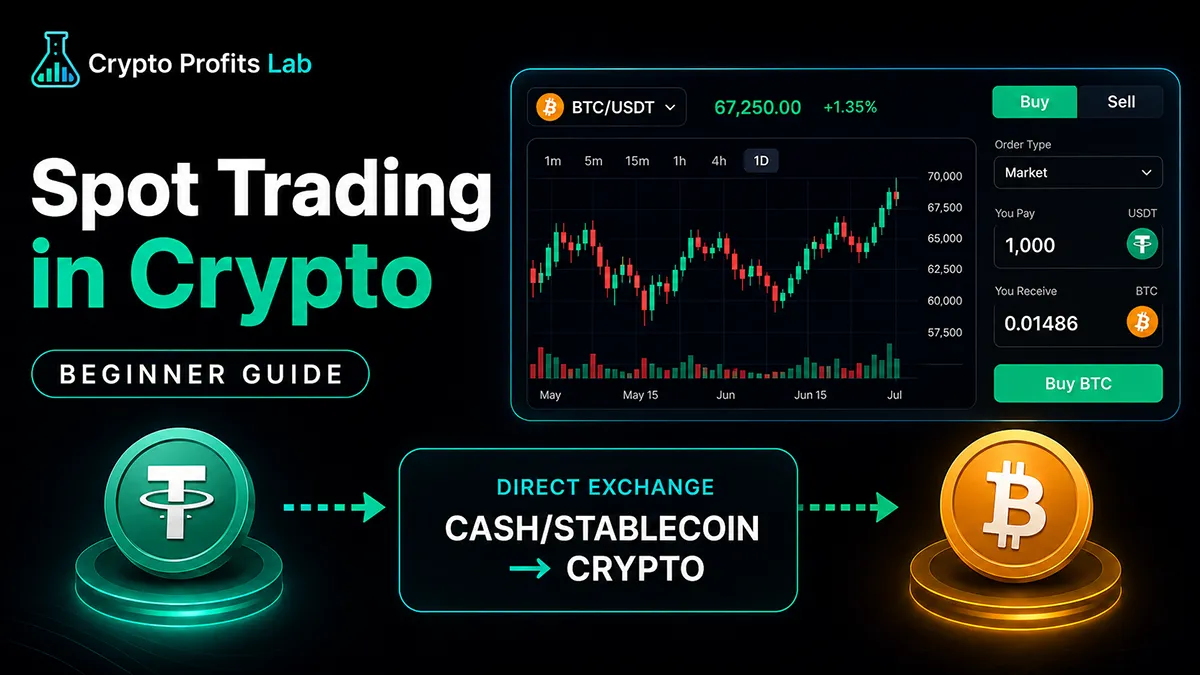
If you are new to cryptocurrency, one of the first trading terms you may see is spot trading in crypto. It sounds technical, but the basic idea is simple: you buy or sell a cryptocurrency at the current market price, and the asset becomes yours once the trade is completed.
That does not make spot trading risk-free. Crypto prices can move quickly, exchanges can charge several types of fees, and a rushed order can fill at a worse price than expected. The goal of this guide is to explain spot trading in crypto in plain English so you understand what happens before, during, and after a trade.
Quick Answer: What Is Spot Trading in Crypto?
Spot trading in crypto means buying or selling cryptocurrency for delivery at or near the current market price. When you buy Bitcoin, XRP, Ethereum, or another asset on a spot market, you are purchasing the actual crypto rather than a futures contract or other derivative.
You can usually keep the purchased crypto on the exchange or transfer it to a compatible wallet. Your profit or loss depends mainly on how the asset’s price changes after you buy it, along with trading fees, spreads, and any withdrawal costs.
For beginners, the important point is simple: spot trading generally does not require leverage. You pay for the asset you buy with funds you already have in your account.
Key Takeaways
- Spot trading in crypto involves buying and selling the actual cryptocurrency rather than trading a derivative contract.
- A spot trade usually takes place through a crypto exchange using a trading pair such as BTC/USD or XRP/USDT.
- Market orders focus on getting the trade filled quickly, while limit orders let you choose the price you are willing to accept.
- The final price you receive can be affected by the spread, liquidity, order book depth, and market volatility.
- Spot trading does not remove the risk of losing money. A cryptocurrency can fall sharply after you buy it.
- Beginners should understand fees, verify the asset and trading pair, use strong account security, and avoid making trades because of FOMO.
Spot Trading in Crypto: Beginner Facts
| Beginner Question | Simple Answer |
|---|---|
| What do you buy? | The actual cryptocurrency |
| Do you own the asset? | Generally, yes, after the order is filled |
| Is leverage required? | No |
| What is the spot price? | The current market price of the asset |
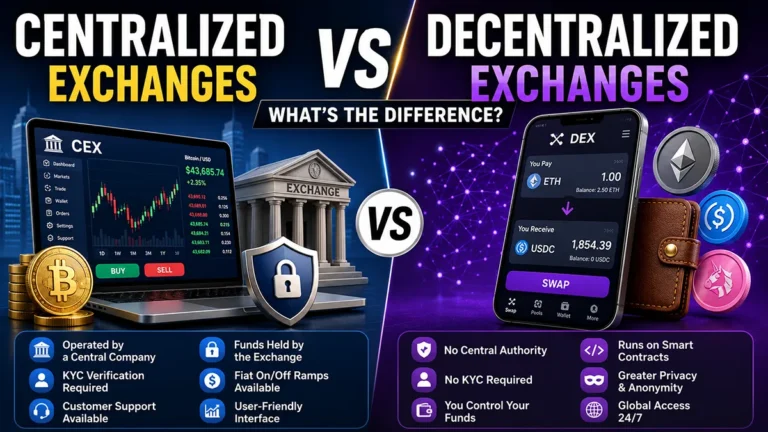
| Where does trading happen? | On centralized exchanges, decentralized exchanges, and other spot marketplaces |
| What is a trading pair? | Two assets that can be exchanged, such as BTC/USD |
| Can you lose money? | Yes. The crypto price can fall after you buy |
| Can you transfer the crypto? | Usually yes, if withdrawals are supported for that asset and network |
| Are there fees? | Usually yes, including possible trading, spread, and withdrawal costs |
| Is spot trading beginner-friendly? | It is generally simpler than leveraged derivatives, but it still requires care |
What Is Spot Trading in Crypto?
The word “spot” refers to buying or selling an asset based on its current market price rather than agreeing today to a transaction that will be settled through a future contract.
Imagine that Bitcoin is trading around $70,000. You place an order to buy $100 worth of Bitcoin on the spot market. If your order fills, your account receives the amount of Bitcoin purchased with that $100, minus any applicable fees.
You now own that Bitcoin through your exchange account unless you move it elsewhere.
The same basic idea applies when you sell. If you already own Bitcoin and exchange it for U.S. dollars or a stablecoin, you are selling the asset on the spot market.
Spot trading in crypto is therefore closer to a direct purchase or sale than to betting on a future contract price.
How Spot Markets Use Trading Pairs
Crypto exchanges organize markets into pairs. A crypto trading pair shows which two assets can be exchanged with each other.
For example:
- BTC/USD means Bitcoin is traded against the U.S. dollar.
- ETH/USDT means Ethereum is being traded against the USDT stablecoin.
- XRP/BTC means XRP is being traded against Bitcoin.
The first asset is commonly called the base asset. The second is commonly referred to as the quote asset.
If BTC/USD is priced at $70,000, that means one Bitcoin is valued at $70,000 in that market.
Understanding pairs is a fundamental part of spot trading in crypto, as every trade is an exchange of one asset for another.
How Does Spot Trading in Crypto Work?
The exact screen differs from one exchange to another, but the process usually follows the same general path.
Step 1: Choose a Reputable Crypto Exchange
The first step is to choose a platform that offers the cryptocurrency and spot market you want to use.
Before depositing money, check whether the exchange is available in your location, which assets it supports, what withdrawal options it offers, how its fees work, and what security tools are available.
Beginners can review our guide to choosing the best crypto exchange for beginners for the factors worth comparing.
Step 2: Fund Your Account
Next, add funds to the account. Depending on the platform, this might mean depositing U.S. dollars, transferring a stablecoin, or sending another cryptocurrency to the exchange.
If you are transferring crypto from a wallet or another exchange, make sure you are using the correct blockchain network and address. A network mismatch can cause serious problems and may result in the loss of funds.
Our how to transfer crypto guide explains the transfer process in more detail.
Step 3: Select the Correct Spot Trading Pair
Once your account is funded, choose the spot market you want to trade.
For example, if you deposit U.S. dollars and want to buy Bitcoin, you might select BTC/USD. If you deposited USDT, you might use BTC/USDT instead.
This is one of the simplest steps in spot trading in crypto, but it is also a common place for beginners to make mistakes. Exchanges can list many similar-looking pairs, so verify both assets before submitting an order.
Step 4: Review the Current Market
Before you buy or sell, look at the current price and basic market information.
A trading screen may show:
- The latest traded price
- Recent trades
- A price chart
- The bid price
- The asking price
- Trading volume
- The order book
- Your available balance
You do not need to understand every number on the screen before making a simple purchase. Focus first on the asset, pair, price, order type, amount, and fees.
Step 5: Choose a Market Order or Limit Order
Two of the most common order types are market orders and limit orders.
A market order tells the exchange to buy or sell as soon as possible at the best available prices. It prioritizes execution, not a guaranteed final price.
A limit order lets you set the highest price you are willing to pay when buying or the lowest price you are willing to accept when selling. The trade only fills if the market reaches your limit price and there is sufficient matching liquidity.
Our guide to market order vs limit order in crypto explains these order types in more detail.
For spot trading in crypto, beginners should understand the difference before clicking Buy or Sell.
Step 6: Review the Order Before Submitting It
Before confirming the trade, check:
- The cryptocurrency you are buying or selling
- The trading pair
- The order type
- The amount
- The estimated price
- The estimated fee
- The total amount you will spend or receive
This final review takes only a few seconds and can prevent expensive mistakes.
Step 7: Decide Where to Keep the Crypto
After the purchase is complete, the crypto will generally appear in your exchange balance.
You can leave it there or, where supported, withdraw it to a personal crypto wallet.
The right choice depends on your goals, experience, security practices, and how often you plan to trade. Keeping crypto on an exchange can be convenient, but it also means relying on that platform to safeguard and provide access to the assets.
If you withdraw, verify the wallet address and network carefully before sending.
That seven-step process covers the basic mechanics of spot trading in crypto.
What Happens Behind the Scenes When You Place a Spot Trade?
When you press Buy or Sell, the exchange attempts to match your order with an order from another market participant.
That matching process is organized through the crypto order book.
Buy orders are commonly called bids. Sell orders are commonly called asks. The highest available bid and lowest available ask help define the market’s current buying and selling prices.
If you place a market buy order, it can fill against one or more sell orders already waiting in the order book.
If your order exceeds the amount available at the best price, part of the order may be filled at higher prices. This is one reason your average execution price can differ from the price you saw just before submitting the order.
Why Liquidity Matters
Crypto liquidity describes how easily an asset can be bought or sold without causing a large price change.
A highly liquid market usually has many active buyers and sellers. That often makes it easier to complete a trade near the current quoted price.
A thin or illiquid market may have fewer orders available. A larger order can move through several price levels, creating a worse average execution price.
Liquidity is especially important when spot trading in crypto with smaller or less frequently traded tokens. A token can show a price on the screen but still be difficult to buy or sell in meaningful size at that exact price.
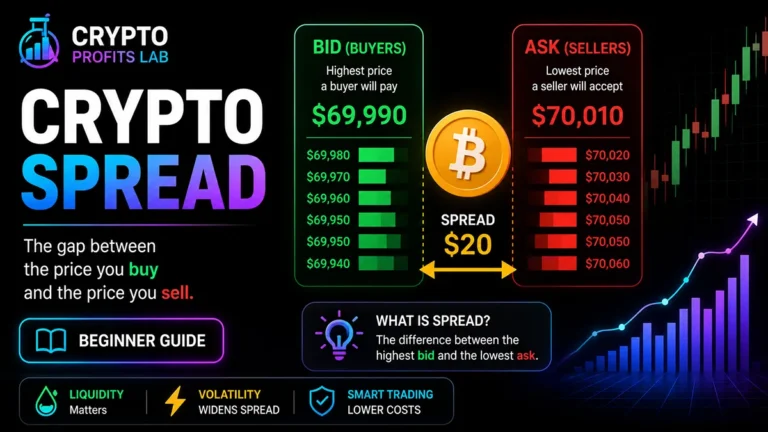
What Is the Spread?
The crypto spread is the difference between the highest price a buyer is currently willing to pay and the lowest price a seller is currently willing to accept.
Suppose the highest bid for a coin is $9.95, and the lowest ask is $10.05.
The spread is $0.10.
A narrower spread generally means buyers and sellers are closer together. A wider spread means there is a larger gap between them.
For beginners, the spread matters because it can act like an indirect trading cost. Even before considering an exchange fee, buying at the ask and immediately selling at the bid could result in a loss.
Spot Trading Fees Can Affect Your Results
Most exchanges charge trading fees, although the exact pricing model varies by platform.
Some use maker and taker fees. Some offer lower rates at higher trading volumes. Some may include costs in the displayed spread. Withdrawal fees can also apply when you move crypto off the platform.
Our guide to crypto trading fees for beginners explains these costs more fully.
Fees may seem small as a percentage, but frequent trading can make them add up quickly. Before starting spot trading in crypto, understand both the trade fee and any costs you may face later when withdrawing or converting the asset.
Spot Trading vs. Buying and Holding
Spot trading and long-term investing can use the same spot market.
The difference mainly lies in what you plan to do after buying.
A trader might buy Bitcoin because they expect the price to rise over the next several days or weeks. A long-term investor might buy the same Bitcoin and plan to hold it for years.
The purchase itself can still be a spot trade in both cases.
Likewise, dollar-cost averaging in crypto often uses repeated spot purchases on a schedule rather than trying to time one perfect entry.
This is why spot trading in crypto is not automatically the same thing as day trading. “Spot” describes the type of market transaction, not how long you must hold the asset.
Spot Trading vs. Futures and Margin Trading
The biggest distinction for beginners is ownership and leverage.
With a basic spot trade, you use money or crypto you already have to buy another crypto asset. After the trade is complete, you hold the purchased asset.
Futures are derivatives. Instead of directly buying the underlying cryptocurrency, you trade a contract whose value is connected to it.
Margin trading involves borrowing funds to increase the size of a position. This introduces leverage, which can magnify both gains and losses.
Spot trading in crypto generally avoids the forced-liquidation mechanics associated with leveraged positions because an unleveraged spot purchase is paid for in full.
However, the asset itself can still lose most or all of its value. Simpler does not mean safe or guaranteed.
Benefits of Spot Trading for Beginners
You Buy the Actual Asset
After a normal spot purchase, you hold the cryptocurrency itself rather than only a contract tied to its price.
No Leverage Is Required
You can trade using only the funds already in your account. This avoids borrowing and the additional risks associated with leveraged positions.
You Can Transfer the Asset
If the exchange supports withdrawals and the blockchain is available, you can usually transfer purchased crypto to your own wallet.
These features help explain why beginners often encounter spot markets before more complicated crypto trading products.
Risks of Spot Trading in Crypto
The biggest risk is price loss.
If you buy a cryptocurrency for $1,000 and its market value falls 40%, your holding is worth about $600 before considering fees.
Crypto can be highly volatile, meaning prices can change sharply in a short period. Our guide to crypto volatility explains why this matters.
Other risks include:
- Exchange failure or withdrawal restrictions
- Hacking and phishing
- Buying the wrong asset
- Sending crypto to the wrong address or network
- Low liquidity
- Wide spreads
- Sudden market moves
- Scam tokens
- Emotional trading
- Regulatory or platform changes
The U.S. Commodity Futures Trading Commission also warns that virtual currency spot markets can involve volatility, cyber risks, platform risks, manipulation, and fraud. Beginners should read the CFTC’s virtual currency trading risk advisory before treating any crypto purchase as low risk.
Common Beginner Mistakes to Avoid
1. Confusing the Spot Price With a Guaranteed Execution Price
The price on the screen can change before your order fills. A market order may also fill across multiple prices.
2. Ignoring the Trading Pair
A coin can trade against several different assets. Always confirm what you are spending and what you are receiving.
3. Using a Market Order in a Thin Market
Low liquidity can cause slippage, especially when an order is large compared with the available order book.
4. Forgetting About Fees and Spreads
A trade can move in the right direction and still produce a disappointing result if costs are high.
5. Buying Because Everyone Else Seems Excited
Crypto FOMO can push beginners into buying after a sharp price increase without understanding the asset or planning an exit.
6. Trading Too Frequently
More trades create more opportunities for mistakes, fees, poor decisions, and complexity in tax recordkeeping.
7. Leaving Account Security Weak
Use a strong, unique password and enable crypto two-factor authentication when available.
Avoiding these mistakes can make spot trading in crypto easier to manage, but it cannot remove market risk.
Safety Checklist Before You Place a Spot Trade
Before confirming an order, ask yourself:
- Do I understand what this cryptocurrency is?
- Am I on the real exchange website or app?
- Is my account protected with strong security?
- Did I select the correct trading pair?
- Do I understand whether I am using a market or limit order?
- Did I check the amount and estimated fee?
- Is the market liquid enough for my order size?
- Can I afford for this investment to lose substantial value?
- Do I know where I will store the asset afterward?
- If withdrawing, did I verify the wallet address and network?
A good beginner habit is to slow down before every irreversible action. Crypto markets move quickly, but rushing is rarely required.
Is Spot Trading in Crypto Good for Beginners?
Spot trading in crypto can be one of the simpler ways to learn how crypto markets work because the basic transaction is easy to understand: you exchange one asset for another and own what you buy.
That simplicity makes it a more approachable starting point than leveraged futures or margin trading.
Still, beginners do not need to become active traders. Buying and holding, dollar-cost averaging, or deciding not to invest are all valid choices.
If a trading screen includes leverage, borrowed funds, liquidation prices, funding rates, perpetual contracts, or other features you do not understand, do not assume they are part of ordinary spot trading.
Final Thoughts
Spot trading in crypto is the direct buying and selling of cryptocurrency on the current market. For a beginner, it is one of the clearest ways to understand how exchanges, trading pairs, order books, market orders, limit orders, fees, spreads, and liquidity fit together.
The mechanics are simple, but the risks are real.
Start by learning the trading pair. Understand the order type. Check the fees. Review the amount. Protect your account. If you move the crypto to a personal wallet, verify the address and network carefully.
Most importantly, never confuse a simple trading process with a guaranteed investment outcome. Spot markets make buying and selling easier; they do not make crypto prices predictable.
Crypto Profits Lab focuses on breaking concepts like these into clear, practical lessons so beginners can understand what they are doing before putting money at risk.
Frequently Asked Questions
What does spot trading mean in crypto?
Spot trading means buying or selling an actual cryptocurrency at the current market price rather than trading a futures or options contract. After a normal spot purchase is completed, the buyer holds the crypto in an exchange account or can usually withdraw it to a compatible wallet. The price can still rise or fall significantly after the purchase, so owning the asset does not eliminate investment risk.
Is spot trading in crypto the same as buying crypto?
Often, yes. When you use an exchange to buy a cryptocurrency with dollars, a stablecoin, or another crypto asset, the purchase typically occurs on a spot market. However, exchanges may also offer futures, margin, staking, or other products on separate screens. Beginners should verify that the order is labeled “spot” and does not use leverage or a derivative contract.
Can you lose money spot trading?
Yes. A spot trader can lose money if the cryptocurrency falls in value after purchase. Trading fees, spreads, and slippage can also reduce returns. Unlike a normal leveraged futures position, an unleveraged spot holding is not usually liquidated simply because the price falls, but the asset itself can still lose most or all of its market value.
Is spot trading safer than futures trading?
Spot trading is generally simpler and does not require leverage, so it avoids some risks associated with leveraged futures, such as forced liquidation. That does not make it safe. Crypto spot prices can be extremely volatile, exchanges can fail, accounts can be compromised, and some assets can become nearly worthless. Beginners should understand both the asset and the platform before trading.
What is the difference between spot trading and a market order?
Spot trading is the market where you buy or sell the actual cryptocurrency. A market order is one type of order you can use within that market. A market order executes immediately at the best available price, while a limit order lets you specify a price. Both market and limit orders can be used for spot trading in crypto.
Do I need a wallet for spot trading?
You usually do not need a separate personal wallet to make a spot trade on a centralized crypto exchange because the exchange maintains the account balance for you. However, you may choose to withdraw purchased crypto to a self-custody wallet afterward. If you do, you become responsible for protecting your private keys or seed phrase and using the correct withdrawal network.
What fees should beginners check before spot trading?
Beginners should check the exchange’s trading fee, the bid-ask spread, possible deposit or conversion charges, and any withdrawal fee that may apply later. Some platforms use maker and taker pricing, while others structure costs differently. Small percentage fees can become meaningful when trades are frequent, so compare the total cost rather than looking only at the advertised trading fee.