Crypto Position Sizing: A Beginner’s Guide to Smarter Trade Size
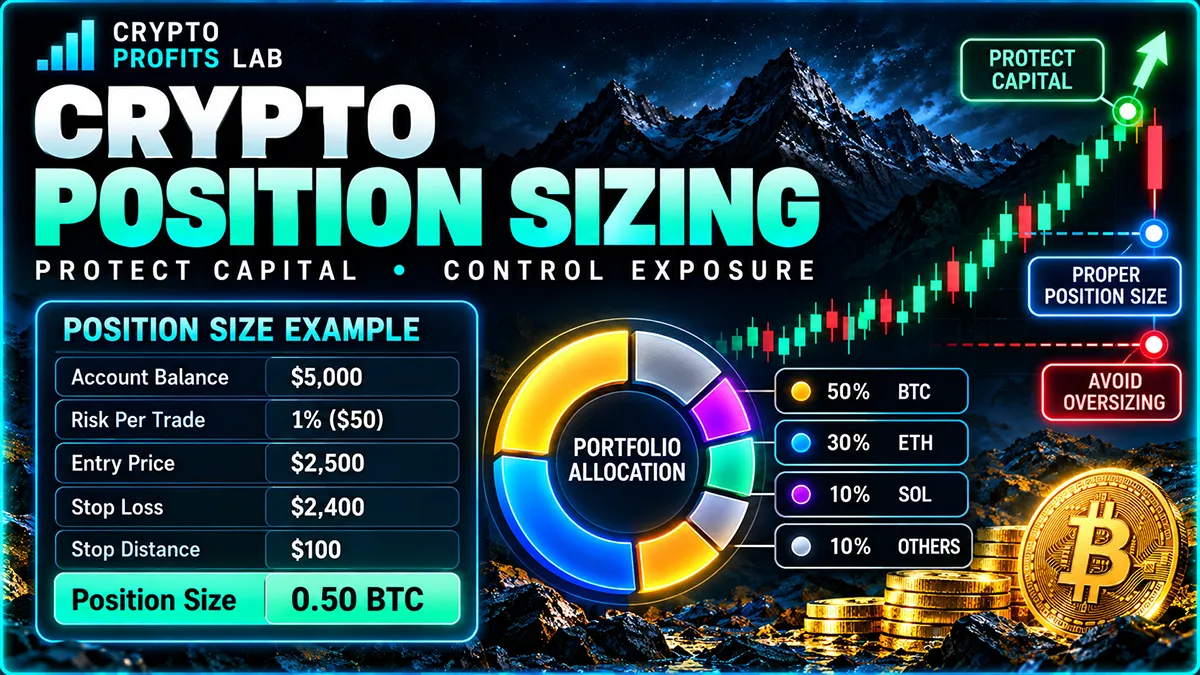
Crypto position sizing means deciding how much money to put into one crypto trade based on how much you are willing to lose if the trade goes wrong.
That is different from asking, “How much crypto can I afford to buy?” A trader may have $5,000 available, but that does not mean every trade should use $5,000. Position size should connect the amount invested with the planned entry, stop-loss level, fees, market volatility, and overall account risk.
For beginners, crypto position sizing can make trading more structured. Instead of choosing a trade size because a coin looks exciting or because an exchange allows a large order, you calculate the size before placing the trade.
This guide explains the idea step by step using simple examples. It is educational, not a recommendation to trade or risk a particular percentage of your money.
Quick Answer
Crypto position sizing is the process of calculating how large a crypto trade should be based on your account size and the amount you are prepared to lose if the trade reaches its planned stop.
A simple approach starts with three numbers:
- Your trading account balance
- The maximum dollar amount you are willing to risk on the trade
- The percentage distance between your entry price and stop-loss price
For example, if an account contains $5,000 and a trader decides the maximum planned loss is $50, that $50 is the risk amount. If the stop is 5% below the entry, a simplified position size would be $1,000 because 5% of $1,000 is $50.
Real trades can lose more or less because of fees, slippage, gaps between available orders, or execution problems.
Key Takeaways
- Crypto position sizing determines how much capital or market exposure you assign to one trade.
- Position size and risk amount are not the same thing.
- A stop-loss distance helps convert a planned dollar risk into a trade size.
- A wider stop generally requires a smaller position if you want to keep the same planned dollar risk.
- A tighter stop generally allows a larger calculated position, but tight stops can be triggered by normal volatility.
- Fees and slippage can make the real loss larger than the simple calculation.
- Leverage changes required margin and can greatly increase risk, so beginners should understand spot trading first.
- No formula can guarantee that a stop will fill at the expected price.
Crypto Position Sizing Beginner Facts
| Term | Beginner Meaning |
|---|---|
| Account balance | The amount of money in the account you are using for trading |
| Position size | The dollar value or quantity of crypto in a trade |
| Risk amount | The maximum planned loss before fees and execution differences |
| Entry price | The price where you plan to enter the trade |
| Stop-loss price | The price where you plan to exit if the trade moves against you |
| Stop distance | The percentage or dollar distance between entry and stop |
| Exposure | The amount of market value affected by the trade |
| Margin | Funds required to support a leveraged position |
| Slippage | The difference between the expected execution price and actual fill price |
What Is Crypto Position Sizing?
Crypto position sizing is a risk-planning method used to decide the appropriate size of a trade before entering it.
Without a sizing plan, beginners often choose positions using round numbers. They may invest $500 in every trade, buy the maximum amount available, or increase the trade because they feel unusually confident about a coin.
Those approaches ignore how different trades can have very different risk.
Suppose two trades are each worth $1,000. One has a stop 2% below the entry, while the other has a stop 10% below the entry. Ignoring fees and slippage, the first has about $20 of planned price risk while the second has about $100.
The dollar value of the position is the same, but the planned loss is not.
Crypto position sizing works backward. First decide the amount of account risk. Then examine the distance to the stop. Finally, calculate the position size that connects those two numbers.
This approach fits naturally with spot trading in crypto, where you buy an asset with your own funds rather than borrowing to increase exposure.
Position Size Is Not the Same as Account Risk
This distinction is one of the most important ideas for beginners.
Imagine you have a $10,000 trading account and buy $2,000 worth of crypto. Your position size is $2,000.
That does not automatically mean you are risking $2,000.
If you have a planned stop that would create an estimated $100 loss, your planned trade risk is approximately $100 before fees and execution differences.
However, a stop order is not a guarantee. In a fast-moving market, the actual loss can exceed the planned amount.
This is why position sizing should be treated as risk estimation rather than a promise.
The Basic Crypto Position Sizing Formula
A beginner-friendly calculation can be broken into three parts.
1. Calculate the Risk Amount
Risk amount = account balance × chosen risk percentage
Example:
$5,000 account × 1% = $50 planned risk
The 1% number is only an example, not a recommended setting for every person.
2. Calculate the Stop Distance
Stop distance percentage = (entry price − stop price) ÷ entry price
If the entry is $100 and the stop is $95:
($100 − $95) ÷ $100 = 0.05, or 5%
3. Calculate the Position Size
Position size = risk amount ÷ stop distance percentage
Using the same example:
$50 ÷ 0.05 = $1,000
The simplified trade would therefore have a $1,000 position size. At a $100 entry price, that equals 10 units.
If price fell from $100 to $95 and the stop filled exactly at $95, the price loss would be about $50.
For a public explanation of the same general trading risk-management concept, see CME Group’s Proper Position Size lesson.
Why the Stop Comes Before the Position Size
Beginners sometimes reverse the process.
They decide to buy $2,000 worth of crypto first and then place a stop wherever it creates an acceptable-looking loss.
That can make the stop meaningless.
A stop should ideally be connected to the reason for the trade. It might be below an important chart level or at a price where the original trade idea no longer makes sense.
Once that level is identified, crypto position sizing adjusts the amount purchased to fit the planned risk.
If you are still learning stop orders, read our crypto stop loss guide before using a stop-based sizing formula.
Step by Step: How to Calculate Crypto Position Sizing
Step 1: Define the Account Amount You Are Using
Start with the amount you have specifically set aside for trading.
Do not automatically use your total savings, retirement funds, emergency money, or household cash as the account value in a trading calculation.
The goal is to measure risk against money that is actually designated for this activity.
Step 2: Choose a Maximum Planned Loss
Decide how much you are willing to lose if the trade fails.
This can be expressed as a dollar amount or percentage of the trading account.
There is no universal correct percentage. Your financial situation, experience, strategy, time horizon, and tolerance for losses all matter.
Step 3: Choose the Entry Price
Identify where you expect to enter.
The actual fill may differ from the planned price, especially during fast markets or when using a market order.
Review market order vs limit order in crypto if you are unsure how the order type can affect execution.
Step 4: Identify the Stop-Loss Level
Choose the price where the trade idea would be considered wrong or where you are no longer willing to accept additional downside.
Do not place the stop only to make the position size larger.
Step 5: Calculate the Stop Distance
Measure the distance between the planned entry and stop.
For a long trade:
(entry − stop) ÷ entry = stop distance percentage
A $50 entry and $47.50 stop creates a 5% stop distance.
Step 6: Calculate the Position Size
Divide your planned dollar risk by the stop distance.
If planned risk is $40 and the stop distance is 5%:
$40 ÷ 0.05 = $800
The simplified position size is $800.
Step 7: Adjust for Real Trading Costs
The basic formula does not automatically include every real-world cost.
Crypto trading fees, crypto spread, and crypto slippage can increase the total cost or loss.
That means an $800 calculation should not be treated as mathematically guaranteed to cap the loss at exactly $40.
Example: Crypto Position Sizing With a $5,000 Account
Suppose a beginner has set aside a $5,000 trading account.
The trader is considering a spot trade with these hypothetical numbers:
- Account balance: $5,000
- Planned risk: $50
- Entry price: $2.00
- Stop price: $1.90
The stop distance is:
($2.00 − $1.90) ÷ $2.00 = 5%
Now calculate the position:
$50 ÷ 0.05 = $1,000
At a $2 entry, $1,000 buys 500 units.
If the asset falls to $1.90 and the stop fills at exactly that price, the price difference is $0.10 per unit.
500 × $0.10 = $50
That is the planned loss before fees and any execution difference.
Notice that the trader did not ask, “How many coins should I buy?” first. Crypto position sizing started with the account risk and stop distance.
What Happens When the Stop Is Wider?
Suppose the same trader keeps the planned risk at $50 but uses a 10% stop instead of a 5% stop.
$50 ÷ 0.10 = $500
The wider stop reduces the calculated position from $1,000 to $500.
That relationship is important:
- Wider stop + same planned risk = smaller position
- Tighter stop + same planned risk = larger position
A wider stop is not automatically safer, and a tighter stop is not automatically better. The stop should make sense for the market and trade idea.
Learning about crypto volatility can help explain why different assets may need different amounts of breathing room.
7 Smart Rules for Crypto Position Sizing
1. Calculate Risk Before You Buy
Do not wait until after the trade is open to decide how much loss is acceptable.
Planning first makes the size easier to evaluate without the pressure of a moving market.
2. Do Not Size a Trade From Confidence Alone
Feeling strongly about a coin does not reduce market risk.
A trade can fail even when the research looks convincing. Using a repeatable process keeps one idea from becoming much larger than every other trade.
3. Let the Stop Distance Affect the Size
If the trade needs a wider stop, reduce the position rather than automatically increasing the amount you are willing to lose.
This is one of the central ideas behind crypto position sizing.
4. Consider Total Portfolio Exposure
Several individually reasonable positions can create a large combined risk.
For example, holding multiple highly correlated crypto assets can behave like one much larger directional bet during a market-wide decline.
Our crypto portfolio for beginners guide explains portfolio construction at a broader level.
5. Include Fees and Slippage
A calculator may show a neat number, but actual execution is not always neat.
Leave room for trading costs and price movement around the stop.
6. Be Extra Careful With Leverage
Leverage can make a small amount of margin control a much larger market position.
That does not make the underlying trade less risky. It can make losses happen faster and introduces liquidation risk.
Read crypto leverage and crypto liquidation before considering leveraged products.
7. Review Your Position Size After Every Trade
Record the planned size, actual entry, stop, fees, exit, and final loss or gain.
Over time, you can see whether your calculations are realistic and whether execution costs are consistently larger than expected.
Crypto Position Sizing vs. Portfolio Allocation
Position sizing and portfolio allocation are related but different.
Portfolio allocation asks how much of your overall investment portfolio should be placed in categories or assets.
Position sizing asks how large one specific trade should be.
For example, a person might decide that crypto represents only one part of a broader investment portfolio. Inside a separate trading account, the person might then use crypto position sizing to control the amount placed into each individual trade.
Do not assume a position-sizing formula replaces diversification or long-term financial planning.
Crypto Position Sizing and Take Profit
A position-size calculation usually focuses first on downside risk, but the upside plan matters too.
Before entering a trade, you may compare the distance to your stop with the distance to a potential profit target.
For example:
- Entry: $100
- Stop: $95
- Planned target: $110
The downside distance is $5 and the potential upside distance is $10. In simplified terms, that creates a potential reward twice the planned risk.
This does not mean the target is likely to be reached. It only describes the relationship between the planned levels.
Our crypto take profit guide explains profit targets in more detail.
Crypto Position Sizing and Trailing Stops
A trailing stop can change the exit level after a trade begins moving in your favor.
The original trade size, however, should still be based on a risk plan created before entry.
A crypto trailing stop may later follow the market upward, but it does not erase the importance of deciding how much exposure to take at the beginning.
Does Leverage Change the Calculation?
Leverage can create confusion because position value and margin are not the same thing.
Suppose a trader controls a $1,000 position using only part of that amount as margin. The market exposure is still based on the $1,000 position, not merely the cash posted as margin.
A beginner can make a serious mistake by sizing a leveraged trade based only on the margin requirement.
Crypto position sizing for leveraged products should consider the full position exposure, stop distance, fees, funding costs where applicable, and liquidation mechanics.
Because leveraged crypto products can produce rapid losses, beginners should understand ordinary spot orders and risk planning before considering them.
Common Beginner Mistakes
Buying the Same Dollar Amount Every Time
A fixed purchase amount ignores different stop distances and volatility.
Two $1,000 trades can have very different planned losses.
Choosing the Position Before the Stop
This can lead to placing the stop at an arbitrary level merely to make the numbers fit.
Risking More Because a Trade “Looks Certain”
No crypto trade is certain.
Confidence should not replace a repeatable risk process.
Confusing Position Size With Maximum Loss
Buying $1,000 of crypto does not automatically mean the planned loss is $1,000, but neither does a stop guarantee that the loss will stay at a smaller number.
Ignoring Multiple Open Positions
Five trades with small individual risk can still create significant combined exposure.
Forgetting Fees and Slippage
Trading costs and execution differences can push actual losses above the simplified plan.
Using Maximum Available Leverage
An exchange may allow a large leveraged position, but availability is not the same as suitability.
Safety and Risk Considerations
Position sizing can help organize risk, but it cannot eliminate risk.
Stop orders can fill at worse prices than expected. Limit orders may not fill. Exchanges can experience outages. Liquidity can disappear quickly. Crypto prices can move sharply at any hour of the day.
If you are learning, consider practicing calculations without money first or using very small amounts while you learn how your exchange handles orders.
Account security also matters. Use a unique password and enable crypto 2FA. A risk formula cannot protect funds if someone gains access to the account.
Never trade money needed for essential expenses, and do not treat a mathematical sizing formula as a guarantee against loss.
A Simple Pre-Trade Checklist
Before placing a trade, ask:
- What is my planned entry?
- Where is my stop?
- What is the stop distance?
- What dollar amount am I prepared to lose?
- What position size does that produce?
- Have I considered fees and slippage?
- How much total exposure do I already have?
- Am I using leverage?
- Do I understand what order will actually execute if my stop triggers?
If you cannot answer these questions, the trade may not be fully planned yet.
Frequently Asked Questions
What Is Crypto Position Sizing?
Crypto position sizing is the process of deciding how much crypto or market exposure to use for one trade based on a predefined risk amount and the distance between the entry and stop-loss level. Instead of buying an arbitrary amount, the trader works backward from the maximum planned loss. It is a risk-management method, not a way to predict which trades will succeed.
How Do You Calculate Crypto Position Sizing?
A simplified method is to divide the planned dollar risk by the percentage distance from entry to stop. For example, if you are prepared to risk $50 and the stop is 5% from the entry, $50 divided by 0.05 equals a $1,000 position. This calculation does not automatically include trading fees, slippage, poor fills, or other execution costs.
What Percentage Should a Beginner Risk Per Trade?
There is no universally correct percentage for beginners. Trading education often uses small percentages as examples, but the appropriate amount depends on personal finances, experience, strategy, volatility, and tolerance for loss. The important concept is to decide the maximum planned loss before entering a trade and keep it small enough that one losing trade does not create unacceptable financial damage.
Is Position Size the Same as the Amount I Can Lose?
No. Position size is the total value or exposure of the trade, while planned risk is the amount you expect to lose if the trade reaches the stop. For example, a $1,000 position with a stop 5% away has approximately $50 of planned price risk before fees and slippage. Actual losses can still be larger if the stop fills at a worse price.
Can I Use Crypto Position Sizing Without Leverage?
Yes. Position sizing is useful in ordinary spot trading and does not require leverage. A spot trader can choose an entry, determine a stop level, decide the maximum planned dollar loss, and calculate the amount of crypto to buy. In fact, learning the concept without leverage can make it easier to understand because margin and liquidation mechanics do not complicate the calculation.
Does Leverage Let Me Use a Bigger Position Safely?
No. Leverage can reduce the amount of margin required to control a position, but it does not automatically reduce market risk. A larger leveraged position can amplify losses and may introduce liquidation risk. Position calculations should consider the full market exposure rather than only the margin posted. Beginners should understand leverage, liquidation, stop orders, and fees before using leveraged crypto products.
What If I Do Not Use a Stop Loss?
A stop-based position-sizing formula depends on having a defined exit level. Without one, the maximum downside is harder to estimate and can be much larger than expected. A trader can use other risk methods, but simply removing the stop from the calculation does not make the risk disappear. Crypto prices can decline sharply, so an exit plan should be considered before entering a trade.
Does Crypto Position Sizing Guarantee I Will Not Lose Too Much?
No. Crypto position sizing creates an estimate based on planned prices and assumptions. Real execution can differ because of slippage, fees, low liquidity, exchange problems, or sudden market moves. A stop can also fill below its trigger price. Position sizing is useful because it creates a structured risk plan, but it cannot place a guaranteed ceiling on every possible trading loss.
Final Thoughts
Crypto position sizing answers a basic question that beginners often overlook: how large should this trade actually be?
The answer should not come from excitement, fear of missing out, the maximum amount an exchange allows, or a guess.
Start with risk. Identify the entry. Decide where the trade is no longer acceptable. Measure the stop distance. Then calculate a position that fits the plan and account for real trading costs.
Crypto position sizing will not turn a bad trade into a good one, predict the next market move, or guarantee that a stop works perfectly. What it can do is make your decisions more consistent and help prevent one oversized trade from dominating your account.
Crypto Profits Lab is built around making concepts like this clearer for beginners. Keep the math simple, understand every order before using it, and focus on learning the process before increasing the amount of money at risk.