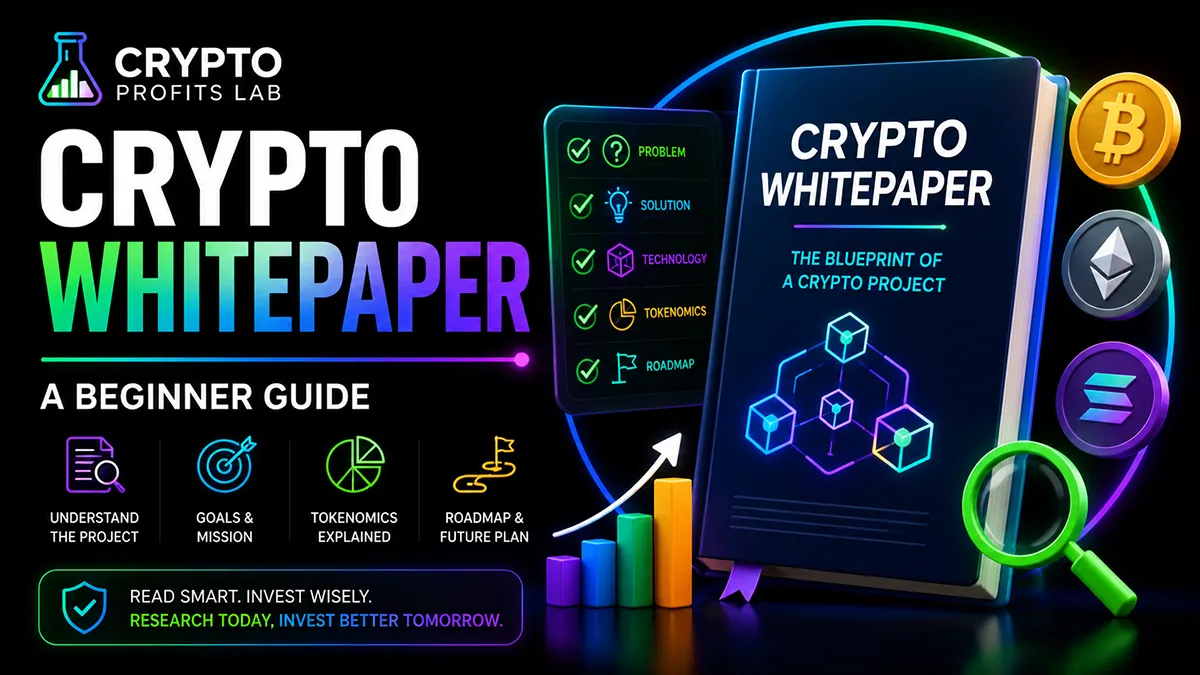
What Is a Crypto Whitepaper? A Beginner Guide
A crypto whitepaper can feel intimidating when you are new to crypto.
The word sounds technical. The document may look long. It may include charts, token supply details, blockchain terms, roadmaps, and promises about what a project plans to build.
But a crypto whitepaper does not need to be scary.
For beginners, it is simply a project document that explains what a crypto project is trying to do, how it may work, and why the team believes it matters.
Some whitepapers are helpful and clear.
Others are vague, confusing, copied, or filled with hype.
That is why learning how to read a crypto whitepaper is useful before buying a new coin, token, or crypto project.
This guide explains what a whitepaper is, why it matters, what sections beginners should check, and what red flags to avoid.
Crypto Profits Lab is built to make crypto education cleaner, simpler, and more trustworthy for beginners. This article keeps the explanation practical and easy to understand.
Quick Answer: What Is a Crypto Whitepaper?
A crypto whitepaper is a document that explains a crypto project’s purpose, technology, token design, roadmap, and goals.
Think of it like a project blueprint.
It should help readers understand what the project wants to solve, how it plans to work, who may use it, and what role the coin or token plays.
A crypto whitepaper is often used by blockchain projects, token launches, DeFi platforms, and other crypto startups to explain their idea to the public.
For beginners, the most important point is this:
A whitepaper is not proof that a project is safe or valuable.
It is only information.
You still need to think carefully, compare claims with reality, and watch for risks.
Key Takeaways
- A crypto whitepaper explains a crypto project’s purpose, token design, technology, and roadmap.
- Beginners should use it as a research tool, not as a guarantee of success.
- A good whitepaper should be clear, specific, realistic, and easy enough to understand.
- A weak whitepaper may be vague, overly promotional, copied, or full of unrealistic promises.
- Tokenomics, team transparency, roadmap details, and risk disclosures are important sections to review.
- A whitepaper can help you avoid hype-driven decisions.
- Never buy crypto only because a whitepaper sounds impressive.
Beginner Facts About Crypto Whitepapers
| Beginner Question | Simple Answer |
|---|---|
| What is a crypto whitepaper? | A document explaining a crypto project’s idea, design, token, and goals. |
| Is a whitepaper required? | Not always, but many serious projects publish one. |
| Does a whitepaper prove a project is safe? | No. It is only one research tool. |
| Who writes it? | Usually the project team, founders, developers, or contributors. |
| What should beginners check? | Purpose, tokenomics, roadmap, team, technology, risks, and clarity. |
| Can a whitepaper be fake? | Yes. Some are copied, misleading, or written mainly for hype. |
| Should I read one before buying? | Yes, especially for newer or smaller crypto projects. |
Why Crypto Whitepapers Matter
A crypto whitepaper matters because it helps explain what a project claims to be building.
Without one, beginners may rely only on social media posts, influencer videos, price charts, or online hype.
That is risky.
A project may sound exciting on social media but have weak details when you read the actual document.
The whitepaper gives you a better place to start.
It may explain:
- What problem the project wants to solve
- How the technology works
- What the token is used for
- How many tokens exist
- How tokens are distributed
- What the roadmap looks like
- Who the project is trying to help
- What risks or limits exist
A crypto whitepaper does not answer every question, but it gives you a foundation.
If you are still learning basic crypto language, start with what is cryptocurrency and what is blockchain technology before reading technical project documents.
Real Example: The Bitcoin Whitepaper
The most famous example is the Bitcoin whitepaper.
It introduced the original idea behind Bitcoin as a peer-to-peer electronic cash system.
For beginners, the Bitcoin paper is useful because it shows what a serious project document can do. It explains a problem, proposes a solution, and describes how the system is meant to work.
That does not mean every modern crypto whitepaper needs to look exactly like Bitcoin’s.
Crypto has expanded into many categories, including smart contracts, tokens, DeFi, NFTs, wallets, exchanges, and blockchain networks.
But the basic idea is still helpful:
A whitepaper should explain the project clearly.
It should not only create excitement.
It should help readers understand the purpose, design, and tradeoffs.
If a project document is full of buzzwords but does not explain anything clearly, beginners should slow down.
Crypto Whitepaper vs Website
A project website is usually designed to look attractive.
It may have colorful graphics, short slogans, exciting headlines, and quick buttons to buy, join, or connect a wallet.
A crypto whitepaper should go deeper.
It should explain details that do not fit on a homepage.
Here is a simple comparison.
| Feature | Project Website | Crypto Whitepaper |
|---|---|---|
| Main purpose | Introduce and market the project | Explain the project in detail |
| Style | Visual, short, promotional | More detailed and structured |
| Best for | Quick overview | Research and understanding |
| Risk | May focus on hype | May still be biased, but should include details |
| Beginner use | First impression | Deeper review before buying |
A website can be useful, but it should not be your only research source.
A crypto whitepaper can help you look beyond marketing.
Crypto Whitepaper vs Tokenomics
A whitepaper and tokenomics are connected, but they are not the same thing.
Tokenomics means the design of a crypto token’s supply, distribution, incentives, and use.
A crypto whitepaper may include tokenomics as one section.
For example, it may explain how many tokens exist, how many are reserved for the team, how many are sold to investors, and whether more tokens can be created later.
If tokenomics is confusing, read what is tokenomics.
Beginners should pay close attention to this section because poor token design can hurt long-term value.
A project can have a great story but still have weak tokenomics.
Step-by-Step: How to Read a Crypto Whitepaper
You do not need to understand every technical detail on your first read.
Use this simple process.
Step 1: Read the Summary First
Start with the introduction or summary.
Ask:
- What is the project trying to do?
- Who is it for?
- What problem does it claim to solve?
- Can I explain it in simple words?
If the summary is hard to understand, that may be a warning sign.
A serious project should be able to explain its purpose clearly.
Some technical topics are naturally complex, but the basic idea should still make sense.
Step 2: Identify the Problem
A crypto project should explain the problem it wants to solve.
For example, a project might focus on faster payments, cheaper transactions, decentralized lending, better privacy, gaming assets, data storage, or blockchain scaling.
The problem should be real enough to understand.
If the document says it will “change everything” but never explains the actual problem, be careful.
A crypto whitepaper should not rely only on big claims.
It should explain why the project exists.
Step 3: Review the Proposed Solution
After the problem, look for the solution.
How does the project plan to solve the problem?
Does it use a blockchain?
Does it use smart contracts?
Does it create a token?
Does it need a token at all?
If the project uses smart contracts, you may want to read what are smart contracts first.
A good whitepaper should connect the problem to the solution in a clear way.
If the token seems unnecessary, that may be a concern.
Step 4: Understand the Token’s Role
This is one of the most important beginner steps.
Ask what the token actually does.
Is it used to pay fees?
Is it used for governance?
Is it used for staking?
Is it used to access a service?
Is it mainly used for trading?
If the project has a token, the whitepaper should explain why the token is needed.
If you are unsure how tokens work, read what is a crypto token.
A crypto whitepaper should make the token’s role clear.
If the token has no clear use, the project may depend mostly on speculation.
Step 5: Check the Token Supply
Token supply can affect price expectations.
Look for details such as:
- Total supply
- Circulating supply
- Token release schedule
- Team allocation
- Investor allocation
- Community rewards
- Staking rewards
- Burn mechanics
A large token supply does not automatically mean a project is bad. A small supply does not automatically mean it is good.
What matters is how the supply works and whether the design makes sense.
Beginners should also understand market cap crypto because price per token can be misleading.
Step 6: Review the Roadmap
A roadmap shows what the project plans to build over time.
A good roadmap should be realistic.
It may include phases such as launch, testing, exchange listings, app development, network upgrades, partnerships, or community growth.
Be careful with roadmaps that promise too much too quickly.
A project that says it will build a wallet, exchange, blockchain, game, metaverse, payment system, and global bank replacement all at once may be unrealistic.
A crypto whitepaper should show focus.
Clear, achievable milestones are usually better than huge promises.
Step 7: Look for the Team or Contributors
Some crypto projects are fully anonymous. Others list founders, developers, advisors, and partners.
An anonymous team is not automatically a scam, but it does increase the need for caution.
If a team is public, beginners can look for experience, past work, and whether the people are real.
If a whitepaper lists famous partners or advisors, check whether those relationships are real.
Do not trust logos on a website without verification.
Step 8: Check Risk Disclosures
A trustworthy project should be honest about risks.
Crypto has many risks, including technical bugs, regulation, market volatility, security failures, competition, low adoption, and liquidity problems.
If a crypto whitepaper makes everything sound easy and risk-free, be careful.
Every serious project has challenges.
A document that admits limitations may be more trustworthy than one that promises perfection.
What a Good Crypto Whitepaper Should Include
A good crypto whitepaper does not need to be perfect, but it should include enough detail to help readers understand the project.
Look for these sections.
| Section | Why It Matters |
|---|---|
| Project summary | Explains the basic idea quickly. |
| Problem statement | Shows why the project exists. |
| Proposed solution | Explains how the project plans to help. |
| Technology overview | Describes how the system works. |
| Token utility | Explains what the token is used for. |
| Tokenomics | Shows supply, distribution, and incentives. |
| Roadmap | Outlines planned development. |
| Team information | Helps readers evaluate credibility. |
| Risks and limitations | Shows honesty and realistic thinking. |
If several of these sections are missing, beginners should be cautious.
A short document is not always bad, but vague information creates risk.
Red Flags in a Crypto Whitepaper
Some whitepapers are written to inform.
Others are written to sell hype.
Here are common red flags.
Red Flag 1: Guaranteed Profit Claims
No crypto project can guarantee profit.
If a whitepaper promises fixed returns, guaranteed price growth, or risk-free income, that is a major warning sign.
Crypto markets are volatile.
Even strong projects can lose value.
Red Flag 2: Too Many Buzzwords
Words like AI, Web3, metaverse, DeFi, quantum, staking, and Layer 2 can sound impressive.
But buzzwords do not prove quality.
If a crypto whitepaper uses many trendy terms without explaining them clearly, be careful.
A beginner should be able to understand the main idea after reading the document.
Red Flag 3: No Clear Token Use
A project may create a token because tokens can attract attention and funding.
But if the token has no real purpose, the project may rely mostly on speculation.
Ask why the token needs to exist.
If the answer is unclear, slow down.
Red Flag 4: Unrealistic Roadmap
A roadmap that promises too much can be a problem.
Building real crypto infrastructure takes time, security testing, developer skill, and user adoption.
Projects that promise massive results with little detail may be trying to excite buyers rather than explain a realistic plan.
Red Flag 5: Missing Token Distribution
Beginners should know who gets the tokens.
If the team, insiders, or early investors receive a large share, they may be able to sell later and pressure the price.
A crypto whitepaper should clearly explain token allocation.
Red Flag 6: Copied or Generic Text
Some scam projects copy whitepapers from other projects.
If the document feels generic, poorly edited, or disconnected from the project website, be careful.
Copying does not prove innovation.
Red Flag 7: No Mention of Risk
Every crypto project has risk.
If a whitepaper only talks about success and never discusses challenges, that is not a good sign.
Honest projects usually explain limits, risks, and assumptions.
Common Beginner Mistakes With Crypto Whitepapers
Mistake 1: Not Reading It at All
Many beginners buy crypto because they see a price chart, social media post, or influencer video.
That is not enough.
Reading the whitepaper can help you understand what the project actually claims to do.
Mistake 2: Reading Only the First Page
The introduction may be helpful, but important details are often later in the document.
Token supply, roadmap, risks, and technical design may be deeper inside.
Take your time.
You do not need to read everything in one sitting.
Mistake 3: Believing Everything in the Document
A crypto whitepaper is usually written by the project team.
That means it may be biased.
Treat it as one source of information, not the final truth.
Compare it with the website, community, code, audits, exchange listings, blockchain activity, and independent research.
Mistake 4: Ignoring Tokenomics
Tokenomics can strongly affect risk.
If many tokens are reserved for insiders or released later, the price may face selling pressure.
Beginners should not skip this section.
Mistake 5: Confusing Complexity With Quality
A document can sound technical and still be weak.
Complex language does not automatically mean a strong project.
A good project should explain complicated ideas as clearly as possible.
Mistake 6: Not Checking for Scams
A whitepaper can look professional and still be part of a scam.
Scammers know how to create good-looking documents.
Always combine whitepaper research with security habits from crypto scams to avoid and crypto safety tips.
Safety and Risk Tips for Beginners
A crypto whitepaper can help with research, but it cannot protect you by itself.
You still need safe habits.
First, never connect your wallet just to read a whitepaper.
A normal document should not require wallet access.
Second, avoid downloading suspicious files from unknown websites.
Some fake project websites may try to trick users into downloading unsafe files.
Third, do not share your seed phrase.
A seed phrase is the recovery phrase for a crypto wallet. No whitepaper, project team, support account, or website should ever ask for it.
Read crypto seed phrase if you need a simple explanation.
Fourth, check the project’s official links carefully.
Scammers often create fake websites and fake social media accounts that look real.
Fifth, avoid urgency.
If someone says you must buy immediately before reading or thinking, that is pressure.
Good decisions do not require panic.
Sixth, understand that early projects can fail.
Even honest teams can miss deadlines, run out of money, face security issues, or fail to attract users.
A crypto whitepaper is a starting point, not a guarantee.
How a Crypto Whitepaper Helps You Avoid Hype
Hype is one of the biggest risks for beginners.
A project may trend on social media. People may talk about huge gains. Influencers may say the project is early. The website may look professional.
A crypto whitepaper helps slow the process down.
Instead of reacting emotionally, you can ask practical questions:
- What problem does this solve?
- Why does the token need to exist?
- Who controls the token supply?
- What has the team already built?
- What is still only a promise?
- What are the risks?
- Is the roadmap realistic?
These questions help you think like a researcher instead of a follower.
That does not guarantee success.
But it can help you avoid some obvious mistakes.
How Whitepapers Connect to Different Crypto Topics
Whitepapers appear across many parts of crypto.
A new blockchain may publish one to explain its network design.
A DeFi project may publish one to explain lending, trading, or rewards.
A token project may publish one to explain supply and use.
A gaming or NFT project may publish one to explain digital ownership.
If you are researching a DeFi project, read what is DeFi first.
If you are researching decentralized exchanges, read what is a DEX.
If you are researching staking, read crypto staking.
The more basic concepts you understand, the easier it becomes to read project documents.
Simple Beginner Checklist
Use this checklist before trusting a project document.
| Question | Why It Matters |
|---|---|
| Can I explain the project simply? | Helps avoid fake complexity. |
| Does the problem seem real? | Shows whether the project has a purpose. |
| Is the solution clear? | Helps determine whether the plan makes sense. |
| Does the token have a real role? | Reduces pure hype risk. |
| Are tokenomics explained? | Helps identify supply and insider risks. |
| Is the roadmap realistic? | Helps spot overpromising. |
| Is the team transparent? | Helps evaluate credibility. |
| Are risks included? | Shows whether the project is honest. |
| Did I verify claims elsewhere? | Reduces blind trust. |
If the answer to several questions is no, slow down.
There will always be another crypto project to research.
Should Beginners Always Read the Whitepaper?
For major assets like Bitcoin or Ethereum, beginners may start with simpler educational guides before reading original technical documents.
For newer or smaller projects, reading the whitepaper becomes more important.
The newer the project, the more careful you should be.
If a token is being promoted heavily but has no clear document, no clear tokenomics, and no realistic roadmap, that is a warning sign.
A crypto whitepaper is not the only thing to review, but it is one of the most useful starting points.
If you are buying through an exchange, also understand how to buy crypto for beginners and best crypto exchange for beginners.
Research and security should go together.
Final Thoughts
A crypto whitepaper is a project document that explains what a crypto project is, how it may work, and what role its token may play.
For beginners, it is one of the best tools for slowing down and thinking clearly.
You do not need to understand every technical detail.
Start with the basics.
What problem does the project solve? How does it work? Why does the token exist? How is supply handled? What does the roadmap say? Who is behind it? What risks are explained?
A good whitepaper should make a project easier to understand.
A bad one may create more confusion, use too many buzzwords, hide important details, or promise unrealistic results.
Crypto Profits Lab is designed to make crypto education simple, clear, and trustworthy for beginners.
Learning how to read a crypto whitepaper can help you avoid hype, ask better questions, and make more careful decisions before buying a new coin or token.
FAQs About Crypto Whitepapers
What is a crypto whitepaper?
A crypto whitepaper is a document that explains a crypto project’s purpose, technology, token design, roadmap, and goals. It helps readers understand what the project claims to solve and how it plans to work. Beginners should use it as one research tool, not as proof that a project is safe or valuable.
Why is a crypto whitepaper important?
A crypto whitepaper is important because it gives more detail than a project website or social media post. It may explain the problem, solution, tokenomics, roadmap, and risks. Beginners can use it to slow down, compare claims, and avoid buying only because of hype or influencer excitement.
Does every crypto project need a whitepaper?
Not every crypto project has a traditional whitepaper, especially older projects, meme coins, or projects that use other forms of documentation. However, serious projects should provide clear public information somewhere. If a newer project has no useful documentation, unclear tokenomics, and only promotional claims, beginners should be cautious.
Can a crypto whitepaper be fake?
Yes. A crypto whitepaper can be copied, misleading, exaggerated, or created mainly to make a project look professional. Scammers may use technical language and attractive design to build trust. Beginners should compare the document with other sources, check tokenomics, verify official links, and watch for unrealistic profit claims.
What should beginners look for in a crypto whitepaper?
Beginners should look for a clear project summary, real problem statement, understandable solution, token utility, token supply, roadmap, team details, and risk disclosures. The document should explain why the token exists and how the project plans to create value. If those details are missing or vague, caution is needed.
Is a long crypto whitepaper better than a short one?
Not always. A long crypto whitepaper can still be confusing, vague, or full of buzzwords. A shorter document can be useful if it explains the project clearly. Quality matters more than length. Beginners should focus on whether the document answers practical questions about purpose, tokenomics, roadmap, team, and risks.
Should I buy crypto after reading the whitepaper?
Reading a crypto whitepaper does not automatically mean you should buy. It is only one step in research. Beginners should also check market cap, liquidity, token distribution, wallet safety, exchange availability, community behavior, and scam risks. If you still do not understand the project, it is better to wait.
What is the biggest red flag in a crypto whitepaper?
The biggest red flag is a promise of guaranteed profit or risk-free returns. Other warning signs include vague explanations, no clear token use, missing supply details, unrealistic roadmaps, copied text, and no mention of risks. A trustworthy project should explain both the opportunity and the challenges clearly.