Multisig Wallet Explained: A Beginner’s Guide to Shared Crypto Security
A normal cryptocurrency wallet can allow one private key to control everything. That simplicity is convenient, but it also creates a single point of failure. If the key is stolen, exposed, or permanently lost, the crypto may be at risk.
A multisig wallet uses more than one private key and requires a chosen number of approvals before funds can move. Instead of trusting one device, one person, or one backup, control can be divided across several signers.
This setup can help individuals protect long-term savings. It can also help families, businesses, crypto projects, and decentralized organizations manage shared funds.
However, additional keys also create additional responsibility. A poor setup can lock users out, expose backups, or make routine transactions confusing.
This guide explains multisig wallet security in simple language, including 2-of-3 arrangements, transaction approvals, common uses, setup planning, recovery, and risks.
Educational note: This article provides general education, not personalized financial, legal, or security advice.
Quick Answer: What Is a Multisig Wallet?
A multisig wallet is a cryptocurrency wallet that requires approval from multiple private keys before a transaction can be completed.
“Multisig” is short for “multiple signatures.” Each private key can create a digital signature that proves its holder approved a transaction.
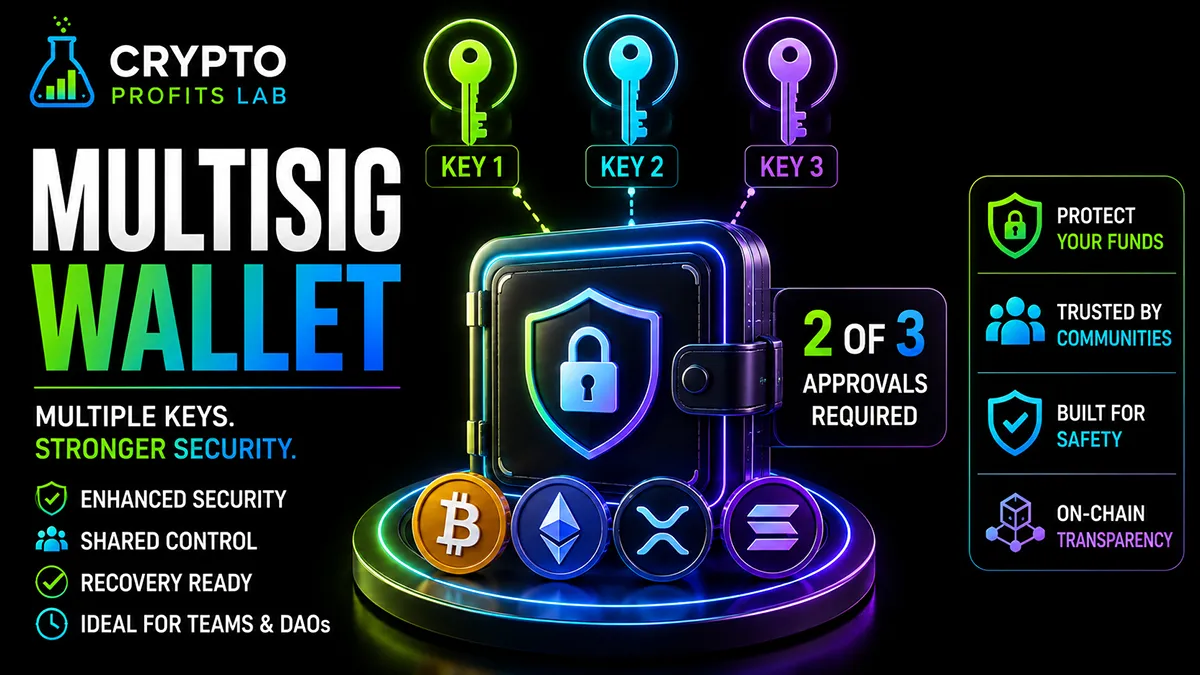
A 2-of-3 setup has three possible signing keys and requires any two of them to approve a payment. Losing one key does not necessarily lock the funds, and stealing one key is not normally enough to spend them.
The added protection can reduce reliance on one key, but users must carefully secure the devices, backups, wallet information, and recovery instructions.
Key Takeaways
- A multisig wallet requires more than one approval under its configured rules.
- A 2-of-3 arrangement requires any two of three authorized keys.
- Multiple keys can reduce the danger of one stolen or lost private key.
- Individuals can keep keys on separate devices and in separate locations.
- Teams can require several people to approve treasury payments.
- Multisignature protection does not prevent every scam, software bug, or user mistake.
- Signers need compatible software, reliable backups, and a tested recovery plan.
- Beginners should understand the complete setup before depositing a large amount.
- A small test transaction should be completed before the wallet holds important funds.
Beginner Multisig Facts
| Question | Beginner-Friendly Answer |
|---|---|
| What does multisig mean? | Multiple signatures |
| What is a signer? | A person or device holding a key that can approve a transaction |
| What does 2-of-3 mean? | Any two of three authorized keys must approve |
| Can one key spend the funds? | Not in a correctly configured 2-of-3 arrangement |
| Can one lost key be tolerated? | Usually yes in a 2-of-3 setup, if the other two keys and required wallet information remain available |
| Is multisig only for businesses? | No. Individuals and families may use it too |
| Does multisig eliminate scams? | No. Several signers can still approve a malicious transaction |
| Is multisig beginner-friendly? | It can be, but it is more complex than a standard wallet |
How Is Multisig Different From a Regular Crypto Wallet?
A standard wallet is often called a single-signature wallet. One private key can authorize a transaction.
If an attacker obtains that key, the attacker may be able to spend the funds. If the owner loses the key and its recovery backup, access may be permanently lost.
A multisig wallet divides authorization across multiple keys. The wallet follows a rule that defines how many approvals are needed.
For example:
- 1-of-2 means either one of two keys can approve.
- 2-of-2 means both keys must approve.
- 2-of-3 means any two of three keys must approve.
- 3-of-5 means any three of five keys must approve.
The first number is the approval threshold. The second number is the total number of authorized keys.
A higher threshold is not automatically better. The right arrangement depends on the number of users, backup plan, security goals, and acceptable inconvenience.
What Is a Digital Signature?
A digital signature is cryptographic proof that a private key approved a specific message or transaction.
It is not a handwritten name or an image of a signature. Wallet software creates it mathematically.
The private key should remain secret. The signature can be checked using related public information without revealing the private key itself.
Our guide to the crypto private key explains why key control is central to self-custody.
With multisignature security, a transaction needs enough valid signatures to meet the wallet’s threshold. A 2-of-3 setup therefore needs two approved signatures before the network accepts or the wallet executes the spending request.
How a Multisig Wallet Works Step by Step
The exact process depends on the blockchain and wallet software, but the basic workflow is similar.
Step 1: Choose the Signers
The user or group decides how many keys will exist and who or what will control them.
One person might use three separate hardware devices. A business might assign keys to three trusted officers. A family might divide responsibility among two relatives and a protected backup.
Step 2: Choose the Approval Threshold
The signers select the number of approvals required.
A 2-of-3 threshold is popular because it can tolerate the loss of one key while preventing one key from acting alone.
A 2-of-2 arrangement offers no spare key. If either key is unavailable, the funds may become inaccessible.
Step 3: Create the Keys
Each signer generates a private key using compatible wallet software or a hardware device.
Keys should be created securely and independently. Copies should not be stored together casually, because that would weaken the purpose of separating control.
Step 4: Create the Shared Wallet
The wallet combines the required public information from the signers and creates an address or smart account governed by the chosen threshold.
Depending on the blockchain, multisignature rules may be built into the transaction system or enforced by a smart contract.
Ethereum.org’s introduction to smart contracts explains that multisig contracts require multiple valid signatures and can reduce the danger of one key becoming a single point of failure.
Step 5: Fund the Wallet Carefully
The user sends a small test amount to the new receiving address.
The address should be verified on more than one trusted device when possible. Sending a large balance before testing the full process is risky.
Step 6: Propose a Transaction
One signer creates a payment request with the recipient address, amount, network fee, and other details.
Creating or proposing the transaction may not move any funds yet.
Step 7: Review and Approve
The other signers independently check the address, amount, fee, network, and purpose.
Each approving signer creates a digital signature. Once the threshold is met, the transaction can be executed or broadcast.
Step 8: Confirm the Transaction
The blockchain processes the signed crypto transaction. Signers can use a blockchain explorer to check its status.
This review process is one of multisig’s main benefits. It creates an opportunity for another device or person to catch a mistake before funds move.
Understanding 2-of-3 Multisig
A 2-of-3 multisig wallet has three authorized keys but needs only two signatures.
Imagine the keys are labeled A, B, and C.
A transaction can be approved with:
- A and B
- A and C
- B and C
Key A alone cannot approve it. Neither can B or C alone.
This arrangement can provide both security and recovery flexibility. If one key is lost, the other two may still control the funds.
However, users also need the wallet’s configuration details, public-key information, or recovery file required by their software. Having two seed backups may not be enough if the user does not know how the shared arrangement was constructed.
Recovery should be documented and tested before a serious amount is deposited.
Common Multisig Wallet Uses
Personal Savings
One person can store keys on different devices or in separate locations.
For example, a user might keep one hardware device at home, one in a secure offsite location, and one protected as a recovery key.
Family or Inheritance Planning
A family can create an arrangement in which more than one trusted person is needed to move funds.
Inheritance planning can involve legal and tax issues, so technical controls should be coordinated with qualified professionals.
Business Treasury Management
A company can require approvals from several officers before paying from a crypto treasury.
This can reduce the risk of one employee acting alone.
DAO Treasury Security
A crypto DAO may use several trusted signers to execute community-approved payments or emergency actions.
The arrangement should clearly explain who the signers are, how they are replaced, and whether they can act without a wider vote.
Escrow
A buyer, seller, and neutral third party might use a 2-of-3 arrangement. The buyer and seller can approve a normal payment, while the third party may help resolve a dispute.
This does not automatically provide legal protection or guarantee that the third party is trustworthy.
Shared Accounts
Partners or organizations can require joint approval before spending shared crypto.
The rules should also cover what happens when a signer leaves, dies, becomes unavailable, or refuses to cooperate.
Multisig on Bitcoin and Smart-Contract Networks
Multisignature systems are not identical on every blockchain.
Bitcoin can use transaction scripts that require signatures from a defined set of keys. The spending rule is part of how Bitcoin is locked.
On Ethereum and compatible networks, a multisig wallet is commonly a smart-contract account. The contract stores the owners and approval threshold, then checks whether enough valid approvals exist.
Smart-contract wallets may support extra features such as:
- Adding or removing signers
- Changing the threshold
- Transaction batching
- Spending limits
- Delayed execution
- Account recovery tools
- Modules or automated rules
Extra features can improve flexibility, but they also add contract and configuration risk.
A wallet designed for one blockchain may not support another. Sending unsupported assets or using an incorrect network can create serious recovery problems.
Multisig Wallet vs. Hardware Wallet
These terms describe different protections.
A hardware wallet is a physical device designed to keep a private key isolated and approve transactions.
A multisig wallet is an authorization arrangement requiring multiple keys.
They can be used together. A 2-of-3 setup might use three hardware devices, each holding a different signing key.
Hardware devices protect individual keys. Multisig reduces dependence on any single key.
Using several devices from the same manufacturer can be convenient, but some users choose different devices or software implementations to reduce reliance on one product. Compatibility and recovery complexity must also be considered.
Multisig Wallet vs. Multi-Factor Authentication
Multisig and multi-factor authentication are not the same.
Multi-factor authentication asks for different forms of evidence, such as a password and a one-time code, to access an account.
Multisig requires cryptographic approvals from multiple authorized private keys.
An exchange may use two-factor authentication while still controlling the keys to customer funds. A self-custody multisignature arrangement distributes transaction authority among keys controlled under the wallet’s rules.
Our guide to crypto 2FA explains account-based authentication in more detail.
Benefits of a Multisig Wallet
Reduces a Single Point of Failure
One stolen key is not enough to spend from a correctly configured 2-of-3 wallet.
Provides Backup Flexibility
One lost key may be replaced or bypassed when enough other signers remain available.
Supports Shared Control
A team can require more than one person to approve payments.
Creates a Review Process
Signers can independently check the recipient, amount, and reason for a transaction.
Supports Geographic Separation
Keys can be stored in different secure locations, so one burglary, fire, or device failure is less likely to affect all of them.
Improves Accountability
A shared process can create clearer records of who proposed and approved a transaction.
These benefits depend on proper setup. Storing every key and backup in one drawer would recreate a single physical point of failure.
Risks and Disadvantages
Greater Complexity
More devices, backups, public-key records, and procedures must be maintained.
Locked-Fund Risk
A user can lose access if too many keys, backups, or wallet details become unavailable.
Coordination Delays
A transaction may have to wait for other signers, which can be inconvenient during urgent situations.
Smart Contract Risk
On smart-contract networks, code bugs or unsafe modules may expose funds.
Software Compatibility Risk
Wallet applications, hardware devices, file formats, and recovery methods may not always work together.
Human Conflict
Business partners, family members, or committee signers may disagree or refuse to approve a payment.
Fee Risk
Creating and using a smart-contract wallet can require crypto gas fees. Complex actions may cost more than a simple transfer.
False Confidence
Several signers can still approve the same fraudulent transaction. Multisignature rules do not replace careful verification.
How to Plan a Multisig Setup Safely
Beginners should plan the recovery process before creating the wallet.
Decide What Problem You Are Solving
Are you protecting personal savings, managing team funds, or sharing control with family members?
The purpose affects the number of signers and acceptable delays.
Choose a Practical Threshold
A 2-of-3 setup often balances redundancy and security, but it is not right for everyone.
Avoid a threshold that is so strict that normal recovery becomes unrealistic.
Separate the Keys
Use independent devices and secure locations. Do not photograph all backups and store them in the same online account.
Protect Every Seed Phrase
A crypto seed phrase may restore one signer’s key. It should be protected from theft, fire, water, accidental disposal, and unauthorized copying.
Save the Required Wallet Information
Document the wallet address, signer details, threshold, software used, network, and recovery instructions.
Do not assume that seed phrases alone contain every piece of information needed to reconstruct the shared wallet.
Plan Signer Replacement
Teams should define how a lost device, departing employee, or compromised key will be replaced.
Test With a Small Amount
Receive, propose, sign, execute, and recover a test transaction before depositing important funds.
Review the Plan Regularly
Devices fail, software changes, and people move. Periodically verify that signers and backups remain available.
Security Checks Before Signing
Each signer should review:
- The blockchain network
- The exact destination address
- The asset and amount
- The network fee
- Contract interactions
- Token approvals
- Any attached data
- Whether the request matches an approved purpose
A malicious interface can display one action while requesting another. Hardware-device screens and independent wallet tools can help signers verify important details.
For token interactions, read our guide to crypto token approval.
Common Beginner Mistakes
Mistake 1: Keeping All Keys Together
Three keys stored in one place can all be stolen or destroyed in one event.
Mistake 2: Depositing Before Testing
The receiving address may be correct while the signing or recovery process is incomplete.
Mistake 3: Assuming Seed Phrases Are Enough
Some setups also require wallet configuration, public-key information, account paths, or a recovery file.
Mistake 4: Using a 2-of-2 Setup Without a Strong Plan
Losing either key can make funds inaccessible.
Mistake 5: Giving One Person Every Backup
This may allow that person to reconstruct enough keys to defeat shared control.
Mistake 6: Blindly Approving a Proposal
A multisig wallet cannot protect users when enough signers approve a malicious address or contract.
Mistake 7: Ignoring Signer Changes
A former employee or partner should not quietly retain authority over shared funds.
Mistake 8: Confusing Custody Models
A service may participate in the signing arrangement, hold a recovery key, or control the interface. Understand whether the setup is fully self-custodial.
Our comparison of custodial vs. non-custodial wallets explains why this distinction matters.
Multisig Safety and Scam Risks
Scammers may imitate wallet providers, send fake transaction proposals, or claim that a signer must “verify” a seed phrase.
No legitimate co-signer needs another person’s seed phrase or private key to create a normal approval.
Be cautious of:
- Unexpected signing requests
- Fake wallet extensions
- Impersonated team members
- Changed payment addresses
- Urgent messages that discourage verification
- Unrequested recovery assistance
- Websites asking for every seed phrase
- Contract upgrades from unknown sources
Use a separate communication channel to confirm large or unusual payments. A phone call or in-person check can expose an impersonation attempt.
Review our crypto phishing scam guide and broader crypto safety tips before managing shared funds.
Beginner Multisig Checklist
Before funding a multisig wallet, confirm:
- The purpose of the wallet is clear.
- The number of signers and threshold are documented.
- Every signer uses a separate key.
- Devices and backups are stored in separate secure places.
- The wallet supports the intended blockchain and assets.
- Required recovery information has been saved.
- Signer replacement procedures are understood.
- A small receiving transaction has succeeded.
- A complete spending transaction has succeeded.
- The recovery process has been tested safely.
- Signers know how to verify addresses and contract actions.
- Unexpected proposals require independent confirmation.
- No one person secretly controls enough backups to meet the threshold.
- The plan is reviewed when people, devices, or software change.
Complex security is not automatically strong security. A setup is useful only when its owners can operate and recover it correctly.
Final Thoughts
A multisig wallet requires several authorized keys and a defined number of signatures before crypto can move.
A 2-of-3 arrangement can reduce the risk created by one stolen, damaged, or lost key. It can also divide responsibility among family members, business partners, treasury managers, or DAO signers.
The tradeoff is complexity. Users must protect more devices and backups, preserve the information needed for recovery, coordinate approvals, and understand the software they rely on.
Beginners should not rush into multisignature security simply because it sounds safer. First decide what risk you are trying to reduce. Then design a practical threshold, separate the keys, document recovery, and test the entire process with a small amount.
Crypto Profits Lab focuses on clear, trustworthy education that helps beginners understand both the advantages and the limitations of crypto security tools.
Multisig Wallet Frequently Asked Questions
What is a multisig wallet in simple terms?
A multisig wallet is a crypto wallet that needs approvals from more than one private key before funds can be spent. The wallet follows a rule such as 2-of-3, meaning any two of three authorized keys must sign. This can reduce reliance on one device or person, but the keys, backups, and recovery information must still be managed carefully.
What does 2-of-3 multisig mean?
A 2-of-3 arrangement has three authorized signing keys and requires any two of them to approve a transaction. One key cannot spend alone. If one key is lost, the remaining two may still access the funds. Users must also preserve the wallet information required to reconstruct the arrangement, because private-key backups may not be the only recovery requirement.
Is a multisig wallet safer than a regular wallet?
It can reduce certain risks, especially the danger that one lost or stolen key causes a total loss. However, it adds setup, backup, software, and coordination risks. Several signers can also approve a scam by mistake. Safety depends on choosing a suitable threshold, separating keys, documenting recovery, testing transactions, and verifying every request before signing.
Can one person use a multisig wallet?
Yes. One person can control several signing keys stored on different devices and in different locations. This can protect personal savings from one device failure or compromised key. The user must avoid keeping all keys and backups together. They also need a recovery plan that explains how the wallet can be reconstructed if the original software or device becomes unavailable.
What happens if I lose one multisig key?
The result depends on the threshold. In a 2-of-3 setup, losing one key may not prevent access because the other two can still approve transactions. In a 2-of-2 setup, one missing key can lock the funds. Move funds to a newly configured wallet when a key is lost or suspected of being exposed, following the wallet provider’s verified instructions.
Does a multisig wallet need seed phrases?
Each signing key may have its own seed phrase or recovery method. A 2-of-3 arrangement could therefore involve three separate backups. Some wallets also require public-key data, configuration files, account paths, or other details to reconstruct the shared wallet. Never combine every seed phrase in one unprotected location, because that can defeat the separation provided by multisig.
Can a multisig wallet be hacked?
No wallet is impossible to attack. An attacker might compromise enough keys, exploit a smart contract, replace wallet software, or trick signers into approving a malicious transaction. Multisignature security mainly reduces single-key risk. Independent devices, separated backups, verified software, careful transaction review, and tested recovery procedures are still necessary.
Are multisig wallets only for Bitcoin?
No. Bitcoin supports multisignature spending rules, and many smart-contract networks support multisig accounts or contracts. The exact design, fees, recovery process, and compatible assets differ by blockchain. A wallet built for one network may not work on another, so beginners should confirm network and token support before creating an address or transferring funds.