What Are Smart Contracts? A Beginner’s Guide
Smart contracts are one of the most important ideas in crypto, but the name can be confusing at first. A beginner may hear the phrase and imagine a legal contract written by a lawyer. In crypto, the meaning is different.
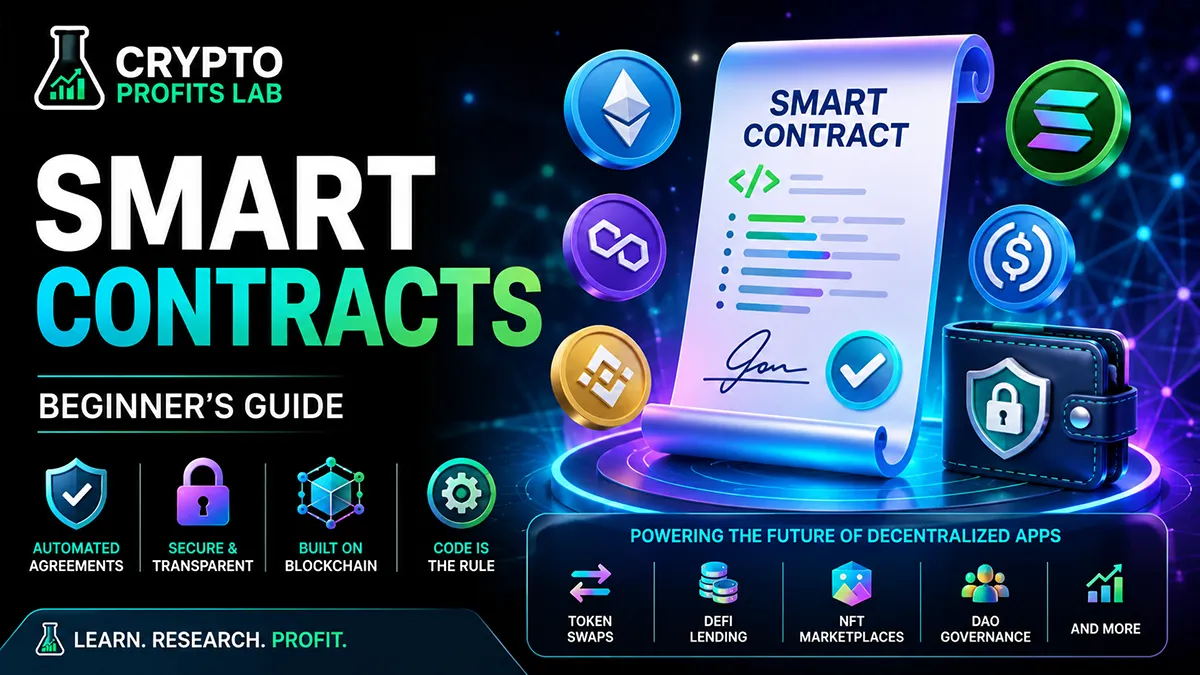
Smart contracts are programs that run on a blockchain. They can follow rules, move crypto, manage tokens, process swaps, handle lending, and power decentralized apps. Instead of a company employee manually approving every action, the blockchain program follows the code.
This is why smart contracts are important. They help make apps like decentralized exchanges, lending platforms, NFT marketplaces, blockchain games, and DeFi tools possible. They are one of the biggest reasons Ethereum became more than just a cryptocurrency.
This guide explains smart contracts in plain English. You will learn what they are, how they work, where beginners see them, and what risks to understand before using apps that depend on them.
This article is for education only. It is not financial, investment, tax, legal, or coding advice.
Quick Answer: What Are Smart Contracts?
Smart contracts are blockchain-based programs that automatically follow written rules. When the right conditions are met, the program can complete an action, such as sending tokens, recording ownership, processing a swap, or managing collateral.
A simple way to think about them is this:
A normal app uses a company’s private servers. A blockchain app can use code that runs on a public blockchain.
For example, a decentralized exchange may use smart contracts to let users swap one token for another without a traditional exchange holding the funds. A lending app may use them to manage deposits, loans, and collateral.
Beginners do not need to write code to understand the basic idea. You only need to know that these programs can control real crypto assets, so safety matters.
If you are new to blockchain basics, read What Is Cryptocurrency? and Blockchain Technology first.
Key Takeaways
- Smart contracts are programs that run on a blockchain.
- They can automatically follow rules without a traditional middleman.
- Ethereum is one of the best-known blockchains for these programs.
- DeFi apps, token swaps, lending platforms, NFTs, and some games use them.
- The code can control real crypto assets, so mistakes can be costly.
- A wallet approval can give a program permission to interact with your tokens.
- Beginners should use trusted apps, small test amounts, and strong wallet safety.
- Smart contracts are powerful, but they are not risk-free.
Beginner Facts Table
| Topic | Beginner Explanation |
|---|---|
| Smart contracts | Blockchain programs that follow coded rules |
| Most common network | Ethereum, though many blockchains support them |
| Main use | Apps, token swaps, lending, NFTs, DeFi, automation |
| User tool | Crypto wallet |
| Main benefit | Removes some middlemen and automates actions |
| Main risk | Bugs, scams, bad approvals, and user mistakes |
| Beginner rule | Never approve a wallet transaction you do not understand |
Why Smart Contracts Matter
Smart contracts matter because they allow blockchains to do more than send coins from one person to another. Bitcoin showed that digital money could work without a central bank. Ethereum expanded the idea by making it possible to run applications on a blockchain.
These applications can be simple or complex. Some only move tokens. Others manage entire financial systems. A DeFi platform, for example, may allow users to lend, borrow, trade, or provide liquidity using blockchain code.
This is a major part of what makes crypto different from traditional finance. Instead of relying only on a bank, broker, or payment processor, users can interact with blockchain-based systems through a wallet.
That does not mean the system is automatically safer. It means the trust model changes. Instead of trusting only a company, users may trust code, wallet security, liquidity, and the app’s design.
To understand how this connects to decentralized finance, read What Is DeFi?.
How Smart Contracts Work
Smart contracts operate on a blockchain and respond to transactions. A user connects a crypto wallet to an app, reviews an action, signs a transaction, and the program follows its coded rules.
Ethereum.org explains that smart contracts are programs that run on the Ethereum blockchain and live at a specific blockchain address.
Here is a simple step-by-step example:
- A user opens a decentralized app.
- The user connects a crypto wallet.
- The app shows an action, such as swapping tokens.
- The wallet asks the user to approve or sign.
- The transaction is sent to the blockchain.
- The contract checks whether the rules are met.
- If the rules are met, the action is completed.
- The result is recorded on the blockchain.
This can happen without a bank employee, exchange support agent, or payment company manually approving the action. The code handles the rules.
But this also means users need to be careful. If the app is fake, the code is malicious, or the wallet approval is dangerous, a user may lose funds.
Smart Contracts and Ethereum
Ethereum is the most famous blockchain for smart contracts. It was designed to support applications, tokens, and programmable blockchain activity. This is why many beginners hear about Ethereum when they start learning DeFi, NFTs, token swaps, and decentralized apps.
ETH is the native cryptocurrency of Ethereum. Users often need ETH to pay gas fees when interacting with apps on the network. Gas fees are the transaction costs paid to use the blockchain.
Ethereum is not the only network that supports blockchain programs. Solana, Avalanche, Cardano, Sui, Arbitrum, Optimism, and other networks also have app ecosystems. However, Ethereum remains one of the most important places to start learning because many common crypto tools and concepts grew from its ecosystem.
To keep learning, read What Is Ethereum? and What Are Crypto Gas Fees?.
Smart Contracts vs Traditional Contracts
The word “contract” can cause confusion. A traditional contract is usually a legal agreement between people or businesses. It may be written on paper or signed digitally. If someone breaks the agreement, lawyers, courts, or companies may get involved.
Smart contracts are different. They are not always legal contracts. They are computer programs that execute instructions on a blockchain.
Here is a simple comparison:
| Feature | Traditional Contract | Blockchain Contract |
|---|---|---|
| Format | Legal document | Code on a blockchain |
| Enforcement | Courts, lawyers, companies | Program rules |
| Access | Usually private parties | Often public blockchain users |
| Speed | May require manual steps | Can run automatically |
| Flexibility | Can be interpreted by people | Follows code exactly |
| Risk | Legal disputes | Code bugs and user mistakes |
The key point for beginners is this: code follows instructions exactly. It does not understand your intent. If you click the wrong button, sign a bad transaction, or use a fake site, the blockchain may not be able to reverse the result.
Common Uses for Smart Contracts
Smart contracts are used across many areas of crypto. Beginners usually encounter them through apps, token swaps, and DeFi platforms.
Common uses include:
- Swapping tokens on decentralized exchanges
- Lending and borrowing crypto
- Minting or trading NFTs
- Managing stablecoin systems
- Creating tokens
- Running blockchain games
- Handling liquidity pools
- Voting in governance systems
- Managing airdrop claims
- Automating reward distribution
For example, Uniswap uses blockchain-based systems to allow token swaps. Aave uses them for lending and borrowing markets. Stablecoins may use them to issue, transfer, or manage tokens.
Helpful internal guides include What Is Uniswap?, What Is Aave?, and What Are Stablecoins?.
Step-by-Step: A Simple Token Swap Example
A token swap is one of the easiest examples for beginners to understand.
Imagine someone wants to swap ETH for a stablecoin on a decentralized exchange. The process may look like this:
- The user opens the exchange app.
- The user connects a wallet.
- The user chooses ETH as the asset to trade.
- The user chooses a stablecoin as the asset to receive.
- The app shows the expected amount and fee.
- The wallet asks the user to confirm.
- The blockchain program processes the swap.
- The new token appears in the wallet after confirmation.
This sounds simple, but several things can go wrong. The user could visit a fake website, choose the wrong token, approve too much access, misunderstand gas fees, or trade during high volatility.
That is why beginners should start with small amounts and learn slowly. A small test transaction can prevent a much larger mistake later.
Before using swaps, read Crypto Wallet and Crypto Safety Tips.
Wallets and Approvals
A crypto wallet is the tool most people use to interact with blockchain apps. The wallet holds private keys and signs transactions. It does not literally hold coins like a physical wallet. The assets exist on the blockchain, and the wallet controls access.
When using apps, beginners may see two common wallet actions:
A signature is the wallet’s way of signing a message or transaction.
An approval is when the wallet gives permission for an app to interact with a token.
Approvals are especially important. Some approvals allow a contract to move a certain token from your wallet. This can be normal when using real apps, but dangerous if the app is malicious.
A beginner should not click approve just because a website asks. Read the wallet prompt. Check the URL. Use trusted apps. Avoid direct-message links. Keep large balances away from risky activity wallets.
To understand the security side, read Crypto Private Key and Crypto Seed Phrase.
Safety and Risk: What Beginners Should Know
Smart contracts can be powerful, but they can also be risky. Code can contain bugs. Hackers may exploit weak designs. Fake websites may trick users into signing harmful agreements. Some projects may look professional but still have poor security.
Common risks include:
- Code bugs
- Wallet-draining scams
- Fake app websites
- Bad token approvals
- Liquidity problems
- Oracle failures
- Bridge risk
- Admin key risk
- Unclear project control
- User error
Admin key risk means a team or developer may still have special control over parts of a project. Oracle risk means an app may depend on outside price data, and bad data can cause problems. Bridge risk appears when assets move between blockchains.
Beginners do not need to master every technical risk immediately, but they should know that blockchain programs are not automatically safe.
For scam protection, read Crypto Scams to Avoid.
Smart Contracts and DeFi
DeFi depends heavily on smart contracts. Without them, decentralized exchanges, lending apps, liquidity pools, and yield farming would not work the same way.
A DeFi app may use code to:
- Accept deposits
- Track balances
- Match swaps
- Manage collateral
- Calculate interest
- Process liquidations
- Distribute rewards
- Record governance votes
This creates open financial tools, but it also creates responsibility. A user who borrows through a DeFi app may be liquidated if collateral falls too much. A user who provides liquidity may face impermanent loss. A user chasing high yield may not understand where the risk comes from.
This is why beginners should not jump straight into complex strategies. Learn the basics first. Then use small amounts if you decide to try an app.
Read Crypto Yield Farming and Crypto Lending before using advanced DeFi tools.
Smart Contracts and Tokens
Many tokens are created and managed using smart contracts. On Ethereum, for example, tokens can follow common standards so wallets and apps know how to interact with them.
This is why projects can create new assets, governance tokens, stablecoins, reward tokens, or meme coins. The token rules may define supply, transfers, permissions, and other features.
However, token creation is easier than building real value. A project can launch a token quickly, but that does not mean the token is useful, safe, or fairly distributed.
This is where tokenomics matters. Tokenomics explains the supply, distribution, utility, unlocks, and incentives behind a token. Beginners should study it before buying new coins.
Read What Is Tokenomics? and What Are Altcoins? before judging a project by price or hype alone.
Common Beginner Mistakes
The first mistake is thinking all blockchain apps are safe because they are decentralized. Decentralized does not automatically mean secure.
The second mistake is approving wallet permissions without reading them. A bad approval can expose tokens to a malicious contract.
The third mistake is using a main wallet for risky apps. A separate wallet with small amounts is safer for learning.
The fourth mistake is clicking links from social media or direct messages. Scammers often copy real app designs and create fake claim pages.
The fifth mistake is assuming an audit guarantees safety. A code audit can help, but it does not remove all risk.
The sixth mistake is chasing high yield before understanding how an app works. High returns often come with high risk.
The seventh mistake is not understanding gas fees. A transaction may fail, cost money, or become expensive during network congestion.
These mistakes are avoidable when beginners slow down and learn the basics.
Beginner Checklist Before Using Blockchain Apps
Use this checklist before interacting with smart contracts:
- Confirm the website URL.
- Avoid links from direct messages.
- Use a separate wallet for testing.
- Keep only small amounts in a hot wallet.
- Read every wallet prompt.
- Understand what approval means.
- Check gas fees before confirming.
- Research the app’s reputation.
- Avoid unrealistic returns.
- Learn what the app actually does.
- Keep your seed phrase offline.
- Do not use your main storage wallet for risky activity.
- Track transactions for records and taxes.
- Stop if you feel rushed or confused.
This checklist will not remove all risk, but it can prevent common beginner mistakes.
Final Thoughts
Smart contracts are blockchain programs that follow coded rules. They help power DeFi, token swaps, lending platforms, stablecoins, NFTs, airdrops, and many crypto apps.
They are one of the most important ideas beginners can learn because they explain why blockchains like Ethereum are useful beyond simple payments. But they also require caution. Code can have bugs. Fake websites can steal funds. Wallet approvals can be dangerous. Blockchain transactions are usually hard to reverse.
The best beginner approach is simple: learn the concept first, protect your wallet, use small amounts, verify links, and never approve a transaction you do not understand.
Crypto Profits Lab is built to make crypto easier for beginners by explaining one concept at a time. If you want to keep learning, your next best reads are What Is Ethereum?, What Is DeFi?, and Crypto Wallet.
FAQ: Smart Contracts for Beginners
What are smart contracts in simple terms?
Smart contracts are programs that run on a blockchain and follow coded rules. They can automatically process actions such as token swaps, lending, transfers, and ownership record updates when conditions are met. Beginners can think of them as blockchain-based instructions that apps use to function. They are powerful, but they can also carry risks if the code or website is unsafe.
Are smart contracts legally binding contracts?
Not always. Despite the name, smart contracts are usually computer programs, not traditional legal contracts. A normal contract may involve courts, lawyers, and human interpretation. A blockchain contract follows code. Some real-world agreements may use blockchain tools, but beginners should not assume every smart contract is a legal agreement or offers legal protection.
Why are smart contracts important in crypto?
Smart contracts are important because they allow blockchains to support apps, tokens, DeFi platforms, NFTs, and automated financial tools. Without them, crypto would mostly be limited to sending and receiving coins. They make it possible for users to swap tokens, borrow, lend, provide liquidity, and interact with decentralized apps through a wallet.
Do I need to know how to code to use smart contracts?
No, beginners do not need to know how to code to use smart contracts. Most users interact with them through apps and wallets. However, you should understand basic wallet safety, transaction approvals, gas fees, and scam risks before using blockchain apps. Knowing what a contract does at a high level can help you avoid dangerous clicks and confusing transactions.
Can smart contracts be hacked?
Yes, smart contracts can be hacked or exploited if the code has bugs, weak design, or unsafe permissions. Even audited projects can have risk. Scammers may also create fake websites that trick users into signing harmful transactions. Beginners should use trusted apps, avoid links from unknown sources, use small test amounts, and never approve wallet actions they do not understand.
What is a smart contract wallet approval?
A wallet approval gives a smart contract permission to interact with a token or asset. Some approvals are normal when using real apps, but malicious approvals can be dangerous. A bad approval may allow a scam contract to move tokens from your wallet. Beginners should read wallet prompts carefully and avoid approving unknown websites or suspicious token permissions.
Which blockchains use smart contracts?
Ethereum is the most famous smart contract blockchain, but many others support similar app functionality. Examples include Solana, Avalanche, Cardano, Sui, Arbitrum, Optimism, and several other networks. Each blockchain has different fees, speed, tools, and risks. Beginners should learn one ecosystem at a time instead of jumping across many networks too quickly.
How do smart contracts relate to DeFi?
DeFi apps use smart contracts to manage trading, lending, borrowing, liquidity pools, rewards, and collateral. Instead of relying only on a bank or centralized company, users interact with blockchain programs through wallets. This can create open financial tools, but it also adds risk. Beginners should understand wallet approvals, liquidation, liquidity, and scam risks before using DeFi.
Are smart contracts safe for beginners?
Smart contracts can be safe to learn about, but using them with real funds requires caution. Beginners should start with education, trusted apps, small test amounts, and strong wallet safety. Never use your main storage wallet for risky experiments. Avoid direct-message links, fake claim pages, and unrealistic yield promises. The safest approach is slow, careful learning.