Crypto Consensus Mechanism Explained: How Blockchains Agree
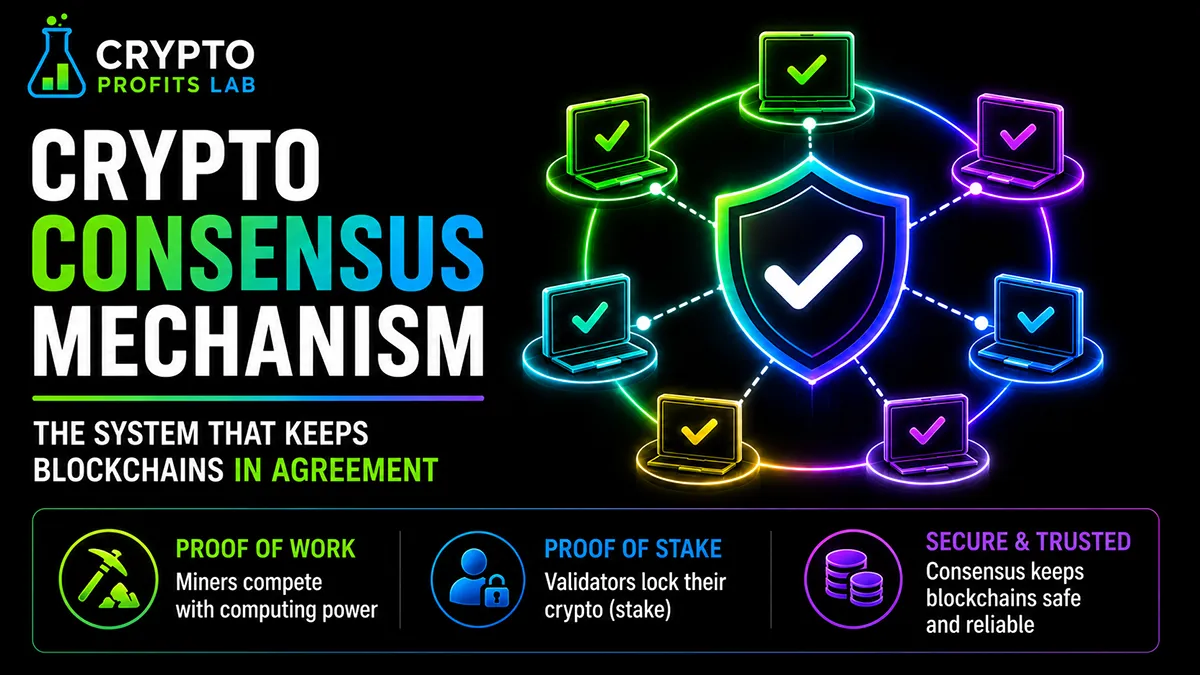
A public blockchain can have thousands of computers storing and checking the same information. Those computers may be operated by people and organizations that do not know or trust one another. Even so, the network needs one accepted transaction history.
A crypto consensus mechanism gives the network a structured way to reach that agreement.
Without a shared method for accepting blocks, rejecting invalid activity, and resolving competing versions of the ledger, a blockchain could split into conflicting records. Users might disagree about balances, transaction order, or which payments are final.
This guide explains the idea in plain English. You will learn how network participants agree, how proof of work and proof of stake differ, why validators and miners matter, and what risks beginners should understand.
Educational note: This article is for general education only. It is not financial, investment, tax, or legal advice.
Quick Answer: What Is a Crypto Consensus Mechanism?
A crypto consensus mechanism is the complete system a blockchain uses to help independent network participants agree on the valid state of the ledger.
That system can include rules for checking transactions, choosing who may propose a block, selecting between competing chains, rewarding honest participation, and penalizing certain dishonest behavior.
Proof of work and proof of stake are the best-known approaches, but they are only parts of a larger agreement process.
A crypto consensus mechanism does not mean every person votes on every transaction. Instead, computers follow shared rules so they can independently reach compatible conclusions about which blocks are valid.
Key Takeaways
- Blockchains need a way for independent computers to agree on one valid history.
- A crypto consensus mechanism combines technical rules, incentives, and security protections.
- Proof of work uses computing work to help secure block production.
- Proof of stake uses locked cryptocurrency and validators.
- Full nodes still check whether transactions and blocks follow network rules.
- A fork-choice rule helps nodes choose between competing valid chains.
- Finality describes how confident users can be that an accepted transaction will not be reversed.
- No system is perfect; every design makes tradeoffs involving security, speed, cost, energy use, and decentralization.
- A familiar label such as proof of stake does not automatically make a network safe or decentralized.
Beginner Consensus Facts
| Question | Beginner-Friendly Answer |
|---|---|
| What does consensus mean? | General agreement among network participants about the valid blockchain state |
| Why is consensus needed? | Different computers need to maintain a compatible transaction history |
| Who participates? | Nodes, miners, validators, and other network software, depending on the blockchain |
| What is proof of work? | A model that uses computational work and mining |
| What is proof of stake? | A model that uses validators and cryptocurrency placed at stake |
| What is a fork-choice rule? | A rule for choosing which valid chain or block history the network should follow |
| What is finality? | The point or level of confidence at which a transaction is unlikely or unable to be reversed |
| Can consensus fail? | Temporary disagreement, attacks, software bugs, or network splits can still occur |
Why Blockchains Need Agreement
A traditional bank maintains a central database. If two records conflict, the bank decides which record is correct.
A public blockchain works differently. Copies of the ledger can be stored by many independent crypto nodes. New transactions may reach those nodes at slightly different times because information takes time to travel across a network.
Imagine two valid transactions arrive nearly together, or two participants propose different blocks at the same height. The network needs shared rules for deciding what to accept.
A crypto consensus mechanism helps answer questions such as:
- Is the transaction properly authorized?
- Does the sender have the required funds?
- Does the proposed block follow the protocol rules?
- Who is allowed to propose the next block?
- Which chain should nodes follow when more than one valid possibility appears?
- When should a transaction be treated as final?
- How are honest participants rewarded?
- How are certain harmful actions discouraged?
Consensus does not create truth about events outside the blockchain. It creates agreement about the information processed under the blockchain’s rules.
How a Crypto Consensus Mechanism Works Step by Step
The details differ across networks, but the general process can be explained in eight steps.
Step 1: A User Creates a Transaction
A user sends cryptocurrency, interacts with a smart contract, or performs another supported action.
The transaction is signed with the appropriate private key and broadcast to the crypto network.
Step 2: Nodes Check Basic Rules
Nodes examine whether the transaction follows protocol requirements.
They may check the digital signature, available balance, transaction format, fee, and whether the same funds have already been spent.
Invalid transactions should be rejected rather than included in the accepted ledger.
Step 3: Valid Transactions Wait for Inclusion
Valid pending transactions may enter a waiting area commonly called a crypto mempool.
A pending transaction is not yet part of a confirmed block.
Step 4: A Block Producer Is Selected
The method depends on the network.
In proof of work, miners compete through computational work. In proof of stake, a validator may be selected according to the protocol’s staking and selection rules.
This selection process is an important part of a crypto consensus mechanism because an open network must limit who can propose blocks without relying on one central administrator.
Step 5: A Candidate Block Is Proposed
The selected miner or validator gathers valid transactions into a proposed block.
The block normally includes a reference to a previous block, helping create an ordered chain of records.
Step 6: Other Participants Verify the Block
Other nodes check the candidate block against the network’s consensus rules.
They do not need to trust the block producer. They can independently reject a block that creates unauthorized coins, spends funds incorrectly, or breaks another rule.
Step 7: The Network Chooses the Accepted Chain
Sometimes competing blocks appear because of timing, connectivity, or deliberate behavior.
A fork-choice rule helps participants select which valid chain to continue building on. The rule may consider cumulative computational work, validator votes, staked value, or another network-specific measure.
Step 8: Confirmations or Finality Increase Confidence
Once a transaction is included, later blocks or validator votes can make reversal less likely.
Our guide to crypto confirmations explains why users and exchanges may wait before treating a transfer as complete.
Consensus Rules vs. Consensus Mechanism
These two terms are closely related but not identical.
Consensus rules define what nodes consider valid. They can cover transaction signatures, block size, token issuance, timing, and other protocol requirements.
A crypto consensus mechanism is broader. It includes the rules plus the processes and incentives that help independent participants produce blocks, choose a chain, and maintain agreement.
This distinction matters because miners or validators generally cannot rewrite every rule simply because they produce blocks. Full nodes can reject blocks that violate the software rules they enforce.
For a more technical overview, read Ethereum.org’s consensus mechanisms guide.
Proof of Work Explained
Proof of work is the model most closely associated with Bitcoin.
Miners use specialized computing equipment to repeatedly perform calculations. The first miner to produce a result that satisfies the network’s current requirement can propose a block.
Other nodes can verify the result far more easily than the miner could find it.
The proof-of-work crypto consensus mechanism uses real-world resources, including equipment and electricity, to make block production costly. An attacker attempting to overpower the network may need an enormous amount of computing capacity and ongoing energy.
Miners are commonly rewarded through newly issued coins, transaction fees, or both. Our crypto mining for beginners guide explains the mining process in more detail.
Possible Proof-of-Work Strengths
- Long operating history on major networks
- Simple economic idea: attacks require costly computing resources
- Block production can be open to participants with suitable equipment
- Invalid blocks remain rejectable by independently operated nodes
Possible Proof-of-Work Tradeoffs
- Significant electricity use on large networks
- Specialized equipment can be expensive
- Mining capacity may become concentrated
- Blocks can have probabilistic rather than immediate finality
- Smaller networks may be more vulnerable to majority-hash-power attacks
Proof of Stake Explained
Proof of stake uses validators rather than mining competition.
Participants lock or commit cryptocurrency according to the protocol’s rules. Selected validators propose blocks, and other validators check or vote on them.
Honest participation can earn rewards. Some networks impose penalties when validators are offline or break important rules. Serious violations may lead to crypto slashing, which can destroy part of the validator’s stake.
The proof-of-stake crypto consensus mechanism makes attacks economically expensive by requiring influence to be backed by valuable staked assets.
A crypto validator runs software, follows network rules, checks blocks, and performs duties defined by the protocol.
Possible Proof-of-Stake Strengths
- Much lower direct energy use than mining-based competition
- No need for large fleets of mining equipment
- Economic penalties can discourage some dishonest behavior
- Some designs can provide stronger or faster forms of finality
Possible Proof-of-Stake Tradeoffs
- Large holders or staking providers may gain substantial influence
- Validator software and key management can be complex
- Protocol design may require detailed penalty and recovery rules
- Users may depend on pools or custodians rather than validating directly
- New or poorly tested designs can contain unexpected weaknesses
Proof of Work vs. Proof of Stake
| Feature | Proof of Work | Proof of Stake |
|---|---|---|
| Main resource | Computing work and electricity | Cryptocurrency placed at stake |
| Block participants | Miners | Validators |
| Common rewards | New coins and transaction fees | Staking rewards and transaction-related rewards |
| Main attack cost | Equipment, electricity, and computing power | Acquiring or controlling substantial stake |
| Energy profile | Can be energy-intensive | Usually uses far less direct energy |
| Common concentration concern | Large mining operations or pools | Large holders, exchanges, or staking pools |
| Penalties | Wasted work and operating costs | Missed rewards and possible slashing |
| Example | Bitcoin | Ethereum |
Neither approach is automatically superior in every situation. A network’s security depends on the complete implementation, participant distribution, software quality, economic value, and community response—not only the category name.
Other Consensus Approaches
Proof of work and proof of stake are not the only designs.
Proof of authority allows a limited group of approved validators to produce blocks. Delegated systems let token holders elect a smaller producer group. Byzantine fault-tolerant designs use rounds of messages and voting so honest validators can agree even when some participants fail or act incorrectly. Hybrid networks combine several techniques.
These models may improve speed or finality, but they can introduce concentration and coordination risks. The label never explains the entire crypto consensus mechanism; beginners must look at who controls block production and how the network responds when participants disagree.
Miners, Validators, and Full Nodes
Miners propose blocks through proof of work. Validators perform staking-related duties and may propose or vote on blocks in proof-of-stake systems. Full nodes independently check transactions and blocks against protocol rules.
These roles can overlap, but they are not identical. A block producer proposes information; other nodes still decide whether it follows the rules they enforce.
What Is Finality?
Finality describes the level of confidence that an accepted transaction will not be reversed.
Some blockchains use probabilistic finality. Confidence increases as more blocks are added after the transaction.
Other systems include explicit validator voting or checkpoints. Once the required conditions are met, reversing the finalized history may be extremely difficult or require breaking major protocol assumptions.
A crypto consensus mechanism must define how the network handles recent competing blocks and when users can reasonably rely on an accepted result.
Finality is especially important for exchanges, bridges, merchants, and high-value transfers.
What Is a Blockchain Fork?
A crypto fork can refer to a temporary difference between competing chain tips or a lasting change in network rules.
Temporary forks may happen when two valid blocks are proposed close together. The fork-choice process normally causes the network to settle on one branch.
A permanent split can happen when groups adopt incompatible rules and continue supporting different chains.
A crypto consensus mechanism can resolve temporary competition under shared rules, but it cannot always prevent a social or software disagreement from producing separate networks.
What Is a 51% Attack?
A majority attack happens when one participant or coordinated group controls enough of the resource used for chain selection to gain abnormal influence.
On a proof-of-work network, this usually refers to a majority of effective mining power. On proof-of-stake networks, the relevant thresholds and consequences depend on the protocol.
A powerful attacker may attempt to reorganize recent blocks, censor transactions, or double-spend its own funds. It generally cannot create valid signatures for other users’ wallets or ignore every consensus rule without nodes rejecting the blocks.
Smaller networks may be more vulnerable because obtaining a large share of their mining power or stake can be less expensive.
Why Incentives Matter
Open blockchains cannot assume every participant is honest.
Rewards encourage miners or validators to perform useful work. Costs and penalties make certain attacks less attractive.
The design tries to make honest behavior economically rational while making disruption expensive, detectable, or punishable.
However, incentives can fail when:
- Rewards are poorly designed
- One group gains excessive influence
- The network’s token loses substantial value
- Software rules contain a bug
- Participants can profit from behavior the designers did not expect
- Social coordination overrides the intended process
A crypto consensus mechanism combines code with economic assumptions and human behavior. Security therefore depends on more than mathematics alone.
How to Evaluate a Blockchain’s Consensus Design
Beginners do not need to read source code to ask useful questions.
- Identify whether the network uses proof of work, proof of stake, authority, delegation, or a hybrid.
- Find out who can produce blocks and whether participation is open or permissioned.
- Check whether ordinary users can run independent verifying nodes.
- Review concentration among miners, validators, staking providers, exchanges, or token holders.
- Learn how the network chooses between competing chains and reaches finality.
- Research outages, reorganizations, software bugs, penalties, and controversial forks.
- Compare the promised speed and low fees with the network’s decentralization and security tradeoffs.
A crypto consensus mechanism should be judged by the complete design and operating history, not by a marketing label.
Safety and Risk for Beginners
Most users do not participate directly in consensus. The crypto consensus mechanism can still affect them when sending funds, staking, using a bridge, or waiting for an exchange deposit.
Use these precautions:
- Confirm that your wallet is connected to the intended network.
- Wait for the recommended number of confirmations on important transfers.
- Treat unusually high staking returns cautiously.
- Understand whether a staking provider controls your keys.
- Do not assume a large market value eliminates technical risk.
- Avoid moving funds during a reported network outage unless necessary.
- Verify official announcements during forks or upgrades.
- Never enter a seed phrase to “update” or “synchronize” a wallet.
- Begin with a small test transfer when using a new network.
Our crypto safety tips provide a broader checklist for protecting funds.
Common Beginner Mistakes
Mistake 1: Thinking Consensus Means Every User Votes
Most users do not manually vote on individual transactions. Network software follows protocol rules, while specific miners, validators, and nodes perform different roles.
Mistake 2: Treating Proof of Work or Proof of Stake as the Whole System
Each is an important component, but chain selection, validation rules, incentives, networking, and finality are also part of the crypto consensus mechanism.
Mistake 3: Assuming Validators Can Approve Anything
Other nodes can reject blocks that violate the rules they enforce.
Mistake 4: Believing More Speed Always Means Better Consensus
Faster processing may involve tradeoffs involving validator count, hardware requirements, finality, or decentralization.
Mistake 5: Confusing Staking With Guaranteed Income
Staking rewards can be offset by token-price losses, fees, downtime, lockups, or slashing. Read our crypto staking guide before participating.
Mistake 6: Ignoring Network-Specific Rules
Confirmation times, validator requirements, penalties, and attack thresholds differ across blockchains.
Mistake 7: Trusting Marketing Labels
Terms such as decentralized, secure, or next-generation should be supported by verifiable information about operators, nodes, code, and control.
Beginner Consensus Checklist
Before using or investing in a blockchain, ask:
- Which crypto consensus mechanism does it use?
- Who can produce or validate blocks?
- Can ordinary users run verifying nodes?
- How concentrated are miners, validators, or stake?
- What resource makes an attack expensive?
- How does the network choose between competing chains?
- How and when does finality occur?
- What rewards honest participation?
- What penalties discourage harmful behavior?
- Has the network experienced outages or reorganizations?
- Can one company pause or upgrade important parts?
- What happens when the community disagrees about the rules?
- Are the benefits worth the technical and economic risks?
The goal is not to find a perfect blockchain. The goal is to understand what assumptions you are relying on.
Final Thoughts
A crypto consensus mechanism allows independent blockchain participants to maintain a compatible ledger without giving one central database operator complete authority.
It includes validation rules, block production, chain selection, incentives, penalties, networking, and finality. Proof of work uses costly computation. Proof of stake uses validators and committed assets. Other networks rely on approved authorities, elected delegates, voting rounds, or hybrid designs.
Every approach makes tradeoffs. Fast processing may come with fewer block producers. Broad participation may make coordination slower. Strong technical rules can still be weakened by poor software, concentrated control, or user mistakes.
Beginners should ask: Who has power? What makes attacks expensive? Who checks the rules? How are disagreements resolved? When is a transaction final?
Crypto Profits Lab provides cleaner, simpler crypto education so readers can understand these systems without hype and make better-informed decisions.
Crypto Consensus Mechanism Frequently Asked Questions
What is a crypto consensus mechanism in simple terms?
A crypto consensus mechanism is the system a blockchain uses to help separate computers agree on one valid transaction history. It includes rules for checking blocks, choosing block producers, resolving competing chains, and rewarding honest participation. Proof of work and proof of stake are common components, but the complete agreement process also includes validation and chain-selection rules.
Why does cryptocurrency need consensus?
Cryptocurrency networks may be operated by many independent computers rather than one bank or company. Those computers can receive transactions at different times and may occasionally see competing blocks. Consensus provides shared rules for deciding which transactions are valid, which chain to follow, and when payments can be treated as confirmed. Without it, users could maintain conflicting records of balances and ownership.
Is proof of work a crypto consensus mechanism?
Proof of work is commonly called a consensus mechanism, but technically it is one major component of the broader system. It helps choose block producers and makes attacks costly through computation and energy use. The complete process also relies on transaction-validation rules, a method for choosing between chains, network communication, and incentives that encourage participants to follow the protocol.
Is proof of stake safer than proof of work?
Neither model is automatically safer in every situation. Security depends on the network’s implementation, economic value, validator or miner distribution, software quality, node participation, and history. Proof of work makes attacks costly through computing resources. Proof of stake relies on valuable assets, validators, rewards, and penalties. Each approach has different concentration and operational risks.
What happens when blockchain nodes disagree?
Nodes follow a fork-choice rule to select among valid competing chains. Temporary disagreement can occur when blocks are proposed close together, or information reaches nodes at different times. As more work, validator votes, or protocol-defined weight accumulates on one branch, nodes normally converge on it. Lasting disagreement about the rules can instead result in a permanent blockchain fork.
Can a consensus mechanism be hacked?
Attackers may target software bugs, validator keys, mining power, network communication, economic incentives, or governance processes. A well-secured crypto consensus mechanism is designed to make control expensive and invalid activity rejectable, but no network is immune to every failure. Smaller or highly concentrated networks may be easier to disrupt than established networks with broad participation and strong economic security.
What is finality in blockchain consensus?
Finality describes how confident users can be that an accepted transaction will not be reversed. On some networks, confidence grows as more blocks are added. Other networks use validator votes or checkpoints to explicitly finalize blocks. The required waiting time depends on the blockchain, transaction value, and receiving service. Finality is especially important for exchanges, bridges, and large transfers.
Do all cryptocurrencies use the same consensus system?
No. Bitcoin uses proof of work, while Ethereum uses a proof-of-stake-based system. Other networks use delegated staking, proof of authority, Byzantine fault-tolerant voting, or hybrid methods. Each design chooses different tradeoffs involving speed, energy, hardware, validator access, economic security, and decentralization. Beginners should research the specific rules of any network they plan to use.