Crypto Order Book: What It Is and How Beginners Read It
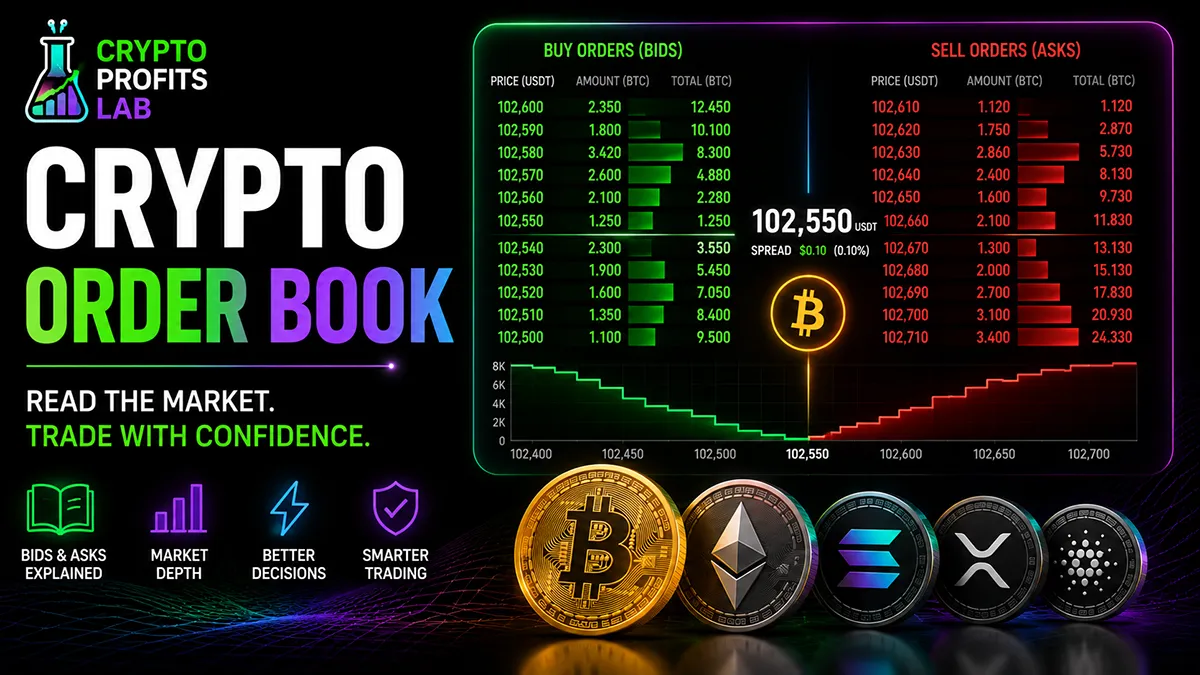
When you open the advanced trading screen on a cryptocurrency exchange, you may see two fast-moving columns of numbers beside the price chart. One side may be green, the other red, and the prices can change every second.
That display is usually a crypto order book.
At first, it can look complicated. In reality, the basic idea is simple: the order book shows prices where people are currently willing to buy and sell a specific cryptocurrency on that exchange.
Learning how to read it can help beginners understand where a market price comes from, why a trade may execute at a different price than expected, and why some cryptocurrencies are easier to buy or sell than others.
You do not need to become a day trader to understand a crypto order book. Even long-term investors can benefit from knowing what bids, asks, spreads, and market depth mean before placing a trade.
Quick Answer
A crypto order book is a live list of buy and sell orders for a cryptocurrency trading pair on an exchange.
Buy orders are called bids. Sell orders are called asks. The highest bid shows the highest price a buyer is currently offering, while the lowest ask shows the lowest price a seller is currently willing to accept.
The difference between those two prices is called the bid-ask spread.
A crypto order book can also show how much cryptocurrency traders are offering at different price levels. This is often called market depth.
Beginners should use the order book as a way to understand current supply, demand, liquidity, and possible trade execution. It should not be treated as a prediction of where the price will move next.
Key Takeaways
- A crypto order book displays current buy and sell orders for a specific trading pair.
- Buy orders are called bids, while sell orders are called asks.
- The highest bid and lowest ask are the prices closest to a potential trade.
- The gap between the best bid and best ask is the bid-ask spread.
- A tight spread often appears in more liquid markets, while a wide spread can increase trading costs.
- Market depth shows how much buying and selling interest exists at different price levels.
- Large visible orders can change or disappear, so the order book should never be treated as a guaranteed price forecast.
- Market orders can move through several price levels when liquidity is thin, creating slippage.
Beginner Facts About a Crypto Order Book
| Beginner Question | Simple Answer |
|---|---|
| What does an order book show? | Current buy and sell orders |
| What is a bid? | A price a buyer is willing to pay |
| What is an ask? | A price a seller is willing to accept |
| What is the best bid? | The highest current buy price |
| What is the best ask? | The lowest current sell price |
| What is the spread? | The difference between the best bid and best ask |
| What is market depth? | The amount available at multiple price levels |
| Does every exchange have the same order book? | No |
| Can orders disappear? | Yes, unfilled orders can often be canceled |
| Does an order book predict price? | No |
What Is a Crypto Order Book?
A crypto order book is an electronic list of outstanding orders for a specific market, such as BTC/USD, ETH/USD, or XRP/USDT.
An outstanding order is simply an instruction that has been placed but has not yet been completely filled or canceled.
The order book generally separates buyers from sellers. Buyers state how much they want to buy and the price they are willing to pay. Sellers state how much they want to sell and the price they are willing to accept.
The Coinbase guide to order books describes an order book as a list of current buy orders, or bids, and sell orders, or asks, for an asset.
The important beginner idea is that the visible market price is not created by one person or one company simply choosing a number. On an order-book exchange, prices develop as buyers and sellers place orders and trades occur when compatible orders meet.
If you are new to trading platforms, our guide to a crypto exchange explains the basic role exchanges play in helping users buy, sell, and trade digital assets.
Understanding Trading Pairs First
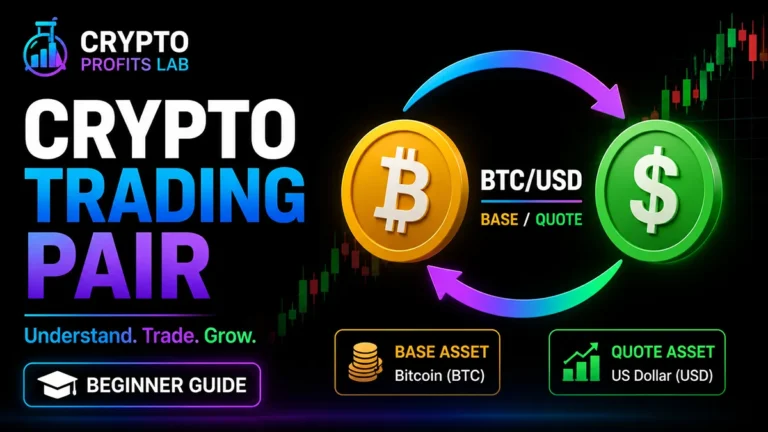
Before reading an order book, check the trading pair. A pair tells you what asset is being traded and what it is priced in.
BTC/USD means Bitcoin priced in U.S. dollars, while ETH/USDT means Ether priced in USDT. The first asset is commonly called the base asset and the second the quote asset.
An order book belongs to one specific pair on one venue. BTC/USD on one exchange can therefore look different from BTC/USD on another because the customers, orders, and liquidity are different.
The Two Sides: Bids and Asks
The easiest way to understand a crypto order book is to divide it into two sides.
Bids: The Buy Side
Bids are open buy orders.
A bidder is saying, in effect, “I am willing to buy this amount at this price.”
The highest bid is usually the buy order closest to the current market. It is often called the best bid.
Imagine the highest visible bids for a coin are:
| Bid Price | Amount Wanted |
|---|---|
| $99.90 | 25 coins |
| $99.80 | 40 coins |
| $99.70 | 60 coins |
The $99.90 order is currently the best bid because it is the highest price a visible buyer is offering.
Asks: The Sell Side
Asks are open sell orders.
A seller is saying, “I am willing to sell this amount at this price.”
The lowest ask is usually called the best ask because it is the lowest visible price at which a seller is willing to sell.
For example:
| Ask Price | Amount Offered |
|---|---|
| $100.10 | 20 coins |
| $100.20 | 35 coins |
| $100.30 | 55 coins |
Here, $100.10 is the best ask.
Together, these bids and asks form the core of the crypto order book.
What Is the Bid-Ask Spread?
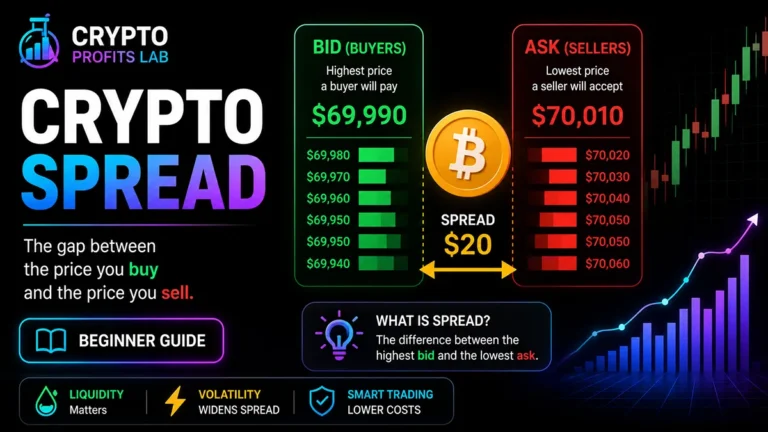
The bid-ask spread is the difference between the highest bid and lowest ask.
Using the examples above:
- Best bid: $99.90
- Best ask: $100.10
- Spread: $0.20
The spread matters because buyers and sellers are not always agreeing on exactly the same price.
When a market has lots of active buyers and sellers, bids and asks may sit very close together. This is commonly described as a tight spread.
When trading activity is lower, the best bid and best ask may be farther apart. This creates a wider spread.
A wider spread can make entering and exiting a position more expensive, especially when using market orders.
Spread is closely connected to crypto liquidity. Liquid markets generally have more orders available near the current price, although liquidity can change quickly.
What Is Market Depth?
A crypto order book does more than show the best bid and best ask. It may show many price levels above and below the current market.
That collection of available orders is often described as market depth.
Suppose a coin is trading near $10. One market might have thousands of coins available within a few cents of the current price. Another market might have only a small number available before the next orders are much farther away.
The first market would generally be considered deeper and more liquid at that moment.
Depth matters because a large order may need to fill against several different price levels.
For example, imagine sellers are offering:
| Ask Price | Coins Available |
|---|---|
| $10.00 | 100 |
| $10.02 | 150 |
| $10.05 | 300 |
If someone submits a market order to buy 400 coins, the order may consume all 100 coins at $10.00, all 150 at $10.02, and another 150 at $10.05.
The buyer therefore does not receive all 400 coins at the first visible price.
This leads directly to an important beginner concept: slippage.
How a Crypto Order Book Connects to Slippage
Crypto slippage is the difference between the price you expect and the price at which some or all of your trade actually executes.
A thin order book can increase the chance of slippage because there may not be enough cryptocurrency available at the best displayed price to fill your entire order.
The larger your order is compared with available market depth, the more price levels it may move through.
This is one reason a market order for a highly traded asset may behave differently from a market order for a small token with limited liquidity.
Beginners sometimes see a coin’s displayed price and assume they can buy any amount at that exact number. An order book shows why that assumption is not always correct.
The displayed market price may represent only the most recent trade or the best prices currently available. The quantity available at those prices matters too.
Market Orders vs. Limit Orders in the Order Book
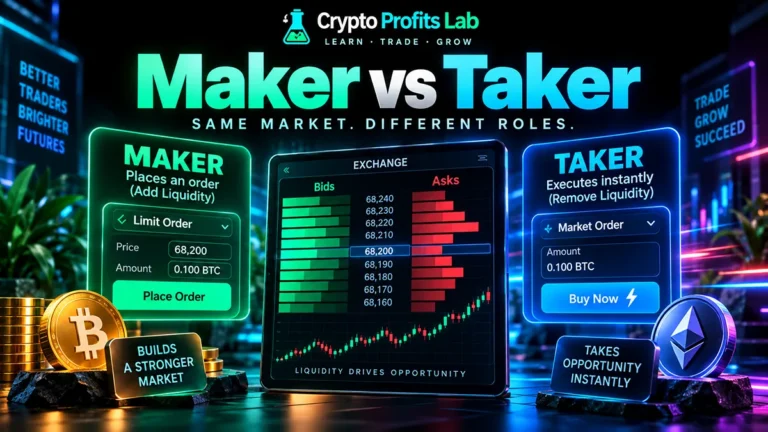
Two order types are especially important when learning a crypto order book: market orders and limit orders.
A market order tells the exchange to buy or sell as soon as possible at the best available prices. The main goal is execution, not getting one exact price.
A limit order lets you specify the maximum price you are willing to pay when buying or the minimum price you are willing to accept when selling.
A limit order that does not execute immediately may remain visible in the order book until it is filled, canceled, or expires according to the exchange’s rules.
For a full beginner explanation, see market order vs. limit order in crypto.
Understanding this difference makes the order book much easier to read. Many of the visible rows are limit orders waiting for another participant to trade against them.
Step-by-Step: How to Read a Crypto Order Book
You do not need to analyze every flashing number. Use this simple process instead.
Step 1: Confirm the Trading Pair
Check the pair at the top of the screen before doing anything else.
BTC/USD is not the same market as BTC/USDT, and the order books can differ.
This simple check can prevent confusion about what currency you are actually using to buy the asset.
Step 2: Find the Best Bid
Look at the buy side and identify the highest current bid.
That is the highest visible price a buyer is currently offering.
Do not assume the full quantity you want can be sold at that price. Check the amount available beside it.
Step 3: Find the Best Ask
Next, locate the lowest current sell price.
That is the best ask.
The best ask is normally the first price a market buy order would encounter, but the final execution can include higher prices if the order is larger than the quantity available.
Step 4: Compare the Spread
Look at the distance between the best bid and best ask.
A very small difference suggests buyers and sellers are currently close in price. A larger difference suggests a wider spread.
Compare spreads within the same asset carefully because spreads can change with liquidity, volatility, exchange activity, and time of day.
Step 5: Look at Several Price Levels
Do not focus on only the first row.
Look slightly deeper into the order book. Are there substantial amounts available near the current price, or does the available quantity drop off quickly?
This gives you a basic view of market depth.
Step 6: Compare Your Order Size With Available Depth
If you are considering a trade, compare its size with the quantity visible near the current price.
A small trade in a deep market may have little effect on execution. A large trade in a thin market can move through multiple levels.
You do not need advanced mathematics to notice the difference.
Step 7: Decide Whether an Order Type Fits Your Goal
If exact price control matters, a limit order may be worth understanding. If immediate execution matters more, a market order may be appropriate, but it can expose you to changing prices and slippage.
Never choose an order type simply because it is the default button on an exchange.
Why Different Exchanges Show Different Order Books
There is no single universal order book containing every crypto order. Each centralized exchange generally maintains its own markets, customers, and liquidity.
That means prices, spreads, and depth can vary slightly between platforms. The book you see is a snapshot of one venue, not every buyer and seller in the global market.
When choosing where to trade, liquidity, fees, security, supported assets, and usability all matter. Our guide to the best crypto exchange for beginners explains the main factors to compare.
Do Decentralized Exchanges Use Order Books?
Some decentralized exchanges use order books, but many popular decentralized trading systems use a different model called an automated market maker, or AMM.
An AMM typically uses liquidity pools and formulas to help determine prices rather than matching every buyer directly with a seller in a traditional central order book.
Because decentralized exchanges can be designed in different ways, beginners should not assume every DEX screen works like a centralized exchange.
If you want to understand that distinction, read What Is a DEX and our beginner guide to liquidity pools in crypto.
7 Smart Ways Beginners Can Use a Crypto Order Book
1. Check Liquidity
Look for active bids and asks near the current price. A deeper book with a tighter spread may make execution easier, although conditions can change quickly.
2. Understand Unexpected Execution Prices
If a market order fills at several prices, the book can show why. There may not have been enough quantity available at the first price.
3. Compare the Spread
A wide spread can add an immediate trading cost because the best buy and sell prices are farther apart.
4. Check More Than the Last Price
The last traded price is not a guarantee for your next order. Available bids, asks, and quantities matter.
5. Be Careful With Thin Markets
Less-active tokens may have fewer orders and larger gaps between price levels, increasing execution risk.
6. Use Other Information Too
A crypto order book is only one tool. Combine it with charts, liquidity, fees, project research, and your own risk plan.
7. Slow Down Before Trading
Checking the spread, order size, and order type before clicking buy or sell can prevent avoidable surprises.
Common Beginner Mistakes
Mistake 1: Assuming Every Number Is a Completed Trade
Most rows are open orders waiting to be filled, not completed trades. Recent transactions are usually shown separately as trade history.
Mistake 2: Treating a Large Wall as a Guarantee
A large bid or ask can look important, but open orders may be reduced or canceled before the price reaches them. Visible size is information, not a promise.
Mistake 3: Ignoring the Spread
A wide spread can affect your entry or exit price, especially in a thin market.
Mistake 4: Using Large Market Orders in Thin Markets
If liquidity is limited, a market order may move through several price levels and create more slippage than expected.
Mistake 5: Treating One Exchange as the Whole Market
An order book represents one venue and trading pair. Other exchanges can show different prices and depth.
Mistake 6: Predicting Price From One Snapshot
Order books change constantly. New orders arrive, existing orders disappear, and news can change market behavior quickly.
Safety and Risk: What Beginners Should Know
Reading an order book can help you understand execution, but it does not remove market risk. Cryptocurrency prices can move quickly, especially during periods of high crypto volatility.
Visible orders are also not permanent. Traders can often cancel unfilled limit orders. Large orders may influence how other traders perceive supply or demand and then disappear, so beginners should avoid making decisions based on a single buy or sell wall.
Market depth does not tell you whether a cryptocurrency is a good investment. A liquid token can still lose value, and active trading does not prove that a project is legitimate or financially sound.
Before trading, verify the asset and trading pair, understand your order type, review fees, and consider how much you can afford to lose. Our guide to crypto trading fees for beginners explains another cost that can affect your results.
Most importantly, do not rush just because numbers are moving quickly. Speed is not the same as opportunity.
Crypto Order Book Frequently Asked Questions
What is a crypto order book in simple terms?
A crypto order book is a live list of buy and sell orders for a cryptocurrency trading pair on an exchange. Buyers place bids showing what they are willing to pay, while sellers place asks showing what they are willing to accept. The book also shows how much cryptocurrency is available at different prices, helping users understand current liquidity and possible trade execution.
What are bids and asks in a crypto order book?
Bids are open buy orders, and asks are open sell orders. The highest bid is the highest visible price a buyer is currently offering. The lowest ask is the lowest visible price a seller is currently willing to accept. These two prices sit closest to each other and help define the current bid-ask spread for that trading pair.
What does the spread mean in an order book?
The spread is the difference between the highest bid and lowest ask. For example, if the best bid is $99.90 and the best ask is $100.10, the spread is $0.20. A tighter spread commonly appears in more liquid markets, while wider spreads can increase the cost and uncertainty of entering or exiting a trade.
Why does my market order fill at several prices?
A market order can fill at several prices when there is not enough quantity available at the best bid or ask to complete the entire trade. The exchange continues matching the order with the next available price levels. This can cause the average execution price to differ from the first price you saw, which is one form of slippage.
Does a large buy wall mean crypto will go up?
No. A large buy wall shows substantial visible bids at a particular price level, but it does not guarantee that price will rise or even hold above that level. Open orders can often be changed or canceled. New market orders can also consume the visible liquidity. Treat buy and sell walls as temporary market information, not dependable predictions.
Is a crypto order book the same on every exchange?
No. Each exchange can have its own customers, trading pairs, open orders, and liquidity. As a result, the same cryptocurrency may show slightly different best bids, best asks, spreads, and market depth across platforms. The order book you see represents the specific market and exchange you are viewing rather than every crypto trade worldwide.
Do beginners need to understand order books to buy crypto?
Beginners can buy crypto without deeply analyzing an order book, especially when using simple purchase interfaces. However, understanding basic bids, asks, spreads, and liquidity can help you recognize how trades are executed and why the final price may differ from the displayed price. This knowledge becomes more useful when using advanced trading screens or limit orders.
Can a crypto order book predict the next price move?
No. A crypto order book shows current open orders, not the future. Visible bids and asks can change or disappear quickly, and unexpected trades or news can alter market conditions. Some traders study order-book behavior as one source of short-term information, but beginners should never treat it as a reliable prediction tool or a guaranteed buy or sell signal.
Final Thoughts
A crypto order book may look intimidating at first, but its purpose is simple: it organizes current buy and sell interest by price.
Once you understand bids, asks, spreads, and market depth, other trading concepts become easier to understand. You can see why market and limit orders behave differently, why thin markets create more slippage, and why the displayed price is not always the exact price every trade receives.
You do not need to watch an order book all day or use it to predict short-term moves. For most beginners, the goal is simply to understand what is happening before placing an order.
That fits the Crypto Profits Lab approach: cleaner, simpler crypto education without turning every concept into hype or a trading signal. Learn the basics, understand the risks, and use the crypto order book to make more informed decisions rather than faster ones.