
Crypto Breakout: A Beginner’s Guide to Price Breakouts
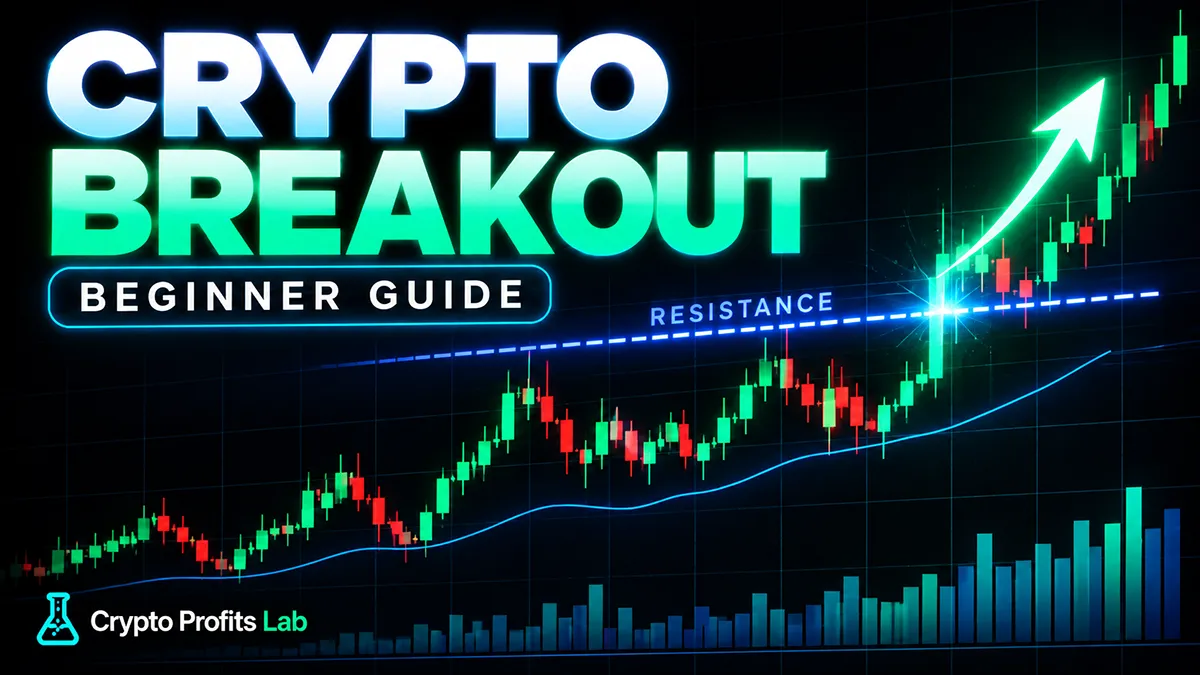
A crypto breakout happens when the price of a cryptocurrency moves clearly beyond an important support or resistance area. Traders watch these moves because they may signal that buyers or sellers have become strong enough to push price outside a range where it had previously been contained.
For beginners, a crypto breakout can look exciting. Price may suddenly move fast, trading activity may increase, and social media may start talking about the move. But a breakout is not automatically a signal that price will keep going in the same direction. Some breakouts fail quickly, and others become false breakouts that trap traders who entered too late.
This guide explains what a breakout is, how it works, what traders commonly look for, why volume matters, how false breakouts happen, and how beginners can analyze these moves without treating them as guaranteed predictions.
Quick Answer: What Is a Crypto Breakout?
A crypto breakout occurs when price moves above resistance or below support after spending time near or inside a defined price range.
For example, imagine a cryptocurrency repeatedly reaches $2.00 but cannot stay above it. That area may act as resistance. If price later rises through $2.00 and holds above it, traders may describe the move as a bullish breakout.
The opposite can happen at support. If price repeatedly holds near $1.70 and then falls decisively below that level, the move may be called a bearish breakout.
A crypto breakout matters because support and resistance often represent areas where buyers and sellers have previously disagreed about value. When price moves beyond one of those areas, the balance between buying and selling may be changing.
Key Takeaways
- A breakout is a move above resistance or below support.
- A bullish breakout moves upward through resistance.
- A bearish breakout moves downward through support.
- Higher trading volume can make a breakout more meaningful, but it does not guarantee success.
- A price wick beyond a level is not always the same as a confirmed breakout.
- Some traders wait for a candle to close beyond the level before considering the breakout established.
- A retest happens when price returns to the broken level after the initial move.
- False breakouts are common, especially in volatile markets.
- Risk management matters because even strong-looking breakouts can fail.
Crypto Breakout Facts for Beginners
| Term | Beginner-Friendly Meaning |
|---|---|
| Breakout | Price moves beyond an important support or resistance area |
| Bullish breakout | Price moves above resistance |
| Bearish breakout | Price moves below support |
| Resistance | An area where selling has previously stopped price from rising |
| Support | An area where buying has previously stopped price from falling |
| Volume | The amount of an asset traded during a period |
| Confirmation | Additional evidence that a breakout may be holding |
| Retest | Price returns to the broken level after the breakout |
| False breakout | Price moves beyond a level but quickly reverses |
| Trading range | An area where price moves between support and resistance |
If support and resistance are new to you, start with our crypto support and resistance guide. It explains the basic price levels that make breakout analysis easier to understand.
Why Breakouts Happen
Markets move because buyers and sellers are constantly competing.
When buyers are willing to pay increasingly higher prices, price can rise. When sellers accept increasingly lower prices, price can fall. Support and resistance areas often form where that competition repeatedly changes direction.
Imagine a cryptocurrency trading between $90 and $100 for several weeks.
Each time price approaches $100, sellers become active and price falls back. That makes $100 a possible resistance area.
At the same time, buyers repeatedly appear near $90. That makes $90 a possible support area.
Eventually, something changes. New demand may enter the market, sellers may become less willing to sell at $100, or broader market conditions may improve. If buying pressure becomes strong enough, price may push through $100.
That move is a crypto breakout above resistance.
The same idea works in reverse. If buyers stop defending $90 and sellers become more aggressive, price can break below support.
Bullish vs. Bearish Breakouts
A bullish breakout happens when price moves above an established resistance area.
A bearish breakout happens when price moves below an established support area.
The terms describe direction, not certainty.
A bullish breakout does not mean price must continue rising. A bearish breakout does not mean price must continue falling. Both can reverse quickly.
For beginners, it is useful to think of a breakout as evidence that the market may be changing, not proof of what must happen next.
Bullish Example
Suppose XRP trades between $2.10 and $2.30 for several days. Price reaches $2.30 multiple times but repeatedly falls back.
If XRP later moves above $2.30 with stronger trading activity and closes above that area, traders may describe it as a bullish breakout.
Bearish Example
Now imagine the same range, but price falls below $2.10 instead.
If selling remains strong and the market begins trading below the former support area, that may be considered a bearish breakout.
Step 1: Identify a Clear Support or Resistance Area
Before analyzing a crypto breakout, you first need a level or zone that matters.
Beginners sometimes draw too many lines on a chart. That can make almost every price move look important.
Instead, focus on obvious areas where price has reacted multiple times.
A resistance area may be more meaningful when price has approached it several times and failed to move through it. A support area may be more meaningful when buyers have repeatedly defended it.
You can learn the chart basics in our crypto charts for beginners guide.
Remember that support and resistance are usually better treated as zones than exact single-price lines. Crypto markets can move quickly, and price may temporarily trade slightly above or below a level before reversing.
Step 2: Watch How Price Approaches the Level
The way price approaches support or resistance can provide useful context.
If price moves toward resistance with a series of higher lows, that may show buyers are becoming more willing to buy at higher prices.
If price moves toward support with a series of lower highs, that may show sellers are becoming more aggressive.
This does not guarantee a breakout. It simply helps you understand the behavior leading into the level.
A sudden vertical move into resistance can also behave differently from a slower, more controlled approach. Fast moves can create excitement, but they can also reverse sharply.
That is one reason beginners should avoid assuming that speed alone makes a crypto breakout stronger.
Step 3: Look at Trading Volume
Trading volume measures how much of an asset changes hands during a period.
Volume can help traders judge how much participation is behind a move.
If price moves through resistance while trading volume increases, more market activity is supporting the move.
Crypto Profits Lab also has a complete crypto trading volume guide that explains the concept in beginner-friendly language.
Low-volume breakouts can still succeed, but they may deserve more caution because fewer market participants are involved.
A crypto breakout with strong volume is not guaranteed to continue. Volume is supporting evidence, not a promise.
Step 4: Decide What Counts as Confirmation
One of the biggest beginner questions is simple: when is a breakout actually a breakout?
There is no single universal rule.
Some traders consider the level broken as soon as price moves through it. Others wait for a candle to close beyond the level. Some want to see both a close beyond the level and increased volume.
The timeframe also matters.
A five-minute candle closing above resistance may mean less to a longer-term trader than a four-hour or daily candle doing the same thing.
The important point is consistency. If you are studying a crypto breakout, decide in advance what confirmation means to you instead of changing the rule after the market moves.
Step 5: Watch for a Retest
After a breakout, price sometimes returns to the level it just crossed.
This is called a retest.
For example, resistance at $100 may be broken when price rises to $104. Price might then fall back toward $100 before moving higher again.
In that situation, the former resistance area may begin acting as support.
The opposite can happen after a bearish breakout. Former support may become resistance when price returns to test it from below.
A retest is not required. Some breakouts continue without returning to the original level.
A retest also does not guarantee continuation. Price can revisit the level and then move back inside the old range.
What Is a False Crypto Breakout?
A false breakout happens when price moves beyond support or resistance but fails to stay there.
Suppose resistance is near $50.
Price jumps to $51.50, attracting traders who believe a breakout has started. Soon afterward, price falls back below $50 and returns to the previous range.
That is a typical false-breakout pattern.
False breakouts are one reason experienced traders often look for confirmation rather than reacting to the first move through a level.
They are especially important in crypto because the market can be highly volatile. Large candles, thin liquidity, sudden news, and rapid shifts in sentiment can all create short-lived moves.
Our crypto volatility guide explains why cryptocurrency prices can change so quickly.
Breakout vs. Fakeout: What Should Beginners Look For?
There is no perfect method for separating a genuine breakout from a fakeout in real time.
However, beginners can look at several pieces of evidence together.
A Close Beyond the Level
A candle that closes beyond support or resistance may carry more information than a quick price spike that immediately reverses.
Stronger Volume
Higher volume can show that more market participants are involved in the move.
Follow-Through
A breakout that continues making progress after the initial move may be more convincing than one that immediately stalls.
Retest Behavior
If price returns to the broken level and then moves away from it again in the breakout direction, some traders view that as additional confirmation.
Broader Market Conditions
A single coin may struggle to sustain a bullish move when the broader crypto market is falling sharply.
These clues should be considered together. None can predict the future with certainty.
Why Wicks Can Confuse Beginners
Candlestick charts show the highest and lowest prices reached during each period.
The thin lines above and below a candle body are often called wicks.
A wick can briefly push above resistance or below support even if the candle eventually closes back inside the range.
That is why some traders do not treat every wick as a confirmed crypto breakout.
For example, if resistance is $100 and price briefly reaches $102 but closes at $99, the market tested prices above resistance but did not finish the period there.
A beginner may see the move above $100 and assume the level was permanently broken. The closing price tells a more complete story.
Breakouts From Trading Ranges
One of the easiest breakout structures for beginners to recognize is a trading range.
A trading range forms when price repeatedly moves between support and resistance without developing a clear trend.
For example:
- Support: $40
- Resistance: $50
- Price repeatedly moves between the two
A move above $50 would be an upside range breakout. A move below $40 would be a downside range breakout.
Ranges are useful because the boundaries are often easier to identify than complex chart patterns.
However, a crypto breakout from a range can still fail. The longer price spends inside a range, the more attention the boundaries may receive, but no amount of chart history can guarantee the next move.
Breakouts and Market Orders
Beginners sometimes chase a fast breakout by placing a market order after price has already moved significantly.
A market order is designed to execute quickly at the best available prices. In a fast-moving market, the final execution price may differ from the price you saw when you clicked buy or sell.
That difference can become more noticeable when liquidity is limited or volatility is high.
Before placing any order, understand the difference between a market order and a limit order. Our market order vs. limit order guide explains both.
Fast-moving breakouts can also increase crypto slippage, which is the difference between the expected trade price and the actual execution price.
Breakouts and FOMO
A sharp crypto breakout can create fear of missing out, commonly called FOMO.
You may see price rising quickly and feel pressure to act before it goes even higher.
That emotional pressure can cause beginners to abandon their plan, buy after a large move, increase their position size, or ignore risk.
Our crypto FOMO guide explains why this reaction is so common.
The important lesson is that a fast move does not create an obligation to trade it. There will always be another chart, another market setup, and another opportunity to learn.
Common Beginner Mistakes
1. Treating Every Move Through a Level as a Breakout
Price often moves slightly beyond support or resistance before reversing.
A single wick may not provide enough information.
2. Ignoring Volume
Price alone tells only part of the story. Volume can show whether participation is expanding or fading during the move.
3. Chasing After a Large Move
Entering after price has already moved far beyond the breakout level can increase the distance to a logical risk point.
It can also make emotional decision-making more likely.
4. Assuming a Retest Must Happen
Retests are common, but they are not guaranteed.
Waiting for a retest can mean missing a move. Entering before a retest can expose you to a failed breakout. There is always a tradeoff.
5. Using Too Much Leverage
Leverage magnifies both gains and losses. A failed breakout can become much more damaging when leverage is involved.
If you are new to leveraged trading, read our crypto leverage guide before considering it.
6. Risking Too Much on One Idea
No chart setup is certain.
Even a strong-looking crypto breakout can reverse. Position size should reflect the possibility that your analysis is wrong.
Our crypto position sizing guide explains how traders think about the amount of capital exposed to one trade.
7. Moving a Stop Loss Without a Plan
A stop loss can help define where a trade should be exited if the market moves against the position.
Moving it farther away simply because you do not want to take a loss can increase risk.
See our crypto stop loss guide for a beginner explanation.
A Simple Breakout Analysis Checklist
Before reacting to a crypto breakout, ask:
- Is the support or resistance area obvious?
- Has price reacted to this area more than once?
- Did price merely wick through the level, or did it close beyond it?
- Is trading volume increasing or decreasing?
- Is the broader crypto market moving in the same direction?
- Has price already moved so far that chasing becomes risky?
- Where would the breakout idea be considered wrong?
- How much capital would be at risk?
- Is the possible reward reasonable compared with the risk?
- Am I acting from a plan or from FOMO?
This checklist cannot tell you whether a breakout will succeed. Its purpose is to slow the decision process and make the analysis more consistent.
Breakouts and Risk-Reward
A breakout may look attractive, but the quality of the setup also depends on where risk begins and where a reasonable objective might be.
That is where risk-reward becomes useful.
The crypto risk-reward ratio guide explains how traders compare the amount they could lose with the amount they might gain.
For example, if a trade risks $100 to pursue a possible $200 gain, the planned risk-reward ratio is 1:2.
A crypto breakout with no clear risk point can be difficult to manage, even if the chart looks exciting.
Risk-reward does not predict whether a trade will win. It helps organize the consequences if the trade is wrong or right.
Safety and Risk: Breakouts Are Not Guarantees
Technical analysis studies price and trading activity. It does not provide certainty.
Crypto assets can be highly volatile, and sudden market moves can occur because of news, liquidity changes, large orders, technical problems, regulation, hacks, or changes in investor sentiment.
The U.S. Commodity Futures Trading Commission warns that virtual-currency markets can involve substantial volatility, manipulation, cyber risks, and other hazards. It also cautions that there is no guaranteed trading strategy.
For additional risk information, read the CFTC customer advisory on virtual currency trading.
Never assume that a crypto breakout removes the possibility of loss.
Beginners should be especially careful with leverage, oversized positions, and trades based only on social-media excitement.
If a setup is not clear, doing nothing is also a valid decision.
Why This Topic Matters for Beginners
Crypto Profits Lab keeps crypto education simple by connecting chart reading with risk management instead of treating one pattern as a guaranteed signal.
Understanding a breakout helps beginners connect support and resistance, volume, volatility, position sizing, stop losses, and trading psychology. The goal is not to predict every move. It is to understand what the chart is showing and what could invalidate the idea.
Crypto Breakout Frequently Asked Questions
What is a crypto breakout?
A crypto breakout happens when the price of a cryptocurrency moves beyond an established support or resistance area. A move above resistance is usually called a bullish breakout, while a move below support is called a bearish breakout. Traders often look for additional confirmation, such as a candle close beyond the level, stronger volume, or continued movement in the breakout direction.
How do you confirm a crypto breakout?
There is no universal confirmation rule. Some traders wait for price to close beyond support or resistance instead of reacting to a brief wick. Others also look for increased trading volume, follow-through, or a successful retest of the broken level. Confirmation can reduce some false signals, but it cannot guarantee that a breakout will continue.
Why does volume matter during a breakout?
Volume shows how much trading activity is occurring. When price breaks support or resistance while volume increases, it suggests that more market participants are involved in the move. That can make the breakout more meaningful. However, high volume does not guarantee continuation, and low-volume breakouts can still succeed. Volume should be treated as supporting evidence rather than a prediction.
What is a false breakout in crypto?
A false breakout occurs when price moves beyond support or resistance but quickly returns to the previous range. For example, a coin may rise above resistance, attract buyers, and then fall back below the level. False breakouts are common in volatile markets, which is why some traders wait for a close, stronger volume, follow-through, or a retest before considering a breakout confirmed.
Is a breakout the same as a trend reversal?
No. A breakout simply means price has moved beyond an important level or range. Sometimes that move begins a new trend, but other times it continues an existing trend or quickly fails. A trend reversal describes a broader change in market direction. Beginners should avoid assuming that every crypto breakout automatically means the entire trend has reversed.
Should beginners trade every crypto breakout?
No. A breakout is a chart event, not a requirement to trade. Beginners should consider the quality of the support or resistance level, volume, volatility, risk, order type, position size, and whether the move has already become extended. Skipping a confusing or fast-moving setup can be a reasonable choice, especially when the risk cannot be defined clearly.
Can a crypto breakout happen without high volume?
Yes. Price can break support or resistance without a large increase in volume. However, many traders pay attention to volume because stronger participation can add context to the move. A low-volume breakout may be more vulnerable to reversal, but it is not automatically false. Volume should be combined with price behavior, market structure, and risk management.
Final Thoughts
A crypto breakout happens when price moves beyond an established support or resistance area.
The move can be bullish or bearish, and traders often look at closing prices, volume, follow-through, retests, and broader market conditions for additional context.
The most important lesson for beginners is that breakouts are not guarantees.
A clean chart pattern can fail. Strong volume can fade. A breakout can reverse into a fakeout. Crypto volatility can turn a promising setup into a losing trade quickly.
That is why breakout analysis should be combined with risk management rather than used as a shortcut to prediction.
Learn the level. Watch the reaction. Check the volume. Understand the risk. Then make decisions based on a consistent process rather than excitement.