
How Does Crypto Work? A Beginner’s Guide
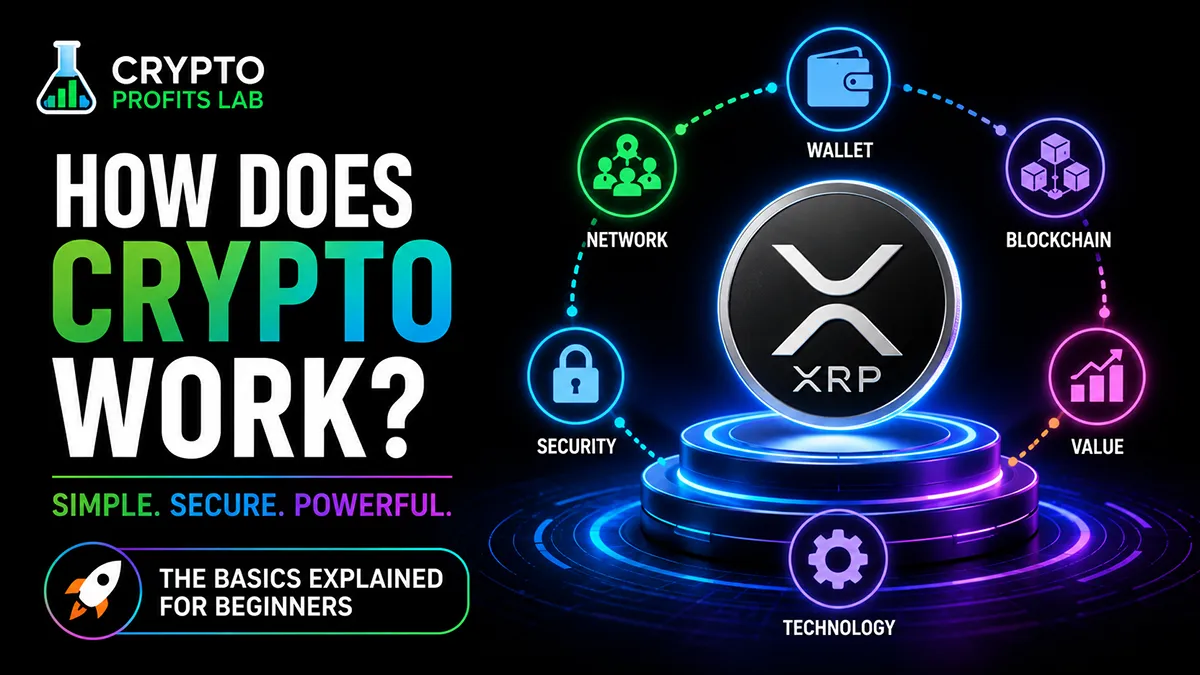
How does crypto work when no bank, card company, or central payment processor controls the system? The answer begins with a shared digital record called a blockchain.
Cryptocurrency is digital value recorded on a computer network. Wallets manage the keys that control them, digital signatures approve transactions, and independent computers verify activity according to shared rules.
This guide explains “how does crypto work” from the moment someone creates a wallet to the moment a transaction becomes confirmed. It also covers prices, exchanges, mining, staking, fees, and the risks every beginner should understand.
Quick Answer
How does crypto work? A cryptocurrency network uses a blockchain or similar shared ledger to record balances and transactions. Instead of one bank updating the record, many network computers check activity against the same rules.
A crypto wallet manages the private keys used to authorize transfers. When you send crypto, the wallet creates and digitally signs a transaction. Network computers verify it, place it into a block, and update the ledger after the block is accepted.
The price of a cryptocurrency is normally set by buyers and sellers. Its usefulness, supply, security, adoption, liquidity, and speculation can all influence demand.
Key Takeaways
- Cryptocurrency is digital value recorded on a blockchain or similar ledger.
- A blockchain is a shared transaction history maintained by network computers.
- A wallet manages the keys used to control crypto.
- A public address receives funds, while a private key authorizes spending.
- Network nodes check transactions before accepting them.
- Miners or validators help add new blocks.
- Exchanges connect buyers and sellers.
- Fees pay for network processing and help prevent spam.
- Confirmed transactions are usually difficult or impossible to reverse.
- Crypto is not automatically private, safe, or guaranteed to increase in value.
How Crypto Works: Beginner Facts
| Beginner question | Simple answer |
|---|---|
| What is cryptocurrency? | Digital value is controlled through cryptographic keys and recorded on a blockchain or similar ledger. |
| Where is crypto stored? | Ownership is recorded on the network; a wallet manages the keys used to control it. |
| Who operates the network? | Nodes, miners, validators, developers, businesses, and users can have different roles. |
| Can a transaction be reversed? | Usually not after it receives sufficient confirmation. |
| Why does crypto have value? | People may value its usefulness, scarcity, security, adoption, or expected future demand. |
| Do all coins work alike? | No. Networks, supply rules, uses, governance, and security systems vary. |
| Must I mine crypto to use it? | No. Most people use wallets and exchanges without mining. |
What Cryptocurrency Actually Is
Before asking how does crypto work, it helps to define cryptocurrency.
Cryptocurrency is a digital asset that uses cryptography and computer networks to record ownership and authorize transfers. Cryptography is the use of mathematics to protect information and to prove that a request came from the correct key holder.
Many cryptocurrencies use blockchains. A blockchain stores transactions in groups called blocks and connects those blocks in order. Changing an older record becomes harder because later blocks depend on the information before them.
Bitcoin was the first widely adopted cryptocurrency to combine a peer-to-peer network, digital signatures, economic incentives, and proof-of-work into a decentralized payment system. Later projects expanded the idea to include smart contracts, applications, gaming, lending, and other uses.
Read What Is Cryptocurrency? for a broader introduction.
The Main Parts That Make Crypto Work
When someone asks how does crypto work, they are usually asking how several connected parts fit together.
Blockchain
The blockchain is the shared record of transactions. Copies can be stored on many computers, reducing dependence on one company’s private database. Learn more in Blockchain Technology Explained.
Network
A crypto network includes the computers, software rules, messages, and incentives that keep a cryptocurrency operating. Bitcoin, Ethereum, Solana, and other networks maintain separate records. Read “What Is a Crypto Network?“.
Nodes
Nodes are computers running the network software. They can receive transactions, enforce rules, share data, and store blockchain history. What Is a Crypto Node? explains their role.
Wallets and Keys
A wallet manages addresses and cryptographic keys. It does not hold coins like a leather wallet holds cash. The blockchain records the assets, while the wallet supplies the tools needed to control them.
Miners or Validators
Depending on the network, miners or validators help order valid transactions and propose blocks. Other nodes check that their blocks follow the protocol.
Users and Applications
People use wallets, exchanges, games, lending services, marketplaces, and other applications. Their activity creates demand for the network.
How Does Crypto Work Step by Step?
The clearest explanation follows one transaction from beginning to end.
Step 1: The Network Establishes Rules
Every cryptocurrency operates under software rules called a protocol. The protocol can define:
- How transactions are formatted
- How new coins enter circulation
- Which fees are required
- How blocks are created
- How participants reach agreement
- What makes an activity valid or invalid
A decentralized network can still change through upgrades, but major changes require coordination among the people and organizations using its software.
Step 2: A User Creates or Opens a Wallet
How does crypto work with a wallet? The wallet creates or imports cryptographic keys.
The public side helps generate receiving addresses. The private key is secret information used to approve outgoing transactions. Many wallets also provide a seed phrase—a set of recovery words that can restore the wallet’s keys.
Anyone who obtains the private key or seed phrase may be able to control the funds. Review What Is a Crypto Wallet?, What Is a Crypto Private Key?, and What Is a Crypto Seed Phrase? before moving valuable assets.
Step 3: The User Creates a Transaction
Suppose Maria wants to send crypto to James. James gives Maria a receiving address for the correct asset and network.
Maria enters the address and amount in her wallet. The wallet prepares a transaction identifying the funds, destination, fee, and other information required by the network.
A wallet address is a public receiving address. It is not a password and does not provide spending control on its own.
Step 4: The Wallet Signs the Transaction
How does crypto work without a bank employee approving every payment? The wallet uses Maria’s private key to create a digital signature.
The signature proves that the correct key authorized the request without exposing the private key. Network computers can verify this mathematical proof.
If a thief steals Maria’s key or seed phrase, the network may accept the thief’s signed transaction as valid. The blockchain verifies signatures; it cannot tell whether the real owner was tricked.
Step 5: The Transaction Reaches the Network
The wallet broadcasts the signed request. Nodes receive it and share it with other nodes.
The transaction may wait with other unconfirmed activity before entering a block. Waiting time depends on the network, demand, and fee.
Step 6: Nodes Check the Transaction
Nodes examine the request. They may verify:
- The digital signature
- The available balance
- Whether the same funds were already spent
- The transaction format
- The fee
- Any smart-contract instructions
Invalid requests are rejected. Valid transactions remain eligible for inclusion in a block. Read What Is a Crypto Transaction?.
Step 7: A Miner or Validator Proposes a Block
Valid transactions are grouped into a candidate block.
On a proof-of-work network, miners compete using computing power. On a proof-of-stake network, validators are selected according to the protocol’s staking rules and other factors.
The successful participant proposes the next block. Other nodes still check it. A miner or validator cannot create a valid block by simply ignoring the network rules.
Learn more in What Is a Crypto Block?, What Is Proof of Work?, and What Is Proof of Stake?.
Step 8: The Block Becomes Part of the Ledger
How does crypto work after a block is proposed? Nodes verify the block and accept it when it follows the protocol.
The transaction now has its first confirmation. Later blocks add more confirmations, making the completed payment increasingly difficult to replace.
Crypto Confirmations Explained explains why an exchange may wait before crediting a deposit.
Step 9: The Receiving Wallet Shows the Balance
James’s wallet reads the updated blockchain and displays the received amount.
The coins did not travel like an email attachment. The shared ledger changed to show that the relevant value is now controlled by keys associated with James’s wallet.
That is how does crypto work during a basic payment.
How Does Crypto Work Without One Central Authority?
A decentralized network contains computers that may not know or trust one another. They need a consistent way to decide which transaction history is valid.
This process is called consensus. Consensus rules help nodes reject invalid transactions, prevent double-spending, and follow the accepted chain.
Proof of Work
Proof of work requires miners to perform costly computation. Producing a valid block takes equipment and electricity, while checking the result is much easier.
Bitcoin uses proof of work. Its design is described in the Bitcoin white paper, which explains a peer-to-peer electronic cash system using digital signatures and a chain secured by computational work.
Mining rewards and transaction fees encourage participation. Read Crypto Mining Explained for more details.
Proof of Stake
Proof of stake uses validators who commit, or stake, cryptocurrency in accordance with the network’s rules. Honest participation can earn rewards, while certain violations may lead to penalties.
Proof of stake generally uses less energy than proof of work, although security and decentralization depend on the specific network.
Neither system guarantees that a coin is safe, useful, decentralized, or valuable.
How Does Crypto Work When New Coins Are Created?
A new cryptocurrency enters circulation according to each project’s rules.
Proof-of-work networks may issue coins as mining rewards. Proof-of-stake networks may reward validators. Some projects create most or all tokens at launch and distribute them among founders, investors, a treasury, community programs, and users.
Projects may also distribute tokens through a crypto airdrop or remove units through a token burn. The complete supply and distribution design is called tokenomics.
Supply matters, but scarcity alone does not create value. A limited asset can still have little demand.
How Does Crypto Work on an Exchange?
Most beginners buy cryptocurrency through an exchange.
A centralized exchange manages customer accounts, matches orders, and may hold customer assets. A decentralized exchange uses smart contracts and user-controlled wallets to facilitate trades.
A common purchase process involves:
- Opening an account
- Completing required identity verification
- Adding money
- Selecting a cryptocurrency
- Reviewing price and fees
- Placing an order
- Choosing whether to keep the asset there or withdraw it
Read What Is a Crypto Exchange? and How to Buy Crypto for Beginners.
A balance shown by a centralized exchange may exist inside the exchange’s private account system until you withdraw. If the company controls the private keys, you depend on it to process withdrawals.
How Does Crypto Work With Smart Contracts?
Smart contracts are programs stored and executed on a blockchain. They perform defined actions when users submit valid requests.
A smart contract can exchange tokens, manage loans, issue digital collectibles, distribute rewards, or record votes.
Ethereum helped make programmable smart contracts widely used. This expanded crypto beyond payments, but it also added risk. A buggy or malicious contract can cause losses even when the underlying blockchain continues to work correctly.
Read Bitcoin vs. Ethereum and What Is DeFi? for related explanations.
How Does Crypto Work With Prices?
A cryptocurrency’s market price is created through buying and selling.
When buyers accept higher prices, the quoted market price may rise. When sellers accept lower offers, prices may fall.
Demand can be influenced by:
- Usefulness
- Supply
- Security
- Adoption
- Liquidity
- Competition
- Regulation
- Market sentiment
- Speculation
- News and economic conditions
A coin priced at one cent is not automatically cheaper or more valuable than a coin priced at $1,000. Total supply and market capitalization also matter.
Review Crypto Volatility Explained and What Is Market Cap in Crypto? before judging an asset by price alone.
Why Crypto Transactions Have Fees
How does crypto work when the network becomes busy? Fees help allocate limited processing space.
Fees can compensate miners or validators and make spam expensive. The amount may depend on demand, transaction data, and computational complexity.
Ethereum commonly refers to these charges as gas fees. A simple transfer may require less processing than a multi-step token swap.
Read What Are Crypto Gas Fees? and Crypto Trading Fees for Beginners to compare network, trading, and withdrawal costs.
Is Cryptocurrency Anonymous?
Most cryptocurrencies are not automatically anonymous.
Public blockchains allow anyone to look up addresses and transaction histories. The ledger may not display a legal name, but exchange records, public posts, payment requests, and reused addresses can connect activity to a person.
Crypto is often described as pseudonymous. Privacy depends on the network and how it is used.
Common Beginner Mistakes
Assuming Every Coin Works Like Bitcoin
Cryptocurrencies use different networks, consensus systems, supply rules, and security models. Research the specific asset.
Sending on the Wrong Network
The sender and receiver must support the same asset and blockchain route. A matching token name does not guarantee compatibility.
Sharing a Seed Phrase
No legitimate exchange, wallet provider, support agent, or recipient needs your seed phrase or private key.
Expecting a Transaction to Be Reversed
Confirmed transfers are generally difficult or impossible to cancel. Verify the address, network, amount, and required memo before sending.
Buying Because a Coin Looks Cheap
A low unit price says little without total supply, market capitalization, demand, and liquidity.
Ignoring Fees
Trading, withdrawing, swapping, bridging, and using applications can create separate charges.
Treating Hype as Research
Profit screenshots, influencer claims, and large communities do not prove that a project is legitimate or useful.
Using Self-Custody Without a Recovery Plan
Know how to restore the wallet and where the seed phrase is stored before transferring funds.
How Does Crypto Work Safely?
Understanding how does crypto work includes knowing what the technology cannot protect you from.
A blockchain may process a transaction correctly even when the user was tricked into approving it. The network usually cannot determine whether the recipient is a scammer or whether a token is a good investment.
Major risks include:
- Price volatility
- Fake exchanges and wallet apps
- Phishing websites
- Seed phrase theft
- Malicious smart contracts
- Incorrect addresses or networks
- Exchange failure
- Weak or abandoned projects
- Tax and regulatory uncertainty
- Lost recovery information
Follow these beginner rules:
- Start with a small amount.
- Use official websites and reputable platforms.
- Enable two-factor authentication where available.
- Store seed phrases offline and privately.
- Verify addresses after copying and pasting.
- Send a test amount before a large transfer.
- Never invest money needed for bills or emergencies.
- Ignore guaranteed returns and urgent payment demands.
- Keep devices and wallet software updated.
- Learn about the transaction before approving it.
Read Crypto Safety Tips and Crypto Scams to Avoid.
A Simple Beginner Example
Suppose Elena buys bitcoin through an exchange and sends it to her personal wallet.
The exchange first records her purchase inside its account system. Elena opens her wallet, selects Receive, and copies her Bitcoin address.
She chooses a Bitcoin withdrawal on the exchange, pastes the address, verifies the network, reviews the fee, and confirms.
The exchange signs and broadcasts a Bitcoin transaction. Nodes check it. Miners compete to place valid transactions into a block. Once the transaction appears in a valid block, Elena’s wallet detects it.
Additional blocks add confirmations. Elena directly controls the received bitcoin if she alone controls the wallet’s private keys.
This example shows how does crypto work by connecting the exchange, wallet, address, transaction, nodes, mining, block, and confirmations.
Beginner Checklist
Before buying or transferring cryptocurrency, confirm:
- I understand what the asset is designed to do.
- I know which network it uses.
- I know who controls the private keys.
- I obtained the wallet or exchange through an official source.
- I enabled available security features.
- I understand purchase and withdrawal fees.
- I checked the address and network.
- I know how to restore the wallet.
- I understand that transactions may be irreversible.
- I can afford to lose the amount involved.
- I am not relying on guaranteed profit claims.
- I will keep transaction and tax records.
A slow, repeatable process is safer than acting quickly because the price is moving.
How Does Crypto Work: Final Thoughts
How does crypto work? It combines blockchains, cryptographic keys, digital signatures, network rules, and economic incentives to record and transfer digital value. That is the simplest answer to how does crypto work for beginners.
Wallets sign transactions. Nodes enforce rules. Miners or validators help add blocks. Confirmations make transfers increasingly settled. Exchanges connect buyers and sellers, while market demand influences price.
This structure can reduce dependence on a single central payment controller, but it does not eliminate risk or personal responsibility. Users must protect keys, verify transactions, understand fees, and avoid scams.
Crypto Profits Lab makes these ideas cleaner and easier for beginners. You do not need advanced computer knowledge to get started, but you should understand the basic process before putting money at risk.
How Does Crypto Work? Frequently Asked Questions
How Does Crypto Work in Simple Terms?
How does crypto work? A blockchain records balances and transactions, while network computers check activity against shared rules. Wallets use cryptographic keys to prove who may authorize transfers. Miners or validators help add valid transactions to blocks. The result is a shared payment and ownership record that can operate without one bank maintaining the entire ledger.
Where Is Cryptocurrency Stored?
Cryptocurrency is not stored inside a wallet as a physical object or ordinary file. Ownership and transaction history are recorded on the blockchain. A wallet manages the private keys needed to control assets associated with particular addresses. Losing those keys can mean losing access to the crypto, even though the blockchain record still exists.
Who Controls a Cryptocurrency Network?
Control differs by project. Nodes enforce software rules, miners or validators add blocks, developers propose code, users choose software, and token holders may vote on some networks. Decentralization exists on a spectrum. A project can use blockchain technology while still depending heavily on a company, foundation, small validator group, or limited development team.
How Are New Cryptocurrency Coins Created?
New coins may enter circulation through mining rewards, validator rewards, launch allocations, or other protocol rules. Some cryptocurrencies have a maximum supply, while others continue issuing new units. Tokens can also be created through smart contracts. Supply schedules, unlocks, inflation, and concentrated ownership can all affect scarcity and market price.
Why Does Cryptocurrency Have Value?
Cryptocurrency has value when people are willing to buy, hold, or use it. Demand may come from payments, network access, application use, scarcity, security, or speculation. No technical feature guarantees lasting value. Prices can change sharply when adoption, liquidity, competition, regulation, economic conditions, or market sentiment changes.
Can Crypto Transactions Be Reversed?
Most confirmed cryptocurrency transactions cannot be canceled by a bank or customer-service department. Recovery may depend on the recipient returning the funds or a platform helping with a deposit problem. Before sending, verify the full address, blockchain network, amount, and any required memo. A small test transfer can reduce the risk of a costly mistake.
Do I Need a Wallet to Buy Cryptocurrency?
You can buy cryptocurrency through a centralized exchange without immediately creating a separate self-custody wallet. The exchange normally controls the private keys in that situation. A personal wallet is useful when you want direct control over your keys or access to on-chain applications. Learn wallet security before withdrawing a significant balance.
Is Cryptocurrency Safe for Beginners?
Cryptocurrency can be used by beginners, but it is not automatically safe. Prices are volatile, transactions can be irreversible, and scams are common. Start small, use reputable services, enable strong security, protect recovery information, and verify every address and network. Never invest money you cannot afford to lose or trust guaranteed-return promises.