Crypto Leverage: A Beginner’s Guide to How It Works
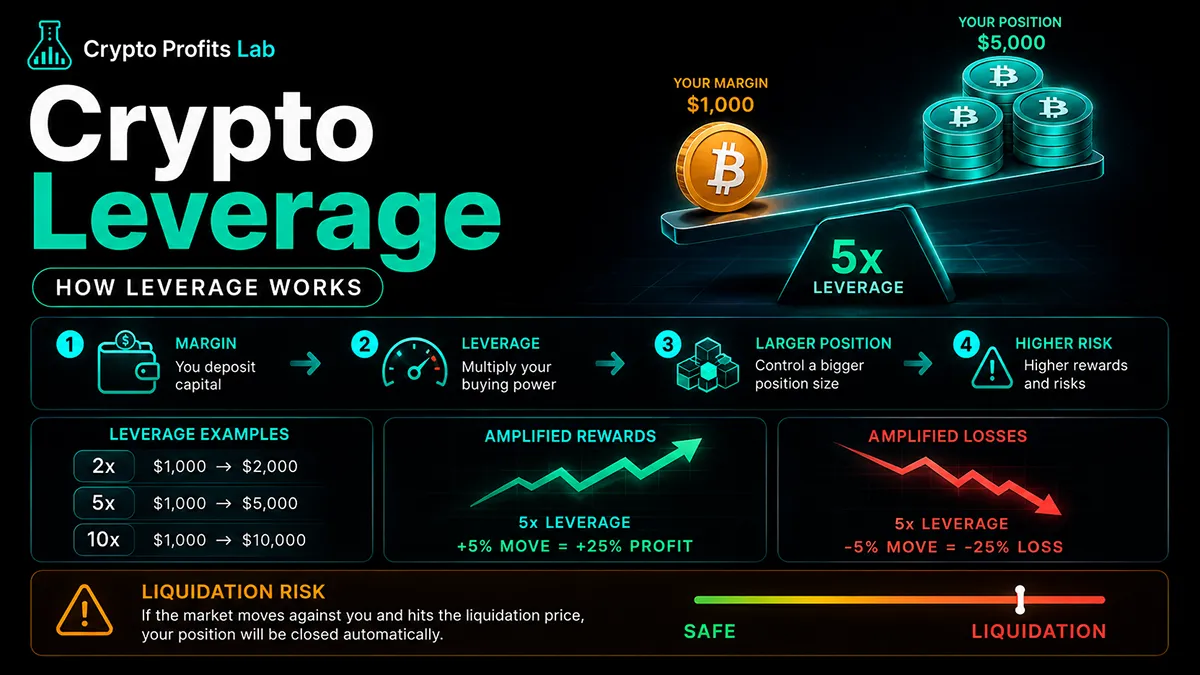
Crypto trading can already feel fast and unpredictable. Adding borrowed buying power can make the experience even more intense. That is where crypto leverage comes in.
Crypto leverage allows a trader to control a larger position than the amount of money they put up themselves. It can multiply gains when a trade moves in the right direction, but it can also multiply losses when the market moves the wrong way.
For beginners, the most important lesson is not how to maximize leverage. It is about understanding how leverage changes, how liquidation works, and why a seemingly small price move can lead to a large loss.
This guide explains the concept in plain English so you can understand the mechanics before deciding whether leveraged trading fits into your crypto plan.
Quick Answer: What Is Crypto Leverage?
Crypto leverage is the use of borrowed funds or leveraged trading products to control a crypto position that is larger than your own starting capital.
For example, with $100 and 5x leverage, you can control a position worth about $500. If that position rises 2%, the gain on the $500 position is larger than it would have been on an unleveraged $100 position.
But the same multiplication works in reverse. A 2% decline also creates a larger loss relative to your starting capital.
Leverage does not create free money. It increases your exposure to price changes and usually adds extra risks, costs, and liquidation rules.
Key Takeaways
- Crypto leverage lets a trader control a position larger than the cash or collateral they provide.
- A leverage ratio of 2x, 5x, or 10x indicates the amount of market exposure relative to the trader’s own capital.
- Leverage can multiply both gains and losses.
- Leveraged positions can be liquidated if losses reduce available margin below the platform’s required level.
- Fees, borrowing costs, funding payments, spreads, and slippage can affect results.
- Higher leverage usually leaves less room for the market to move against a position.
- Beginners do not need leverage to participate in cryptocurrency. Spot trading in crypto allows you to buy or sell the actual asset without using leverage.
Crypto Leverage Beginner Facts
| Beginner Question | Simple Answer |
|---|---|
| What is leverage? | A way to control a larger position with less of your own capital |
| What does 2x mean? | Roughly twice the market exposure of your supporting capital |
| What does 10x mean? | Roughly ten times the market exposure |
| Does leverage increase gains? | It can when the trade moves in your favor |
| Does leverage increase losses? | Yes, losses are amplified too |
| What is margin? | Capital or collateral supporting the leveraged position |
| What is liquidation? | The platform automatically closes a position because the margin has fallen too low |
| Is leverage required? | No |
| Are there extra costs? | There can be, depending on the product |
| Is leverage beginner-friendly? | It is substantially more complex than ordinary spot trading |
What Is Crypto Leverage in Simple Terms?
Think of leverage as a multiplier on market exposure.
Suppose you have $200.
If you buy $200 worth of cryptocurrency without leverage, a 5% increase changes the value of the position by about $10 before fees. A 5% decline also changes it by about $10.
Now imagine a platform that allows you to use 5x crypto leverage.
Your $200 could support roughly $1,000 of market exposure.
If that $1,000 position moves 5% in your favor, the change in value is about $50 before costs. If it moves 5% against you, the loss is also about $50.
The cryptocurrency moved by exactly 5% in both examples. What changed was the size of the position.
That is why leverage can create larger results from a smaller amount of starting capital.
It is also why leveraged trading can create losses much faster than an ordinary crypto purchase.
How Crypto Leverage Works
The exact process depends on the exchange and product, but leveraged cryptocurrency trading usually involves several basic pieces:
- Collateral
- Margin
- Position size
- Leverage ratio
- Market direction
- Maintenance requirements
- Liquidation price
Here is how those pieces fit together.
Step 1: You Provide Collateral or Margin
The trader starts by putting up their own money or cryptocurrency.
This capital helps support the leveraged position and absorb losses.
For example, if you supply $500 to support a $2,500 position, you are using about 5x leverage.
Margin is not simply another trading fee. It is capital supporting the position.
Step 2: You Select a Leverage Level
A trading platform might offer leverage ratios such as 2x, 3x, 5x, 10x, or higher depending on the product, account, and jurisdiction.
Higher crypto leverage means a larger position relative to your own supporting capital.
That may look attractive when you imagine a profitable trade, but there is another side to the equation.
The more leverage you use, the less room you generally have for the market to move against you before losses become serious.
Step 3: You Choose a Market Direction
A trader who believes a cryptocurrency will rise may open a long position.
Some leveraged products also allow a short position. A short position is designed to benefit if an asset’s price falls.
This differs from simply purchasing an asset through a regular crypto exchange and holding the coins or tokens.
Step 4: The Full Position Changes in Value
Once the trade is open, the full position gains or loses value as the cryptocurrency’s price moves.
Imagine that $400 of your own money supports a $2,000 position.
Your profit or loss is based mainly on the $2,000 exposure, not merely the $400 you supplied.
That amplified market exposure is the core effect of crypto leverage.
Step 5: The Platform Monitors Your Margin
A leveraged position must maintain enough supporting capital to stay open.
When the position moves against you, your available margin can shrink.
Trading platforms calculate margin differently, so beginners should never assume one exchange’s rules apply to another.
Before opening a leveraged position, you should understand the platform’s:
- Initial margin requirement
- Maintenance margin
- Liquidation process
- Fees
- Position limits
- Collateral rules
If those terms are unclear, the product is probably too complex to use yet.
Step 6: Liquidation Can Occur
If losses become large enough that the account no longer meets the platform’s margin requirements, the exchange may automatically close the position.
That process is called liquidation.
This is one of the biggest differences between leveraged trading and a normal unleveraged crypto purchase.
Step 7: The Position Is Closed
If the position is not liquidated, the trader can typically close it in accordance with the platform’s rules.
The final profit or loss depends on factors such as:
- Entry price
- Exit price
- Position size
- Leverage
- Trading fees
- Financing or funding costs
- Slippage
The displayed price move alone does not tell the whole story.
A Simple Crypto Leverage Example
Suppose you have $1,000 available.
Without leverage, you could use that $1,000 to create $1,000 of market exposure.
Now compare that with 2x and 5x leverage.
| Scenario | Your Capital | Position Size | 5% Favorable Move | 5% Unfavorable Move |
|---|---|---|---|---|
| No leverage | $1,000 | $1,000 | +$50 | -$50 |
| 2x leverage | $1,000 | $2,000 | +$100 | -$100 |
| 5x leverage | $1,000 | $5,000 | +$250 | -$250 |
These are deliberately simplified examples. They ignore trading fees, financing costs, funding payments, slippage, and liquidation requirements.
The important lesson is that crypto leverage magnifies exposure in both directions.
Leverage does not make your market prediction more accurate.
It simply makes the financial effect of that prediction larger relative to the amount of capital supporting the trade.
What Does 10x Leverage Mean?
With 10x leverage, a trader controls roughly ten dollars of market exposure for every dollar of capital supporting the position.
For example, $100 might provide approximately $1,000 of exposure.
If that $1,000 position rises 1%, its value changes by about $10 before fees.
Relative to the trader’s $100 starting margin, that is approximately a 10% gain.
But a 1% move in the wrong direction produces roughly the same effect as a loss.
This is where beginners need to be careful.
It can be tempting to think that a 10x position could survive exactly a 10% adverse market move. Real liquidation calculations are more complicated.
Maintenance margin, fees, available collateral, the product structure, and the exchange’s liquidation rules all affect the actual liquidation price.
What Is Margin in Leveraged Crypto Trading?
Margin is the trader’s capital or collateral supporting a leveraged position.
Two terms are particularly important.
Initial Margin
Initial margin is generally the amount required to open the position.
Maintenance Margin
Maintenance margin is the minimum level of collateral that must remain available to keep the position open.
If losses reduce the account below the maintenance requirement, liquidation can occur.
Crypto leverage and margin are therefore closely related.
Leverage determines how large your market exposure is relative to your capital. Margin is the capital helping support that exposure.
What Is Liquidation in Crypto?
Liquidation happens when a trading platform automatically closes a leveraged position because there is no longer enough margin to satisfy its requirements.
Imagine a trader opens a leveraged long position because they expect Bitcoin to rise.
Instead, Bitcoin falls quickly.
As the position loses value, the trader’s remaining margin gets smaller. If it falls too far, the exchange may close the position automatically.
With higher crypto leverage, the liquidation level is generally closer to the trade’s entry price because a smaller adverse move can cause a large loss relative to the collateral.
Liquidation is not the same as voluntarily selling because you changed your mind.
It is a risk-control process imposed by the platform.
Crypto Leverage vs. Spot Trading
These two approaches can involve exactly the same cryptocurrency while creating very different risk profiles.
With ordinary spot trading, you exchange one asset for another and generally own the cryptocurrency you purchased.
With crypto leverage, margin or a leveraged trading product allows you to take a position larger than your own capital would normally allow.
| Feature | Spot Trading | Leveraged Trading |
|---|---|---|
| Leverage required? | No | Yes |
| Borrowed or amplified exposure? | Normally no | Yes |
| Ordinary liquidation risk? | No | Yes |
| Complexity | Lower | Higher |
| Loss amplification | No leverage multiplier | Yes |
| Financing or funding costs | Normally not | May apply |
| Asset ownership | Usually direct | Depends on the product |
For a complete beginner, learning spot trading first provides a much stronger foundation.
Crypto Leverage vs. Margin Trading vs. Futures
These terms are related, but they are not interchangeable.
Margin trading generally involves using borrowed assets or funds to increase the size of a position.
Futures are derivative contracts whose value is connected to an underlying asset. The trader is trading the contract rather than simply buying the underlying cryptocurrency.
Some crypto futures allow significant leverage.
Perpetual futures are a popular type of crypto derivative that does not have a traditional expiration date. They may use periodic funding payments between market participants to help keep the contract price near the underlying spot price.
Crypto leverage is the broader idea of increasing market exposure relative to the amount of your own capital.
Margin accounts, futures, and other derivatives are different ways that amplified exposure may be created.
Beginners should never assume all of these products have identical rules.
Isolated Margin vs. Cross Margin
Another pair of terms you may see is isolated margin and cross margin.
With an isolated margin, only a specified amount of collateral is generally assigned to a particular position.
If the trade performs badly, the loss is intended to be contained within that allocated margin according to the platform’s rules.
With cross margin, available collateral can be shared across multiple positions or used to support a losing position.
Cross margin can reduce the risk of immediate liquidation of a position, but it may also expose more of the account balance to losses.
The exact mechanics vary by exchange.
Beginners should understand which margin mode is selected before opening any trade.
Why Crypto Leverage Is Risky
Cryptocurrency is already known for large and rapid price movements.
Leverage makes those movements more financially significant.
If an unleveraged cryptocurrency position falls 5%, the investor has roughly a 5% decline before costs.
A leveraged trader can experience a much larger percentage loss on their supporting capital from the same market movement.
The U.S. Commodity Futures Trading Commission warns that leverage can amplify the underlying risk of virtual-currency trading and make changes in the underlying market much more significant for leveraged accounts.
CFTC virtual currency trading risk advisory
Additional risks can include:
- Sudden liquidation
- Rapid market gaps
- Slippage
- Funding costs
- Borrowing interest
- Exchange outages
- Counterparty risk
- Thin liquidity
- Emotional trading
- Account-security problems
Crypto markets also operate around the clock.
A leveraged position can move significantly while you are asleep, working, or otherwise away from your trading screen.
How Volatility Affects Leveraged Positions
Crypto volatility describes how quickly and dramatically cryptocurrency prices can change.
Volatility already creates risk for ordinary investors.
Crypto leverage multiplies the financial impact that those price movements can have on a trader’s margin.
A rapid price move can also cause slippage, meaning the order fills at a different price than the trader expected.
Market conditions matter too.
Understanding crypto liquidity and the crypto spread helps explain why some markets are easier to enter and exit than others.
A highly leveraged position in a thin, volatile market can combine several forms of risk at once.
Trading Costs Can Add Up Quickly
Leveraged trading can involve more costs than a basic spot purchase.
Depending on the platform and product, possible costs include:
- Trading fees
- Maker and taker fees
- Bid-ask spreads
- Borrowing interest
- Funding payments
- Conversion charges
- Slippage
- Liquidation-related fees
Our guide to crypto trading fees for beginners explains common exchange costs in more detail.
Position size is important here.
If a fee is calculated using the full leveraged position, that fee can represent a larger percentage of the smaller amount of capital supporting the trade.
Frequent trading can compound those costs.
7 Smart Rules for Safer Crypto Leverage
There is no way to make leveraged cryptocurrency trading risk-free.
These rules are meant to reduce avoidable mistakes, not guarantee profits.
1. Learn Spot Trading First
Understand ordinary buying and selling before adding leverage.
Learn how trading pairs, market orders, limit orders, spreads, liquidity, and fees work.
Our guide to market order vs limit order in crypto explains two of the most important order types.
When the basic mechanics feel easy, more advanced concepts become easier to recognize.
2. Use Lower Leverage
Lower leverage generally gives a position more room to move before losses consume a large percentage of the supporting capital.
Using 2x does not make a trade safe.
It simply creates less amplification than 10x, 25x, or 50x.
A beginner’s goal should never be finding the highest crypto leverage that an exchange will permit.
3. Risk Only a Small Portion of Your Capital
Do not put an entire trading balance behind one leveraged position.
Even a trade that looks convincing can move in the wrong direction.
Smaller position sizes can help prevent one mistake from damaging an entire account.
4. Know Your Liquidation Level Before Entering
The trading platform should show or help calculate an estimated liquidation price.
Understand that number before opening the trade.
Ask yourself:
- How far is liquidation from my entry?
- What market move would cause it?
- What fees affect it?
- Which collateral supports the position?
If you cannot answer those questions, do not rush into the position.
5. Decide How Much You Are Willing to Lose
Risk should be considered before a trade is opened, not after the market turns against you.
Some traders use stop orders or other exit rules to limit losses.
A stop order cannot guarantee an exact execution price during a fast market, but having a predefined risk level is generally more disciplined than making decisions during panic.
6. Avoid FOMO and Revenge Trading
Crypto FOMO can make traders chase a price after it has already risen rapidly.
Revenge trading happens when someone tries to immediately win back money after a loss by taking another aggressive position.
Adding leverage to emotional trading can make the damage much worse.
A missed trade is usually less dangerous than an impulsive leveraged trade.
7. Never Use Money Needed for Everyday Life
Do not risk:
- Rent or mortgage money
- Emergency savings
- Utility money
- Tax money
- Borrowed household funds
- Money needed for food or medical expenses
Leveraged trading can produce substantial losses quickly.
If losing the money would create a personal financial emergency, it should not be used to support a leveraged position.
Common Beginner Mistakes With Leverage
Using the Maximum Leverage Offered
An exchange displaying 50x or 100x does not mean that amount is suitable.
High leverage can leave almost no room for normal market movement.
Thinking Leverage Is Free Money
A larger position means larger exposure.
It does not mean you can comfortably afford the larger loss.
Ignoring the Liquidation Price
A trader can eventually be correct about the market’s direction and still be liquidated by a short-term move first.
Forgetting Fees
Borrowing costs, funding payments, trading fees, and spreads can steadily reduce returns.
Trading Illiquid Coins
A thin market can produce wider spreads and worse slippage.
Reviewing the crypto order book can help beginners understand how much buying and selling interest actually exists near the current price.
Increasing Risk After a Loss
Doubling the position after losing money does not erase the original mistake.
It increases the amount at risk.
Trading a Product You Do Not Understand
Margin accounts, futures, and perpetual contracts can have different rules.
A familiar-looking Buy or Sell button does not make the underlying product simple.
Security Risks Still Matter
Trading risk is only one part of crypto risk.
An exchange account should be protected with a strong, unique password and crypto two-factor authentication whenever available.
Remain alert for:
- Phishing websites
- Fake exchange apps
- Fraudulent support messages
- Malicious wallet links
- Fake investment platforms
- Requests for seed phrases or passwords
A profitable trade does not help if someone steals access to the account.
Our crypto safety tips guide covers the basic security habits every beginner should understand.
Is Crypto Leverage Good for Beginners?
For most complete beginners, there is no need to use leverage.
New investors can learn how markets work through small spot purchases and strategies such as dollar-cost averaging crypto without taking on liquidation risk.
Leveraged trading requires understanding:
- Position sizing
- Margin
- Liquidation
- Order execution
- Fees
- Volatility
- Emotional risk management
Crypto leverage can have specialized uses for experienced traders, but usefulness does not make it necessary.
Beginners should not feel pressured to use leverage merely because an exchange makes it available.
A Better Learning Path for Beginners
A simpler progression is:
- Learn what cryptocurrency is.
- Understand how a crypto exchange works.
- Learn spot trading in crypto.
- Understand trading pairs, order books, liquidity, spreads, and fees.
- Learn to read crypto charts for beginners.
- Study position sizing and basic risk management.
- Learn about leveraged products only after those earlier concepts make sense.
This approach may seem slower, but it gives each new concept a foundation.
Crypto Profits Lab is built around that philosophy: understand the simple version first and add complexity only when it serves a clear purpose.
Final Thoughts
Crypto leverage is a tool for increasing market exposure relative to the amount of your own capital supporting a trade.
It can make a winning position more profitable, but it can also make a losing position substantially more damaging.
Higher leverage means less room for error. Liquidation can automatically close a trade. Fees can accumulate. Volatile markets can move faster than expected.
Beginners should understand margin, liquidation, costs, volatility, and position size before considering any leveraged product.
There is also nothing wrong with avoiding leverage entirely.
Buying cryptocurrency through ordinary spot markets can provide exposure to crypto prices without the added mechanics of margin and forced liquidation.
The strongest beginner decision is rarely the one offering the largest theoretical gain.
It is the decision you understand, can afford, and can manage without putting your financial security at unnecessary risk.
Crypto Leverage Frequently Asked Questions
What does 10x leverage mean in crypto?
Ten times leverage means a trader controls roughly ten times as much market exposure as the amount of capital supporting the position. For example, $100 might support approximately $1,000 of exposure. This can multiply both gains and losses relative to the trader’s margin. A relatively small unfavorable price move can therefore create a large percentage loss and may eventually trigger liquidation.
Can you lose more than you invest when using leverage?
It depends on the exchange, product, collateral structure, and liquidation rules. Many platforms attempt to liquidate positions before losses exceed the margin supporting them, but traders should not assume that every product guarantees this outcome. Rapid market moves, fees, account structures, or unusual conditions can create additional risk. Always read the platform’s terms before opening a leveraged position.
Is 2x leverage safe for beginners?
No leverage level is automatically safe. Two-times leverage creates less amplification than 10x or 50x, but the position can still lose substantial money. Market volatility, position size, liquidity, fees, and liquidation rules all matter. Lower leverage may reduce the speed at which losses grow, but it cannot prevent an incorrect trade or guarantee that your capital will be protected.
What is a liquidation price in crypto?
A liquidation price is the approximate market level at which a leveraged position may no longer have sufficient margin to meet the exchange’s requirements. If the market reaches that area, the platform may automatically close some or all of the positions. The exact calculation can depend on leverage, maintenance margin, fees, available collateral, and the specific trading product.
What is the difference between spot trading and leveraged trading?
Spot trading typically involves buying or selling cryptocurrency with funds you already have and generally results in ownership of the purchased asset. Leveraged trading uses margin or derivatives to create greater market exposure than your own capital normally provides. A standard unleveraged spot purchase does not carry leverage-related liquidation risk, whereas a leveraged position can be automatically closed if margin falls too low.
Do leveraged crypto trades have extra fees?
They can. In addition to ordinary trading fees and bid-ask spreads, some leveraged products may involve borrowing interest, funding payments, conversion costs, slippage, or liquidation-related fees. The exact charges vary by exchange and product. Because the position itself can be much larger than the trader’s supporting capital, even seemingly small fees can have a meaningful effect on the final result.
Can beginners trade cryptocurrency without leverage?
Yes. Leverage is completely optional. Beginners can buy and sell cryptocurrency through spot markets without borrowing funds or using leveraged derivatives. Spot trading still carries substantial market risk because cryptocurrency prices can fall, but it avoids margin requirements and leverage-related liquidation. Learning spot trading, order types, fees, liquidity, and security first can create a much stronger foundation.
Why is high leverage especially dangerous in crypto?
High leverage creates a large market position relative to a small amount of supporting capital. Even a modest unfavorable price move can therefore produce a large percentage loss. Cryptocurrency prices can also change rapidly, including overnight and during periods of thin liquidity. Higher leverage typically brings the liquidation level closer to the entry price, leaving less room for ordinary market volatility.