Crypto Risk Reward Ratio: 7 Smart Ways to Trade Better
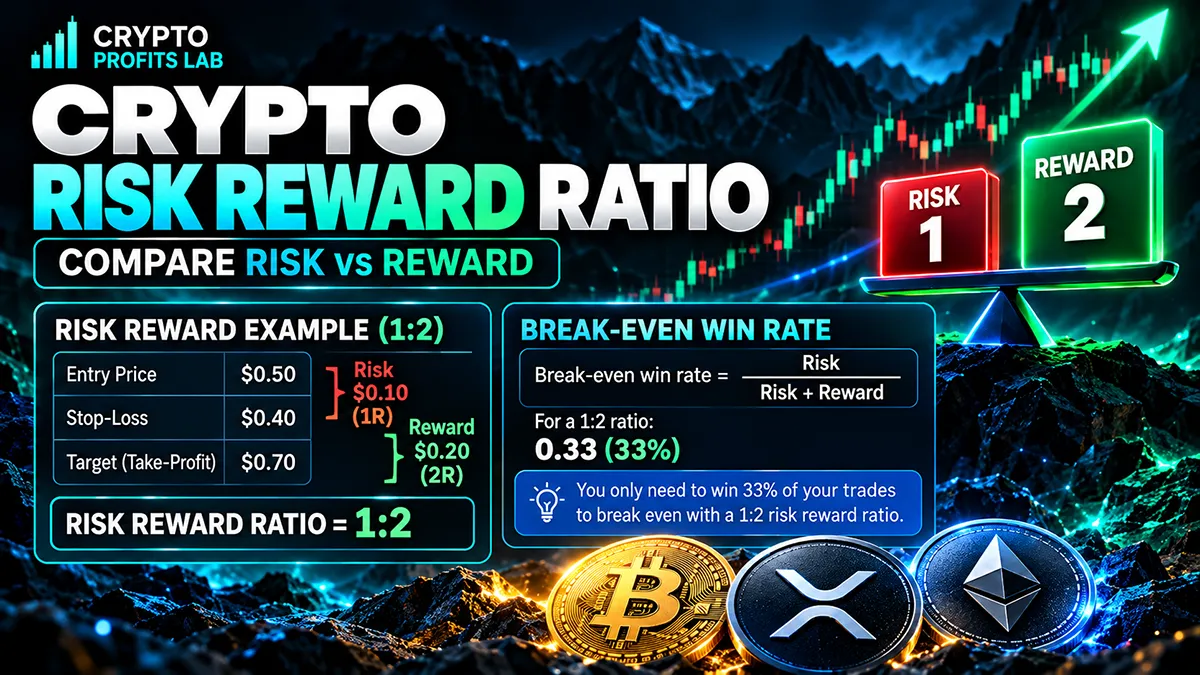
A crypto risk reward ratio compares how much you are prepared to lose on a trade with how much you hope to gain if the trade reaches its target.
It does not predict whether the trade will work. Instead, it gives you a simple way to compare the possible downside with the possible upside before you put money at risk.
For beginners, that can be useful because crypto prices can move quickly. It is easy to focus on potential profit while giving less attention to what happens if the trade moves the other way.
This guide explains the crypto risk reward ratio in plain English, shows how to calculate it, and connects it with stop losses, take-profit targets, position sizing, fees, slippage, and market volatility.
Quick Answer
A crypto risk reward ratio compares the amount you could lose if a trade reaches your stop with the amount you could gain if price reaches your planned target.
For example, imagine you buy a coin at $100, place a stop at $95, and set a target at $110.
Your planned risk is $5 per unit. Your planned reward is $10 per unit.
That creates a 1:2 risk-to-reward relationship: you are risking $1 for every $2 of potential reward.
The ratio does not tell you how likely the target is to be reached. A trade with a large possible reward can still have a low chance of success. The ratio is a planning tool, not a prediction.
Key Takeaways
- A crypto risk reward ratio compares planned downside with planned upside.
- A 1:2 ratio means the potential reward is twice the planned risk.
- The ratio depends on your entry, stop-loss level, and profit target.
- A larger potential reward does not automatically make a trade better.
- Win rate and risk/reward need to be considered together.
- Fees, spread, and slippage can change the real outcome.
- Position size determines how much money is actually exposed to the planned price move.
- Stop and target levels should make sense for the market rather than being chosen only to create an attractive ratio.
Crypto Risk Reward Ratio Beginner Facts
| Term | Beginner Meaning |
|---|---|
| Entry price | The price where you plan to enter the trade |
| Stop loss | The planned exit if price moves against you |
| Profit target | The planned exit if price moves in your favor |
| Risk | The distance from entry to stop |
| Reward | The distance from entry to target |
| 1:1 ratio | Planned reward equals planned risk |
| 1:2 ratio | Planned reward is twice planned risk |
| Win rate | The percentage of trades that are profitable |
| Position size | The amount of money or crypto used in the trade |
| Slippage | The difference between expected and actual execution price |
What Is a Crypto Risk Reward Ratio?
A crypto risk reward ratio is a way of measuring the relationship between a trade’s possible loss and possible gain.
Suppose you are thinking about a spot trade in a cryptocurrency priced at $50. You plan to leave the trade if price falls to $48, and you plan to take profit if price reaches $56.
The distance from $50 to $48 is $2. That is the planned risk.
The distance from $50 to $56 is $6. That is the planned reward.
Dividing the reward by the risk gives:
$6 ÷ $2 = 3
The trade therefore has a 1:3 risk-to-reward relationship.
This does not mean you will make three times as much money as you lose. It only describes the planned price distances before the trade begins.
The ratio becomes more useful when it is combined with a clear crypto stop loss, a realistic crypto take profit, and sensible crypto position sizing.
How the Crypto Risk Reward Ratio Formula Works
The basic calculation is:
Risk = Entry Price − Stop Price
Reward = Target Price − Entry Price
Risk/Reward = Risk ÷ Reward
Many traders describe the result in the form 1:X.
Using an entry of $100, a stop of $95, and a target of $110:
Risk = $100 − $95 = $5
Reward = $110 − $100 = $10
$5 ÷ $10 = 0.5
That can be expressed as a 1:2 risk/reward ratio because the potential reward is twice the planned risk.
For a public explanation of the same general relationship between trade risk, stop levels, and profit targets, see CME Group’s The 2% Rule lesson. CME’s educational example shows how a predetermined risk/reward ratio can be used alongside stop-loss planning.
Why Risk Comes Before Reward
Beginners often start with the upside.
They may see a coin trading at $1 and imagine what the profit would be if it reached $2. That creates a tempting reward number, but it says nothing about the downside.
A stronger process begins by asking where the trade idea would be considered wrong.
That price can become a possible stop level. Once the risk distance is known, the target can be compared with it.
This matters because the ratio should describe a real trade plan. It should not be reverse-engineered only to make the numbers look attractive.
If you choose an unrealistic stop or an unrealistic target simply to create a 1:5 ratio, the calculation may look impressive while the trade itself makes little sense.
Risk Reward Ratio vs. Win Rate
The ratio is only one part of a trading approach.
Imagine Strategy A wins 70% of the time but has a 1:1 ratio.
Now imagine Strategy B wins only 40% of the time but has a 1:3 ratio.
Strategy B can still be profitable over a large sample if its winning trades are large enough compared with its losing trades. But that depends on actual execution, costs, discipline, and whether the assumed win rate continues.
The important point is that the ratio does not tell you the win rate.
A high ratio with a very low probability of reaching the target may be less useful than a smaller ratio built around realistic market behavior.
Beginners should avoid treating 1:2, 1:3, or any other number as a magic rule.
How to Calculate Break-Even Win Rate
The crypto risk reward ratio becomes more useful when you understand the break-even win rate.
Break-even win rate is the percentage of trades that would need to win for the results to theoretically break even over time, assuming winning and losing trades match the planned reward and risk and ignoring trading costs.
The formula is:
Break-Even Win Rate = Risk ÷ (Risk + Reward) × 100
For a 1:2 crypto risk reward ratio:
1 ÷ (1 + 2) × 100 = 33.3%
That means a strategy with a consistent 1:2 risk/reward relationship would theoretically need to win about 33.3% of its trades to break even before fees, spread, slippage, and other costs.
Here are several simple examples:
| Risk/Reward Ratio | Break-Even Win Rate |
|---|---|
| 1:1 | 50% |
| 1:1.5 | 40% |
| 1:2 | 33.3% |
| 1:2.5 | 28.6% |
| 1:3 | 25% |
| 1:4 | 20% |
| 1:5 | 16.7% |
This helps explain why win rate cannot be judged by itself.
A trader who wins only 40% of trades could theoretically be profitable with a consistent 1:2 crypto risk reward ratio, while a trader who wins 60% of trades could still lose money if the average losing trade is much larger than the average winner.
However, real trading is not this exact. Fees, crypto spread, crypto slippage, missed targets, and stop execution can all raise the win rate needed to actually break even.
The break-even formula is therefore best used as a planning tool rather than a guarantee of profitability.
Step by Step: How to Calculate a Crypto Risk Reward Ratio
Step 1: Choose the Planned Entry
Start with the price where you intend to enter.
If you use a market order, the actual fill may be slightly different from the price you see on screen. A limit order gives you more price control but may not fill.
If you are new to these differences, review market order vs limit order in crypto.
Step 2: Decide Where the Trade Is Wrong
Next, identify a logical stop area.
The stop could be below a chart level, below recent support, or at another point where your reason for entering no longer makes sense.
Do not choose the stop only because it creates the ratio you want.
Step 3: Measure the Risk
For a long trade, subtract the stop from the entry.
Example:
Entry = $25
Stop = $23
Risk = $2 per unit
Step 4: Choose a Realistic Target
Now identify where you would consider taking profit.
A target might be based on a previous high, a resistance area, a planned percentage move, or another method you understand.
If you are still learning price charts, see crypto charts for beginners.
Step 5: Measure the Reward
If the entry is $25 and the target is $31:
Reward = $31 − $25 = $6
Step 6: Compare Reward With Risk
Risk = $2
Reward = $6
That produces a 1:3 relationship.
Your planned ratio is therefore 1:3 before fees and execution differences.
Step 7: Check the Position Size
The ratio describes price distances. It does not tell you how much money to place into the trade.
That is where position sizing matters.
A 1:3 setup on a $100 position and the same setup on a $10,000 position have the same ratio but very different dollar risk.
Use crypto position sizing to connect the planned stop distance with the amount of capital you are actually risking.
Example: 1:2 Crypto Risk Reward Ratio
Assume a trader is considering a coin at $200.
The plan is:
- Entry: $200
- Stop: $190
- Target: $220
The planned risk is:
$200 − $190 = $10
The planned reward is:
$220 − $200 = $20
That creates a 1:2 crypto risk reward ratio.
If the trader buys five units, the simplified price risk is $50 and the possible gross reward is $100.
But the trade may not end exactly that way. Fees can reduce the gain. Slippage can increase the loss. The stop may fill below $190, and the target might not be reached at all.
The ratio is a planning estimate, not a guarantee.
Example: 1:3 Crypto Risk Reward Ratio
Now suppose another setup has:
- Entry: $80
- Stop: $76
- Target: $92
The risk is $4 per unit.
The reward is $12 per unit.
That creates a 1:3 crypto risk reward ratio.
At first glance, 1:3 may look more attractive than 1:2. But the target is also farther away from the entry.
If market conditions make $92 unrealistic, the larger ratio may not be useful.
This is why ratio quality depends on more than arithmetic.
7 Smart Ways to Use Crypto Risk Reward Ratio
1. Build the Ratio From Real Price Levels
Start with levels that make sense on the chart.
If you force the stop to be extremely close or push the target unrealistically far away, you can create almost any ratio you want on paper.
The numbers should reflect a real trade idea.
2. Combine It With Position Sizing
The ratio tells you the relationship between potential loss and gain. Position sizing tells you how much money that relationship represents.
Use both.
A small account should not automatically take the same dollar exposure as a large account simply because the ratio looks good.
3. Account for Volatility
Some crypto assets make large price swings during ordinary trading.
A very tight stop can create a beautiful ratio while also being easy to trigger.
Review crypto volatility so the stop has a reason beyond improving the math.
4. Keep Targets Realistic
A target should not exist only because you want a 1:4 or 1:5 setup.
Look at the market structure and ask whether there is a realistic path to the target.
5. Include Trading Costs
The ratio usually starts with price movement, but actual results include costs.
Crypto trading fees, crypto spread, and crypto slippage can all reduce the effective reward or increase the effective risk.
6. Do Not Change the Plan Because of Emotion
Once price starts moving, fear and excitement can take over.
A trader may move a stop farther away to avoid accepting a loss or push the target higher because of crypto FOMO.
If you change the plan, have a clear reason.
7. Review Results Over Many Trades
One trade tells you very little.
Record the planned ratio, actual entry, actual exit, fees, and result.
Over time, you can compare the planned ratio with what really happened.
What Is a Good Crypto Risk Reward Ratio?
There is no single ratio that is good for every trader, asset, or strategy.
You may hear rules such as “never take less than 1:2.” That can be a useful educational example, but it is not a universal law.
A strategy with a high win rate may operate differently from one that expects many small losses and occasional large winners.
The best way to think about a crypto risk reward ratio is as one variable in a larger system.
You need to consider:
- How often the setup succeeds
- Whether the stop is realistic
- Whether the target is realistic
- How volatile the asset is
- How much capital is at risk
- Trading costs
- Whether you can follow the plan consistently
A ratio by itself cannot answer those questions.
How Stop Loss Placement Changes the Ratio
Moving the stop changes the math immediately.
Suppose your entry is $100 and target is $110.
With a stop at $95:
Risk = $5
Reward = $10
Ratio = 1:2
If you move the stop to $90:
Risk = $10
Reward = $10
Ratio = 1:1
If you move it to $98:
Risk = $2
Reward = $10
Ratio = 1:5
The 1:5 setup may look much better, but a $2 stop could be too tight for normal price movement.
That is why stop placement should come from the trade plan, not from the desire to improve the ratio.
How Take Profit Placement Changes the Ratio
The same principle applies to the target.
With an entry at $100 and stop at $95, a target at $105 gives a 1:1 relationship.
A target at $110 gives 1:2.
A target at $115 gives 1:3.
The farther target improves the theoretical crypto risk reward ratio, but it may also reduce the chance of reaching the target.
Read the crypto take profit guide for more on setting planned exits.
Trailing Stops and Risk Reward
A crypto trailing stop can make the final outcome different from the original ratio.
For example, a trade may begin with a fixed 1:2 plan. If price rises and the trailing stop follows it upward, the eventual exit can occur before or after the original target depending on how the strategy is structured.
That does not make the original ratio useless. It simply means the initial ratio describes the trade at entry, while a trailing approach can change the realized result as the trade develops.
Risk Reward and Leverage
Leverage does not improve the ratio itself.
If your entry, stop, and target remain the same, the price relationship remains the same whether the trade is leveraged or not.
What leverage changes is the amount of market exposure relative to the capital supporting the position.
That can make gains and losses occur much faster in dollar terms and can add liquidation risk.
Beginners should understand crypto leverage and crypto liquidation before using leveraged products.
Fees, Spread, and Slippage Change the Real Ratio
A planned 1:2 setup will not necessarily produce exactly twice as much profit as loss.
Suppose the trade risks $50 to target $100 of gross profit.
Entry and exit fees may reduce the profit. Spread can affect the entry and exit prices. A fast-moving stop could suffer slippage and produce a $55 or $60 loss instead of $50.
The realized crypto risk reward ratio can therefore be different from the planned ratio.
This is especially important for short-term trades where the expected profit is small compared with transaction costs.
Common Beginner Mistakes
Treating 1:2 or 1:3 as a Magic Number
No ratio guarantees profitability.
A ratio must be considered with win rate, realistic price levels, and execution.
Moving the Stop Just to Improve the Ratio
A tighter stop makes the math look better, but it can also make the trade easier to stop out.
Setting Unrealistic Profit Targets
A distant target may produce an impressive ratio while having little connection to current market conditions.
Ignoring Position Size
A good ratio does not make an oversized trade safe.
Forgetting Fees and Slippage
Real trading results include costs that the basic ratio may not show.
Confusing Reward With Expected Profit
Reward is the potential gain if the target is reached. It is not a forecast of what you will earn.
Using Leverage to Make the Reward Look Larger
Leverage increases exposure. It does not change whether the underlying entry, stop, and target make sense.
Safety and Risk Considerations
Crypto trading involves substantial risk.
Stop orders can execute at worse prices than expected. Limit orders may not fill. Exchanges can experience outages. Liquidity can disappear during fast market moves. Crypto trades around the clock, so sharp changes can occur while you are away from the screen.
A crypto risk reward ratio cannot eliminate any of those risks.
Beginners may want to practice the calculations on paper or use very small amounts while learning how their exchange handles stop and target orders.
Also protect the trading account itself. Use a unique password, enable crypto 2FA, and verify that you are using the correct website or app.
Never risk money required for essential expenses, and do not assume a mathematically attractive setup is automatically a good trade.
A Simple Pre-Trade Checklist
Before entering, ask:
- What is my entry price?
- Where is my stop?
- Why is the stop there?
- Where is my target?
- Why is the target realistic?
- What is the crypto risk reward ratio?
- How large is the position?
- What is the maximum planned dollar loss?
- Have I considered fees, spread, and slippage?
- Am I using leverage?
- Can I accept the loss if the stop is reached?
If you cannot answer these questions clearly, the trade may need more planning.
Frequently Asked Questions
What Does Crypto Risk Reward Ratio Mean?
A crypto risk reward ratio compares the amount you plan to risk on a trade with the amount you could potentially gain if the price reaches your target. A 1:2 ratio means the planned reward is twice the planned risk. It is calculated from the entry, stop-loss, and target prices. The ratio helps structure a trade, but it does not predict whether the target or stop will be reached first.
How Do You Calculate Crypto Risk Reward Ratio?
First calculate the distance from your entry to the stop. Then calculate the distance from the entry to the profit target. Compare those two amounts. If you risk $5 per unit and the target offers $10 per unit, the relationship is 1:2. The simple calculation does not automatically include fees, spread, slippage, or differences between planned and actual execution prices.
Is a 1:2 Risk Reward Ratio Good for Crypto?
A 1:2 ratio is commonly used as an educational example because the potential reward is twice the planned risk, but it is not automatically good for every trade. The target still needs to be realistic, and the stop needs to make sense for the asset’s volatility. Win rate, trading costs, liquidity, position size, and strategy all affect whether a particular ratio is useful.
Is a Higher Risk Reward Ratio Always Better?
No. A higher ratio may require a more distant profit target or an unusually tight stop. Either choice can make the trade less realistic. A 1:5 setup looks attractive mathematically, but if the target is rarely reached, it may not perform better than a smaller ratio. Traders should consider probability, market structure, volatility, and execution rather than judging a trade only by the ratio.
What Is the Difference Between Risk Reward Ratio and Position Size?
Risk/reward compares the distance between your entry, stop, and target. Position size determines how much capital or crypto is placed into the trade. Two traders can use the same 1:2 setup but risk very different dollar amounts because their position sizes differ. Using both concepts together helps translate a price-based trading plan into a specific amount of money at risk.
Does a Crypto Risk Reward Ratio Include Trading Fees?
The basic ratio usually compares price distances and does not automatically include trading fees. Real results may also be affected by spread and slippage. These costs can reduce a winning trade and increase a losing trade, especially when targets are small. For a more realistic plan, estimate transaction costs and consider whether they meaningfully change the amount you expect to risk or gain.
Can Risk Reward Ratio Predict Whether a Crypto Trade Will Win?
No. A ratio describes potential loss and potential gain based on planned price levels. It does not calculate the probability that either level will be reached first. A trade with a 1:4 ratio can still lose, while a 1:1 trade can win. Evaluating a trading approach requires looking at the ratio together with win rate, market conditions, costs, and consistency over many trades.
Should Beginners Use Crypto Risk Reward Ratio on Every Trade?
Beginners can use the ratio as a planning tool whenever a trade has a defined entry, stop, and target. It can help make the downside and upside visible before money is committed. However, not every investing approach uses short-term stops or targets. Long-term investing, dollar-cost averaging, and other strategies may require different risk-management methods rather than a fixed trade-by-trade ratio.
Final Thoughts
A crypto risk reward ratio gives beginners a simple way to compare what they are prepared to lose with what they hope to gain.
The arithmetic is easy. The difficult part is choosing realistic levels.
Your stop should have a reason. Your target should have a reason. Your position size should fit the amount you can afford to risk. Fees, spread, slippage, volatility, and leverage should all be considered before the order is placed.
Do not chase the biggest possible ratio. A beautiful number on paper does not make an unrealistic trade better.
Crypto Profits Lab focuses on making concepts like the crypto risk reward ratio easier to understand without unnecessary jargon. Learn the mechanics, keep the process simple, and use the ratio as one part of a broader risk-management plan rather than as a promise of profit.