What Is a Crypto Network? A Complete Beginner’s Guide
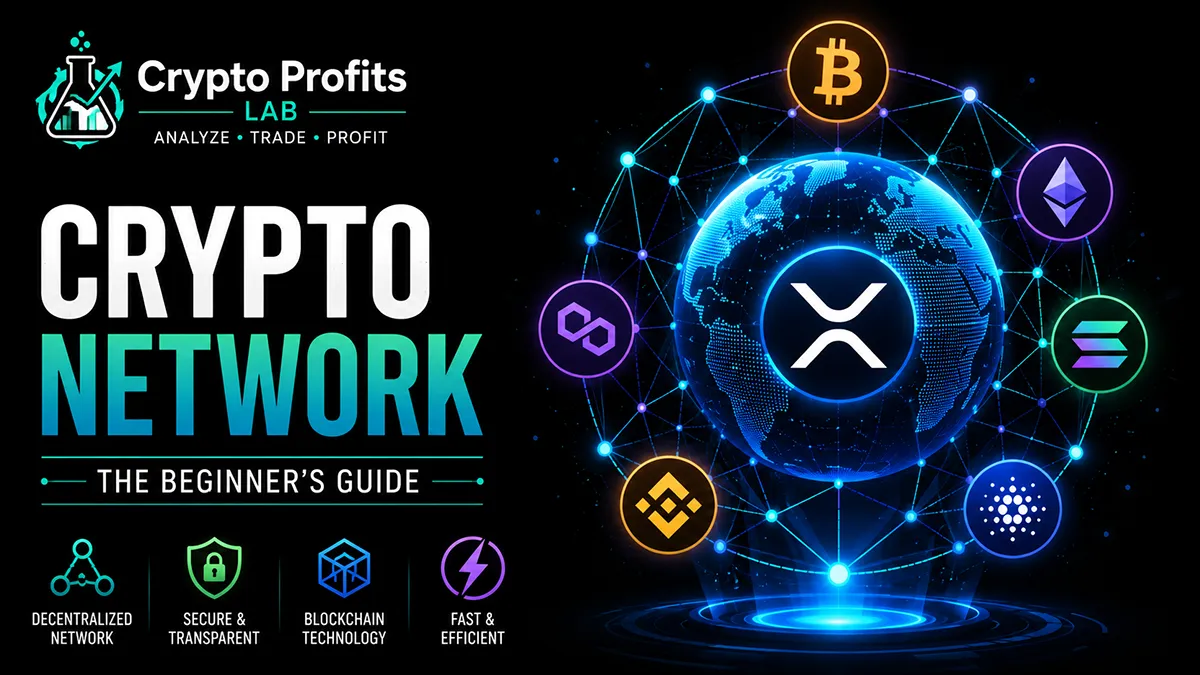
A crypto network is a digital system that enables cryptocurrency to move, be verified, and be recorded without relying on a single central bank or payment company. It combines computers, software rules, cryptography, and a shared record called a blockchain.
Beginners often hear phrases such as “choose the correct network,” “network fee,” or “network confirmation” without understanding what they mean. That confusion can become expensive. Selecting the wrong network when withdrawing from an exchange can delay a deposit or, in some cases, make funds difficult to recover.
This guide explains the subject in plain English. You will learn how a crypto network works, why different networks exist, how coins and tokens fit into them, and how to choose the right option when sending cryptocurrency.
Quick Answer: What Is a Crypto Network?
A crypto network is a group of connected computers that follow the same rules for processing cryptocurrency activity. These computers share information, verify transactions, and maintain a common record of account balances and ownership.
Some networks use miners, while others use validators. Each network also has its own native coin, fee system, speed, security design, and technical limits.
Bitcoin uses the Bitcoin network. Ether uses the Ethereum network. Tokens such as USDC may exist on multiple networks, so the sender and recipient must select matching options.
Key Takeaways
- A crypto network is the system that processes and records cryptocurrency activity.
- Wallets connect users to networks but do not physically store coins.
- Nodes share data and check whether transactions follow the rules.
- Miners or validators help add approved transactions to the blockchain.
- Every network has its own fees, confirmation times, and security model.
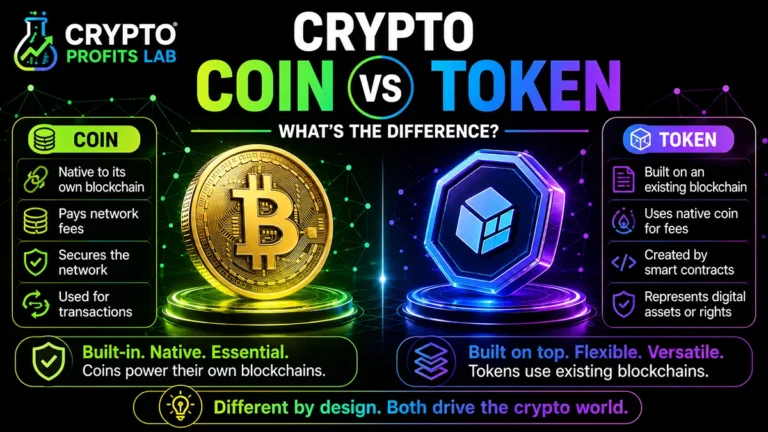
- A coin is native to its own network, while a token is built on another network.
- The sending and receiving networks must match when moving funds.
- A small test transfer can reduce the risk of an expensive mistake.
Crypto Network Facts for Beginners
| Term | Simple meaning |
|---|---|
| Blockchain | The shared record maintained by the network |
| Node | A computer running the network’s software |
| Miner | A participant that helps secure a proof-of-work network |
| Validator | A participant that helps secure many proof-of-stake networks |
| Native coin | The main asset used by a particular network |
| Token | A digital asset created on an existing network |
| Network fee | The charge paid to process an action |
| Mainnet | The live network where assets have real value |
| Testnet | A practice network used for testing |
| Confirmation | Evidence that a transaction was added to the blockchain |
| Bridge | A tool designed to move assets between supported networks |
Why Crypto Networks Exist
Traditional payment systems rely on central organizations. A bank updates its private database when one customer pays another. A card company decides whether to approve a purchase and can often reverse or block the payment.
A crypto network uses a different structure. Many independent computers maintain copies of the same transaction history. The system follows published software rules rather than relying on a single organization to control every entry.
This design can allow people to transfer digital value across borders, use decentralized applications, or hold assets in a self-custody wallet. However, direct control also means users must pay close attention to addresses, networks, fees, and security.
How a Crypto Network Works Step by Step
The exact process varies, but most public blockchain networks follow a similar sequence.
Step 1: A by Step
The exact process varies, but most public blockchain networks follow a similar sequence.
Step 1: A Wallet Creates an Instruction
A user begins by entering a recipient’s crypto wallet address, selecting an asset, and choosing an amount.
The wallet then creates a crypto transaction. This is a digital instruction asking the network to move a value or perform another action.
A wallet is best understood as an interface. It helps you view balances and communicate with the network. The coins themselves are not stored inside the phone, browser extension, or hardware device. Ownership is recorded on the blockchain.
Step 2: The Wallet Signs the Transaction
The wallet uses a crypto private key to create a digital signature. The signature proves that the person controlling the wallet is authorized to use the funds.
The private key should never be exposed during this process. A properly designed wallet signs the instruction without sending the private key to the network.
This is why protecting a recovery phrase is so important. Anyone who gains control of the recovery phrase can recreate the wallet and sign transactions.
Step 3: The Transaction Is Broadcast
After the user approves the details, the signed instruction is sent to the crypto network. This process is called broadcasting.
The transaction reaches computers called crypto nodes. Nodes communicate with one another and share valid information.
Step 4: Nodes Check the Rules
Nodes verify details such as:
- Whether the digital signature is valid
- Whether the sender has enough funds
- Whether the same funds were already spent
- Whether the transaction format is correct
- Whether the fee meets the network’s requirements
- Whether any smart-contract rules are satisfied
A valid transaction can be shared with other nodes. An invalid one is rejected.
This rule-checking process is a major part of blockchain technology. Participants do not need to trust every stranger on the internet, as each node can independently verify the data.
Step 5: A Miner or Validator Adds the Transaction
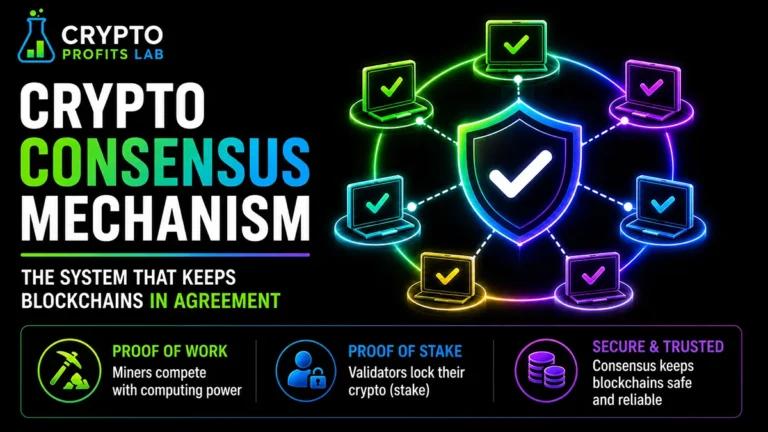
The network still needs a method for agreeing on the next group of transactions. This agreement process is called consensus.
Bitcoin uses miners and proof-of-work. Our guide to crypto mining for beginners explains how miners compete to add blocks and help secure the system.
Many newer blockchains use validators and proof of stake. Validators usually lock or stake assets and participate in confirming new blocks.
The chosen miner or validator includes the transaction in a block, and the block becomes part of the permanent record.
Step 6: Confirmations Build Confidence
Once a transaction enters a block, it receives a confirmation. New blocks added afterward create additional confirmations.
Different services wait for different numbers of confirmations. A wallet may display incoming funds quickly, while an exchange may wait longer before crediting a deposit.
The required time depends on the network, the asset, the transaction value, and the receiving platform’s policies.
What Makes One Crypto Network Different From Another?
No single network is best at everything. Developers make different choices about speed, cost, security, decentralization, programmability, and hardware requirements.
Transaction Speed
Some networks create new blocks within seconds. Others take longer. A fast block time can improve the user experience, but the number of confirmations required also matters.
Fees
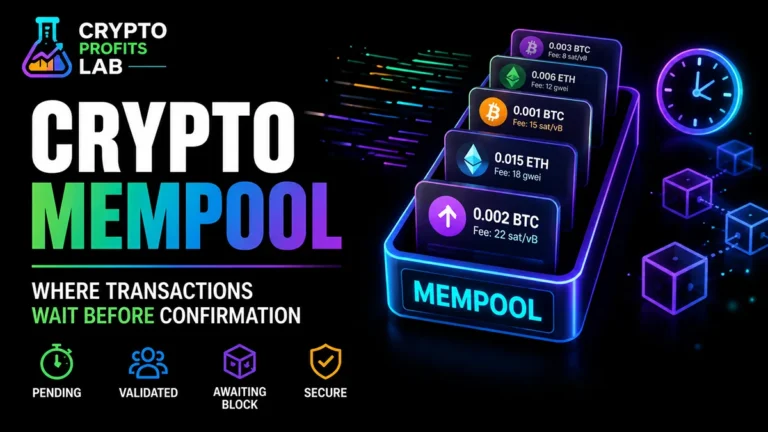
Every crypto network has its own way of pricing activity. Fees may rise when many users compete for limited space.
Simple coin transfers may cost less than token swaps or complex smart contract actions. On Ethereum and similar systems, these charges are often referred to as crypto gas fees.
Security
A network’s security depends on its design, software, participants, economic incentives, and history.
Large established networks may be more difficult to attack because doing so would require substantial computing power, staked assets, or coordination. Smaller systems can still be useful, but they may have different risk profiles.
Decentralization
Decentralization describes how widely control is distributed. Questions include:
- How many nodes can independently verify activity?
- How many miners or validators produce blocks?
- Is participation open?
- Can one organization change the rules?
- Is the software publicly reviewable?
Decentralization is not a simple yes-or-no label. It exists on a spectrum.
Smart-Contract Support
Some networks mainly focus on transferring value. Others support programmable agreements called smart contracts.
Ethereum is the best-known smart-contract platform, but many alternatives also support decentralized exchanges, lending applications, games, and digital collectibles.
Native Assets and Token Standards
Each network defines what assets can exist and how they behave. Ethereum commonly uses ERC-20 tokens, while other ecosystems use their own technical standards.
Examples of Popular Crypto Networks
The following examples illustrate how networks can serve different purposes.
Bitcoin Network
The Bitcoin network focuses primarily on transferring and securing Bitcoin. It uses proof-of-work, miners, and a limited-supply policy enforced by its software rules.
Bitcoin is often valued for its long operating history and strong emphasis on security and decentralization.
Ethereum Network
The Ethereum network supports ether, tokens, and smart contracts. Developers use it to build decentralized finance applications, exchanges, games, and other blockchain services.
Ethereum uses proof of stake and charges gas for network activity.
Solana Network
The Solana network is designed for high transaction capacity and low fees. It supports tokens and smart-contract applications.
Polygon Network
The Polygon ecosystem offers scaling tools designed to make blockchain activity faster or less expensive.
A token available on Polygon may also exist on Ethereum, but those versions operate on different networks and must be handled carefully.
XRP Ledger
The XRP Ledger is designed for fast transfers and uses a consensus process that differs from proof-of-work and traditional proof-of-stake.
Deposits to exchanges may require a destination tag in addition to the address.
Native Coins Versus Tokens
A native coin is built into its own network. It usually pays fees and may help secure the blockchain.
Examples include:
- BTC on Bitcoin
- ETH on Ethereum
- SOL on Solana
- XRP on the XRP Ledger
A crypto token is created on top of an existing network. The token uses the underlying network to process transfers and enforce its smart-contract rules.
For example, a token on Ethereum normally requires ETH for gas. A token on Solana normally requires SOL for transaction fees.
This distinction explains why seeing a token balance does not always mean you can move it. You may first need a small amount of the network’s native coin.
Mainnet, Testnet, and Layer 2 Networks
A mainnet is the live version of a blockchain. Assets on a mainnet can have real market value, and mistakes may have real financial consequences.
A testnet is a practice environment used by developers and users. Testnet coins are normally intended only for testing and should not be sold as real assets. Ethereum’s official developer documentation about networks provides a more technical explanation of mainnets, public testnets, and development networks.
A Layer 2 crypto network processes activity separately while relying on another blockchain for some level of settlement or security. Layer 2 systems are often designed to reduce fees or increase capacity.
The same wallet address may appear on several Ethereum-compatible networks. That does not mean the balances are automatically shared. Each network maintains its own records.
Why Choosing the Correct Network Matters
Many exchanges display a network menu when you withdraw cryptocurrency. The options may include Ethereum, Polygon, Solana, BNB Smart Chain, Arbitrum, Optimism, or others.
The recipient must support the exact network selected by the sender.
Suppose an exchange offers USDC withdrawals on Ethereum and Polygon. If the receiving platform only supports Ethereum deposits, selecting Polygon may prevent the deposit from being credited automatically.
The asset name alone is not enough. Match all three items:
- The cryptocurrency or token
- The destination address
- The network
How to Choose a Network When Sending Crypto
Use this process whenever an exchange or wallet asks you to select a network.
1. Begin With the Receiving Platform
Open the deposit page on the destination wallet or crypto exchange.
Select the asset and read the supported network options. Do not begin by choosing the cheapest network on the sending platform.
2. Match the Network Names
Return to the sending platform and select the exact same network.
Watch for similar names. “Ethereum,” “Arbitrum One,” and “Optimism” may all use Ethereum-style addresses, but they are separate networks.
3. Check for a Memo or Tag
Some assets require a memo, destination tag, or payment ID when sent to an exchange.
Copy both the address and the extra identifier when the receiving platform provides one.
4. Review the Minimum Deposit
An exchange may require a minimum deposit. Sending less could delay crediting or result in the amount not being recovered.
Check the minimum before sending a test amount.
5. Send a Small Test Transfer
A test transfer can confirm that the address and crypto network are compatible.
Wait until the test arrives before sending the rest. This is especially valuable when using a new wallet, exchange, token, or bridge.
6. Save the Transaction ID
Keep the transaction ID until the recipient confirms the deposit. You can search it with a blockchain explorer for the selected network.
What Is a Crypto Bridge?
A crypto bridge is a tool that helps move supported assets or representations of assets between networks.
A bridge is different from a normal transfer. Sending a token directly to the same-looking address on another network does not automatically bridge it.
Bridges may lock an asset on one network and issue a related token on another. Other designs use liquidity pools or different technical methods.
Bridge risks can include smart-contract bugs, dishonest operators, fake websites, limited liquidity, and incorrect network selection. Beginners should verify the bridge’s official address and understand the process before using it.
Common Crypto Network Mistakes
Choosing the Cheapest Withdrawal Option
A low fee can be tempting, but the destination may not support that option. Recovery can cost more than the amount saved.
Always choose compatibility first and price second.
Assuming Matching Addresses Mean Matching Networks
Ethereum-compatible networks often use addresses that begin with 0x. The same address format does not make the networks interchangeable.
Funds sent on one chain remain recorded on that chain unless a supported bridge or recovery process moves them.
Confusing a Coin With a Token
A coin is native to a network, while a token depends on a network. Beginners may buy a token and then discover they need a different asset to pay the fee.
Check which native coin is required before withdrawing to self-custody.
Forgetting a Destination Tag
Some exchange deposits need both an address and an identifying tag. Leaving out the tag may send the funds to the exchange’s wallet without identifying your individual account.
Using an Unknown Network Added to a Wallet
Wallets may allow custom networks. A scam website can persuade a user to add a fake or misleading configuration.
Only use network details from official documentation or a trusted wallet provider.
Believing Every Token With the Same Name Is Identical
Scammers can create tokens that copy the name and symbol of a legitimate asset.
Verify the network and contract address before buying, swapping, or accepting an unfamiliar token.
Crypto Network Safety and Risk
Networks remove some centralized controls, but they do not eliminate risk.
Irreversible Transactions
A confirmed transfer is usually difficult or impossible to reverse. Customer support cannot rewrite a public blockchain simply because the sender made a mistake.
Careful verification is more effective than trying to recover funds afterward.
Smart-Contract Risk
A blockchain can process a transaction correctly even when the smart contract is harmful or defective.
A malicious token approval may give an application permission to spend assets later. Review every wallet request before signing.
Bridge Risk
Bridges have been frequent targets for attackers because they may control large pools of locked assets.
Using fewer bridges and keeping only the necessary amounts in cross-chain applications can reduce exposure.
Network Congestion
Fees can rise, and processing can slow during periods of high demand. A pending transaction is not automatically lost.
Check the transaction ID before sending another payment.
Network Interruptions
Some blockchains have experienced temporary slowdowns or outages. During an interruption, exchanges may pause deposits and withdrawals.
Wait for official updates rather than trusting unsolicited messages from supposed support agents.
Fake Support and Phishing
Scammers often target people who report a delayed transfer. They may offer to “synchronize” the wallet or “validate” the network.
No legitimate helper needs your recovery phrase or private key. Review our crypto safety tips and guide to crypto scams to avoid before moving valuable assets.
How to Research a Crypto Network
Before using an unfamiliar network, check:
- The project’s official website and documentation
- The native coin used for fees
- Supported wallets and exchanges
- Available blockchain explorers
- Miner or validator distribution
- Network history and major incidents
- Whether the software is open source
- Whether bridges are required
- The level of application and developer activity
- Any special address, memo, or minimum-deposit requirements
Avoid relying only on social media promotions or promises of high returns.
Final Thoughts
A crypto network is the underlying system that makes cryptocurrency transactions possible. It connects wallets, nodes, miners, or validators to a shared blockchain record.
The most important practical lesson is simple: the sender and recipient must use compatible networks. Before moving funds, confirm the asset, address, network, memo, minimum deposit, and fee. When the amount matters, send a test transfer first.
You do not need to understand every technical detail to use cryptocurrency more safely. Learning the basics of a crypto network gives you a foundation for understanding fees, confirmations, tokens, wallets, bridges, and blockchain applications with greater confidence.
Crypto Network Frequently Asked Questions
Is a crypto network the same as a blockchain?
A crypto network includes the connected computers, software, communication rules, and participants that operate the system. The blockchain is the shared record that participants maintain. People often use the terms interchangeably in casual conversation, but they describe different parts of the system. The network processes and verifies activity, while the blockchain stores the agreed-upon transaction history.
How do I know which network my crypto is on?
Check the wallet or exchange transaction details, which should name the network and provide a transaction ID. You can also search for the address or transaction ID on the appropriate blockchain explorer. The asset’s name alone may not identify the network, as tokens such as USDC can exist on multiple chains. Always confirm the network before sending or depositing funds.
Can I send crypto from one network to another?
A normal wallet transfer usually remains on the network where it was created. Moving value between different networks may require a supported bridge, a centralized exchange, or another cross-chain service. Do not assume that sending to the same address on a different chain will convert the asset. Confirm the receiving network and follow the service’s instructions carefully.
Why do different networks have different fees?
Networks use different technical designs, block-space limits, consensus systems, and methods for calculating demand. Fees can also fluctuate when many users submit transactions simultaneously. A simple transfer may cost less than a token swap or a smart contract action. Lower fees can be useful, but users should also evaluate security, reliability, decentralization, and platform support.
What happens if I choose the wrong crypto network?
The result depends on the sender, recipient, wallet, and networks involved. Funds may not appear automatically, even when the transaction is confirmed. In some cases, the recipient or exchange may recover them for a fee; in others, recovery may be impossible. Contact the receiving platform with the transaction ID, but never share a private key or recovery phrase.
Does every cryptocurrency have its own network?
No. Native coins such as BTC, ETH, and SOL belong to their own networks. Many other digital assets are tokens created on existing networks. One token may also be issued on several chains. This is why users must identify both the asset and the network rather than relying only on the token’s name or ticker symbol.
What is the safest crypto network?
There is no single network that is safest for every purpose. Security depends on factors such as decentralization, validator or miner participation, software quality, economic incentives, operating history, and the application being used. Established networks may have stronger security records, but users must still protect their wallets, verify transactions, and avoid malicious smart contracts.
Do I need the native coin to use a crypto network?
Usually, yes. Most networks charge transaction fees in their native coin. For example, Ethereum activity normally requires ETH, and Solana activity normally requires SOL. An exchange may deduct fees differently during a withdrawal, but a self-custody wallet generally needs a small native-coin balance to send tokens or interact with applications.