Crypto Coin Guides for Beginners
There are thousands of cryptocurrencies, tokens, and blockchain projects. Each one may have a different purpose, network, supply structure, security model, and level of risk.
These crypto coin guides explain individual projects in clear, beginner-friendly language. Use them to learn what a cryptocurrency is designed to do, how its network works, and which risks deserve closer attention.
This page is not a list of the best coins to buy. Crypto Profits Lab does not promise profits or tell readers which cryptocurrency will rise in price.
Learn the basics first. Then use the guides below as starting points for your own research.
Crypto Coin Guides Quick Start
Complete beginners should follow this order:
- Learn what cryptocurrency and blockchain technology are.
- Understand the difference between a coin and a token.
- Learn market cap, volatility, supply, and tokenomics.
- Study wallet and exchange safety.
- Begin with major cryptocurrency guides.
- Compare projects by purpose rather than price alone.
- Research risks before buying or transferring anything.
- Avoid decisions based only on hype, influencers, or price predictions.
Start with What Is Cryptocurrency? and Blockchain Technology when these concepts are still unfamiliar.
Learn the Basics Before Choosing a Coin
A coin guide is more useful when you understand the language used to describe a cryptocurrency.
Before researching individual projects, read:
- What Is Cryptocurrency?
- How Does Crypto Work?
- Blockchain Technology
- What Is a Crypto Token?
- What Are Altcoins?
- Market Cap Crypto
- Crypto Volatility
- What Is Tokenomics?
- Token Unlocks in Crypto
- Crypto Whitepaper
These guides explain several important ideas:
- A low price per coin does not automatically mean a cryptocurrency is inexpensive.
- Market cap is different from the price of one coin.
- Circulating supply may be smaller than the total or maximum supply.
- Future token unlocks can add more supply to the market.
- Different blockchains use different security and transaction systems.
- A strong marketing campaign does not prove that a project is useful or safe.
- Past price growth does not guarantee future performance.
Learning these concepts can help you use crypto coin guides as research tools instead of treating them as shopping lists.
Start With the Major Crypto Guides
Beginners do not need to research every cryptocurrency immediately.
Start with a small group of well-known projects that introduce different types of blockchain technology and cryptocurrency use cases.
Bitcoin
What Is Bitcoin? explains the first widely adopted decentralized cryptocurrency, its limited supply, proof-of-work network, mining system, and role as a digital asset.
Ethereum
What Is Ethereum? explains a blockchain designed to support smart contracts, tokens, decentralized applications, and other programmable activity.
XRP
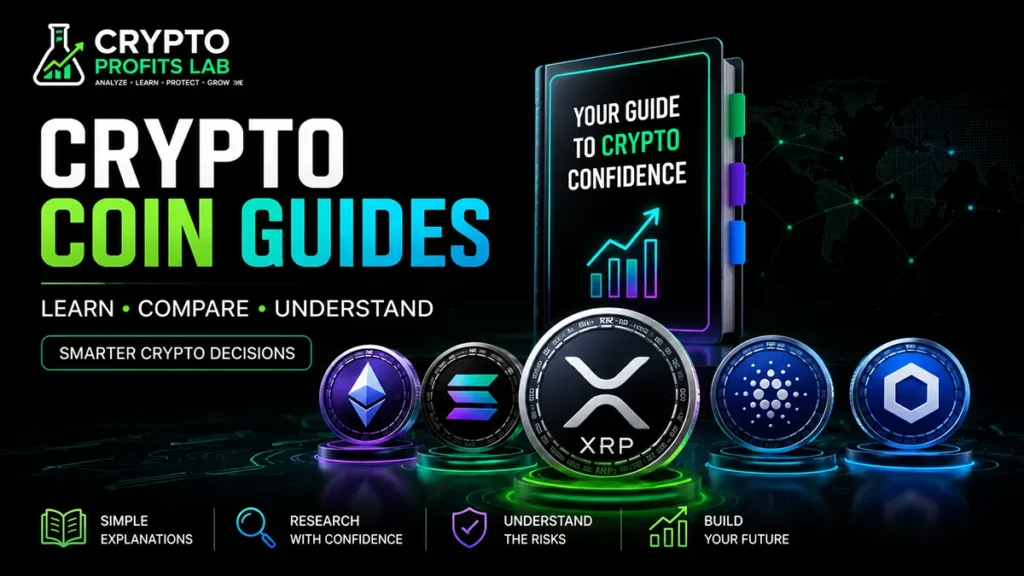
What Is XRP? explains the XRP Ledger, XRP’s role within the network, and how the project differs from mining-based cryptocurrencies.
Solana
What Is Solana? introduces a blockchain designed to support applications, tokens, payments, trading, and other on-chain activity.
Cardano
What Is Cardano? explains Cardano’s proof-of-stake blockchain, ADA, smart-contract capabilities, and research-driven development approach.
Chainlink
What Is Chainlink? explains how blockchain oracles help smart contracts use prices, events, and other information from outside their own networks.
These six starting guides introduce digital money, smart-contract platforms, payment networks, proof-of-stake systems, and blockchain infrastructure.
Browse Crypto Coin Guides by Type
The categories below are learning aids. Some cryptocurrencies may fit into more than one group, and a project’s design can change over time.
Payments and Value Transfer
These guides cover cryptocurrencies commonly associated with transferring, storing, or exchanging digital value.
Compare their network designs, transaction systems, supply rules, fees, and intended uses. Do not assume that every payment-focused cryptocurrency solves the same problem or uses the same technology.
Smart-Contract and Application Platforms
These networks can support smart contracts, tokens, decentralized applications, or other programmable activity.
- What Is Ethereum?
- What Is Solana?
- What Is Cardano?
- What Is Avalanche?
- What Is Polygon?
- What Is Polkadot?
- What Is Cosmos?
- What Is Algorand?
- What Is Sui?
- What Is Aptos?
- What Is Near Protocol?
- What Is Sei?
- What Is Arbitrum?
- What Is Optimism?
- What Is Internet Computer?
When comparing these projects, look beyond claims about transaction speed. Consider decentralization, network fees, developer activity, user demand, security, token distribution, and how the network is actually being used.
Some of these projects operate as primary blockchains. Others help existing blockchain systems process activity more efficiently.
Learn more about scaling through What Is Layer 2 Crypto?.
Blockchain Data, Interoperability, Storage, and Computing
Some crypto projects focus on supporting the wider blockchain ecosystem instead of competing mainly as payment currencies.
- What Is Chainlink?
- What Is Quant?
- What Is Hedera?
- What Is Filecoin?
- What Is Arweave?
- What Is Celestia?
- What Is Render?
- What Is Bittensor?
These projects may focus on data delivery, network communication, distributed storage, blockchain infrastructure, computing resources, or artificial-intelligence-related systems.
A token connected to useful technology can still be volatile. Research how the token is used, who needs it, how supply enters circulation, and whether the project depends on a small group of operators or customers.
DeFi and Tokenized Finance
These guides cover projects connected to decentralized trading, lending, financial markets, or tokenized assets.
Before using a DeFi platform, learn about:
- What Is DeFi?
- What Is a DEX?
- Smart Contracts
- Crypto Token Approval
- What Are Crypto Gas Fees?
- Crypto Slippage
DeFi can introduce smart-contract, token-approval, liquidity, bridge, price, and wallet risks. Beginners should not connect valuable wallets to applications they do not understand.
Specialized and Emerging Networks
Some projects use designs or focus areas that do not fit neatly into one category.
Read each guide to understand the project’s network design, intended purpose, token role, and major limitations. Newer technology can be interesting without being proven, widely adopted, or appropriate for every user.
Meme and Community-Driven Cryptocurrencies
Meme coins are often influenced heavily by online communities, attention, humor, and speculation.
Read Meme Coins before buying an asset mainly because it is trending.
Community size does not remove volatility, concentration, liquidity, or token-supply risk. A popular online campaign can increase attention without creating lasting value.
How to Research a Cryptocurrency
A helpful coin review should answer more than “Will the price go up?”
Use this research process for every project.
1. Identify the Project’s Purpose
What is the cryptocurrency or network designed to do?
Possible purposes include:
- Digital payments
- Smart contracts
- Decentralized applications
- Data delivery
- File storage
- Network interoperability
- Lending or trading
- Governance
- Gaming
- Tokenized real-world assets
- Computing resources
A project should be understandable without relying entirely on slogans.
2. Determine Whether It Is a Coin or Token
A native coin operates on its own blockchain or distributed network. A token is normally created through another blockchain’s token system.
Read What Is a Crypto Token? and What Is ERC-20? for more information.
3. Understand the Network
Ask:
- Does the project have its own blockchain?
- Which consensus system does it use?
- Who validates transactions?
- How decentralized is the network?
- What fees do users pay?
- Has the network experienced major interruptions?
- Does it rely on another blockchain?
The guides to What Is Proof of Work? and What Is Proof of Stake? explain two common network-security methods.
4. Review the Token Supply
Check:
- Circulating supply
- Total supply
- Maximum supply
- Inflation or future issuance
- Burn mechanisms
- Founder and investor allocations
- Staking rewards
- Token unlock schedules
A large difference between circulating supply and future supply deserves attention.
Read What Is Tokenomics? and Token Unlocks in Crypto before comparing supply numbers.
5. Look at Market Cap and Liquidity
The price of one coin does not show the total size of a cryptocurrency.
Market cap considers price and circulating supply. Liquidity reflects how easily an asset may be bought or sold without causing a large price change.
Learn more through:
6. Read the Whitepaper and Official Documentation
A whitepaper may explain the project’s purpose, technology, token model, and development plan.
Do not assume a professional-looking document proves that the project is legitimate or likely to succeed.
Use the Crypto Whitepaper guide to learn what to look for.
7. Study Adoption and Use
Ask whether people, developers, applications, or businesses are actually using the network.
Consider:
- Active applications
- Transaction activity
- Developer participation
- Partnerships
- Exchange availability
- Wallet support
- Real demand for the coin or token
Announcements and partnerships should be verified through original sources whenever possible.
8. Identify the Main Risks
Every cryptocurrency has risks.
Possible risks include:
- Price volatility
- Limited adoption
- Network failures
- Smart-contract problems
- Concentrated token ownership
- Future supply increases
- Regulatory uncertainty
- Exchange delisting
- Low liquidity
- Security vulnerabilities
- Misleading marketing
- Dependence on a small development team
A balanced guide should explain weaknesses as clearly as potential uses.
Cryptocurrency Research Checklist
Use this table while reading crypto coin guides.
| Research Question | Why It Matters |
|---|---|
| What problem does the project address? | Helps separate a clear purpose from vague marketing |
| Is it a coin or token? | Shows whether it uses its own network or another blockchain |
| How is the asset used? | Explains whether the token has a necessary role |
| What is the circulating supply? | Shows how many units are currently available |
| Can more supply enter the market? | Reveals inflation and token-unlock risk |
| What is the market cap? | Helps compare the project’s relative size |
| How liquid is the asset? | Affects buying, selling, and potential slippage |
| Who controls the network? | Helps evaluate centralization and governance |
| How is the network secured? | Shows how transactions are validated |
| Is the technology being used? | Helps separate adoption from promises |
| What are the largest risks? | Prevents research from becoming one-sided |
| Where can it be safely stored? | Helps avoid wallet and network mistakes |
What a Coin Guide Can and Cannot Tell You
A coin guide can help explain:
- What a cryptocurrency is
- Why it was created
- How its network works
- How its coin or token is used
- How supply is structured
- Which risks deserve attention
- How it differs from other projects
A coin guide cannot reliably tell you:
- What the future price will be
- Whether you will make money
- When to buy or sell
- Whether a project will achieve its goals
- Whether an exchange or wallet will remain available
- Whether regulations will change
- Whether a cryptocurrency is suitable for your finances
Treat every Crypto Profits Lab guide as an educational starting point rather than a prediction.
Before Buying Any Cryptocurrency
Before purchasing a coin or token:
- Learn how the project works.
- Understand its supply and tokenomics.
- Check its market cap and liquidity.
- Review its major risks.
- Choose a reputable exchange.
- Protect the account with strong two-factor authentication.
- Confirm which networks are supported.
- Learn how the asset should be stored.
- Start with an amount you can afford to lose.
- Avoid buying because of urgent social-media claims.
Helpful guides include:
- Best Crypto Exchange for Beginners
- How to Buy Crypto for Beginners
- Best Crypto Wallet for Beginners
- Crypto Portfolio for Beginners
- Crypto Safety Tips
- Crypto FOMO
Important Reminder for Beginners
Crypto coin guides are educational resources. They are not recommendations to buy, sell, trade, or hold a cryptocurrency.
Crypto assets can be volatile, and losses are possible. A technically interesting project may still have poor adoption, weak token economics, limited liquidity, security problems, or an unsustainable market price.
For an independent overview of crypto-related risks and educational resources, visit the Investor.gov crypto assets resource.
Before making a decision:
- Research the project independently.
- Verify information through original sources.
- Avoid guaranteed-profit claims.
- Protect your seed phrase and private keys.
- Never invest money you cannot afford to lose.
- Do not let a rising price create a false sense of safety.
- Be cautious when strangers offer personalized investment help.
Read Crypto Scams to Avoid before responding to investment messages, giveaways, support accounts, or private trading groups.
How to Use the Crypto Profits Lab Coin Guides
Use this page as a research hub.
- Start with the beginner foundation guides.
- Choose a cryptocurrency you want to understand.
- Read the complete guide without focusing only on price.
- Write down the project’s purpose, supply, use, and risks.
- Compare it with other projects in the same category.
- Check the official project documentation.
- Return to this page to continue learning.
Crypto Profits Lab keeps crypto coin guides simple enough for complete beginners while still explaining the details that matter.
New coin guides can be added to this hub as the educational library grows.
Crypto Coin Guides FAQ
Which cryptocurrency should beginners learn about first?
Bitcoin and Ethereum are useful educational starting points because they introduce two different sides of crypto. Bitcoin helps beginners learn about decentralized digital money, mining, supply limits, and proof of work. Ethereum introduces smart contracts, tokens, decentralized applications, and network fees. Learning about either project is not the same as receiving a recommendation to buy it.
Are Crypto Profits Lab coin guides buying recommendations?
No. Crypto Profits Lab coin guides are educational resources. They explain what projects are designed to do, how their networks and tokens work, and which risks beginners should understand. They do not predict prices or promise returns. Readers should perform independent research and consider their own finances and risk tolerance before buying any cryptocurrency.
What is the difference between a crypto coin and a token?
A coin is normally native to its own blockchain or distributed network. Bitcoin, ether, and XRP are examples of native assets. A token is created through another blockchain’s token or smart-contract system. The difference affects transaction fees, wallet compatibility, network selection, and how the asset operates.
Does a low coin price mean a cryptocurrency is cheap?
No. The price of one coin does not show the project’s total market value. A cryptocurrency can have a low unit price because billions or trillions of units exist. Market cap, circulating supply, future token issuance, liquidity, and demand provide more useful context than unit price alone.
How should beginners compare two cryptocurrencies?
Compare their purposes, network designs, security models, adoption, transaction fees, supplies, market caps, liquidity, token distributions, and major risks. Projects in different categories may not be direct competitors. For example, a payment-focused cryptocurrency should not be judged using exactly the same criteria as a storage network or DeFi token.
Can a crypto coin guide predict future prices?
No. A guide can explain technology, supply, adoption, and risk, but future prices depend on many unpredictable factors. Market sentiment, regulations, token unlocks, security incidents, economic conditions, liquidity, competition, and changing demand can all affect value. Be cautious of anyone presenting a price prediction as a guaranteed outcome.
Should beginners research newer altcoins?
Beginners can learn about newer altcoins, but they should first understand cryptocurrency basics, wallets, market cap, tokenomics, liquidity, and scams. Newer projects may have shorter operating histories, limited adoption, concentrated ownership, or untested technology. Learning about a project does not create an obligation to invest in it.
Final Thoughts
The purpose of crypto coin guides is to make individual projects easier to understand—not to encourage rushed buying decisions.
Begin with cryptocurrency and blockchain fundamentals. Learn market cap, supply, tokenomics, wallets, and scams. Then compare projects by their purpose, technology, adoption, and risks.
Do not judge a cryptocurrency only by its logo, popularity, unit price, or recent chart.
Crypto Profits Lab provides clean, simple, and trustworthy beginner education so you can research one project at a time without relying on hype or investment promises.
Use this page whenever you want to explore another cryptocurrency, and return to the foundational guides whenever a technical term feels unclear.